
 100% FREE ACCESS
11th Standard Syllabus & Materials
11th Standard
TN 11th Tamil இயற்கை வேளாண்மை,சுற்றுச்சூழல் -செய்யுள் - மனோன்மணீயம் Important Questions And Answers Study Material - QB365 Set A
NEW11th Standard
TN 11th Tamil என்னுயிர் என்பேன் -துணைப்பாடம் - இசைத்தமிழர் இருவர் Important Questions And Answers Study Material - QB365 Set A
NEW11th Standard
TN 11th Tamil மொழி கலை -செய்யுள் - ஒவ்வொரு புல்லையும் Important Questions And Answers Study Material - QB365 Set A
NEW11th Standard
TN 11th Tamil பீடு பெற நில் - இலக்கணம் - பகுபத உறுப்புகள் Important Questions And Answers Study Material - QB365 Set A
NEW11th Standard
TN 11th Tamil பீடு பெற நில் - துணைப்பாடம் - வாடிவாசல் Important Questions And Answers Study Material - QB365 Set A
NEW11th Standard
TN 11th Tamil பீடு பெற நில் - செய்யுள் - குறுந்தொகை Important Questions And Answers Study Material - QB365 Set A

Published on: 28/06/2021
QB365 provides detailed and simple solution for every
Creative Questions in class 11 Commerce Subject. It
will helps to get more idea about question pattern in every Creative questions with solution.
Download Tamil Nadu 11th Standard Commerce question papers, model tests, one-mark questions, important questions, and public exam papers in PDF format. Free study materials and answer keys for TN State Board students.
Questions + Answers key
Take MCQ Commerce Test1.
Briefly explain the duties of the Partners.
2.
What are the drawbacks of non-registration of the Partnership firm?
3.
Explain any five Kinds of Partners.
4.
Explain the Types of Partnership Firm?
5.
Explain the duties of partners.
1.
Duty to carry on business:
Every partner has to carry on the business of the firm to the maximum advantage of all the partners.
Duty to be true:
Every partner must be true, just and faithful to one another. There must be utmost good faith and fair dealings.
Duty to render true accounts:
A partner is bound to keep and render true and full accounts of the partnership. He must produce relevant vouchers for the expenses incurred by him and hand over to the firm all amounts which have come into his hands as a partner.
Duty to indemnity the firm:
Every partner must indemnify the firm for any loss caused by his fraud or wilful negligence in the conduct of the business.
Duty to share the loss:
Every partner is bound to share the losses in the agreed ratio in the absence of an agreed ratio, it must be borne equally.
2.
Registration of Partnership is only optional in India. But if a firm is not registered, it has to face the following drawbacks.
(i) A Partner of an unregistered firm cannot file any case against the firm or against any other Partner, including an ex-partner for enforcing his contractual rights under the partnership agreement or under the act.
(ii) An unregistered firm cannot file any suit against third parties in any civil court for recovering the money due.
(iii) Any third party can take legal action against the business or the partners.
(iv) The firm cannot take legal action against its partners.
(v) An unregistered firm cannot enforce its claims against third parties for recovering a sum exceeding rupees one hundred.
(vi) A Partner cannot sue for dissolving the firm or realising the property of the dissolved firm or for the settlement of accounts on dissolution.
(viii) The firm forfeits its rights in restricting the outsiders from using the trademarks and copyrights of the firm.
3.
(I) Active Partner: A partner who takes an active part in the conduct of the partnership business is known as an active partner.
(ii) Sleeping Partner or Dormant Partner: Such a partner contributes capital and shares in the profits or losses of the firm but does not take part in the management of the business.
(iii) Nominal Partner:
(1) Such a partner neither contributes any capital nor is he entitled to manage the affairs of the business.
(2) He only lends his name to the firm because of the strength of his name and reputation, the firm may attract additional business and raise funds easily.
(iv) Secret Partner:
(1) A secret partner is one whose association is not known to the general public.
(2) Other than this distinct feature, he is like rest of the partners in all respects.
(v) Minor Partner:
(1) Under the Indian Majority Act, person who has not completed 18 years of age is a minor.
(2) However, he will continue to be a minor till he completes 21 years if a guardian has been appointed to the minor.
4.
(i) Partnership at will:
(1) Partnership formed to carry to Business for an undefined period is called Partnership at will.
(2) Thus this type of Partnership continues its business activities as long as there are mutual co-operation and confidence among partners.
(3) The partnership can be terminated if any other Partner notified his desire to quit.
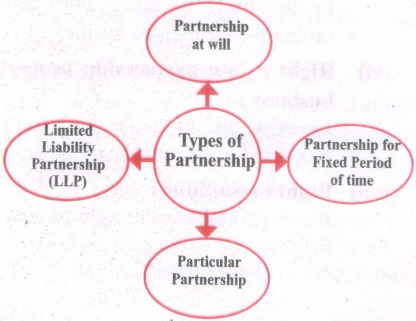
(ii) Partnership for a fixed term:
(1) Where a Partnership is formed for a definite period of time, it is known as the partnership for a fixed term.
(2) The Partnership for a fixed term comes to an end on the expiry of the stipulated period.
(iii) Particular Partnership:
(1) When a Partnership is formed to carry on a Particular venture or a business of temporary nature, it is called particular Partnership.
(2) If automatically comes to an end with the expiry of the stipulated period of time.
(3) For Example: a Partnership may be created for one year only.
(iv) Limited Liability Partnership:
(1) Limited Liability Partnership is very popular in the Service sector and in the small-scale business enterprises
(2) Limited Liability Partnership means for paying the debts of the firm only the assets of the business will be utilized and not the personal properties.
5.
(i) Duty to carry on business: Every partner has to carry on the business of the firm to the maximum advantage of all the partners.
(ii) Duty to be true: Every partner must be true, just and faithful to one another.
(iii) Duty to render true accounts: A partner is bound to keep and render true and full accounts of the partnership.
(iv) Duty to indemnify the firm: Every partner must indemnify the firm for any loss caused by his fraud or willful negligence in the conduct of the business
(v) Duty to share the loss: Every partner is bound to share the losses in the agreed ratio in the absence of an agreed ratio, it must be borne equally
(vi) Duty to Claim remuneration: No partner, including a managing partner, is entitled to any remuneration (salary or commission), for the work done by him, unless there is an agreement to the contrary

11th Standard Syllabus & Materials
11th Standard
TN 11th Tamil பீடு பெற நில் - செய்யுள் - காவடிச்சிந்து Important Questions And Answers Study Material - QB365 Set A
NEW11th Standard
TN 11th Tamil பீடு பெற நில் - உரைநடை - மலை இடப்பெயர்கள் : ஓர் ஆய்வு Important Questions And Answers Study Material - QB365 Set A
NEW11th Standard
TN 11th Tamil மாமழை போற்றுதும் - துணைப்பாடம் - யானை டாக்டர் Important Questions And Answers Study Material - QB365 Set A
NEW11th Standard
TN 11th Tamil மாமழை போற்றுதும் - செய்யுள் - ஐங்குறுநூறு Important Questions And Answers Study Material - QB365 Set A



Tamilnadu Stateboard 11th Standard Subjects

Maths
Commerce

Economics

Biology

Business Maths and Statistics

Accountancy

Computer Science

Physics

Chemistry
Maths
Biology
Economics
Physics
Chemistry

History
Business Maths and Statistics

Computer Science
Accountancy

Computer Applications
History
Computer Technology
Commerce
Computer Applications
Computer Technology

Tamil

English

French
Tamilnadu Stateboard Standards



