
 100% FREE ACCESS
11th Standard Syllabus & Materials
11th Standard
TN 11th Tamil இயற்கை வேளாண்மை,சுற்றுச்சூழல் -செய்யுள் - மனோன்மணீயம் Important Questions And Answers Study Material - QB365 Set A
NEW11th Standard
TN 11th Tamil என்னுயிர் என்பேன் -துணைப்பாடம் - இசைத்தமிழர் இருவர் Important Questions And Answers Study Material - QB365 Set A
NEW11th Standard
TN 11th Tamil மொழி கலை -செய்யுள் - ஒவ்வொரு புல்லையும் Important Questions And Answers Study Material - QB365 Set A
NEW11th Standard
TN 11th Tamil பீடு பெற நில் - இலக்கணம் - பகுபத உறுப்புகள் Important Questions And Answers Study Material - QB365 Set A
NEW11th Standard
TN 11th Tamil பீடு பெற நில் - துணைப்பாடம் - வாடிவாசல் Important Questions And Answers Study Material - QB365 Set A
NEW11th Standard
TN 11th Tamil பீடு பெற நில் - செய்யுள் - குறுந்தொகை Important Questions And Answers Study Material - QB365 Set A

Published on: 13/05/2022
QB365 provides detailed and simple solution for every Creative Questions in class 11 Computer Applications Subject. It will helps to get more idea about question pattern in every Creative questions with solution.
latest Creative QuestionsDownload Tamil Nadu 11th Standard Computer Applications question papers, model tests, one-mark questions, important questions, and public exam papers in PDF format. Free study materials and answer keys for TN State Board students.
Questions + Answers key
Take MCQ Computer Applications Test
1.
Explain public key encryption.
2.
Explain Cracking in detail.
3.
List the computer crimes and their functions.
4.
Explain the different types of encryption.
5.
Explain social engineering with an example.
1.
PUBLIC KEY ENCRYPTION:
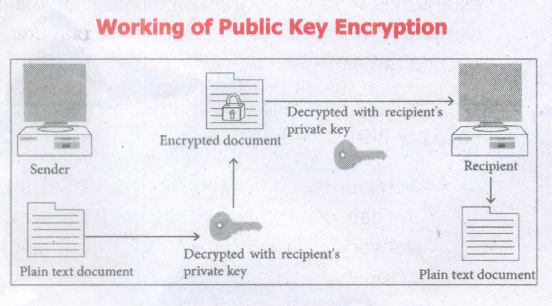
1. Public key encryption is also called Asymmetric encryption. It uses the concept of a key value pair, a different key is used for the encryption and decryption process. One of the keys is typically known as the private key and the other is known as the public key.
2. The private key is kept secret by the owner and the public key is either shared amongst authorized recipients or made available to the public at large.
3. The data encrypted with the recipient's public key can only be decrypted with the corresponding private key.
2.
CRACKING:
1. Cracking is where someone edits a program source so that the code can be exploited or modified. A cracker (also called a black hat or dark side hacker) is a malicious or criminal hacker
2. "Cracking" means trying to get into computer systems in order to steal, corrupt, or illegitimately view data.
3. A cracker is someone who breaks into someone else's computer system, often on a network, bypassing passwords or licenses in computer programs
4. Software cracking is the most often used of cracking which is nothing but removing tl, encoded copy protection.
5. There is another type of cracking called password cracking. This is mainly used to crack the passwords. Password cracking can be performed either by using an automated program or can be manually realized.
6. One more interesting fact apout cracking is social engineering. It is a method of getting passwords and information using human weakness
7. The other method that uses social engineering crackers is password guessing.
8. They find your personal information from some personal datal facts and try to guess a password
9. Usually a cracker maintains knowledge of the vulnerabilities he or she finds and exploits them for personal advantage, not revealing them to either to the general public or to the manufacturer.
3.
| Crime | Function |
| Crime Function | Hacking, threats, and blackmailing towards a business or a person |
| Cyberstalking | Harassing through online |
| Malware | Malicious programs that can perform a variety of functions including stealing, encrypting or deleting sensitive data, altering or hijacking core computing functions and monitoring user's computer activity without their permission |
| Denial of service attack | Overloading a system with fake requests so that it cannot serve normal legitimate requests |
| Fraud | Manipulating data, for example changing the banking records to transfer money to an unauthorized account. |
| Harvesting | A person or program collects login and password information from a legitimate user to illegally gain access to others account(s). |
| Intellectual property theft | Stealing practical or conceptual information developed by another person or company |
| Salami slicing | Stealing tiny amounts of money from each transaction |
| Scam | Tricking people into believing something that is not true |
| Spam | Distribute unwanted e-mail to a large number of internet users |
| Spoofing | It is a malicious practice in which communication is sent from an unknown source disguised as a source known to the receiver. |
4.
Types of Encryption :
There are two types of encryption schemes as listed below:
i. Synunetric Key encryption,
ii. Public Key encryption.
Symmetric Key Encryption :
Symmetric encryption is a technique to use the same key for both encryption and decryption. The main disadvantage of the symmetric key encryption is that all authorized persons involved, have to exchange the key used to encrypt the data before they can decrypt it. If anybody intercepts the key information, they may read all message. Depicts the working of symmetric key encryption.
Public Key Encryption:
Public key encryption is also called Asymmetric encryption. It uses the concept of a key value pair, a different key is used for the encryption and decryption process. One of the keys is typically known as the private key and the other is known as the public key. The private key is kept secret by the owner and the public key is either shared amongst authorized recipients or made available to the public at large. The data encrypted with the recipient's public key can only be decrypted with the corresponding private key. public key encryption.
5.
(i) Social engineering:
A misuse of an individual's weakness, achieved by making them to click malicious links, or by physically accessing the computer through tricks. Phishing and pharming are examples of social engineering.
(ii) Phishing:
Phishing is a type of computer crime used to attack, steal user data, including login name, password and credit card numbers. It occurs when an attacker targets a victim into opening an e-mail or an instant text message. The attacker uses phishing to distribute malicious links or attachments that can perform a variety of functions. including the extraction of sensitive login credentials from victims.
(iii) Pharming:
Pharming is a scamming practice in which malicious code is installed on a personal computer or server, misdirecting users to fraudulent web sites without their knowledge or permission.Pharming has been called "phishing without a trap" It is another way hackers attempt to manipulate users on the Internet. It is a cyber attack intended to redirect a website's traffic to a fake site.

11th Standard Syllabus & Materials
11th Standard
TN 11th Tamil பீடு பெற நில் - செய்யுள் - காவடிச்சிந்து Important Questions And Answers Study Material - QB365 Set A
NEW11th Standard
TN 11th Tamil பீடு பெற நில் - உரைநடை - மலை இடப்பெயர்கள் : ஓர் ஆய்வு Important Questions And Answers Study Material - QB365 Set A
NEW11th Standard
TN 11th Tamil மாமழை போற்றுதும் - துணைப்பாடம் - யானை டாக்டர் Important Questions And Answers Study Material - QB365 Set A
NEW11th Standard
TN 11th Tamil மாமழை போற்றுதும் - செய்யுள் - ஐங்குறுநூறு Important Questions And Answers Study Material - QB365 Set A



Tamilnadu Stateboard 11th Standard Subjects

Maths

Commerce

Economics

Biology

Business Maths and Statistics

Accountancy

Computer Science

Physics

Chemistry
Maths
Biology
Economics
Physics
Chemistry

History
Business Maths and Statistics

Computer Science
Accountancy
Computer Applications
History
Computer Technology
Commerce
Computer Applications
Computer Technology

Tamil

English

French
Tamilnadu Stateboard Standards


