
 100% FREE ACCESS
11th Standard Syllabus & Materials
11th Standard
TN 11th Tamil இயற்கை வேளாண்மை,சுற்றுச்சூழல் -செய்யுள் - மனோன்மணீயம் Important Questions And Answers Study Material - QB365 Set A
NEW11th Standard
TN 11th Tamil என்னுயிர் என்பேன் -துணைப்பாடம் - இசைத்தமிழர் இருவர் Important Questions And Answers Study Material - QB365 Set A
NEW11th Standard
TN 11th Tamil மொழி கலை -செய்யுள் - ஒவ்வொரு புல்லையும் Important Questions And Answers Study Material - QB365 Set A
NEW11th Standard
TN 11th Tamil பீடு பெற நில் - இலக்கணம் - பகுபத உறுப்புகள் Important Questions And Answers Study Material - QB365 Set A
NEW11th Standard
TN 11th Tamil பீடு பெற நில் - துணைப்பாடம் - வாடிவாசல் Important Questions And Answers Study Material - QB365 Set A
NEW11th Standard
TN 11th Tamil பீடு பெற நில் - செய்யுள் - குறுந்தொகை Important Questions And Answers Study Material - QB365 Set A

Published on: 18/02/2019
+1 Public Model Exam March 2019
Download Tamil Nadu 11th Standard Computer Science question papers, model tests, one-mark questions, important questions, and public exam papers in PDF format. Free study materials and answer keys for TN State Board students.
Questions + Answers key
Take MCQ Computer Science Test
1.
The set of statements that are executed again and again in iteration is called as:
condition
loop
statement
body of loop
2.
Which of the following statement is true or false?
(i) Attributes represent the features of a class
(ii) Methods are not used to perform specific tasks in the class
i-false, ii-true
i-false, ii-false
i-true, ii-true
i-true, ii-false
3.
The first programming language "Ezhil" is designed by ________.
C++
Java
Python
Visual Basic
4.
Array subscripts is always starts with which number?
-1
0
2
3
5.
The type of inheritance that reflects the transitive nature is
Single Inheritance
Multiple Inheritance
Multilevel Inheritance
Hybrid Inheritance
6.
How many arguments are there in pow() function?
2
3
1
4
7.
How many types of integer literals in C++?
3
5
7
6
8.
Which of the following means a name having two or more distinct meanings?
Abstraction
Overridding
Overloading
data binding
9.
Which of the following is the most important advantage of inheritance?
data hiding
code reusability
code modification
accessibility
10.
_______________is a special folder to keep the files or folders deleted by the user, which means you still have an opportunity to recover them.
My computer
Documents
Recycle bin
Pictures
11.
If Fibonacci number is defined recursively as
\(F(n)= \begin{cases}0 \ \mathrm{n}=0 \\ 1 \ \mathrm{n}=1 \\ \mathrm{~F}(\mathrm{n}-1)+\mathrm{F}(\mathrm{n}-2) \text { otherwise }\end{cases}\)
to evaluate F(4), how many times F() is applied?
3
4
8
9
12.
Expansion of MSB is......
Most Sign Bit
Most Significant Bit
Medium Signal Bit
Most Significant Byte
13.
Stating the input property and the input-output relation a problem is known
specification
statement
algorithm
definition
14.
Which of the following refers to Android operating system's version?
JELLYBEAN
UBUNTU
OS/2
MITTIKA
None of the above
15.
Which is the fastest memory?
Hard disk
Main memory
Cache memory
Blue-Ray disc
16.
Which determines the functional output of cryptographic algorithm?
17.
Write the output of the following program.
using namespace std;
#include< iostream >
#inc1ude< ctype.h >
int maint)
{
char ch = '3';
cout<< "\n The Return Value of isdigit(ch) is :" <<
isdigit( ch) ;
}
18.
Differentiate structure and class though both are user defined data type.
19.
Match the following
| A | B |
|---|---|
| (a) Modulus | (1) Tokens |
| (b) Separators | (2) Remainder of a division |
| (c) Stream extraction | (3) Punctuators |
| (d) Lexical Units | (4) get from |
20.
Both conditional statement and iterative statement have a condition and a statement. How do they differ?
21.
Define factorial of a natural number recursively
22.
What is Bus?
23.
What are the security management features available in Operating System?
24.
Differentiate Input and output unit.
25.
Explain the uses of private, protected and public inheritance.
26.
Discuss the benefits of constructor overloading?
27.
Define information hiding.
28.
29.
Write a C++ program to print multiplication table of a given number.
30.
Draw a flowchart that depicts iterative control flow.
31.
What is the function of file management?
32.
Reason out why the NAND and NOR are called universal gates?
33.
What is the format of the specification of an algorithm?
34.
Write the output of the following program
#include < iostream >
using namespcae std;
class simple
{
private:
int a,b;
public:
simple(int m, int n=100) //default argument
{
a=m;
b=n;
cout << "\n Parameterized Constnictor with default argument" << endl;
}
void putdata( )
{
cout << "\nThe two integers are " << a <<'\t' << b << endl;
cout << "\nThe sum of the variables" << a << "+" << b << " = " << a+b;
}
};
int main( )
{
simple s1(10,20), s2(50);
cout << "\n\t\tObject 1 with both values \n";
s1.putdata( );
cout << "\n\t\tObject 2 with both values \n";
s2.putdata( );
return 0;
}
35.
Given the following set of definitions. What data
members and functions are directly accessible by
the functions mentioned here?
void inform(void):
class x {
int a;
float b,
void init(void);
public:
char ch; void gett(void)
protected:
doublet;
void get amt (void) ;
friend void A (void);
};
class y: public X
{
intx;
public;
intj;
void readit(void) ;
protected :
void inform (void);
friend void B (void);
};
void display (void);
36.
Answer the question (i) to (v) after going through the following class.
classBook
{
intBookCode ; char Bookname[20];float fees;
public:
Book( ) //Function 1
{
fees=1000;
BookCode=1;
strcpy (Bookname,"C++");
}
void display(float C) //Function 2
{ cout<<BookCode<<":"<<Bookname<<":"<<fees<<endl; }
{ cout<<"End of Book Object"<<endl; }
Book (intSC,char S[ ],float F) ; //Function 4
};
(i) In the above program, what are Function 1 and Function 4 combined together referred as?
(ii) Which concept is illustrated by Function3? When is this function called/ invoked?
(iii) What is the use of Function3?
(iv) Write the statements in main to invoke function1 and function2
(v) Write the definition for Function4.
37.
Write a C++ Program to declare a structure book containing name and author as character array of 20 elements each and price as integer. Declare an array of book. Accept the name, author, price detail for each book. Define a user defined function to display the book details and calculate the total price. Return total price to the calling function.
38.
What is Recursion? Write a program to find the factorial of the given number using recursion.
39.
Write a program to find the LCM and GDC of two numbers.
40.
Explain how will you copy files and folders in windows.
41.
Decanting problem. You are given three bottles of capacities 5, 8 and 3 litres. The 8L bottle is filled with oil, while the other two are empty. Divide the oil in 8L bottle into two equal quantities. Represent the state of the process by appropriate variables. What are the initial and final states of the process? Model the decanting of oil from one bottle to another by assignment. Write a sequence of assignments to achieve the final state.
42.
What are Registers? Explain the five Registers that are essential for instruction execution.
43.
1.
(d)
body of loop
2.
(d)
i-true, ii-false
3.
(c)
Python
4.
(b)
0
5.
(c)
Multilevel Inheritance
6.
(a)
2
7.
(a)
3
8.
(c)
Overloading
9.
(b)
code reusability
10.
(c)
Recycle bin
11.
(a)
3
12.
(b)
Most Significant Bit
13.
(a)
specification
14.
(a)
JELLYBEAN
15.
(c)
Cache memory
16.
In cryptography a key is a piece of information (parameter) that determines the functional output of a cryptographic algorithm.
17.
Output-l :
Enter a Character: 3
The Return Value of isdigit(ch) is :1
18.
The only difference between structure and class is the members of structure are by default public where as it is private in class.
19.
| A | B |
|---|---|
| (a) Modulus | (2) Remainder of a division |
| (b) Separators | (3) Punctuators |
| (c) Stream extraction | (4) get from |
| (d) Lexical Units | (1) Tokens |
20.
| Conditional Statement | Iterative Statement |
| Statements are executed only once when the condition is true. | Iterative statement repeatedly evaluates a condition and executes a statement until it becomes false. |
| If condition statement. | While condition statement. |
21.
\(\text { Fact }(\mathrm{n})=\left\{\begin{array}{l}
1 \text { if } \mathrm{n}=0 \\
\mathrm{n} * \text { fact }(\mathrm{n}-1) \text { otherwise }
\end{array}\right.\)
Recursive Algorithm:
Fact (n)
-- inputs: n
outputs: Fact=n!
if(n-0)- --base case
otherwise
1
else
n fact (n-1)--recursive step
22.
A bus is a collection of wires used for communication between the internal components of a computer.
23.
Security Management features:
File access level security, System level security, Network level security.
24.
| Input Unit | Output Unit |
| An input device feeds information to a computer system for processing. | output device reproduces or displays the results of that processing. |
| Input devices only allow for input of data to a computer. | output devices only receive the output of data from another device. |
| It is a peripheral device used to provide data and control signals to an information processing system such as computer. | It is a unit which sends data from the computer to another device. |
| Eg. keyboard, mouse | Eg. printer, monitor |
25.
(i) Private inheritance should be used when you want the features of the base class to be available to the derived class but not to the classes that are derived from the derived class.
(ii) Protected inheritance should be used when features of base class to be available only to the derived class members but not to the outside world.
(iii) Public inheritance can be used when features of base class to be available the derived class members and also to the outside world.
26.
Function overloading can be applied for constructors, as constructors are special functions of classes. A class can have more than one constructor with different signature. Constructor overloading provides flexibility of creating multiple type of objects for a class.
1. Memory is allocated for the objects.
2. Initialisation for the objects.
27.
Encapsulation is the most striking feature of a class. The data is not accessible to the outside world, and only those functions which are wrapped in the class can access it. This encapsulation of data from direct access by the program is called data hiding or information hiding.
28.
29.
The syntax of if-else ladder:
#include <iostream>
using namespace std;
int main()
(
int num:
cout<<"Enter Number to find its multiplication table";
cin >> num;
for (int a = 1; a<= 10; a++)
{
cout << num << "*" << a << "=" << num*a << endl;
}
return 0;
}
30.
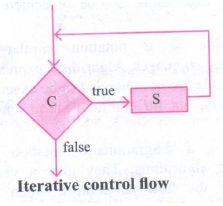
31.
File management functions of an operating system involves keeping track of all different data/files and maintaining the correctness of data stored in the files including file directory structure.
32.
NAND and NOR gates are called Universal gates, because the fundamental logic gates can be realized through them.
33.
Let P be the required property of the inputs and Q the property of the desired outputs.
Format of specification of an algorithm:
(a) Algorithm name (Inputs)
(b) Inputs - P
(c) Outputs - Q
34.
Output:
Parameterized Constructor with default argument
Parameterized Constructor with default argument
Object 1 with both values
The two integers are ... 10 20
The sum of the variables 10 + 20 = 30
Object 2 with one value and one default value
The two integers are ...50 100
The sum of the variables 50 + 100 = 150
35.
The function :: inform ( ) can access public data members of classes X and Y and the function display ( ) provided, the definition of; : inform ( ) occurs after the declaration of X, Y and display ( ).
X:: init(), X:: gett ( ), X:: getamti land A () can access all the members of X and :: inform().
Y :: readit ( ), y : : inform ( ) and B ( ) can access all the member ofY, public and protected member of X (the inherited memebrs) and :: inform ( ) (only withe the scope resolutoin operator: : ).
:: display ( ) can access public members of X and Y, ::.
infonn( ) , and A ( ) and B ( ) if only their declarations (A ( ) 's and B ( ) 's occur before display ( ).
36.
(i) Constructor overloading (function 1 and function 4 are constructors with different signatures in the class book)
(ii) Function 3 is destructor of the class. Function 3 is executed when the object of the class book goes out of scope.
(iii) Function 3 is destructor of the class.
1. Destructor (function3) will free resources if any that the object may have acquired during its lifetime
2. Destructor function removes the memory of an object which was allocated by the constructor at the time of creating an object. Thus frees the unused memory.
(iv) book b;
b.display (4.5);
(v) Book: :Book (int sc.char.s[], float, F) // Function 4
{
Book Code SC
strcpy (Book name, S);
fees-F;
}
37.
#inclue< iostream.h >
using namespace std;
struct book
{
char bname[20];
char author[20];
int price;
}b[10];
void input (struct book a[])
{
int i;
cout << "Enter the book details'' <
{
cout << "Enter book name"<
cin >> b[i].bname;
cout << "Enter Author name''<
cin >> b[i].author;
cout << "Enter the price of the book"<|
}
}
void display (struct book b[])
{
int i; total = 0;
for(i=0; i<9; i++)
{
cout << "Book Name < cout << "Author Name: < cout << ''Book Price: < total = total + b[i].prince < cout << ''Total price''< }
}
int main()
{
input(b);
display(b);
return 0;
}
38.
A function that calls itself is known as recursive function. And, this technique is known as recursion.
#include
int factorial(int);//Function prototype//
int main ()
{
int no;
cout <<"\nEnter a number to find its factorial;";
cin>>no;
cout <<"\nFactorial of Number" < return 0;
}
int factorial(int m)
{
if (m>1)
{
return m*factorial(m-1);
}
else
{
return 1;
}
}
Output:
Enter a number to find its factorial: 5
Factorial of Number 5 = 120
39.
#include <iostream>
using namespace std;
int main()
{
int a1, b1 lem, ged-1, p;
cout << "\n Enter 1st no:";
cin>>a1;
cout << "\n Enter 2nd no:";
cin >> b1;
p=a1*b1;
for (int i = al; i<-p; i++)
if (i%al == 0) && (i%b1 == 0)
{
1cm=i;
break;
}
cin.get():
cout << "L.C.M. =" <<lcm<<endl;
gcd=p/LCM;
cout<<"G.C.D="<< ged;
cin.get():
return 0;
}
40.
To copy file(s) or folder(s), first select the file(s) or folder(s) and then choose one of the following:
(i) Click on the EDIT menu, select the COPY function.
(ii) Keyboard shortcut, CTRL + C.
(iii) Or else click on the selected item with the RIGHT mouse button and select "COPY" from the shortcut menu.
To place a copy of the file( s) or folder( s) in the new location, navigate to the new location then paste using one of the following:
(i) Click on the EDIT menu, select the PASTE function.
(ii) Keyboard shortcut, CTRL + V.
(iii) In the position where you want the item to be pasted, click with the Right mouse button and select "Paste" from the shortcut menu.
Method Dragging and Dropping:
(i) In the RIGHT pane, select the file( s) or folder( s) you want to copy.
(ii) Manipulate the FOLDER LIST on the left side of the Windows Explorer so that it shows the new location.
(iii) Make sure you use the scroll bars and the + and ( collapse and expand buttons) to navigate.
(iv) Hold down the CTRL key on the keyboard and at the same time, click and drag the selected file(s) and/or folder(s) over to the FOLDER LIST on the left, and drop it where you want to copy the file(s) and/or folder(s) to.
(v) Before dropping, make sure the target folder is highlighted (active). Also make sure you release the mouse before you release the CTRL key when dropping.
(vi) The file(s) and folder(s) will now appear in the new area.
41.
Ans.(a)
Let a, b, c be the variables whose maximum value are 8L, 5L and 3L respectively.
Initial State
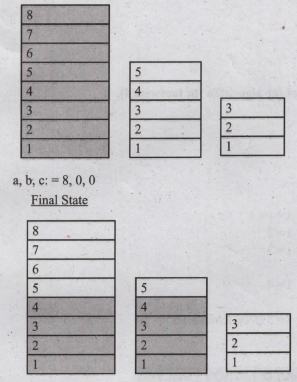
a, b, c: 4, 4,0
Specifications:
1 decant
2-inputs: a, b, c: =8,0,0
3-outputs: a, b, c: = 4, 4, 0
Algorithm:
Let us assume that a: = b denote oil in b is poured into a bottle until either "a" is full or "b" becomes empty.
1 decant (a, b, c)
2 a, b, c:=8,0,0
3 b:=a
4 --a, b, c: 3, 5, 0.
5 c:=b
6 --a, b, c: = 3, 2, 3
7 a:=c
8 -- a, b, c: = 6, 2,0
9 c:=b
10 --a, b, c:=6,0,2
11 b: a
12 a, b, c: = 1, 5, 2
13 c:=b
14 --a, b, c: 1, 4, 3
15 a: c
16 --a, b, c: = 4, 4,0
42.
Registers:
(i) Registers are the high-speed temporary storage locations in the CPU. Hence, their contents can be handled much faster than the' contents of memory.
(ii) Although the number of registers varies from computer to computer, there are some registers which are common to all computers. Five registers that are essential for instruction execution are:
(iii) Program Counter (PC): Contains the address of the next instruction to be fetched.
(iv) Instruction Register (IR): Contains the instruction most recently fetched.
(v) Memory Address Registers (MAR): Contain the address of a location in memory for read and write operations.
(vi) Memory Buffer Register (MBR): It contains the value to be stored in memory or the last value read from memory.
(vii) Accumulator (ACC): An accumulator is a general purpose register used for storing temporary result produced by the arithmetic logic unit.
43.

11th Standard Syllabus & Materials
11th Standard
TN 11th Tamil பீடு பெற நில் - செய்யுள் - காவடிச்சிந்து Important Questions And Answers Study Material - QB365 Set A
NEW11th Standard
TN 11th Tamil பீடு பெற நில் - உரைநடை - மலை இடப்பெயர்கள் : ஓர் ஆய்வு Important Questions And Answers Study Material - QB365 Set A
NEW11th Standard
TN 11th Tamil மாமழை போற்றுதும் - துணைப்பாடம் - யானை டாக்டர் Important Questions And Answers Study Material - QB365 Set A
NEW11th Standard
TN 11th Tamil மாமழை போற்றுதும் - செய்யுள் - ஐங்குறுநூறு Important Questions And Answers Study Material - QB365 Set A



Tamilnadu Stateboard 11th Standard Subjects

Maths

Commerce

Economics

Biology

Business Maths and Statistics

Accountancy
Computer Science

Physics

Chemistry
Maths
Biology
Economics
Physics
Chemistry

History
Business Maths and Statistics

Computer Science
Accountancy

Computer Applications
History
Computer Technology
Commerce
Computer Applications
Computer Technology

Tamil

English

French
Tamilnadu Stateboard Standards
