
 100% FREE ACCESS
11th Standard Syllabus & Materials
11th Standard
TN 11th Tamil இயற்கை வேளாண்மை,சுற்றுச்சூழல் -செய்யுள் - மனோன்மணீயம் Important Questions And Answers Study Material - QB365 Set A
NEW11th Standard
TN 11th Tamil என்னுயிர் என்பேன் -துணைப்பாடம் - இசைத்தமிழர் இருவர் Important Questions And Answers Study Material - QB365 Set A
NEW11th Standard
TN 11th Tamil மொழி கலை -செய்யுள் - ஒவ்வொரு புல்லையும் Important Questions And Answers Study Material - QB365 Set A
NEW11th Standard
TN 11th Tamil பீடு பெற நில் - இலக்கணம் - பகுபத உறுப்புகள் Important Questions And Answers Study Material - QB365 Set A
NEW11th Standard
TN 11th Tamil பீடு பெற நில் - துணைப்பாடம் - வாடிவாசல் Important Questions And Answers Study Material - QB365 Set A
NEW11th Standard
TN 11th Tamil பீடு பெற நில் - செய்யுள் - குறுந்தொகை Important Questions And Answers Study Material - QB365 Set A

Published on: 18/02/2019
11th First Revision Test 2019 Question Answer
Download Tamil Nadu 11th Standard Computer Science question papers, model tests, one-mark questions, important questions, and public exam papers in PDF format. Free study materials and answer keys for TN State Board students.
Questions + Answers key
Take MCQ Computer Science Test
1.
Which of the following statement is ture or false?
| (i) void getvalue ( ) { = } |
//member function initializes the class object |
| (ii) Data dl; | //object declaration |
| (iii) int num; | //variable declaration |
| (iv) s1.getvalue( ) | //member function |
i-true, ii-false, iii-false, iv-true
i-false, ii-false, iii-true, iv-true
i-false, ii-true, iii-true, iv-false
i-true, ii-true, iii-false, iv-false
2.
Which of the following is called entry control loop?
do-while
for
while
if-else
3.
Which of the following is a way that the arguments can be passed to a function?
(i) call by value
(ii) call by reference
(iii) call by address
only (i)
(i), (ii) and (iii)
(ii), (iii)
only (ii)
4.
Which of the following cannot be a structure member?
Another structure
Function
Array
variable of double datatype
5.
Which of the following are portal or website of books collection?
E-Papers
E-Commere
E-languages
E-libraries
6.
class vehicle
{ int wheels;
public:
void input_data(float,float);
void output_data();
protected:
int passenger;
};
class heavy_vehicle : protected vehicle {
int diesel_petrol;
protected:
int load;
public:
void read_data(float,float)
void write_data(); };
class bus: private heavy_vehicle {
char Ticket[20];
public:
void fetch_data(char);
void display_data(); };
The data member that can be accessed from the function display data()
passenger
load
Ticket
All of these
7.
Which of the following provides flexibility of creating multiple type of objects for a class?
function overloading
operator overloading
constructor overloading
object overloading
8.
The term is used to describe a programming approach based on classes and objects is
OOP
POP
ADT
SOP
9.
Which operator denotes shift right bitwise?
>>
<<
&
!
10.
Using this recursive definition
\(a^n= \begin{cases}1 & \text { if } n=0 \\ a \times a^{n-1} & \text { otherwise }\end{cases}\)
how many multiplications are needed to calculate a10?
11
10
9
8
11.
To convert an octal number of binary equivalent, each octal digit is expressed as _______.
3 bits form
4 bits form
8 bits form
2 bits form
12.
Which of the following is located at the top of the screen?
Task bar
Scroll bar
Tool bar
Menu bar
13.
Ensuring the input-output relation is
the responsibility of the algorithm and the right of the user.
the responsibility of the user and the right of the algorithm.
the responsibility of the algorithm but not the right of the user.
the responsibility of both the user and the algorithm.
14.
Identify the usage of Operating Systems
Easy interaction between the human and computer
Controlling Input & Output Devices
Managing use of main memory
All the above
15.
Which is the fastest memory?
Hard disk
Main memory
Cache memory
Blue-Ray disc
16.
Define Phishing.
17.
Write the output of the following program.
#include < string.h >
#include < iostream >
using namespace std;
intmain()
{
char string 1[] = "Computer";
char string2[] = "Science";
int result;
result = strcmp(string1,string2);
if(result 0)
{
cout=x'' String 1 : " << string 1<< " and String2"
}
if (result<0)
{
cout << " String 1 :" << string1<< " and String2
" << string2 << " Are Not Equal";
}
}
18.
Differentiate structure and class though both are user defined data type.
19.
Write a short note on const keyword with an example.
20.
How do we refine a statement?
21.
What is the relationship between loop invariant, loop condition and the input-output recursively?
22.
What is MDR?
23.
List out different distributions of Linux operating system.
24.
What is the function of an ALU?
25.
Write the output of the following program.
//Implementation of Single Inheritance using public
visibility mode
#include < iostream >
using namespace std;
class Shape
{
private:
int count;
protected:
int width;
int height;
public:
void setWidth(int w)
{
width=w;
}
void setHeight(int h)
{
height=h;
}
};
class Rectangle: publicShape
{
public:
int getArea()
{
return (width * height);
}
};
int main()
{
Rectangle Rect;
Rect.setWidth( 5);
Rect.setHeight(7);
II Print the area of theobject.
cour<< "Total area: "<< Rect.getArea() << endl;
return ();
}
26.
class sale ( int cost, discount ;public: sale(sale &); Write a non inline definition for constructor specified;
27.
List some of the features of modular programming.
28.
What is called anonymous structure. Give an example
29.
Convert the following if-else to a single conditional statement:
if (x > = 10)
a = m + 5;
else
a = m;
30.
Draw a flowchart for alternative control flow.
31.
What is protected by the security modules of an OS?
32.
Give the truth table of XOR gate
33.
How is state represented in algorithms?
34.
Write the output for the following program.
#include < iostream >
using namespcae std;
class Test
{
private:
intX;
intY;
public:
Test (int, int); //parameterized constructor declaration
Test (Test &); //Declaration of copy constructor to initialize data members.
void Display( );
};//End of class
Test:: Test(int a, int b) //Definition of parameterized constructor.
{
X=a;
Y=b;
}
Thet: :Test(Test &T) //Definition of copy constructor
{
X=T.X:
Y=T.Y;
}
void Test:: Displayt// !Definition of Display ( ) member function
{
cout << endl << "X; " << X;
cout << endl << "Y; " << Y << endl;
}
int main ( )
{
Test Tl (10,20);/ /Parameterized Constructor automatically called when //object is created.
cout << endl << "T1 Object:" << endl;
cout << "Value after initialization: "
T1.Display( );
Test T2(T1);//Initalize object with other object using copy constructor
cout << endl << "T2 Object:" << endl;
cout << "Value after initialization: "
T2.Display( );
return 0;
}
35.
A railway reservation counter needs to computerise its reservation process. Using the following information write a C ++ program to do so:
class Train {
int number; //Train number
int seats _1; //Total seats in 1st class
int seats _2 ; //Total seats in 2nd class
int seats _3; //Total seats in 3rd class
public;
Train (int i, int j, int k, int l)
{
number = i; seats_1 =j ;
seats-2 =' k;,seats-3 = 1,.
}
int getnum(void)
{ return number; }
int getseats_1(void)
{ return seats_1 ; }
int getseats_2(void)
{ return seats _2 ;}
int getseats - 3 (void)
{return seats - 3:}
};
class Reservation : public Train
{ int bkd_1 ; //Seats reserved in 1st class
int bkd_2 ; ///Seats reserved in 2nd class
int bkd_3 ; ///Seats reserved in 3rd class
public:
int i, j, k, 1;
Reservation (int i, int j, int k, int 1) : Train (i ,j, k,l)
{bkd_1 = bkd_2 = bkd_3 = 0 ; }
void book(char type, int num);
void cancel (char type, int num) ;
void disp_status (void);
};
void Reservation: : book (char type, int num)
{ switch(type)
}
case '1': bkd_1+=num; //addnum to bkd_1
break;
case '2': bkd_2+=num; //addnum to bkd_2
break ;
case '3': bkd_3+=num; Iladdnum to bkd_3
break;
default: cout <<"Wrong class\n";
}
}
void Reservation: : cancel (char type. int num)
{ switch(type)
}
case '1': bkd_1-=num;
break;
case '2': bkd_2-=num;
break ;
case '3' : bkd_3-=num;
break ;
default: cout <<"Wrong class\n" ;
}
}
void Reservation : : disp_stauts (void)
{
cout <<"\t\t Train Numbe r: "<
Unreserved\n" ;
int val;
val = getseats_1 () ;
cout<< "I\t "< xval << "\t "<< bkd_1<< "
\t "<< val-bkd_1 << "\n";
val = getseats_2 () ;
cout << "2\t "<< val << "\t "< xbkd 2 << "
\t "<< val-bkd_2 << "\n";
val = getseats_3 ( ) ;
cout << "3\t "<< val << "\t "<< bkd 3 << "
\t "<< val-bkd_3 << "\n";
36.
Answer the questions based on the following program
#include < iostream >
#include < string.h >
using namespace std;
class comp {
public:
char s[10];
void getstring(char str[10])
{
strcpy(s,str);
}
void operator==(comp);
};
void comp::operator==(comp ob)
{
if(strcmp(s,ob.s)==0)
cout << "\nStrings are Equal";
else
cout << "\nStrings are not Equal";
}
int main()
{
comp ob, ob1;
char string1[10], string2[10];
cout << "Enter First String:";
cin>>string1;
ob.getstring(string1);
cout << "\nEnter Second String:";
cin >> string2;
ob1.getstring(string2);
ob==ob1;
return 0;
}
(i) Mention the objects which will have the scope till the end of the program.
(ii) Name the object which gets destroyed in between the program
(iii) Name the operator which is over loaded and write the statement that invokes it.
(iv) Write out the prototype of the overloaded member function
(v) What types of operands are used for the overloaded operator?
(vi) Which constructor will get executed? Write the output of the program.
37.
Write a c++ program to declare and accept an array of professors. Display the details of the department = ”COMP.SCI” and the name of the professors start with ‘A’. The structure “college” should contain the following members.
prof_id as integer
name and Department as character array
38.
What is Recursion? Write a program to find the factorial of the given number using recursion.
39.
Write a program to find the LCM and GDC of two numbers.
40.
Explain the elements of Ubuntu.
41.
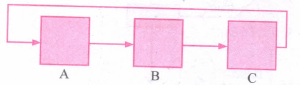
42.
Explain booting of computer and its types.
43.
1.
(c)
i-false, ii-true, iii-true, iv-false
2.
(a)
do-while
3.
(b)
(i), (ii) and (iii)
4.
(b)
Function
5.
(d)
E-libraries
6.
(d)
All of these
7.
(c)
constructor overloading
8.
(a)
OOP
9.
(a)
>>
10.
(c)
9
11.
(a)
3 bits form
12.
(d)
Menu bar
13.
(d)
the responsibility of both the user and the algorithm.
14.
(d)
All the above
15.
(c)
Cache memory
16.
Phishihg is a term used to describe a malicious individual or group of individuals who scam users by sending e-mails or creating web pages that are designed to collect an individual's online bank, credit card, or other login information.
17.
Output:
String1: Computer and String2: Science Are Not Equal
18.
The only difference between structure and class is the members of structure are by default public where as it is private in class.
19.
Const is the keyword used to declare a constant. Const keyword modifies/restricts the accessibility of a variable. So it is known as Access modifier.
20.
In refinement, each statement is repeatedly expanded into more detailed statements in the subsequent levels.
21.
A loop invariant is a condition [among program variables] that is necessarily true immediately before and immediately after, each iteration of a loop. A loop invariant is some condition that holds for every iteration of the loop.
22.
(i) Memory Data Register is the register of a computer's control unit that contains the data to be stored in the computer storage (Eg. RAM).
(ii) It is also called Memory Buffer Register.
23.
Different server distributions in Linux OS:
Ubuntu, Linux Mint, Debian, Fedora, RedHat.
24.
The ALU is a part of CPU where various computing functions are performed on data. ALU performs arithmetic operations such as addition, subtraction, multiplication, division and logical operations.
25.
Output:
Total area: 35.
26.
class sale
{
int cost, discount;
public:
sale (sale&);
};
// non inline constructor
sale: : sale(sale&s)
{
cost = s.cost;
discount = s.discount;
}
27.
Important features of Modular programming:
1. Emphasis on algorithm rather than data
2. Programs are divided into individual modules
3. Each modules are independent of each other and have their own local data
4. Modules can work with its own data as well as with the data passed to it.
Example: Pascal and C.
28.
A structure without a name/tag is called anonymous structure.
struct
{
long rollno;
int age;
float weight;
} student;
The student can be referred as reference name to the above structure and the elements can be accessed like student.rollno, student.age and student.weight .
29.
a=(x>=10)? m + 5:m;
30.
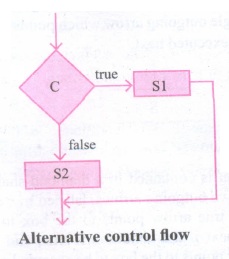
31.
The security modules of an Operating System protect the resources and information of a computer system against destruction and unauthorized user access. It is a process of ensuring OS integrity, confidentiality and availability.
32.
XOR - Truth table
| A | B | A \(\oplus \)B |
| 0 | 0 | 0 |
| 0 | 1 | 1 |
| 1 | 0 | 1 |
| 1 | 1 | 0 |
33.
The state represented in a algorithm is set of variables. At any place the value of the variables are substituted and evaluation is done.
34.
Output:
T1 Object:
Value after initialization:
X:10
Y:20
T2 Object:
Value after initialization:
X:10
Y:20
35.
#include< iostream.h >
#include< conio.h > //for clrscr ()
class Train {
//same as before
};
class Reservation: public Train
{
//same as before
};
//same as before
int main ( )
{ clrscr();
int num ;
cout << "Enter Train Number :\n" ; cin >> num ;
cout << "\nEnter total number of seats in 1st class\n";
int s1 ; cin >> s1 ;
cout<< "\nEnter totalnumberofseatsm2ndclass\n";
int s2 ; cin >> s2 ;
cout<< "\nEnter total number of seats in 3rd class\n";
int s3 ; cin >> s3 ;
Reservation Tr(num, sI,s2.s3) ;
char c1_type ;
int choice, seats ;
do
{
cout << "\nMain Menu\n" ;
cout << "1. Reservation \n" ;
cout << "2. Cancellation \n" ;
cout << "3. Display status \n" ;
cout << "4. Exit\n" ;
cout<< "Enter your choice:" ;
cin >> choice; cout << "\n" ;
switch(choice)
{case 1 : cout<< "Which class? (1\2\3): ";
cin > cltype ;
cout << "\nHow many seats?";
cin >> seats ;
cout << "\n";
Tr.book(cl_type, seats);
break;
case 2 : cout <<"Which class? (1\2\3) : ";
cin >> cl_type ;
cout << "\nHow many seats?";
cin>> seats ;
cout << "\n";
Tr.cancel(cl_type, seats) ;
break;
case 3 : Tr.disp_status ( ) ;
break;
case 4 : break ;
default: cout<< 'Wrong choice!!\n"
} ; \\end of switch
} while (choice >> 1 && choice < = 3);
return 0;
} \\end of main ( )
36.
(i) Objects: ob and obl of main ()
(ii) object ob of void operator==(comp ob);
(iii) Overloaded operator: ===
Statement that invokes: ob == obl;
(iv) void operator==(comp ob):
(v) operands used are the objects of the class comp
(vi) The default constructor generated by the compiler will be executed.[comp();]
| Output 1 | Output 2 |
| Enter first string: hello Enter second string: hello String are equal |
Enter first string: hello Enter second string: fine String are not equal. |
37.
#incluede< iostream >
using namespace std;
#include< string.h >
struct college
{
int prof.id;
char pname[20];
char dept[20];
} p[10];
int main()
{
int i;
for (i=0; i<10; i++)
{
cout << "Enter professor.id'' << endl;
cin >> p[i].prof_d;
cout << "Enter proferssor name'' << endl:
cin >> p[i].pname;
cout << "Enter department'' << endl;
cin >> p[i].dept;
}
for(i=0;i < 10; i++)
{
int flag= 1;
if(p[i].dept== "COMP.SCI"&& p[i].pname='A')
cout << p[i].prof id << endl;
cout << p[i].pname << endl;
cout << p[i].dept << endl;
}
if(flag==0)
cout << "The given details not found" << endly
return 0;
}
38.
A function that calls itself is known as recursive function. And, this technique is known as recursion.
#include
int factorial(int);//Function prototype//
int main ()
{
int no;
cout <<"\nEnter a number to find its factorial;";
cin>>no;
cout <<"\nFactorial of Number" < return 0;
}
int factorial(int m)
{
if (m>1)
{
return m*factorial(m-1);
}
else
{
return 1;
}
}
Output:
Enter a number to find its factorial: 5
Factorial of Number 5 = 120
39.
#include <iostream>
using namespace std;
int main()
{
int a1, b1 lem, ged-1, p;
cout << "\n Enter 1st no:";
cin>>a1;
cout << "\n Enter 2nd no:";
cin >> b1;
p=a1*b1;
for (int i = al; i<-p; i++)
if (i%al == 0) && (i%b1 == 0)
{
1cm=i;
break;
}
cin.get():
cout << "L.C.M. =" <<lcm<<endl;
gcd=p/LCM;
cout<<"G.C.D="<< ged;
cin.get():
return 0;
}
40.
Elements of Ubuntu:
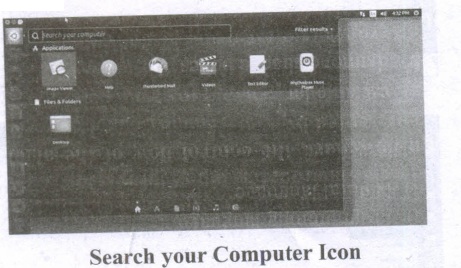
Search your Computer Icon:
This icon is equal to search button or icon in Windows OS. Here, you have to give the name of the File or Folder for searching them.
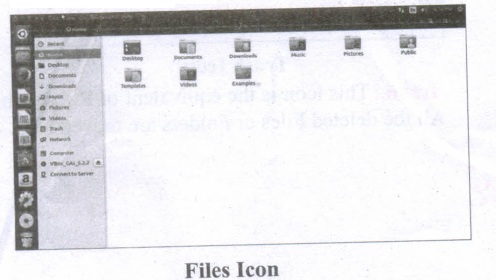
Files: This icon is equivalent to My Computer icon. From here, you can directly go to Desktop, Documents and so on
Firefox Web Browser:
By clicking this icon, you can directly browse the Internet. This is equivalent to clicking the Web Browser in Task bar or in Desktop or in Start button in Windows.

LibreOffice Writer:
This icon will directly take you to document preparation application like MS Word in Windows.

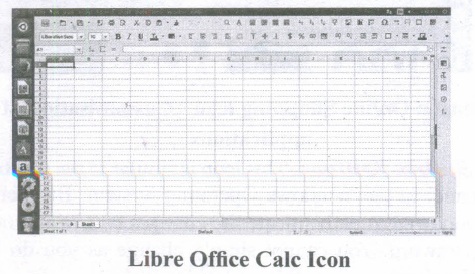
LibreOffice Calc:
This icon will lead you to spreadsheet preparation application like MS Excel in Windows.
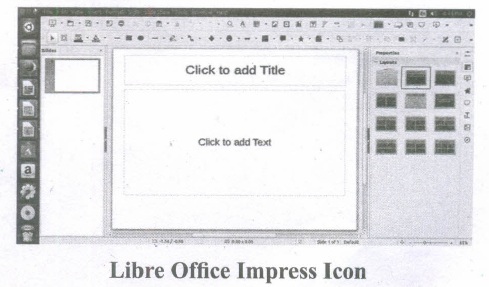
LibreOffice Impress:
By clicking this icon, you can prepare any presentations in Ubuntu like MS PowerPoint.
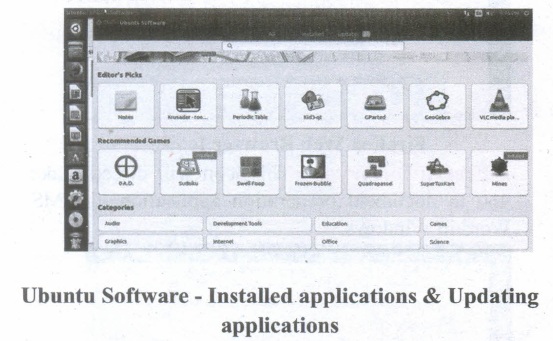
Ubuntu Software:
This icon will let you add any additional applications you want. This can be done by clicking the Update option at the top right corner of that screen.
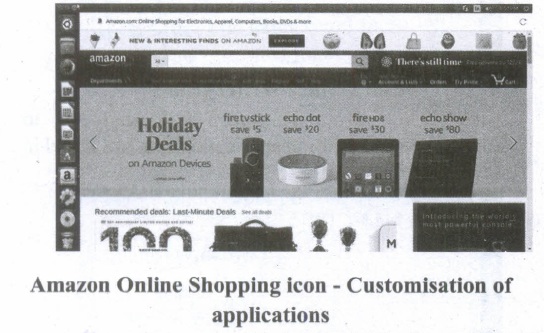
Amazon Online Shopping icon:
Icons like this can be customised. You can add it or delete it based on your need.
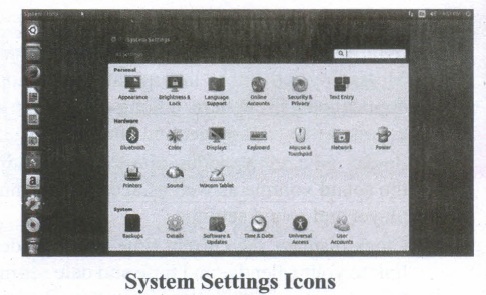
System Settings:
This icon is similar to the Control panel in the Windows Operating System. But here, you need to authenticate the changes by giving your password. You cannot simply change as you do in Windows.
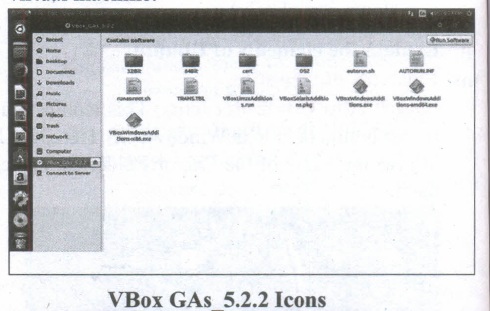
VBox_GAs_5.2.2:
The expansion for VBox is Virtual Box. The reason to use Oracle Virtual Box is Ubuntu Linux can be run as a guest OS within the virtual machine.
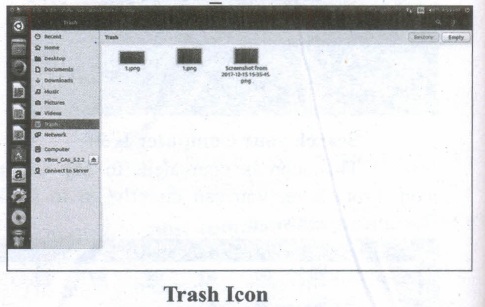
Trash: This icon is the equivalent of Recycle bin. All the deleted Files or Folders are moved here.
41.
42.
Booting of computer:
(i) An Operating system (OS) is a basic software that makes the computer to work. When a computer is switched on, there is no information in its RAM.
(ii) At the same time, in ROM, the pre-written program called POST (Power on Self Test) will be executed first. This program checks if the devices like RAM, keyboard, etc., are connected properly and ready to operate. If these devices are ready, then the BIOS (Basic Input Output System) gets executed. This process is called Booting.
(iii) Thereafter, a program called "Bootstrap Loader" transfers OS from hard disk into main memory. Now the OS gets loaded (Windows/Linux, etc.,) and will get executed. Booting process is of two types.
1) Cold Booting
2) Warm Booting
(iv) Cold Booting:
When the system starts from the initial state i.e. it is switched on, we call it cold booting or Hard Booting. When the user presses the power button, the instructions are read from the ROM to initiate the booting process.
(v) Warm Booting:
When the system restarts or when Reset button is pressed, we call it Warm Booting or Soft Booting. The system does not start from the initial state and so all diagnostic tests need not be carried out in this case. There are chances of data loss and system damage as the data might not have been stored properly.
43.

11th Standard Syllabus & Materials
11th Standard
TN 11th Tamil பீடு பெற நில் - செய்யுள் - காவடிச்சிந்து Important Questions And Answers Study Material - QB365 Set A
NEW11th Standard
TN 11th Tamil பீடு பெற நில் - உரைநடை - மலை இடப்பெயர்கள் : ஓர் ஆய்வு Important Questions And Answers Study Material - QB365 Set A
NEW11th Standard
TN 11th Tamil மாமழை போற்றுதும் - துணைப்பாடம் - யானை டாக்டர் Important Questions And Answers Study Material - QB365 Set A
NEW11th Standard
TN 11th Tamil மாமழை போற்றுதும் - செய்யுள் - ஐங்குறுநூறு Important Questions And Answers Study Material - QB365 Set A



Tamilnadu Stateboard 11th Standard Subjects

Maths

Commerce

Economics

Biology

Business Maths and Statistics

Accountancy
Computer Science

Physics

Chemistry
Maths
Biology
Economics
Physics
Chemistry

History
Business Maths and Statistics

Computer Science
Accountancy

Computer Applications
History
Computer Technology
Commerce
Computer Applications
Computer Technology

Tamil

English

French
Tamilnadu Stateboard Standards
