
 100% FREE ACCESS
11th Standard Syllabus & Materials
11th Standard
TN 11th Tamil இயற்கை வேளாண்மை,சுற்றுச்சூழல் -செய்யுள் - மனோன்மணீயம் Important Questions And Answers Study Material - QB365 Set A
NEW11th Standard
TN 11th Tamil என்னுயிர் என்பேன் -துணைப்பாடம் - இசைத்தமிழர் இருவர் Important Questions And Answers Study Material - QB365 Set A
NEW11th Standard
TN 11th Tamil மொழி கலை -செய்யுள் - ஒவ்வொரு புல்லையும் Important Questions And Answers Study Material - QB365 Set A
NEW11th Standard
TN 11th Tamil பீடு பெற நில் - இலக்கணம் - பகுபத உறுப்புகள் Important Questions And Answers Study Material - QB365 Set A
NEW11th Standard
TN 11th Tamil பீடு பெற நில் - துணைப்பாடம் - வாடிவாசல் Important Questions And Answers Study Material - QB365 Set A
NEW11th Standard
TN 11th Tamil பீடு பெற நில் - செய்யுள் - குறுந்தொகை Important Questions And Answers Study Material - QB365 Set A

Published on: 13/05/2022
QB365 provides detailed and simple solution for every book back questions in class 11 Computer Science subject.It will helps to get more idea about question pattern in every book back questions with solution.
latest Book back QuestionsDownload Tamil Nadu 11th Standard Computer Science question papers, model tests, one-mark questions, important questions, and public exam papers in PDF format. Free study materials and answer keys for TN State Board students.
Questions + Answers key
Take MCQ Computer Science Test
1.
What are ethical issues? Name some.
2.
Explain about proxy server.
3.
What is the role of firewalls?
4.
What do you mean by overriding?
5.
What is difference between the members present in the private visibility mode and the members present in the public visibility mode
6.
class sale ( int cost, discount ;public: sale(sale &); Write a non inline definition for constructor specified;
7.
What is operator overloading? Give some example of operators which can be overloaded.
8.
What are the rules for function overloading?
9.
Given the following C++ code, answer the questions (i) & (ii).
class TestMeOut
{
public:
~TestMeOut() //Function 1
{cout<<“Leaving the exam hall”<<endl;}
TestMeOut() //Function 2
{cout<<“Appearing for exam”<<endl;}
void MyWork() //Function 3
{cout<<“Answering”<<endl;} };
(i) In Object Oriented Programming, what is Function 1 referred as and when doesit get invoked / called ?
(ii) In Object Oriented Programming, what is Function 2 referred as and when doesit get invoked / called ?
10.
Write with example how will you dynamically initialize objects?
11.
List some of the features of modular programming.
12.
What is paradigm? Mention the different types of paradigm.
13.
How will you pass a structure to a function?
14.
15.
What are arithmetic operators in C++? Differentiate unary and binary arithmetic operators. Give example for each of them.
16.
What are the differences between “Logical error” and “Syntax error”?
17.
Assume a=10, b=15; What will be the value of a^b?
18.
What is case analysis?
19.
Write the De Morgan's law.
20.
Write a short note on XNOR gate.
21.
List out the major differences between Windows and Ubuntu OS.
22.
If you are working on multiple files at a time, sometimes the system may hang. What is the reason behind it? How can you reduce it?
23.
Write the characteristics of sixth generation.
24.
What is an input device? Give two examples.
25.
What are the characteristics of a computer?
1.
An Ethical issue is a problem or issue that requires a person or organization to choose between alternatives that must be evaluated as right (ethical) or wrong (unethical). These issues must be addressed and resolved to have a positive influence in society.
Some of the common ethical issues are listed below:
(i) Cyber crime
(ii) Software Piracy
(iii) Unauthorized Access
(iv) Hacking
(v) Use of computers to commit fraud
(vi) Sabotage in the form of viruses.
2.
A proxy server provides a gateway between users and the internet. It is a server, referred to as an “intermediary” because it goes between end-users and the web pages they visit online. A proxy server is essentially a computer on the internet that has an IP address of its own.
3.
A firewall is a computer network security based system that monitors and controls incoming and outgoing network traffic based on predefined security rules. A firewall commonly establishes a block between a trusted internal computer network and entrusted computer outside the network. They are generally categorized as network-based or host-based. Network based firewalls are positioned on the gateway computers of LANs [local area Network], WANS [Wide Area Network] and intranets.
4.
When a derived class member function has the same name as that of its base class member function, the derived class member function shadows/hides the base class's inherited function. This situation is called function overriding.
5.
| Members present in the private visibility mode | Members present in the public visibility mode |
| Can be accessed only by the class members. | Can be accessed by the outside members also. |
| By default the members will be in private visibility mode. | Members, to be in public visibility mode has to be specified explicitly. |
| When classes are inherited, private members are not inherited. | When classes are inherited, the public members are inherited as private, protected and public members of the derived class. |
6.
class sale
{
int cost, discount;
public:
sale (sale&);
};
// non inline constructor
sale: : sale(sale&s)
{
cost = s.cost;
discount = s.discount;
}
7.
The term operator overloading, refers to giving additional functionality to the normal C++ operators like +, ++, -, --, +=, -=, *, <, >.It is also a type of polymorphism in which an operator is overloaded to give user defined meaning to it.
For example ¹+'operator can be overloaded to perform addition on various data types, like for Integer, String (concatenation) etc.
8.
Rules for function overloading:
(i) The overloaded function must differ in the number of its arguments or data types.
(ii) The return type of overloaded functions are not considered for overloading same data type.
(iii) The default arguments of overloaded functions are not considered as part of the parameter list in function overloading
9.
(i) Function 1 is the 'destructor'.
It is executed automatically when an object of the class TestMeOut goes out of scope.
(ii) Function 2 is called default 'constructor'.
It is executed automatically when instance of the class TestMeOut comes into scope or when objects of the class TestMeOut are created.
10.
When the initial values are provided during runtime then it is called dynamic initialization.
Example to illustrate dynamic initialization
#include < iostream >
using namespace std;
class X
{
int n;
float avg;
public;
X(int p,float q)
{
n=p;
avg=q;
}
void disp( )
{
cout << "\n Roll number:-"<< n;
}
};
int main( )
{
int a; float b;
cout<< "\nEnter the Roll number";
cin >> a;
cout << "\nEnter the Average";
cin >> b;
X x(a,b);\\dynamic initialization
x.disp( );
return 0;
}
Output:
Enter the Roll Number 1201
Enter the Average 98.6
Roll number:- 1201
Average:- 98.6
11.
Important features of Modular programming:
1. Emphasis on algorithm rather than data
2. Programs are divided into individual modules
3. Each modules are independent of each other and have their own local data
4. Modules can work with its own data as well as with the data passed to it.
Example: Pascal and C.
12.
Paradigm means organizing principle of a program. It is an approach to programming. There are different approaches available for problem solving using computer. They are Procedural programming, Modular Programming and Object Oriented Programming.
13.
(i) A structure variable can be passed to a function in a similar way of passing any argument that is of built-in data type.
(ii) if the structure itself is an argument, then it is called "call by value".
(iii) If the reference of the structure is passed as an argument then it is called, "call by reference".
14.
15.
Arithmetic operators perform simple arithmetic operations like addition, substraction, multiplication, division etc.
| Unary Operators | Binary Operators |
| Require only one operand | Require two operands |
| Example: +,-, *,/,%, >, < <=, AND, OR | Example: ++ (Plus, Plus) Increment operator, --(Minus, Minus) Decrement operator, NOT, -, |
16.
| Syntax error | Logical error |
| The syntax is a set of grammatical rules to construct a program. Every programming language has unique rules for constructing the source code. Syntax errors occur when grammatical rules of c++ are violated. | A Program has not produced the expected result even though the program is grammatically correct. It may happen by the wrong use of variable/operator/order of execution etc. This means, the program is grammatically correct, but it contains some logical errors. So, Semantic error is also called as "Logic Error". |
17.
| Operator | Operation | Result |
| ^ | a^b | 00001010 a |
| 00001111 b | ||
| 00000101 a^b | ||
| a^b = (00000101)2 = 510 | ||
18.
1. Case analysis statement generalizes it to multiple cases.
2. Case analysis splits the problem into an exhaustive set of disjoint cases.
19.
De Morgan's
\(\bar { A+B } =\bar { A } .\bar { B } \)
\(\left( \bar { A.B } \right) =\bar { A } +\bar { B } \)
20.
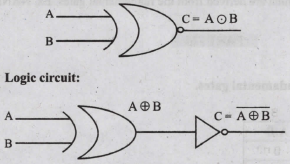
The XNOR (exclusive - NOR) gate is a combination XOR gate followed by an inverter. Its output is "true" if the inputs are the same, and "false" if the inputs are different.
The output of XNOR is C = AB + \(\bar {A} \) \(\bar {B} \)
= A ⊙ B
where ⊙ indicates included dot.
Truth table
| Input | Output | |
| A | B | C |
| 0 | 0 | 1 |
| 0 | 1 | 0 |
| 1 | 0 | 0 |
| 1 | 1 | 1 |
Logic symbol :
21.
| S.No | Ubuntu OS | Windows |
| 1. | Open-source (Licensing freedom) |
Closed source (Licensing Restriction |
| 2. | Online peer support | Paid-help-desk support |
| 3. | Full hardware support | Partial hardware support |
| 4. | Support CUI | No CUI support |
| 5. | Flexibility | Rigidity |
22.
When we open multiple applications, each application opened on the system takes some internal and hardware resources to keep it running. Memory is used by all the applications. System processing speed will be shared and it will become slow finally the system will hang.
Methods of reducing it:
1. It is advisable to run one program at a time.
2. Upgrade RAM
3. Clean the cache Memories
4. Defragmentation can be done
23.
(a) Natural Language Processing
(b) Development of Robotics
(c) Parallel and Distributed computing
(d) Artificial Intelligence
(e) Development of Robotics
24.
Input Device:
It is a peripheral device used to provide data and control signals to an information processing system. Eg: Keyboard, Mouse, Scanners, Digital cameras, Joysticks.
25.
The Basic characteristics of the computers are:
(i) High speed
(ii) Stores Huge Data
(iii) They do millions of different tasks
(iv) Very versatile
(v) Accurate
(vi) Diligence

11th Standard Syllabus & Materials
11th Standard
TN 11th Tamil பீடு பெற நில் - செய்யுள் - காவடிச்சிந்து Important Questions And Answers Study Material - QB365 Set A
NEW11th Standard
TN 11th Tamil பீடு பெற நில் - உரைநடை - மலை இடப்பெயர்கள் : ஓர் ஆய்வு Important Questions And Answers Study Material - QB365 Set A
NEW11th Standard
TN 11th Tamil மாமழை போற்றுதும் - துணைப்பாடம் - யானை டாக்டர் Important Questions And Answers Study Material - QB365 Set A
NEW11th Standard
TN 11th Tamil மாமழை போற்றுதும் - செய்யுள் - ஐங்குறுநூறு Important Questions And Answers Study Material - QB365 Set A



Tamilnadu Stateboard 11th Standard Subjects

Maths

Commerce

Economics

Biology

Business Maths and Statistics

Accountancy
Computer Science

Physics

Chemistry
Maths
Biology
Economics
Physics
Chemistry

History
Business Maths and Statistics

Computer Science
Accountancy

Computer Applications
History
Computer Technology
Commerce
Computer Applications
Computer Technology

Tamil

English

French
Tamilnadu Stateboard Standards


