
 100% FREE ACCESS
11th Standard Syllabus & Materials
11th Standard
TN 11th Tamil இயற்கை வேளாண்மை,சுற்றுச்சூழல் -செய்யுள் - மனோன்மணீயம் Important Questions And Answers Study Material - QB365 Set A
NEW11th Standard
TN 11th Tamil என்னுயிர் என்பேன் -துணைப்பாடம் - இசைத்தமிழர் இருவர் Important Questions And Answers Study Material - QB365 Set A
NEW11th Standard
TN 11th Tamil மொழி கலை -செய்யுள் - ஒவ்வொரு புல்லையும் Important Questions And Answers Study Material - QB365 Set A
NEW11th Standard
TN 11th Tamil பீடு பெற நில் - இலக்கணம் - பகுபத உறுப்புகள் Important Questions And Answers Study Material - QB365 Set A
NEW11th Standard
TN 11th Tamil பீடு பெற நில் - துணைப்பாடம் - வாடிவாசல் Important Questions And Answers Study Material - QB365 Set A
NEW11th Standard
TN 11th Tamil பீடு பெற நில் - செய்யுள் - குறுந்தொகை Important Questions And Answers Study Material - QB365 Set A

Published on: 13/05/2022
QB365 provides detailed and simple solution for every Creative Questions in class 11 Computer Science Subject. It will helps to get more idea about question pattern in every Creative questions with solution.
latest Creative QuestionsDownload Tamil Nadu 11th Standard Computer Science question papers, model tests, one-mark questions, important questions, and public exam papers in PDF format. Free study materials and answer keys for TN State Board students.
Questions + Answers key
Take MCQ Computer Science Test
1.
Given data: Principal amount Rs. 50000
Number of years 5
Rate of interest 7
To find the simple interest of the above mentioned given data. Write a C++ program using inline functions.
2.
Write about function prototype
3.
Explain about generating random numbers with suitable program.
4.
Explain the use of scope resolution operator with an example
5.
Explain Inline function with an example
1.
#include < iostream >
using namespace std;
inline float simple interest(float p1 ,float n1, float r1)
{
float si 1=(p 1*n 1*r1)/100;
return(si 1);
}
int main ( )
{
flot si, p,n,r
cout < < "\n Enter the Principle Amount Rs. :";
cin > > p;
cout < <"\n Enter the Number of Years :";
cin > > n;
cout < < "\n Enter the Rate of Interest :";
cin > > r;
si=simple interest(p,n,r);
cout < < "\n The Simple Interest = Rs."<
}
Output:
Enter the Principle Amount Rs. :50000
Enter the Number of Years :5
Enter the Rate of Interest :7
The Simple Interest = Rs. 17500
2.
C++ program can contain any number of functions. But, it must always hav. only one main ( ) function to begin the program execution. We can write the definitions of fun dons in any order as we wish. We can define the main( ) function first and all other functions after that or we can define all the needed functions prior to main( ), Like a variable declaration, a function must be declared before it is used in the program. The declaration statement may be given outside the main( ) function.
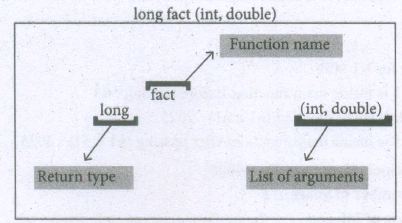
The prototype above provides the following information to the compiler:
1. The return value of the function is of type long.
2. fact is the name of the function
3. the function is called with two arguments
The first argument is of int data type.
The second argument is of double data type.
int display(int, int)//function prototype//
The above function prototype provides details about the return data type, the name of the function, and a list of formal parameters or arguments.
3.
The srand( ) function in C++ seeds the pseudo random number generator used by the rand( ) function. The seed for rand( ) function is 1 by default. It means that if no srand( ) is called before rand( ), the rand( ) function behaves as if it was seeded with srand(1). The srand( ) function takes an unsigned integer as its parameter which is used as seed by the rand( ) function. It is defined in< cstdlib >or < stdlib.h >header file.
#include< iostream >
#include< cstdlib.h >
using namespace std;
int main ( )
{
int random = rand( ); 1* No srand( ) calls before rand( ), so seed = 1*/
cout < < "\nSeed = 1, Random number =" < < random;
srand(10);
/* Seed = 10 */
random = rand ( );
cout < < "\n\n Seed = 10, Random number ="< < random;
return 0;
}
Output:
Seed = 1, Random number = 41
Seed = 10, Random number = 71
4.
The scope operator reveals the hidden scope of a variable. The scope resolution operator (::) is used for the following purposes. To access a Global variable when there is a Local variable with same name. An example using Scope Resolution Operator.
// Program to show that we can access a global variable
// using scope resolution operator :: when there is a local
// variable with same name //
#include< iostream >
using namespace std;
int x=45; // Global Variable x
int main()
{
int x = 10; // Local Variable x
cout << "\nValue of global x is " << ::x;
cout << "\nValue oflocal x is" << x;
return 0;
}
Output:
Value of global x is 45 .
Value of local x is 10
5.
Inline functions can be used to reduce the overheads like STACKS for small function definition.
An inline function looks like normal function in the source file but inserts the function's code directly into the calling program. To make a function inline, one has to insert the keyword inline in the function header.
Syntax:
inline retuntype functionname( datatype parametemame1, ... datatype parametemameN)
Advantages of inline functions: Inline functions execute faster but requires more memory space. Reduce the complexity of using STACKS.
Example:
#include< iostream >
using namespace std;
inline float simpleinterest(float.pl, float nl, float rl)
{
float si 1=(p1*n1*r1)/100;
retumf si 1);
}
intmain0
{
float si.p,n,r;
cout<< "\nEnter the Principal Amount Rs.:";
cin> p;
cout<< "\nEnter the Number of Years :";
cin<< n;
cout << "\nEnter the Rate ofInterest :";
cin>> r:
si=simpleinterest(p,n,r) ;
cout<< "\nThe Simple Interest = Rs."<< si;
return 0;
}

11th Standard Syllabus & Materials
11th Standard
TN 11th Tamil பீடு பெற நில் - செய்யுள் - காவடிச்சிந்து Important Questions And Answers Study Material - QB365 Set A
NEW11th Standard
TN 11th Tamil பீடு பெற நில் - உரைநடை - மலை இடப்பெயர்கள் : ஓர் ஆய்வு Important Questions And Answers Study Material - QB365 Set A
NEW11th Standard
TN 11th Tamil மாமழை போற்றுதும் - துணைப்பாடம் - யானை டாக்டர் Important Questions And Answers Study Material - QB365 Set A
NEW11th Standard
TN 11th Tamil மாமழை போற்றுதும் - செய்யுள் - ஐங்குறுநூறு Important Questions And Answers Study Material - QB365 Set A



Tamilnadu Stateboard 11th Standard Subjects

Maths

Commerce

Economics

Biology

Business Maths and Statistics

Accountancy
Computer Science

Physics

Chemistry
Maths
Biology
Economics
Physics
Chemistry

History
Business Maths and Statistics

Computer Science
Accountancy

Computer Applications
History
Computer Technology
Commerce
Computer Applications
Computer Technology

Tamil

English

French
Tamilnadu Stateboard Standards


