
 100% FREE ACCESS
11th Standard Syllabus & Materials
11th Standard
TN 11th Tamil இயற்கை வேளாண்மை,சுற்றுச்சூழல் -செய்யுள் - மனோன்மணீயம் Important Questions And Answers Study Material - QB365 Set A
NEW11th Standard
TN 11th Tamil என்னுயிர் என்பேன் -துணைப்பாடம் - இசைத்தமிழர் இருவர் Important Questions And Answers Study Material - QB365 Set A
NEW11th Standard
TN 11th Tamil மொழி கலை -செய்யுள் - ஒவ்வொரு புல்லையும் Important Questions And Answers Study Material - QB365 Set A
NEW11th Standard
TN 11th Tamil பீடு பெற நில் - இலக்கணம் - பகுபத உறுப்புகள் Important Questions And Answers Study Material - QB365 Set A
NEW11th Standard
TN 11th Tamil பீடு பெற நில் - துணைப்பாடம் - வாடிவாசல் Important Questions And Answers Study Material - QB365 Set A
NEW11th Standard
TN 11th Tamil பீடு பெற நில் - செய்யுள் - குறுந்தொகை Important Questions And Answers Study Material - QB365 Set A

Published on: 08/06/2021
QB365 provides detailed and simple solution for every book back questions in class 11 Computer Science subject.It will helps to get more idea about question pattern in every book back questions with solution.
Download Tamil Nadu 11th Standard Computer Science question papers, model tests, one-mark questions, important questions, and public exam papers in PDF format. Free study materials and answer keys for TN State Board students.
Questions + Answers key
Take MCQ Computer Science Test
1.
Explain the different types of number systems?
2.
What is number system? Describe different number systems in detail.
3.
Explain the Derived gates with expression and truth table.
4.
How AND and OR can be realized using NAND and NOR gate
5.
Explain the fundamental gates with expression and truth table.
1.
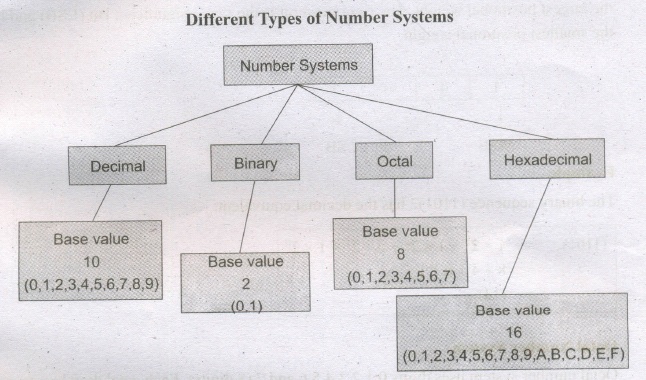
A numbering system is a way of representing numbers. The most commonly used numbering system in real life is Decimal number system.· Other number systems are Binary, Octal, Hexadecimal number system. Each number system 'is uniquely identified by its base value or radix. Radix or base is the count of number of digits in each number system. Radix or base is the general idea behind positional numbering system.
Decimal Number System
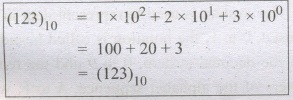
It consists of 0,1,2,3,4,5,6,7,8,9(10 digits). It is the oldest and most popular number system used in our day to day life, In the positional number system, each decimal digit is weighted relative to its position in the number. This means that each digit in the number is multiplied by 10 raised to a power corresponding to that digit's position.
Binary Number System
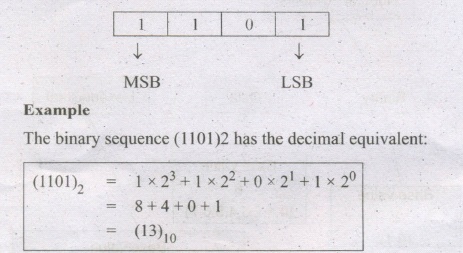
There are only two digits in the Binary system, namely, 0 and 1. The numbers in the binary system are represented to the base 2 and the positional multipliers are the powers of2. The left most bit in the binary number is called as the Most Significant Bit (MSB) and it has the largest positional weight. The right most bit is the Least Significant Bit (LSB) and has the smallest positional weight.
Octal Number System
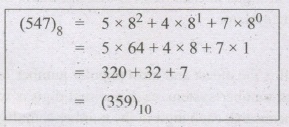
Octal number system uses digits 0,1,2,3,4,5,6 and 7-(8 digits). Each octal digit.has its own positional value or weight as a power of 8.
Example
The Octal sequence (547)8 has the decimal equivalent:
Hexadecimal Number System:
A hexadecimal number is represented using base 16. Hexadecimal or Hex numbers are used as a shorthand form of binary sequence. This system is used to represent data in a more compact manner. Since 16 symbols are used, 0 to F, the notation is called hexadecimal. The first 10 symbols are the same as in the decimal system, 0 to 9 and the remaining 6 symbols are taken from the first 6 letters of the alphabet sequence, A to F, where A represents 10, B is 11, C is 12, D is 13, E is 14 and F is 15.
2.
A number system is a set of digits used to represent the values derived from a common base or radix.
Decimal Number System:
(i) The term Decimal is derived from a Latin prefix deci, which means ten.
(ii) The Decimal number system has ten digits ranging from 0-9. Because this system has ten digits.
(iii) It is also called as a base ten number system or denary number system.
(iv) Decimal number should always be written with a subscript 10.
Binary Number System:
(i) The decimal number system is not convenient to implement in digital system.
(ii) For instance, it is very difficult to design electronic equipment so that it can work with 10 different voltage levels (each one representing one decimal character, 0 through 9).
(iii) On other hand, it is very easy to design simple, accurate electronic circuits that operate with only 2 voltage levels.
(iv) For this reason, almost every digital system utilizes the binary number system (base 2) as the basic number system of its operation;
(v) In a binary system, there are only two symbols or possible digit values, 0 and 1.
Octal Number System:
(i) The octal number system is playing a vital role in digital computer work.
(ii) The octal number system has a base of 8.
(iii) It means that it has eight unique symbols such as 0,1,2,3,4,5,6 and 7.
(iv) Thus, each digit of an octal number can have any value from 0 to 7.
(v) The places to the left of the octal point are positive powers of 8 and places to the right are negative powers of 8.
Hexadecimal Number System:
(i) The hexadecimal system uses base 16 in digital systems.
(ii) It has 16 possible symbols.
(iii) It uses the digits 0 through 9 plus the letters A, B, C, D, E and F as the 16 different symbols.
(iv) Hexadecimal System is a positional value system, wherein each hexadecimal digit has its own value or weight expressed as a power of 16.
3.
The logic gates like NAND, NOR, XOR and XNOR are derived gates which are derived from the fundamental gates AND, OR NOT.
(1) NAND gate:
The NAND is the combination of NOT and AND. The NAND is generated by inverting the output of an AND operation.
Output: y = \(\overline { \left( A.B \right) } \)
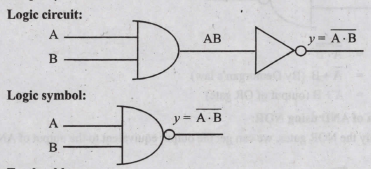
The truth table for NAND gate is
| Input | Output | |
| A | B | y = \(\overline { \left( A.B \right) } \) |
| 0 | 0 | 1 |
| 0 | 1 | 0 |
| 1 | 0 | 0 |
| 1 | 1 | 0 |
(ii) NOR gate:
The NOR is the combination of NOT and OR. The NOR is generated by inverting the output of an OR operation.
Logic function: y = \(\overline { \left( A+B \right) } \)
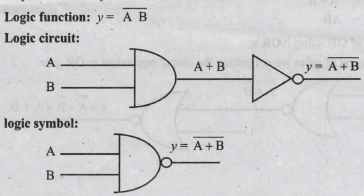
the truth table for NAND gate is
| Input | Output | |
| A | B | y = \(\overline { \left( A+B \right) } \) |
| 0 | 0 | 1 |
| 0 | 1 | 0 |
| 1 | 0 | 0 |
| 1 | 1 | 0 |
(iii) XOR gate:
The XOR (exclusive - OR) gate acts in the same way as the logical either /or.
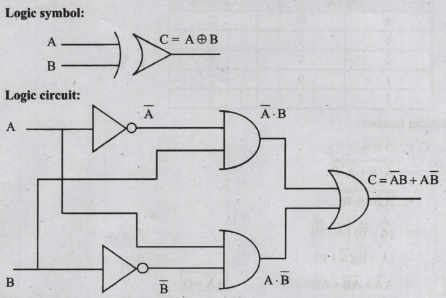
the truth table
| Input | Output | |
| A | B | C |
| 0 | 0 | 0 |
| 0 | 1 | 1 |
| 1 | 0 | 1 |
| 1 | 1 | 0 |
(iv) XNOR gate:
XNOR (exclusive - NOR) gate is a combination of XOR gate followed by an inverter.
Logic function: y= \(\overline { A \ B } \)
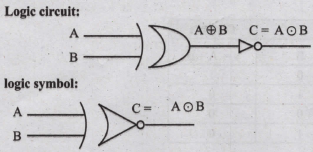
the truth table
| Input | Output | |
| A | B | C |
| 0 | 0 | 1 |
| 0 | 1 | 0 |
| 1 | 0 | 0 |
| 1 | 1 | 1 |
Boolean function:
\(\mathrm{C} =\overline{\mathrm{A} \oplus \mathrm{B}} \)
\(=\overline{{\overline{\mathrm{A}}} \cdot \mathrm{B}+\mathrm{A} \cdot \overline{\mathrm{B}}} \)
\(=\overline{\overline{\mathrm{A}} \cdot \mathrm{B}} \cdot \overline{\mathrm{A} \cdot \overline{\mathrm{B}}} \)
\(=(\overline{\mathrm{A}}+\overline{\mathrm{B}})(\overline{\mathrm{A}}+\overline{\bar{B}}) \)
\(=(\mathrm{A}+\overline{\mathrm{B}})(\overline{\mathrm{A}}+\mathrm{B}) \)
\(=\mathrm{A} \overline{\mathrm{A}}+\overline{\mathrm{AB}}+\mathrm{AB}+\mathrm{B} \overline{\mathrm{B}} \quad \mathrm{A \overline {A }}=\mathrm{O}\)
\(\mathrm{C} =\overline{\mathrm{A}} \overline{\mathrm{B}}+\mathrm{AB}\)
4.
Bubbled AND Gate
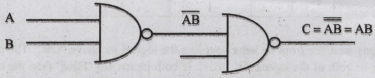
(i) Realized of and using only AND gate:
The Boolean function for AND is C=AB. The same can be realized using only NAND gates.
(ii) Realized of and using only NAND's gate:
The Boolean function for OR is C=A + B. The same can be realized using only NAND gates.
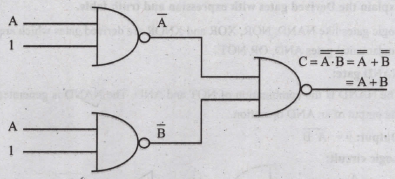
\(\mathrm{C} =\overline{\overline{\mathrm{A}} \cdot \overline{\mathrm{B}}} \)
\(=\overline{\mathrm{A}}+\overline{\mathrm{B}} \text { (By Demorgan's law) } \)
\(=\mathrm{A}+\mathrm{B} \text { (output of OR gate) }
\)
(iii) Realization of AND using NOR:
By using only the NOR gates, we can get the output equivalent to the output of AND gate.
C=A.B
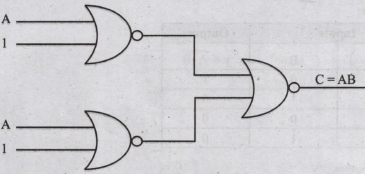
\(\mathrm{C} =\overline{\overline{\mathrm{A}} \cdot \overline{\mathrm{B}}} \)
\(=\overline{\mathrm{A}}+\overline{\mathrm{B}}\)
= AB
(iv) Realization of OR using NOR's:
By using only NOR gates we are getting the output equivalent to OR gate.

5.
A gate is a basic electronic circuit which operates on one or more signals to produce an output signal.
The three fundamental gates are AND, OR and NOT gates.
AND Gate
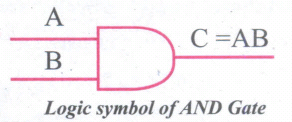
The AND gate can have two or more input signals and produce an output signal. The output is "true" only when both inputs are "true", otherwise, the output is "false". In other words the output will be 1 if and only if both inputs are 1; otherwise the output is 0. The output of the AND gate is represented by a variable say C, where A and B are two and if input boolean variables. In boolean algebra, a variable can take either of the values '0' or '1'. The logical symbol of the AND gate is
The Truth Table For AND Gate is
| Input | Output | |
| A | B | C |
| 0 | 0 | 0 |
| 0 | 1 | 0 |
| 1 | 0 | 0 |
| 1 | 1 | 1 |
OR Gate;
The OR gate gets its name from its behaviour like the logical inclusive "OR". The output is "true" if either or both of the inputs are "true". If both inputs are "false" then the output is "false". In other words the output will be 1 if and only if one or both inputs are 1; otherwise, the output is 0. The logical symbol of the OR gate is
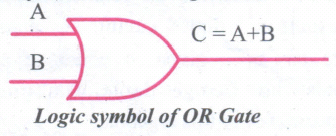
The truth table For OR Gate is
| Input | Output | |
| A | B | C |
| 0 | 0 | 0 |
| 0 | 1 | 1 |
| 1 | 0 | 0 |
| 1 | 1 | 1 |
NOT Gate;
The NOT gate, called a logical inverter, has only one input. It reverses the logical state. In other words the output C is always the complement of the input. The logical symbol of the NOT gate is
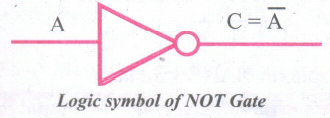
The truth table for NOT gate is
| Input | Output |
| A | C |
| 1 | 0 |
| 0 | 1 |

11th Standard Syllabus & Materials
11th Standard
TN 11th Tamil பீடு பெற நில் - செய்யுள் - காவடிச்சிந்து Important Questions And Answers Study Material - QB365 Set A
NEW11th Standard
TN 11th Tamil பீடு பெற நில் - உரைநடை - மலை இடப்பெயர்கள் : ஓர் ஆய்வு Important Questions And Answers Study Material - QB365 Set A
NEW11th Standard
TN 11th Tamil மாமழை போற்றுதும் - துணைப்பாடம் - யானை டாக்டர் Important Questions And Answers Study Material - QB365 Set A
NEW11th Standard
TN 11th Tamil மாமழை போற்றுதும் - செய்யுள் - ஐங்குறுநூறு Important Questions And Answers Study Material - QB365 Set A



Tamilnadu Stateboard 11th Standard Subjects

Maths

Commerce

Economics

Biology

Business Maths and Statistics

Accountancy
Computer Science

Physics

Chemistry
Maths
Biology
Economics
Physics
Chemistry

History
Business Maths and Statistics

Computer Science
Accountancy

Computer Applications
History
Computer Technology
Commerce
Computer Applications
Computer Technology

Tamil

English

French
Tamilnadu Stateboard Standards


