
 100% FREE ACCESS
11th Standard Syllabus & Materials
11th Standard
TN 11th Tamil இயற்கை வேளாண்மை,சுற்றுச்சூழல் -செய்யுள் - மனோன்மணீயம் Important Questions And Answers Study Material - QB365 Set A
NEW11th Standard
TN 11th Tamil என்னுயிர் என்பேன் -துணைப்பாடம் - இசைத்தமிழர் இருவர் Important Questions And Answers Study Material - QB365 Set A
NEW11th Standard
TN 11th Tamil மொழி கலை -செய்யுள் - ஒவ்வொரு புல்லையும் Important Questions And Answers Study Material - QB365 Set A
NEW11th Standard
TN 11th Tamil பீடு பெற நில் - இலக்கணம் - பகுபத உறுப்புகள் Important Questions And Answers Study Material - QB365 Set A
NEW11th Standard
TN 11th Tamil பீடு பெற நில் - துணைப்பாடம் - வாடிவாசல் Important Questions And Answers Study Material - QB365 Set A
NEW11th Standard
TN 11th Tamil பீடு பெற நில் - செய்யுள் - குறுந்தொகை Important Questions And Answers Study Material - QB365 Set A

Published on: 13/05/2022
QB365 provides detailed and simple solution for every Book back Questions in class 11 Computer Technology Subject. It will helps to get more idea about question pattern in every book back questions with solution.
latest Book back QuestionsDownload Tamil Nadu 11th Standard Computer Technology question papers, model tests, one-mark questions, important questions, and public exam papers in PDF format. Free study materials and answer keys for TN State Board students.
Questions + Answers key
Take MCQ Computer Technology Test
1.
Explain any five internet applications with suitable examples.
2.
Explain the types of computer networks based on its size, distance and the structure.
3.
Discuss in detail about Graphic Objects feature in Presentation.
4.
Valarmathi’s teacher asks her to create a presentation in OpenOffice Impress. As Valarmathi has never worked in Impress before, help her to perform the following tasks:
a. She wants that except for the first slide, all the slides should have the same design. For this, what does she need to do?
b. To easily communicate with her audience, she wants to provide them with a hard copy of the slides of the presentation. What should she create for it?
c. She wants to insert some pictures and movie files in some slides. How can she do that?
d. Suggest her the view that would be the most suitable for showing the presentation to the audience.
e. To make her presentation more attractive, she wants to add some effects in it. How can she do it? Suggest.
5.
Create a student database with register number, student name, Mark1, Mark2, and Mark3. Calculate the total and average of the students. Show the marks which are below 50 in red colour and marks above 50 is shown in green colour.
6.
Explain how to format a worksheet
7.
Explain about changing the column width in Calc.
8.
Explain the versions of Windows Operating System.
9.
Explain the concept of a Distributed Operating System along with its advantages.
10.
How the read and write operations are performed by a processor? Explain.
11.
Convert (98.46)10 to Binary
12.
Discuss the various generations of computers
13.
Explain Mail Merge feature.
14.
How do you resize the position of a table?
15.
What are Header and Footer? How do you insert page numbers?
1.
There are many applications of internet such as:
1. Communication: Computer users around the world extensively use the email service on internet to communicate with each other. Pictures, documents and other files are sent as email attachments. VolP stands for Voice over Internet Protocol, referring to the protocol that underlies all internet communication.
2. Job search:
Nowadays many people search for their jobs online as it is quicker and there is a larger variety of jobs vacancies present. People can publish resume online for prospective job. Popular examples are Naukri.com, Linkedln, etc
3. Video conferencing: It enables direct face to face communication across networks via web cameras, microphones and other communication tools. Video conferencing can enable individuals in distant locations to participate in meetings on short notice, with time and money saving. Video conferencing is very interactive in education to communicate between teacher to teacher, teacher to classroom and classroom to classroom with students at different places.
4. E-commerce: E-commerce or electronic commerce is the buying and selling of goods and services, or transmitting of funds or data, over an electronic network. These transactions occur either business-to-business, business to consumer, consumer to consumer or consumer to business. Flipkart, Snapdeal, Paytm, etc are example of e-commerce.
5 Travel: One can use internet to gather information about various tourist place. It can be used for booking Holiday tours. Some of the websites providing this service are goibibo.com, makemytrip.com, olacabs.com.
6. Nowadays internet is almost use in every fields. Due to increase in technology, use of internet has benefitted the users in many ways. Internet enables millions of computers from different organization and people to communicate and share resource globally.
2.
Different types of computer networks are:
1. LAN(Local Area Network):
(i) The local area network is a network which is designed to operate over a small physical area such as an office, factory or a group of buildings. LAN are widely used in variety of applications.
(ii) In LAN all the machines are connected to a single cable. Different topologies such as Bus, Ring, Star, Tree, etc. are used for LANs.
(iii) The size of LAN is usually small. The various devices in LAN are connected to central devices called Hub or Switch using a cable.
(iv) A LAN is usually a privately owned and links the devices in a single office, building or campus of up to few kilometres in size.
(v) The data rate for LAN can now range from 4 to 16 Mbps.
2. MAN(Metropolitan Area Network):
(i) A MAN is basically a bigger version of LAN. It is designed to extend over the entire city. MANs extend beyond 100 KM.
(ii) The MAN can be in the form of a single network such as a cable network or it can be a combination of multiple LANs.
(iii) A MAN may be wholly owned and operated by a private company or it may be a service provided by a public company, such as local telephone company(telco).
3. WAN(Wide area network):
(i) When a network spans a large distance or when the computers to be connected to each other are at wide separated locations a local area network cannot be used. For such situation, a Wide area Network(WAN) must be installed.
(ii) The communication between different users of WAN is established using leased telephone lines or satellite links and similar channels.
(iii) A WAN provides a long-distance transmission of data, voice image and video information over large geographical areas that may comprise a country, a continent or even the whole world.
(iv) WANs may use public, leased or private communication devices, and can spread over a wide geographical area. WAN that is wholly owned and used by a single company is often called as enterprise network.
(v) In most WANs the network contains a large number of cables or telephone lines each one connecting a pair of routers.
4. PAN (Personal area network):
(i) A personal area network, or PAN, is a computer network that enables communication between computer devices.
(ii) PANs can be wired, such as USB or FireWire, or they can be wireless, such as infrared, ZigBee, Bluetooth and ultra-wide band (UWB).
(iii) The range of a PAN typically is a few meters. Examples of wireless PAN (WPAN) are devices include cell phone, headsets, wireless keyboards, wireless mice, printers, bar code scanners and game consoles.
(iv) Hence computer network are classified into four types based on the size, distance and the structure namely: LAN (Local Area Network), MAN (Metropolitan Area Network), WAN (Wide Area Network) and PAN (Personal Area Network).
3.
1. Plans objects go about as compartments for various articles or as depictions of data. Compartments - Figures show all plans objects.
2. Graphics routinely unite text, blueprint, and concealing. Visual computerization may include the intentional decision, creation, or course of action of typography alone, as in a handout, flyer, standard, site, or book with no other segment.
3. Clarity or reasonable correspondence may be the unprejudiced, relationship with other social segments may be searched for, or basically, the creation of an unquestionable style.
4. Outlines can be helpful or imaginative. The last can be a recorded variation, similar to a photograph, or comprehension by a specialist to include crucial features, or a skilled worker, where case the capability with whimsical delineations may get clouded.
5. It can similarly be used for designing.
6. At the point when an application makes a DC, the framework consequently stores a bunch of default objects in it (there is no default bitmap or way).
7. An application can analyze the characteristics of the default objects by calling the GetCurrentObject and GetObject capacities.
8. The application can change these defaults by making another item and choosing it into the DC.
9. An article is chosen into a DC by calling the SelectObject function.
10. An application can set the current brush tone to a predetermined shading esteem with SetDCBrushColor.
11. The GetDCBrushColor work returns the DC brush tone. The SetDCPenColor work sets the pen tone to a predefined shading esteem. The GetDCPenColor work returns the DC pen tone.
4.
a. Select Format → Page from the Menu bar on the page setup, dialog box, choose background tab.
b. Select the type of fill you want for your background from the fine choices, None, color, gradient, hatching or bitmap. A list of choices for the selected fill type will appear → select it. Select one of the items on the list and click OK. The fill you have chosen is added to slide master then go normal view.
c. Select the first slide then right click → select slide design then select the design in slide master, then right click, a popup menu will appear, it displays 'back ground settings for all' you can choose 'No' option. The only first slide would not appear the background design.
Follow above steps to make first slide different from other slides.
5.
Data base here will be a table with column name as register number, student name, Mark1, Mark2, and Mark3.
Below is the database as per the requirement given in the question:
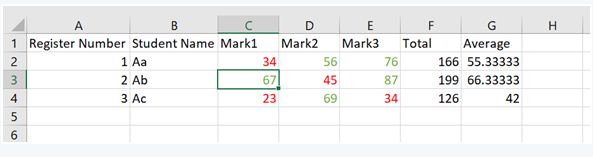
For total, Formula used is =Sum (C2:E2) and then drag the cursor for below rows.
For average, Formula used is =F2/3 and then drag the cursor for below rows.
6.
(i) Formatting Data in a cell gives additional effect to the text. Additional effect includes changing the font style, font size, automatic wrapping, bold, underline, italic etc. The data in Calc can be formatted in several ways. Using formatting icons can be used.
(ii) Text formatting : Making the cell contents as bold, italics, underlined, changing font style, size, colour etc., comes under text formatting.
(iii) Number formatting : Number formatting options are used to visually change the format of a numeric content. These formatting changes are appear for visual as, it does not change the original value. For example, To display a number as currency form use Number format: Currency.
7.
Changing Column Width and Row Height :
(i) Often while entering data into a worksheet you will realize that the width of the column is not enough.
(ii) StarOffice Calc. allows you to change the width of a column and the height of a row. To change the column width, select the column whose width you want to change.
(iii) Click on Format → Column → Width and type the new column width in the dialog box, which appears as shown in figure Click on OK.
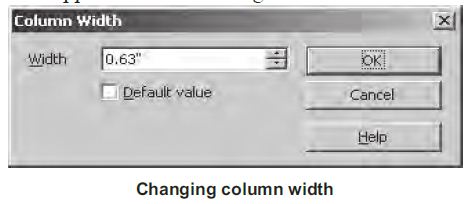
(iv) You can also change the column width in another way. Point to the line separating the column whose width you want to change from the next column.
(v) The mouse pointer becomes a double – headed arrow. Click and drag this pointer to the left to decrease the width and to the right to increase the width.
8.
| S.No | Versions | Logo | Year | Prominent feature |
| 1. | Windows 1.x |  |
1985 | 1. Introduction of GUI in 16 - bit. processor 2. Mouse was introduced as an input device |
| 2. | Windows 2.x |  |
1987 | 1. Supports to minimize or maximize windows. 2. Control panel feature was introduced with various system settings and customising options. |
| 3. | Windows 3.x |  |
1992 | 1. Introduced the concept of multitasking. 2. Supported 256 colours which brought a more modem, colourful look to the interface. |
| 4. | Windows 95 |  |
1995 | 1. Introduced Start button, the taskbar, Windows Explorer and Start menu. 2. Introduced 32 - bit processor and focused more on multitasking. |
| 5. | Windows 98 |  |
1998 | 1. Integration of the Web browser (Internet Explorer) with the Operating System. 2. DOS gaming began to disappear as Windows based games improved. 3. Plug and play feature was introduced. |
| 6. | Windows NT |  |
Designed to act as servers in network. | |
| 7. | Windows Me |  |
2000 | IIt introduced automated system diagnostics and recovery tools. |
| 8. | Windows 2000 |  |
2000 | 1. Served as an Operating System for business desktop and laptop systems. 2. Four versions of Windows 2000 were released: Professional (for business) 3. desktop and laptop systems), Server (both a Web server and an office server), 4. Advanced Server (for line-of-business applications) and Data Centre Server (for high traffic computer networks). |
| 9 | Windows XP |  |
2001 | 1. Introduced 64-bit Processor. 2. Improved Windows appearance with themes and offered a stable version |
| 10. | Windows Vista |  |
2006 | Updated the look and feel of Windows |
| 11. | Windows 7 |  |
2009 | Booting time was improved, introduced new user interfaces like Aero Peek, pinning programs to taskbar, handwriting recognition etc. and Internet Explorer 8. |
| 12. | Windows 8 |  |
2012 | 1. Windows 8 was faster than previous versions of Windows. 2. Start button was removed 3. Windows 8 takes better advantage of multicore processing, solid state drives (SSD), touch screens and other alternate input methods. 4. Served as common platform for mobile and computer. |
| 13. | Windows 10 |  |
2015 | 1. Start Button was added again. 2. Multiple desktop. 3. Central Notification Center for App notification and quick actions. 4. Cortana voice activated personal assistant. |
9.
The Distributed Operating System is used to access shared data and files that reside in any machine around the world. The user can handle the data from different locations. The users can access as if it is available on their own computer.
The advantages of distributed Operating System are as follows:
(i) A user at one location can make use of all the resources available at another location over the network.
(ii) Many computer resources can be added easily in the network
(iii) Improves the interaction with the customers and clients.
(iv) Reduces the load on the host computer.
10.
(i) The Central Processing Unit(CPU) has a Memory Data Register (MDR) and a Memory Address Register (MAR).
(ii) The Memory Data Register (MDR) keeps the data which is transferred between the Memory and the CPU. The Program Counter (PC) is a special register in the CPU which always keeps the address of the next instruction to be executed.
(iii) The Arithmetic and Logic unit of CPU places the address of the memory to be fetched, into the Memory Address Register.
(iv) A bus is a collection of wires used for communication between the internal components of a computer.
(v) The address bus is used to point a memory location. A decoder, a digital circuit is used to point to the specific memory location where the word can be located.
(VI) The address register is connected with the address bus, which provides the address of the instruction. A data bus is used to transfer data between the memory and the CPU.
(vii) The data bus is bidirectional and the address bus is unidirectional. The control bus controls the operations of both read or write operations.
(viii) The read operation fetches data from memory and transfers to MDR. control line performs two operations like read write using 1 or O.
(ix ) Also, the write operation transfers data from the MDR to memory. This organization is as shown in figure.
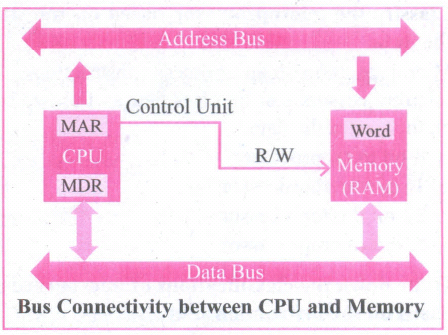
(i) The word in the RAM has the same size (no.of bits) as the Memory Data Register (MDR). If the processor is an 8-bit RAM processor like Intel 8085, its MDR and the word in the both have 8 bits.
(ii) If the size of the MDR is eight bits, which can be connected with a word in the memory which is also eight bits size. The data bus has eight parallel wires to transfer data either from MDR to word or word to MDR based on the control(Read or write).
.png)
(iii) This control line is labeled as which becomes 1 means READ operation and 0 means WRITE operation. shows content of M'DR and the Word before the READ operation. Also shows the content of MDR and the Word after the READ operation.
.png)
(iv) The read operation transfers the data (bits) from memory word to data register. The write operation transfers the data (bits) from memory data register to word.
11.
98.4610
1. Integer part
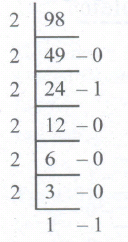
2. Fractional part
0.46 x 2 = 0.92 = 0
0.92 x 2 = 1.84 = 1
0.84 x 2 = 1.68 = 1
0.68 x 2 = 1.36 = 1
0.36 x 2 = 0.72 = 0
0.72 x 2 = 1.44 = 1
98.4610 = (1100010.011101...)2
12.
| S.N | Generation | Period | Main Component used | Merits/ Demerits |
| 1 | First Generation | 1942-1955 | Vaccum tubes | 1. Big in size 2. Consumed more power 3. Malfunction due to overheat 4. Machine Language was used |
| First Generation Computer - ENIAC, EDVAC, UNIVAC 1 ENIAC weighed about 27 tons, size 8 feet x 100 feet x 3 feet and consumed around 150 watts of power | ||||
| 2 | Second Generation | 1955-1964 | Transistors | 1. Smaller compared to First Generation 2. Generated Less Heat 3. Consumed less power compared to first generation 4. Punched cards were used 5. First operating system was developed - Batch Processing and Multiprogramming Operating System 6. Machine language as well as Assembly language was used. |
| Second Generation Computers IBM 1404, IBM 1620, UNIVAC 1108 | ||||
| 3 | Third Generation | 1964-1975 | Integrated Circuits(IC) | 1. Computers were smaller, faster and more reliable 2. Consumed less power. 3. High-Level Languages were used |
| Third Generation Computers -IBM ·360 series, Honeywell 6000 series | ||||
| 4 | Fourth Generation | 1975-1980 | Microprocessor Very Large Scale Integrated Circuits (VLSI) |
1. Smaller and Faster 2. Microcomputer series such as IBM and APPLE were developed 3. Portable Computers were introduced |
| 5 | Fifth Generation | 1980-till date | Ultra Large Scale Integration (ULSI) |
1. Parallel, Processing 2. Superconductors 3. Computers size was drastically reduced. 4. Can recognize Images and Graphics 5. Introduction of Artificial Intelligence and Expert Systems 6. Able to solve high complex problems including decision making and logical reasoning |
| 6 | Sixth Generation | In future |  |
1. Parallel and Distributed computing 2. Computers have become smarter faster and smaller 3. Development of robotics 4. Natural Language Processing 5. Development of Voice Recognition Software |
13.
(i) Mail merge is a process to create personalized letters and pre-addressed enveloped or mailing labels forms mailings form a form letter
(ii) The feature is usually employed in a word processing document which contains fixed text and variables (which act as place holders that are replaced by text from the data source.)
(iii) It is used to create multiple documents at once. These documents have identical layout, formatting, text and graphics.
(iv) The documents can create will mail merge include bulk labels, letters, envelops and emails and more using information stored in a list, database or spreadsheet
14.
Resize the position of Table:
A newly created table will occupy the entire width of the page area by default. The table can be resized as per our requirement:
(i) To resize a table quickly, move the mouse over the table edge until the cursor becomes a double headed arrow, and drag the border to its new desired position.
(ii) To resize a row height/column width using Mouse:
(iii) To resize row height
(iv) Move the insertion point over the horizontal border for the row height now the insertion point will change into double headed arrow, click and drag to resize the row height.
15.
The header is a section of the document that appears in the top margin, while the footer is a section of the document that appears in the bottom margin of the page. Typically, headers display the title or chapter name, author name of a document while the footer displays the page number, date, time etc which gets displayed on all the pages automatically.
To Insert Headers and Footers:
(i) Select from the main menu Insert -> Header -> Default
(ii) The header text area is separated from the normal text are (a)
(iii) Enter the text that is to be repeated in all pages or Select Insert -> Fields -> Title.
(iv) The Header dialog box is displayed
To insert a Footer, the steps are as given below:
(i) Select from the main menu Insert -> Footer -> Default
(ii) Piace the cursor in the Footer part of the page.
(iii) Select Insert -> Fields -> Page Number.
Once the headers and footers are given in the first page, the same text appears in all the pages.
Inserting and Formatting Page Numbers:
Once the Header/footer area is enabled, the page numbers can be inserted by performing the following steps:
(i) position the cursor where you want to insert the number
(ii) choose Insert -> Fields -> Page Number
(iii) The page number appears with a gray background
Normally, the page numbers appear as 1,2,3 ..... , To change the numbering style, the following sequence of steps can be performed:
(i) Position the cursor where the page number has to appear
(ii) Select Format -> page, which will bring the page style dialog box
(iii) Select page Tab
(iv) In the Layout settings, select the format drop down combo box
(v) Select the desired style and click OK button

11th Standard Syllabus & Materials
11th Standard
TN 11th Tamil பீடு பெற நில் - செய்யுள் - காவடிச்சிந்து Important Questions And Answers Study Material - QB365 Set A
NEW11th Standard
TN 11th Tamil பீடு பெற நில் - உரைநடை - மலை இடப்பெயர்கள் : ஓர் ஆய்வு Important Questions And Answers Study Material - QB365 Set A
NEW11th Standard
TN 11th Tamil மாமழை போற்றுதும் - துணைப்பாடம் - யானை டாக்டர் Important Questions And Answers Study Material - QB365 Set A
NEW11th Standard
TN 11th Tamil மாமழை போற்றுதும் - செய்யுள் - ஐங்குறுநூறு Important Questions And Answers Study Material - QB365 Set A



Tamilnadu Stateboard 11th Standard Subjects

Maths

Commerce

Economics

Biology

Business Maths and Statistics

Accountancy

Computer Science

Physics

Chemistry
Maths
Biology
Economics
Physics
Chemistry

History
Business Maths and Statistics

Computer Science
Accountancy
Computer Applications
History
Computer Technology
Commerce
Computer Applications
Computer Technology

Tamil

English

French
Tamilnadu Stateboard Standards


