
 100% FREE ACCESS
11th Standard Syllabus & Materials
11th Standard
TN 11th Tamil இயற்கை வேளாண்மை,சுற்றுச்சூழல் -செய்யுள் - மனோன்மணீயம் Important Questions And Answers Study Material - QB365 Set A
NEW11th Standard
TN 11th Tamil என்னுயிர் என்பேன் -துணைப்பாடம் - இசைத்தமிழர் இருவர் Important Questions And Answers Study Material - QB365 Set A
NEW11th Standard
TN 11th Tamil மொழி கலை -செய்யுள் - ஒவ்வொரு புல்லையும் Important Questions And Answers Study Material - QB365 Set A
NEW11th Standard
TN 11th Tamil பீடு பெற நில் - இலக்கணம் - பகுபத உறுப்புகள் Important Questions And Answers Study Material - QB365 Set A
NEW11th Standard
TN 11th Tamil பீடு பெற நில் - துணைப்பாடம் - வாடிவாசல் Important Questions And Answers Study Material - QB365 Set A
NEW11th Standard
TN 11th Tamil பீடு பெற நில் - செய்யுள் - குறுந்தொகை Important Questions And Answers Study Material - QB365 Set A

Published on: 19/02/2019
11th Public Model Exam March 2019
Download Tamil Nadu 11th Standard Economics question papers, model tests, one-mark questions, important questions, and public exam papers in PDF format. Free study materials and answer keys for TN State Board students.
Questions + Answers key
Take MCQ Economics Test
1.
On the basis of regulation the market can be classified as _________
spot market
future market
both (a) and (b)
none of these
2.
Who gave welfare definition of economics?
Samuelson
Alfred Marshall
Pigou
Adam Smith
3.
The Economist, who was the first to formulate the law of Diminishing Marginal Utility in Economics, is _______
H.H.Gossen
R.GD. Allen
J.R. Hicks
John S. Mill
4.
Gross Profit - Implicit Cost.
Net Profit
Gross Profit
Normal Profit
Super Normal Profit
5.
Steel Authority of India Ltd. (SAIL) was established in the year
1974
1970
1972
1971
6.
7.
MPn= _________.
TPn-TPn-1
TCn-TCn-1
\(\frac { TP }{ Q } \)
TUn-TUn-1
8.
____ is one of the largest dam in India.
Puzhal Dam
Sathanur Dam
Periyar Dam
Mettur Dam
9.
India Shares ______ percent of the total world population
17.5
20.5
35.6
10.5
10.
Indicate the cause for rural poverty.
Lack of non-farm employment
High employment
Low inflation rate
High investment
11.
According to HDR (2016), India ranked __ out of 188 countries.
130
131
135
145
12.
The farmers have access to credit under Kisan credit card scheme through the following except
Co-operative banks
RRBs
Public sector banks
all the above
13.
In which market form, does absence of competition prevail?
Perfect competition
Monopoly
Duopoly
Oligopoly
14.
In literacy rate, TN ranks
second
fourth
sixth
eighth
15.
Which of the following is not a characteristic of land?
Its limited supply
It is mobile
Heterogeneous
Gift of Nature
16.
The basic problem studied in Economics is
Unlimited wants
Unlimited means
Scarcity
Strategy to meet all our wants
17.
The first person who used the mathematics in Economics is
Sir William Petty
Giovanni Ceva
Adam Smith
Irving Fisher
18.
According to the Loanable Funds Theory, supply of loanable funds is equal to
S + BC + DH + DI
I + DS + DH + BM
S + DS + BM + DI
S + BM + DH + DS
19.
Money cost is also known as _____ cost.
explicit
implicit
social
real
20.
The number of births per thousand population is called as
Crude death rate
Mortality rate
Morbidity rate
Crude birth rate
21.
What do you mean by very short period market or market period?
22.
Explain density of population.
23.
What is meant by division of labour?
24.
What are the major agricultural products produced in Tamil Nadu?
25.
The demand function is given by x = 20 - 2p - p2 where p and x are the price and the quantity respectively. Find the elasticity of demand for p = 2.5.
26.
List out the weaknesses of Green Revolution.
27.
State any two factors hindering Rural Electrification in India.
28.
29.
Define cost function.
30.
Solve the equation x + 2y + 5z = 23; 3x + y + 4z = 26; 6x + y + 7z = 47 by determinant method.
31.
Bring out the features of Monopolistic competition.
32.
Explain Fiscal Reforms taken by the Government of India.
33.
Distinguish between total and marginal utility.
34.
Write short note on health care services in India?
35.
Elucidate the different types of land tenure system in colonial India.
36.
What are the functions of Entrepreneur?
37.
Briefly explain the Subsistence Theory of Wages.
38.
Explain the scarcity definition of Economics and assess it.
39.
State the differences between money cost and real cost.
40.
Describe the Agrarian Crisis after Reforms?
41.
Explain the contributions of VKRV Rao to the Indian economy.
42.
State and explain the Growth definition given by Paul Samuelson.
43.
Write a note on Uncertainty Bearing Theory of Profit.
44.
Bring out the relationship among TR, AR, MR curves and elasticity of demand.
45.
Explain the Law of supply with a suitable diagram?
46.
Write a short note on
a) Leather b) Electronis c) Auto motives
47.
What are the standard forms of differentiation?
48.
Find the solution of the system of equation
7x1 - x2 - x3 = 0
10x1 - 2x2 + x3 = 8
6x1 + 3x2 - 2x3 = 7
49.
Explain the law of Equi-marginal utility
50.
Discuss the Indian Economy during British Period.
51.
Analyse the causes for Rural Indebtedness.
52.
Compare and contrast various definitions of Economics.
53.
Explain how price and output are determined under monopolistic competition with help of a diagram.
1.
(c)
both (a) and (b)
2.
(b)
Alfred Marshall
3.
(a)
H.H.Gossen
4.
(a)
Net Profit
5.
(a)
1974
6.
(b)
7.
(a)
TPn-TPn-1
8.
(d)
Mettur Dam
9.
(a)
17.5
10.
(a)
Lack of non-farm employment
11.
(b)
131
12.
(d)
all the above
13.
(b)
Monopoly
14.
(d)
eighth
15.
(b)
It is mobile
16.
(c)
Scarcity
17.
(b)
Giovanni Ceva
18.
(a)
S + BC + DH + DI
19.
(a)
explicit
20.
(d)
Crude birth rate
21.
(i) Very short period or Market period refers to the type of competitive market in which the quantum supplied of a product cannot be increased or decreased.
(ii) In this market, the market supply is perfectly inelastic.
(iii) The demand force is more active than the supply force in the determination of price. Example: flowers during festivals
22.
It refers to the average number of persons residing per square kilometre. It represents the man-land ratio. As the total land area remains the same, an increase in population causes density of population to rise.
Density of population = \(\frac { Total \ population }{ Land \ area \ of \ the \ region } \)
23.
Division of labour means dividing the process of production into distinct and several component processes and assigning each component in the hands of a labour or a set of labourers who are specialists in the particular process the concept of Division of Labour was introduced by Adam Smith.
24.
(i) Tamil Nadu is one of the major producers of turmeric.
(ii) It is also the leading producer of Kambu, Corn, Groundnut, Oilseeds and Sugarcane
25.
x = 20 - 2p - p2 p = 2.5
\(e_{p} =\frac{d x}{d p}, \frac{p}{x} \)
\(\frac{d x}{d p} =0-2-2 p
\)
\(e_{p} =(-2-2 p) \cdot \frac{2.5}{\left(20-2 p-p^{2}\right)}
\)
\(=-2-2(2.5) \times \frac{2.5}{20-2(2.5)-(2.5)^{2}}\)
\(=(-2-5) \times \frac{2.5}{20-5-6.25}=\frac{-7 \times 2.5}{8.75}=\frac{-17.5}{8.75}=-2=|2|\)
Elastic demand.
26.
(i) Indian agriculture is still a gamble of the monsoons.
(ii) This strategy needs heavy investment in seeds, fertilizers, pesticides and water.
(iii) Gap between irrigated and rain fed areas had widened.
(iv) Farm mechanization created unemployment.
(v) Larger chemical use reduced the soil fertility and spoiled human health.
27.
Lack of funds, inter-state disputes, uneven terrain, high transmission loss, power theft.
28.
29.
C = F(Q) the functional relationship between cost and output is cost function. When output increases, Cost increases.
30.
The equations are x + 2y + 5z = 23; 3x + y + 4z = 26; 6x + y + 7z = 47
The Matrix form of the given equation is-written as,
\(\left[ \begin{matrix} 1 & 2 & 5 \\ 3 & 1 & 4 \\ 6 & 1 & 7 \end{matrix} \right] \left[ \begin{matrix} x \\ y \\ z \end{matrix} \right] =\left[ \begin{matrix} 23 \\ 26 \\ 47 \end{matrix} \right] \)
\(\triangle =\left| \begin{matrix} 1 & 2 & 5 \\ 3 & 1 & 4 \\ 6 & 1 & 7 \end{matrix} \right| \)
Δ = 1 (7 - 4) - 2 (21 - 24) + 5 (3 - 6) = 3 + 6 - 15 = - 6 ≠ 0
\({ \triangle }_{ x }=\left| \begin{matrix} 23 & 2 & 5 \\ 26 & 1 & 4 \\ 47 & 1 & 7 \end{matrix} \right| \) ⇒ Δx = 23 (7 - 4) - 2 (182 - 188) + 5 (26 - 47)
= 23 (3) - 2 (-6) + 5 (-21) ⇒ 69 + 12 -105 = -24
\({ \triangle }_{ y }=\left| \begin{matrix} 1 & 23 & 5 \\ 3 & 26 & 4 \\ 6 & 47 & 7 \end{matrix} \right| \) = -12
\({ \triangle }_{ z }=\left| \begin{matrix} 1 & 2 & 23 \\ 3 & 1 & 26 \\ 6 & 1 & 47 \end{matrix} \right| \) = -18
By Cramer's rule
∴ \(x=\frac { \triangle x }{ \triangle } =\frac { -24 }{ -6 } =4;y=\frac { \triangle y }{ \triangle } =\frac { -12 }{ -6 } =2;z=\frac { \triangle z }{ \triangle } =\frac { -18 }{ -6 } =3\)
x = 4; y = 2; z = 3 ⇒ (x, y, z) = (4,2,3)
31.
Features of monopolistic competition :
The important features of monopolistic competition are:
(i) There are large number of buyers and many sellers.
(ii) Firms under monopolistic competition are price makers. They set their own prices.
(iii) Firms produce differentiated products. It is the key element of monopolistic competition.
(iv) There is a free entry and exit of firms.
(v) Firms compete with each other by incurring selling cost or expenditure on sales promotion of their products.
(vi) Non-price competition is an essential part of monopolistic competition.
(vii) A firm can follow an independent price policy.
32.
Fiscal Reforms:
(i) A key element in the stabilization effort was to restore fiscal discipline. It means reduction of fiscal deficit to the extent of just 3% of GDP as suggested by Fund Bank Policies. In this way, the budget aimed at containing government expenditure and augmenting revenues, reversing the downtrend in the share of direct taxes to total tax revenues and curbing conspicuous consumption.
(ii) Some of the important policy initiatives introduced for correcting the fiscal imbalance were, reduction in fertilizer subsidy, abolition of subsidy on sugar and disinvestment of a part of the governments equity holdings in select Public Sector Undertakings.
33.
Utility is defined as the power of commodity or a service to satisfy a human want.
a. Total Utility: Total Utility refers to the sum of utilities of all units of a commodity consumed. For example, if a consumer consumes ten biscuits, then the total utility is the sum of satisfaction of consuming all the ten biscuits.
b. Marginal Utility: Marginal Utility is the addition made to the total utility by consuming one more unit of a commodity. For example, if a consumer consumes 10 biscuits, the marginal utility is the utility derived from the 10th unit. It is nothing but the total utility of 10 biscuits minus the total utility of 9 biscuits.
Thus MUn = TUn - TUn-1
Where
MUn = Marginal Utility of 'nth' commodity.
TUn = Total Utility of n units.
TUn-1 = Total Utility of n-1 units.
c. Relationship between Marginal Utility and Total Utility:
| Marginal Utility | Total Utility |
| (i) Declines | Increases |
| (ii) Reaches zero | Reaches maximum |
| (iii) Becomes negative | Declines |
34.
(i) The health care services in India are mainly the responsibility of the ministry of health.
(ii) Health status is better in Kerala as compared to other states.
(iii) India's health status is worse than other developed countries.
35.
Zamindari system or Landlord-Tenant system:
(i) In 1793, Lord Cornwallis introduced Permanent Settlement Act.
(ii) Zamindars were the owners of the land and had to pay land revenue to the government.
(iii) The share of the government in total rent collected was fixed at 10/11th, the balance went to the Zamindar as remuneration.
Mahalwari system or Communal Farming system:
(i) This system was followed in Madhya Pradesh and Punjab.
(ii) The ownership of the land was maintained by a collective body of villagers.
(iii) They distributed land among the peasants, collected revenue from them and paid it to the state.
Ryotwari system or Owner-Cultivator system:
(i) This system was first introduced in Tamil Nadu and later to Maharashtra, Gujarat, Assam, Coorg, East Punjab and Madhya Pradesh.
(ii) The ownership rights of use and control of land were held by the tiller himself.
(iii) There was direct relationship between owners and tillers. This system was the least oppressive system before Independence.
36.
Initiation: He considers the situation and availability of resources and plans the process of production.
Innovation: He introduces new methods in the production process.
Co-ordination: He uses a particular combination of the factors of production.
Control, direction & supervision: He directs the factors to get better results and supervises for the efficient functioning of all factors.
Risk taking, uncertainty bearing: Risk is insured, uncertainties cannot be insured.
37.
(i) Wage is equal to the subsistence level of the labourer ie the minimum amount of food, clothing & shelter which workers & their family require for existence
(ii) If workers are paid higher wages than the subsistence level, the workers would be better off & so population increases.
(iii) So wages come down & vice versa.
(iv) So wages should not be above or below the subsistence level of the labourer.
38.
Definition: "Economics is a science which studies human behaviour as a relationship between ends and scarce means, which have alternative uses."
Explanation:
(i) Human beings have unlimited wants (ends)
(ii) Supply of resources is scarce in relation to demand.
(iii) Scarce resources have alternative uses.
Assessment:
(i) Robbins says that economics is neutral between ends.
(ii) He focuses on the theory of resource allocation.
(iii) He ignores theory of economic growth and development and macroeconomic aspects.
39.
| S.No | Money cost | Real cost |
| 1 | Cost is expressed in money. It includes the expenditures such as cost of raw materials, payment of rent, interest on capital, expenses on fuel and power, expenses on transportation and other types of production related costs. | Cost is expressed in the form of efforts, pain and sacrifices incurred by the factor owners for their services in production |
| 2 | Also called prime cost, nominal cost, accounting cost, explicit cost, out-of-pocket cost. | Adam Smith regarded pain and sacrifices as real cost. |
40.
(i) High input costs: The biggest input for farmers is seeds. Before liberalisation, farmers across the country had access to seeds from state government institutions. The institutions produced own seeds and were responsible for their quality and price. With liberalisation, India's seed market was opened up to global agribusinesses. Also, following the deregulation many state government institutions were closed down in 2003. These hit farmers doubly hard: seed prices' shot up, and fake seeds made an appearance in a big way.
(ii) Cutback in agricultural subsidies: Farmers were encouraged to shift from growing a mixture of traditional crops to export oriented 'cash crops' like chill, cotton and tobacco. Liberalisation policies reduced the subsidies on pesticide, fertilizer and elasticity. As a result prices have increased by 300%. However, the prices of agricultural goods have not increased to that extent.
(iii) Reduction of import duties: With a view to open India's markets, the liberalization' reforms also withdrew tariffs and duties on imports. By 2001, India completely removed restrictions on imports of almost 1,500 items including food. As a result, cheap imports flooded the market, pushing prices of crops like cotton and pepper down.
(iv) Paucity of credit facilities: After 1991 the lending pattern of commercial banks, including nationalised bank drastically changed. As a result, loan was not easily adequate. This has forced the farmers to rely on moneylenders who charge exorbitant rate of interest.
41.
Contributions of VKRV Rao:
V.K.R.V: Rao was deeply interested in three large themes. They were:
(i) National Income,
(ii) Food, nutrition and the distribution of good; and
(iii) Employment and occupational distributions.
(1) National Income Methodology:
As an applied economist, Rao's name is remembered for his pioneering work on the enumeration of national income of India. Rao was a pupil of J.M. Keynes and he worked with Colin Clark. H.W Singer considered V.K.R.V Rao as " the best equipped of all Keynes' pupils. He attempted
(i) to develop the national income concepts suited to India and developing countries generally;
(ii) to analyze the concepts of investment, saving and the multipliers in an underdeveloped economy; and
(iii) to study the compatibility of the national incomes of industrialized and underdeveloped countries. Rao's paper on "Full Employment and Economic Development" was one of the earliest contributions in the field of development towards employment.
(2) International Food Aid:
Rao was influential in creating ideas and shaping policy in the international attack on world poverty, not only through his contributions to the question of international aid and improved flows of external resources, but also through his activities in the field of food aid.
(3) Support for Socialism:
During the early phases of planning in India, Rao supported the case of a socialist India, where the state would control the commanding heights of the economy and the public sector would play a dominant role in economic development.
(4) Rao's Views on Industrialization:
In his pamphlet "What is wrong with Indian Economic Life?" (1938), Rao gave the following reasons for low per capita income and low levels of per capita nutrition in India.
(i) Uneconomic holdings with subdivisions and fragmentation;
(ii) Low levels of water availability for crops;
(iii) Excess population pressure on agriculture due to the absence of a large industrial sector;
(iv) Absence of capital;
(v) Absence of autonomy in currency policy, and m general in monetary matters encouraging holding of gold.
(5) Village Clusters :
Rao felt that rural communities had to be given a viable base. Therefore he suggested that a cluster of villages should form a unit for rural development, so that both social and economic interactions between villages could develop, and they could effectively generate and fashion their own development with a more meaningful participation by people.
(6) Investment, Income and Multiplier:
Rao's examination of the "interrelation between investment, income and multiplier in an underdeveloped economy" (1952) was his major contribution to macroeconomic theory. As a thinker, teacher, economic adviser and direct policy maker, Y.K.R.Y. Rao followed the footsteps of his great teacher, John Maynard Keynes.
(7) Institution Builder:
He founded three national level research institutes namely Delhi School of Economics, Institute of Economic Growth (both at Delhi) and Institute for Social and Economic Change (Bangalore).
42.
Growth definition :
Samuelson Paul Samuelson defines Economics as "the study of how men and society choose, with or without the use of money, to employ scarce productive resources which could have alternative uses, to produce various commodities over time, and distribute them for consumption, now and in the future among various people and groups of society".
The major implications of this definition are as follows:
(a) Like Robbins, Samuelson states that the means are scarce in relation to unlimited ends and that such means could be put to alternative uses.
(b) Samuelson makes his definition dynamic by including the element of time in it. Therefore, his definition covers the theory of economic growth.
(c) Samuelson's definition is applicable also in a barter economy, where money is not used.
(d) His definition covers various aspects like production, distribution and consumption.
(e) Samuelson treats Economics as a social science, whereas Robbins regards it as a science of individual behaviour of all the definitions discussed above, the 'growth' definition stated by Samuelson appears to be the most satisfactory.
43.
Introduction:
Uncertainty theory was propounded by the American Economist Frant H. Knight. To him, profit is the reward for "uncertainty bearing". He distinguishes between "Insurable" and "Noninsurable" risks.
Insurable Risks:
Certain risks are measurable (or) calculable. Some of the examples of these risks are the;
i) The risk of fire.
ii) Theft and
iii) Natural disasters.
Hence they are insurable. Such risks are compensated by the Insurance companies.
Non-Insurable Risks:
There are some risks which are immeasurable (or) incalculable. The probability of their occurrence cannot be anticipated because of the presence of uncertainty in them. Some of the examples of these risks are;
i) Competition.
ii) Market condition.
iii) Technology change and
iv) Public policy.
No insurance company can undertake these risks. Hence they are non-insurable.
According to Knight, profit does not arise on account of risk taking, because the entrepreneur can guard himself against a risk by taking a suitable insurance policy.
When an entrepreneur takes himself the burden of facing an uncertain event, he secure remuneration. That remuneration is "profit".
44.
Relationship among TR, AR, MR Curves:
When marginal revenue is positive, total revenue rises, when MR is zero, the total revenue becomes maximum. When marginal revenue becomes negative, total revenue starts falling. When AR and MR both are falling, then MR falls at a faster rate than AR.
TR, AR, MR and Elasticity of Demand:
The relationship among AR, MR and elasticity of demand (e) is stated as follows.
MR = AR (e-i/e)
The relationship between the AR curve and MR curve depends upon the elasticity of AR curve (AR = DD = Price).
a) When price elasticity of demand is greater than one, MR is positive and TR is increasing.
b) When price elasticity of demand is less than one, MR is negative and TR is decreasing.
c) When price elasticity of demand is equal to one, MR is equal to zero and TR is maximum and constant.
It is to be noted that, the output range of 1 to 5 units, the price elasticity of demand is greater than one according to total out by method. Hence TR is increasing and MR is positive.
TR, AR, MR & Elasticity
| Quantity (Q) |
Price (P) |
TR | AR | MR | Elasticity |
| 0 | 11 | 0 | 11 | - | e > 1 |
| 1 | 10 | 10 | 10 | 10 | |
| 2 | 9 | 18 | 9 | 8 | |
| 3 | 8 | 24 | 8 | 6 | |
| 4 | 7 | 28 | 7 | 4 | |
| 5 | 6 | 30 | 6 | 2 | |
| 6 | 5 | 30 | 5 | 0 | e = 1 |
| 7 | 4 | 28 | 4 | -2 | e > 1 |
| 8 | 3 | 24 | 3 | -4 | |
| 9 | 2 | 18 | 2 | -6 | |
| 10 | 1 | 10 | 1 | -8 | |
| 11 | 0 | 0 | 0 | -10 |
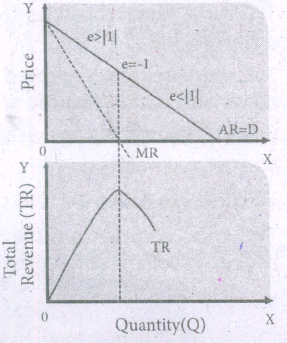
At the output range of 5 to 6 units, the price elasticity of demand is equal to one. Hence TR is maximum and MR equals to zero.
At the output range of 6 units to 10 units, the price elasticity of demand is less than unity. Hence TR is decreasing and MR is negative.
45.
Law of Supply: Law of Supply describes a direct relation between price of a good and the supply of that good.
Definition: The Law of Supply can be stated as:
Other things remaining the same, if the price of a commodity increases its quantity supplied increases and if the price of a commodity decreases, quantity supplied also decreases".
Supply Function: Mathematically the supply function is,
Qs = f (Px' PI' Pf, T, O, E)
Px = Price of x Commodity
Pr = Price of related goods
Pf = Price of factors of production
T = Technology
O = Objective of the producer
E = Expected Price of the commodity.
Assumptions:
i. There is no change in the prices of factors of production
ii. There is no change in price of capital goods.
iii. Natural resources and their availability remain the same.
iv. Prices of substitutes are constant.
v. There is no change in technology.
vi. Climate remains unchanged.
vii. There is no change in tax policy.
Supply schedule: A supply schedule shows the different quantities of supply at different prices. This information is given in the supply schedule given below.
| Price and Supply | |
| Price (P) | Supply (Qs) |
| 1 | 20 |
| 2 | 40 |
| 3 | 60 |
| 4 | 80 |
| 5 | 100 |
Qs = 20P
Supply curve: Supply curve represents the data given in the supply schedule. As the price of the commodity increases, the quantum supplied of the The Iso-Cost commodity also increases. Thus the supply curve has a positive slope from left to right.
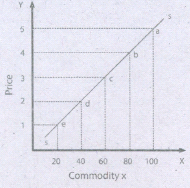
i) The Quantum supplied of commodity x is represented on X axis.
ii) The price of the commodity is represented on the y-axis.
iii) The points such as e, d, c, b and a on the supply curve "SS" represent various quantities at different prices.
46.
a) Leather
Tamil Nadu accounts for 30 per cent of leather exports and about 70 per cent of leather production in the country. Hundreds of leather and tannery industries are located around Vellore, Dindigul and Erode. Every year the State hosts the India International Leather Fair in Chennai.
b) Electronics
Chennai has emerged as EMS Hub of India. Many multi - national companies have chosen Chennai as their South Asian manufacturing hub.
c) Auto motives
Chennai nicknamed as "The Detroit of Asia" is home to a large number of auto component industries. Tamil Nadu has 28% share each in automotive and auto components industries, 19% in the trucks segment and 18% each in passenger cars and two wheelers.
47.
1. \(\frac{dc}{dx}\) = 0 Where C is a constant (Read differentiation of 'C' with respect to 'x' is)
2. \(\frac { d\left( x^{ n } \right) }{ dx } =nx^{ n-1 }\)
3. \(\frac { d\left( x \right) }{ dx } =1x^{ 1-1 }=1x^{ 0 }=1\)
4. \(\frac { d\left( u+v \right) }{ dx } =\frac { du }{ dx } +\frac { dv }{ dx } \)
5. \(\frac { d\left( u-v \right) }{ dx } =\frac { du }{ dx } -\frac { dv }{ dx } \)
48.
The matrix form of the given equation is written as
\(\begin{bmatrix} 7 & -1 & -1 \\ 10 & -2 & +1 \\ 6 & 3 & -2 \end{bmatrix}\left[ \begin{matrix} { x }_{ 1 } \\ { x }_{ 2 } \\ { x }_{ 3 } \end{matrix} \right]\)\(=\begin{bmatrix} 0\\ 8\\ 7\\ \end{bmatrix}\)
\(\Delta\)=\(\begin{vmatrix} 7& -1& -1\\ 10& -2& +1\\ 6& 3& -2\\ \end{vmatrix}\)
=7(4-3)-(-1)(-20-6)+(-1)(30+12)
=7(1)+1(-26)-1(42)
=7 - 26 - 42 = - 61
\(\triangle \)x1 \(=\begin{bmatrix} 0 & -1 & -1 \\ 8 & -2 & +1 \\ 7 & 3 & -2 \end{bmatrix}\)
=0(4-3)-(-1)(-16-7)+(-1)(24+14)
=0+1(-23)-1(38)
=-23-38 = - 61
\(\Delta x_2=\begin{vmatrix} 7& 0& -1\\ 10& 8& 1\\ 6& 7& -2\\ \end{vmatrix}\)
=7(-16 - 7) - (0)(-20 - 6)+(-1)(70 - 48)
=7(-23)+0 - 1 (22)
=-161 - 22 = -183
\(\triangle \)x3 \(=\begin{bmatrix} 7 & -1 & 0 \\ 10 & -2 & 8 \\ 6 &3 & 7 \end{bmatrix}\)
=7(-14-24)-(-1)(70-48)+0(30+12)
=7(-38)+1(22)+0(42)
=-266+22+0
\(\triangle \)x1 = - 244
\(x_{1}=\frac{\Delta x_{1}}{\Delta}=\frac{-61}{-61}=1\)
\(x_{2}=\frac{\Delta x_{2}}{\Delta}=\frac{-183}{-61}=3\)
\(x_{3}=\frac{\Delta x_{3}}{\Delta}=\frac{-244}{-61}=4\)
49.
Introduction:
(i) The law of diminishing marginal utility was extended and is called Law of Equi-marginal utility
(ii) Law of substitution or Law of consumer's Equilibrium or Gossen's II law or law of maximum satisfaction.
Definition:
Marshall, "If a person has a thing which he can put to several uses, he will distribute it among these uses in such a way that it has the same marginal utility in all. For, if it had a greater marginal utility in one use than another, he would gain by taking away some of it from the second use and applying it to first.
Assumption
(i) Consumer is rational and wants maximum satisfaction.
(ii) Utility is measurable in cardinal numbers.
(iii) Marginal utility of money is constant.
(iv) Income of the consumer is given.
(v) There is perfect competition.
(vi) Price is given.
(vii) Law of diminishing marginal utility operates
Explanation:
(i) The consumer has Rs. 11.
(ii) He wants to spend it on apple ( Rs 1 each) and orange (Rs. 1 each)
(iii) He will be in equilibrium only when he gets maximum satisfaction ie.
\(\mathrm{K}=\frac{\text { Marginal utility of apple }}{\text { Price of apple }}=\frac{\text { Marginal utility of orange }}{\text { Price of orange }}\)
If is \(\frac{\mathrm{MU_A}}{\mathrm{P_A}}\) less than \(\frac{\mathrm{MU_O}}{\mathrm{P_O}}\) he would transfer money from apple to orange till it is equal.
He should buy 6 units of apple & 5 units of oranges. He gets (92 + 58) = 150 units satisfaction.
\(\frac{\mathrm{MU_A}}{\mathrm{P_A}}=\frac{\mathrm{MU_O}}{\mathrm{P_O}}=\frac{4}{1}=\frac{4}{1}\)
| Apple | orange | |||
| Units of Commodities | Total Utility | marginal Utility | Total Utility | marginal Utility |
| 1 | 25 | 25 | 30 | 30 |
| 2 | 45 | 20 | 41 | 11 |
| 3 | 63 | 18 | 49 | 8 |
| 4 | 78 | 15 | 54 | 5 |
| 5 | 88 | 10 | 58 | 4 |
| 6 | 92 | 4 | 61 | 3 |
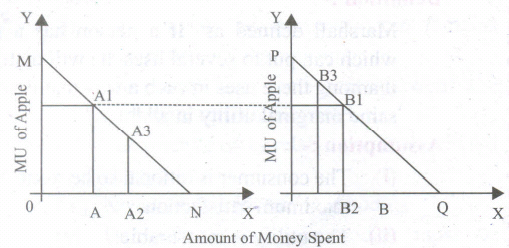
Explanation:
(i) X axis shows amount of money spent
(ii) Y axis shows marginal utility of apple and orange.
(iii) If consumer spends Rs.6 on apple and Rs.5 on orange MU will be equal.
(iv) ie. AA1 = BB1 = 4 = 4. So he gets maximum utility.
Criticisms:
(i) Utility cannot be measured.
(ii) No consumer compares the utility and disutility from each unit of the commodity while buying it.
(iii) This law cannot be applied to durable goods.
Conclusion:
(i) The law of Equi-marginal utility is an improvement over the law of diminishing marginal utility because it can be used for many commodities consumed at the same time.
50.
Introduction:
(i) In 1601 the East India Company entered India.
(ii) In 1614 Sir Thomas Roe set up factories in India with permission from Jahangir.
(iii) Hundred years after Battle of Plassey, the rule of the East India Company came to an end in 1858.
(iv) Britain exploited India for two centuries.
Period of Merchant Capital:
(i) This period was from 1757 to 1813.
(ii) The only aim of the East India Company was profit. India's riches was used to develop industrial capitalism of Britain.
(iii) The officers of the company were unscrupulous and corrupt.
Period of Industrial Capital:
(i) This period was from 1813 to 1858. India became a market for British textiles.
(ii) Raw materials were exported to England at low price.
(iii) India's traditional handicrafts started declining.
Period of Finance Capital:
(i) This period was from the end of the 19th Century till Independence.
(ii) Britain invested in railroad, postal system and limited field of education in India by plundering Indian Capital.
(iii) Indian taxpayers were compelled to finance for the construction of railways.
Decline of Indian handicrafts:
(i) Through discriminatory tariff policy the British Government purposefully destroyed the handicrafts.
(ii) With the disappearance of nawabs and kings, there was no one to protect the handicrafts.
(iii) Indian handicrafts could not compete with the machine-made products.
(iv) The introduction of railways increased the domestic market for the British goods.
Conclusion:
(i) Before the advent of the British, India was self sufficient.
(ii) Under the British rule only industries were allowed to develop.
(iii) This brought down the economic condition of the Indians.
51.
Introduction:
Rural indebtedness refers to the situation where the rural people are unable to repay the loan accumulated over a period.
Causes:
Poverty of farmers:
The vicious circle of poverty forces the farmers to borrow for consumption, cultivation and celebrations. Poverty, debt and high rates of interest hold the farmer in the grip of money lenders.
Failure of monsoon:
So it is difficult to identify good years to repay their debts.
Litigation:
(i) Due to land disputes, litigation in the court compels them to borrow heavily
(ii) Being uneducated and ignorant they are caught in the litigation process and lose their savings.
Money lenders-high interest rate:
The rate of interest charged by the local money lenders is very high and the compounding of interest leads to indebtedness of the farmer.
52.
| Wealth | Welfare | Scarcity | Growth |
| Adam Smith classical era. |
Alfred Marshall- neo classical era. |
Lionel Robbins new age. |
Paul Samuelson modern age. |
| An Inquiry into nature and causes of Wealth of Nations (1776). |
Principles of |
An Essay on the nature and Significance of Economic Science (1932). |
Economics studies how men and society choose with or without the use of money, to employ scarce productive resources which could have alternative uses, to produce various commodities over time and distribute them for consumption now and in the future among various people and groups of society. |
| Economics is the science of wealth. | Economics is a study of mankind in the ordinary business of life, it examines that part of individual and social action which is most closely connected with the attainment and with the use of material requisites of well being. It studies wealth and man. |
Economics is a science which studies human behaviour as a relationship between ends and scarce means which have alternative uses. |
Economics deals with how the society uses the limited resources for alternative uses. |
| Deals with only the goods which are scarce and have money value |
wealth and welfare of man is important. | Human behaviour regarding choice is important. |
It covers production, distribution and consumption. |
| Deals with consumption, production, exchange, distribution of wealth. |
Only material welfare is considered, differentiates between material and immaterial things. |
Economic problem arises because of scarcity of resources. |
Economics is a social science. |
| By introducing welfare, economics becomes inexact. |
Ethical aspects are not considered so Economics is exact |
||
| Welfare definition makes Economics classificatory. | Economics is a positive science. |
||
| Economics is a science of individual behaviour. |
|||
| Both material and immaterial activities are considered. |
53.
Introduction:
E.H. Chamberlin introduced the concept of monopolistic competition.
(i) Firm under monopolistic competition has equilibrium when MC = MR & when MC cuts MR from below.
(ii) The AR curve slopes downward and is fairly elastic.
(iii) Different firms produce different varieties of the product and sell them at different prices.
Each firm seeks to get equilibrium with regard to
1) price & output 2) product adjustment 3) selling cost adjustment
Short run equilibrium
.JPG)
In fig (a) OM is the equilibrium output. OP is the price.
TR = OMQP, TC = OMRS, Abnormal Profit = PQRS
In fig (b) TR = OMQP, TC = OMLR, Loss = PQLR
Long run equilibrium:
.JPG)
(i) In short run the firm may earn super normal profit or incur loss.
(ii) In the long run the AR is more elastic.
(iii) The firms earn only normal profit.
(iv) Equilibrium output = OM. Price = OP, AR = QM, AC = QM.
(v) Equilibrium is got when AR = AC. AR is tangent to AC at Q.

11th Standard Syllabus & Materials
11th Standard
TN 11th Tamil பீடு பெற நில் - செய்யுள் - காவடிச்சிந்து Important Questions And Answers Study Material - QB365 Set A
NEW11th Standard
TN 11th Tamil பீடு பெற நில் - உரைநடை - மலை இடப்பெயர்கள் : ஓர் ஆய்வு Important Questions And Answers Study Material - QB365 Set A
NEW11th Standard
TN 11th Tamil மாமழை போற்றுதும் - துணைப்பாடம் - யானை டாக்டர் Important Questions And Answers Study Material - QB365 Set A
NEW11th Standard
TN 11th Tamil மாமழை போற்றுதும் - செய்யுள் - ஐங்குறுநூறு Important Questions And Answers Study Material - QB365 Set A



Tamilnadu Stateboard 11th Standard Subjects

Maths

Commerce
Economics

Biology

Business Maths and Statistics

Accountancy

Computer Science

Physics

Chemistry
Maths
Biology
Economics
Physics
Chemistry

History
Business Maths and Statistics

Computer Science
Accountancy

Computer Applications
History
Computer Technology
Commerce
Computer Applications
Computer Technology

Tamil

English

French
Tamilnadu Stateboard Standards
