
 100% FREE ACCESS
11th Standard Syllabus & Materials
11th Standard
TN 11th Tamil இயற்கை வேளாண்மை,சுற்றுச்சூழல் -செய்யுள் - மனோன்மணீயம் Important Questions And Answers Study Material - QB365 Set A
NEW11th Standard
TN 11th Tamil என்னுயிர் என்பேன் -துணைப்பாடம் - இசைத்தமிழர் இருவர் Important Questions And Answers Study Material - QB365 Set A
NEW11th Standard
TN 11th Tamil மொழி கலை -செய்யுள் - ஒவ்வொரு புல்லையும் Important Questions And Answers Study Material - QB365 Set A
NEW11th Standard
TN 11th Tamil பீடு பெற நில் - இலக்கணம் - பகுபத உறுப்புகள் Important Questions And Answers Study Material - QB365 Set A
NEW11th Standard
TN 11th Tamil பீடு பெற நில் - துணைப்பாடம் - வாடிவாசல் Important Questions And Answers Study Material - QB365 Set A
NEW11th Standard
TN 11th Tamil பீடு பெற நில் - செய்யுள் - குறுந்தொகை Important Questions And Answers Study Material - QB365 Set A

Published on: 19/02/2019
+1 Second Revision Test Answer
Download Tamil Nadu 11th Standard Economics question papers, model tests, one-mark questions, important questions, and public exam papers in PDF format. Free study materials and answer keys for TN State Board students.
Questions + Answers key
Take MCQ Economics Test
1.
CENVAT stands for________________.
Common Entity Value Added Tax
Corporate Entities Value Added Tax
Central Value Added Tax
None of these
2.
Economics according to the Lionel Robbins is a___________ science.
normative
applied
positive
experimental
3.
People to hold cash for the current transaction (or) day-to-day expenses.
Speculative Motive
Precautionary Motive
Both
Transaction Motive
4.
__________________Port handles all the Coal and Ore traffic in Tamil Nadu.
Ennore
Nagapattinam
Tuticorin
Chennai
5.
Mahalwari System was introduced in ______
1820
1800
1993
1793
6.
Human wants are classified into
Necessaries and luxuries
Luxuries and comforts
Necessaries and comforts
Necessaries and luxuries
7.
Pick the odd one out
Luxuries
Comforts
Necessaries
Agricultural goods
8.
__________ is the other name given for factor of production.
Inputs
Outputs
Exertion
Formation
9.
_______ is also called as international price discrimination.
Oligopoly
Dumping
Duopoly
Monopoly
10.
Identify the year in which National Rural Health Mission was launched.
2000
2005
2010
2015
11.
First World War started in the year
1914
1814
1941
1841
12.
State of rest is a point termed as
Equilibrium
Non-Equilibrium
Minimum point
Maximum point
13.
In monopoly, MR curve lies below ____________
TR
MC
AR
AC
14.
Which of the following is wrongly matched?
Gateway of Tamil Nadu - Thoothukudi
Home textile city - Erode
Steel city - Salem
Pump city - Coimbatore
15.
The short-run production is studied through
The Law of Returns to scale
The Law of Variable Proportions
Iso-quants
Law of Demand
16.
Marginal revenue is the addition made to the
total sales
total revenue
total production
total cost
17.
The Arguments against LPG relate to ________
Economic growth
More investment
Disparities among people and regions
Modernization
18.
The basic problem studied in Economics is
Unlimited wants
Unlimited means
Scarcity
Strategy to meet all our wants
19.
The position of Indian Economy among the other strongest economies in the world is ______
Fourth
Seventh
Fifth
Tenth
20.
Theory of distribution is popularly known as,
Theory of product-pricing
Theory of factor-pricing
Theory of wages
Theory of interest
21.
Integrate: \(\int { 4{ x }^{ 3 } } dx\)
22.
Write a note on population in Tamil Nadu.
23.
Define Density of Population?
24.
What is land?
25.
26.
State the features that distinguish a land tenure system from other system.
27.
Define open unemployment.
28.
Name any two types of utility.
29.
Give the definition for 'Real cost'.
30.
Trace the development of Health care in India.
31.
Explain the different types of Elasticity of Demand.
32.
Explain Microsoft office Excel?
33.
Explain SEZ?
34.
What are the important features of monopolistic competition?
35.
Give a note on Twelfth Five Year Plan.
36.
Bring out the relationship among Total, Average and Marginal Products.
37.
Distinguish between rent and quasi-rent.
38.
39.
State the relationship between AC and MC.
40.
Mr. Sivanesan purchased 5 apples, 6' mangoes and 10 bananas. Mr Subbu purchased 6 apples, 8 mangoes and 15 bananas. Mr. Rajan purchased 2 apples, 2 mangoes and 8 bananas. They spent Rs.100, Rs.130 and Rs.46 respectively. Find the price of an apple, a mango and a banana.
41.
Explain the contribution of Amartya Kumar Sen towards the Economic development.
42.
What are the different kinds of profit?
43.
Explain the different methods of Economics and their steps.
44.
Explain briefly total cost with a suitable diagram.
45.
Explain briefly the Iso-cost Line with the help of a diagram?
46.
47.
48.
Explain about Banking network in Tamil Nadu.
49.
Explain about Agrarian Crisis after reforms.
50.
51.
Analyse the causes for Rural Indebtedness.
52.
53.
Explain how price and output are determined under monopolistic competition with help of a diagram.
1.
(c)
Central Value Added Tax
2.
(c)
positive
3.
(d)
Transaction Motive
4.
(a)
Ennore
5.
(d)
1793
6.
(d)
Necessaries and luxuries
7.
(d)
Agricultural goods
8.
(a)
Inputs
9.
(b)
Dumping
10.
(b)
2005
11.
(a)
1914
12.
(a)
Equilibrium
13.
(c)
AR
14.
(b)
Home textile city - Erode
15.
(b)
The Law of Variable Proportions
16.
(b)
total revenue
17.
(c)
Disparities among people and regions
18.
(c)
Scarcity
19.
(b)
Seventh
20.
(b)
Theory of factor-pricing
21.
\(\int { 4{x }^{ 3 } } dx=4\int { { x }^{ 3 } } dx\)
\(=4\frac { { x }^{ 3+1 } }{ 3+1 } +c=4\frac { { x }^{ 4 } }{ 4 } +c={ x }^{ 4 }+c\)
22.
Tamil Nadu stands sixth in population with 7.21 crore against India's 121 crores as per 2011 census. However Tamil Nadu's population is higher than that of several countries according to U.N. Report.
23.
It refers to the average number of persons residing per square kilometre. It represents the man-land ratio.
24.
Land as a factor of production refers to all those natural resources or gifts of nature which are provided free to man It includes within itself several things such as land surface air, water, minerals, forests, rivers, lakes, seas, mountains climate and weather. Thus, "Land" includes all things that are not made by man.
25.
26.
Who owns the land; Who cultivates the land; Who is responsible for paying the land revenue to the government.
27.
(i) Open unemployment is found among agricultural labourers, rural artisans and literate persons.
(ii) Here the unemployed people are identified as they remain without work.
28.
(i) Form utility
(ii) Time utility
(iii) Place utility
(iv) Service utility
(v) Possession utility
(vi) Knowledge utility
29.
It is the payment made for the efforts, pain and sacrifices of all factor owners in production.
30.
(a) Health in India:
(i) Health in India is a state government responsibility. The Central Council Of Health and Welfare formulates the various health care projects and health department reform policies.
(ii) The administration of health industry in India as well as the technical needs of the health sector are the responsibility of the Ministry Of Health And Welfare.
(iii) Health care in India has many forms. These are the ayurvedic medicine practice, Unani or galenic herbal care, homeopathy, allopathy, yoga, and many more. Each different healthcare form has its own treatment system and practice patterns.
(iv) The medical practicing in India needs a proper licensing from the Ministry of Health. All. medical systems are now under one ministry viz AYUSH.
(b) Health Care Services in India:
(i) The health care services in India are mainly the responsibility of the Ministry of Health. State wise, health status is better in Kerala as compared to other States. Compared to other developed countries, India's health status is not satisfactory. India's health status is poor compared to Sri Lanka.
31.
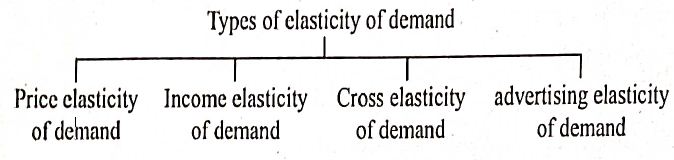
Different types of Elasticity of Demand :
Price Elasticity of Demand
Price elasticity of demand is commonly known as elasticity of demand. This is because price is the most influential factor affecting demand. "Elasticity of demand measures the responsiveness of the quantity demanded to changes in the price".
(1) Price Elasticity of Demand: The price elasticity of demand; commonly known as the elasticity of demand refers to the responsiveness and sensitiveness of demand for a product to the changes in its price. In other words, the price elasticity of demand is equal to
\({ E }_{ p }=\frac { Proportionate \ change \ in \ quantity \ demanded }{ Proportionate \ change \ in \ price } \)
Numerically,
\({ E }_{ p }=\frac { \triangle Q }{ \triangle P } \times \frac { P }{ Q } \)
Where, \(\triangle Q={ Q }_{ 1 }-{ Q }_{ 0 },\triangle P={ P }_{ 1 }-{ P }_{ 0 },Q1\)=New quantity,
\({ Q }_{ 0 }\)=Original quantity, \({ P }_{ 1 }\)=New price, \({ P }_{ 0 }\)=Original price.
(2) Income 'Elasticity of Demand: The income is also a factor that influences the demand for a product. Hence, the degree of responsiveness of a change in demand for a product due to the change in the income is known as income elasticity of demand. , The formula to compute the income elasticity of demand is:
\({ E }_{ Y }=\frac { Proportionate\ change\ in\ quantity\ Demanded\ for\ a\ product }{ Proportionate\ change\ in\ Income } \)
For most of the goods, the income elasticity of demand is greater than one indicating that with the change in income the demand will also change and that too in the same direction, i.e. more income means more demand and vice-versa.
(3) Cross Elasticity of Demand The cross elasticity of demand refers to the percentage change in quantity demanded for one commodity as a result of a small change in the price of another commodity. This type of elasticity usually arises in the case of the interrelated goods such as substitutes and complementary goods. The cross elasticity of demand for goods X and Y can be expressed as:
\({ E }_{ C }=\frac { Proportionate\ change\ in\ Demanded\ of\ commodity\ X }{ Proportionate\ change\ in\ price\ of\ commodity\ Y } \)
(4) Advertising Elasticity of Demand: The responsiveness of the change in demand due to the change in advertising or other promotional expenses, is known as advertising 'elasticity-of demand. It can be expressed as:
\({ E }_{ a }=\frac { Proportionate\ change\ in\ Demand }{ Proportionate\ change\ in\ Advertising\ Expenditure } \)
32.
It is used in data analysis by using formula. A spread sheet is a large sheet of paper which contains rows and columns. The intersection of rows and columns is termed as 'cell'. MS Excel 2007 version supports up to 1 million rows and 16 thousand columns per work sheet.
33.
It is an area in which business and trade laws are different from rest of the country mainly aiming at increasing trade, investment and job creation.
34.
(i) Large number of buyers and sellers.
(ii) They are price makers. They set their own prices.
(iii) Firms produce differentiate products.
(iv) Free entry and exit.
(v) It follows an independent price policy.
(vi) Non-price competition is essential.
(vii) Expenditure on sale promotion of their products.
35.
(i) Twelfth Five Year Plan period was 2012 - 2017.
(ii) Its main theme is "Faster, more inclusive and sustainable growth".
(iii) Its growth rate target is 8%.
36.
Relationship among Total, Average and Marginal Products.
| Stages | Total Product | Marginal Product | Average Product |
| Stage - I | It increases at an increasing rate. Then it increases at a decreasing rate. This is the point of inflexion. | It increases, reaches maximum and starts to decrease. | It increases, reaches maximum. |
| Stage - II | It continues to increase at a diminishing rate and reaches maximum | It continues to diminish and becomes zero. | It is equal to MP then begins to diminish. |
| Stage - III | It diminishes. | It becomes negative. | It diminishes but always greater than zero (positive) |
37.
| SI.No | Rent | Quasi Rent |
|---|---|---|
| 1 | Rent accrues to land | Quasi - Rent accrues to man made appliances |
| 2 | The supply of land is fixed forever. | The supply of man made appliances is fixed for a short period only. |
| 3 | It enters into price. | It does not enter into price. |
| 4 | It is temporary. |
38.
39.
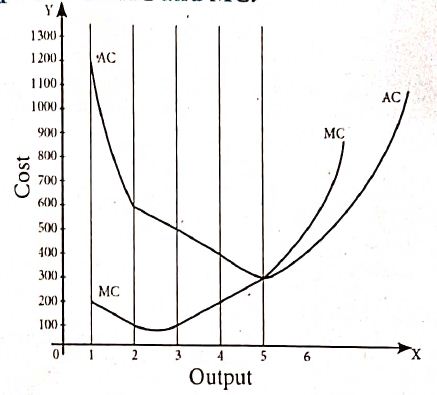
When AC is falling, MC remains below AC.
When AC becomes constant MC becomes equal to it.
When AC starts increasing MC is above the AC
MC always cuts AC at its minimum point from below.
40.
In equations:
5x + 6y + 10z = 100
6:t + 8y + 15z = 130,
2x + 2y + 8z = 46
In matrix form
\(\left[ \begin{matrix} 5 & 6 & 10 \\ 6 & 8 & 15 \\ 2 & 2 & 8 \end{matrix} \right] \left[ \begin{matrix} x \\ x \\ x \end{matrix} \right] =\left[ \begin{matrix} 100 \\ 130 \\ 46 \end{matrix} \right] \)
\( \triangle =5\left| \begin{matrix} 8 & 15 \\ 2 & 8 \end{matrix} \right| -6\left| \begin{matrix} 6 & 15 \\ 2 & 8 \end{matrix} \right| +10\left| \begin{matrix} 6 & 8 \\ 2 & 2 \end{matrix} \right| \)
= 5(64 - 30) - 6(48 - 30) + 10(12 - 16)
= 170 - 108 - 40
=22
To find \(\triangle\)x
\({ \triangle }_{ x }=\left| \begin{matrix} 100 & 6 & 10 \\ 130 & 8 & 15 \\ 46 & 2 & 8 \end{matrix} \right| \\ \)
\(\triangle\)x= 100(64 - 30) - 6(1040 - 690) + 10(260 - 368) x
= 100(34) - 6(350) + 10(-108)
= 3400 - 2100 - 1080 = 220
To find \(\triangle\)y
\({ \triangle }_{ y }=\left| \begin{matrix} 5 & 100 & 10 \\ 6 & 130 & 15 \\ 2 & 46 & 8 \end{matrix} \right| \)
\(=5\left| \begin{matrix} 130 & 15 \\ 46 & 8 \end{matrix} \right| -100\left| \begin{matrix} 6 & 15 \\ 2 & 8 \end{matrix} \right| +10\left| \begin{matrix} 6 & 130 \\ 2 & 46 \end{matrix} \right| \)
=5(1040 - 690) - 100 (48 - 30) + 10(276 - 260)
= 5(350) - 100(l8) + 10(16)
= 1750 - 1800 + 160 = 110
To find \(\triangle\)z
\({ \triangle }_{ z }=\left| \begin{matrix} 5 & 6 & 100 \\ 6 & 8 & 130 \\ 2 & 2 & 46 \end{matrix} \right| \)
\({ \triangle }_{ z }=5\left| \begin{matrix} 8 & 130 \\ 2 & 46 \end{matrix} \right| -6\left| \begin{matrix} 6 & 130 \\ 2 & 46 \end{matrix} \right| +100\left| \begin{matrix} 6 & 8 \\ 2 & 2 \end{matrix} \right| \)
\(x=\frac { 220 }{ 22 } =10\) (cost of apple Rs.10)
\(y=\frac { 110 }{ 22 } =5\) (cost of Mango Rs.5)
\(z=\frac { 44 }{ 22 } =2\) (cost of Banana Rs.2)
41.
Contribution of Amartya Kumar Sen:
The Nobel citation refers to Sen's contributions to social choice theory, development economics, study on poverty and famines and concept of entitlements and capability development (1998).
(1) Poverty and Famines:
Sen's Poverty and Famines: An Essay on Entitlement and Deprivation" (1981) is both a theoretical and an applied work. In the book, several famines have been studied in the working of a general theoretical framework from an original angle. He examined various meanings of poverty and drew attention to the incidence of absolute and relative deprivation.
(2) Poverty and Inequality:
Sen has carried out massive work on poverty and inequality in India. Sen's major point has been that the distribution of income/ consumption among the persons below the poverty line is to be taken into account.
(3) The Concept of Capability:
The concept of capabilities developed by Sen has been cited as a better index of wellbeing than commodities or utilities. Capability, as defined by Sen, is the ability to transform Rawlsian primary goods to the achievement of well being.
(4) Entitlement:
Sen has included the concept of entitlement items like nutrition, food, medical and health care, employment, security of food supply in times of famine etc. He considered famine as arising out of the failure of establishing a system of entitlements.
(5) Choice of Technique:
Sen's 'Choice of Technique' was a research work where he argued that in a labour surplus economy, generation of employment cannot be increased at the initial stage by the adaptation of capital-intensive technique. Conclusively, Amartya Sen, more than just an economist, is an ethical philosopher. He is a lover of freedom and a humanist. He has focussed on the poor, viewing them not as objects of pity requiring charitable hand-outs, but as disempowered folk needing empowerment, education, health, nutrition, gender equality, safety net in times of distress; all are needed to empower people.
42.
Kinds of profit:
(i) Monopoly Profit: Profit earned by the firm because of its monopoly control.
(ii) Windfall Profit: Some times, profit arises due to changes in price level. Profit is due to unforeseen factors.
(iii) Profit as functional reward: Just like rent, wage and interest, profit is earned by the entrepreneur for his entrepreneurial function.
43.
Methods of Economics:
Deduction and Induction Like any other science, Economics also has its laws or generalisations. These laws govern the activities in the various divisions of Economics such. as Consumption, Production, Exchange and Distribution. The logical process of arriving at a law or generalization in a science is called its method.
Economics uses two methods: deduction and induction.
(a) Deductive Method of Economic Analysis
(i) It is also named as analytical or abstract method. It consists in deriving conclusions from general truths
(ii) It takes few general principles and applies them to draw conclusions. The classical and' neo-classical school of economists notably, Ricardo, Senior, JS Mill, Malthus, Marshall, Pigou, applied the deductive method in their economic investigations.
Steps of Deductive Method
Step 1: The analyst must have a clear and precise idea of the problem to be inquired into.
Step 2: The analyst clearly defines the technical terms used in the analysis. Further, assumptions of the theory are to be precise.
step 3: Deduce hypothesis from the assumptions taken.
step 4: Hypotheses should be verified through direct observation of events in the real world and through statistical methods. (e.g) There exists an inverse relationship. between price and quantity demanded of a good.
(b) Inductive Method of Economic Analysis
(i) Inductive method, also called empirical method, is adopted by the "Historical School of Economists".
(ii) It involves the process of reasoning from particular facts to general principle. Economic generalizations are derived in this method, on the basis of
(i) Experimentations;
(ii) Observations; and
(iii) Statistical methods.
Step 1: Data are collected about a certain economic phenomenon. These are systematically arranged and the general conclusions are drawn from them.
step 2: By observing the data, conclusions are easily drawn.
step 3: Generalization of the data and then Hypothesis Formulation
step 4: Verification of the hypothesis (eg. Engel's law).
Economists today are of the view that both these methods are complementary. Alfred Marshall has rightly remarked: "Inductive and Deductive methods are both needed for scientific thought, as the right and left foot are both needed for walking".
44.
Total Cost:
Total cost means the sum total of all payments made in the production. It is also called as total cost of production.
TC = TFC + TYC
For example, when the total fixed cost is Rs.1000 and the total variable cost is Rs. 200 then the total cost is Rs.1200 (Rs.1000 + Rs.200)
IF TFC = 12 and
TYC = Q3 -18Q2 + 91Q
TC = 12 + Q3 - 18Q2 + 91Q
| Output (in unit) |
Total Fixed Cost (TFC) (in Rs) |
Total Variable Cost (TVC) (in Rs) |
Total Cost (TC) TFC+TVC (in Rs) |
| 0 | 1000 | 0 | 1000 |
| 1 | 1000 | 200 | 1200 |
| 2 | 1000 | 300 | 1300 |
| 3 | 1000 | 400 | 1400 |
| 4 | 1000 | 500 | 1500 |
| 5 | 1000 | 600 | 1600 |
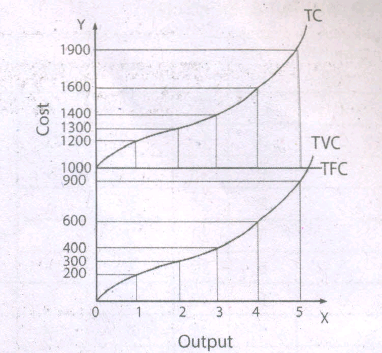
It is to be noted that,
a) The TC curve is obtained by adding TFC + TVC curves vertically.
b) TFC curve remains parallel to x-axis indicating a straight line.
c) TVC starts from the organ and move upwards as no variable cost is incurred at zero output.
d) When TFC + TVC are added, TC starts from TFC and move upwards.
e) TC curve lies above the TVC curve.
f) TVC and TC curves are the same shapes but beginning point is different.
45.
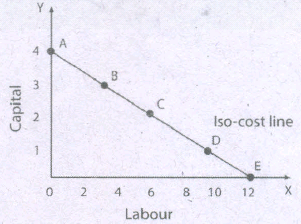
The Iso-cost line: The iso-cost line is an important component in analysing producer's behaviour. The iso-cost line represents different combinations of inputs which shows the same amount of cost. The iso-cost line gives information on factor prices and financial resources of the firm. It is otherwise called as "lso-price line" or "iso-income line" or "iso-expenditure line" or "total outlay curve".
Suppose that a producer has a total budget of H2O and for producing a certain level of output, he has to spend this amount on two factors Labour (L) and Capital (K). Prices of factors K is no and L is HO. Iso Cost Curve can be drawn by using the following hypothetical table.
| The Iso-Cost | |||
| Combination | Units of Capital Price = Rs 30 | Units of Labour Price = Rs 10 | Total Expenditure( in Rupees) |
| A | 4 | 0 | 120 |
| B | 3 | 3 | 120 |
| C | 2 | 6 | 120 |
| D | 1 | 9 | 120 |
| E | 0 | 12 | 120 |
As shown in Table, there are five combinations of capital and labour such as combination A represents 4 units of capital and zero units of labour and this combination costs Rs 120.
Similarly other combinations (B, C, D and E) cost same amount of rupees (Rs 120).
Symbolically,
4K + OL = Rs.120
3K + 3 = Rs.120
2K + 6L = Rs.120
lK + 9L = Rs.120, and
OK + 12L = Rs.120.
Thus, all the combinations A, B, C, D and E cost the same total expenditure.
From the figure it is shown that the costs to be incurred on capital and labour are represented by the triangle OAE. The line AE is called as Iso-cost line.
46.
.JPG)
47.
48.
(i) There was a steady increase in the number of bank branches in the state from 7,253 in 2011 - 12 to 10,321 in 2017.
(ii) Of the total bank branches in the state, nationalized banks, alone accounted for a large share of 55%.
(iii) Scheduled Commercial banks (26%), State Bank of India associates 14%, Regional Rural banks - 4% and remaining being Foreign banks.
(iv) Tamil Nadu housed 7.5% of the total number of banks in the country.
(v) The short term and medium term co-operative banks have three tiers.
State-co-operative Bank at
The state level (SCB)
↓
District Central Co-operative Bank at
The district level (DCCB)
↓
Primary Agricultural Co-operative bank at
The Village level (PACB)
(vi) The long term co-operative banks have two tier structure. They are,
Central Land Development Bank
(State level)
↓
Primary Land Development Bank
(Block level)
49.
(a) High Input Costs:
(i) The biggest input for farmers is seeds. Before liberalisation, farmers across the country had access to seeds from the state government institutions.
(ii) The institutions produced own seeds and were responsible for their quality and price.
(iii) With liberalization, India's seed market was opened up to global agribusiness. Also, following the deregulation many state government institutions were closed down in 2003.
(iv) These hit farmers doubly hard.
(v) Seed prices shot up, and fake seeds made an appearance in a big way.
(b) Cutback in agricultural subsidies:
Liberalisation policies reduced pesticide and fertilizer subsidy and so fertilizer prices have increased by 300% and electricity tariffs have been also increased.
(c) Reduction of import Duties:
(i) With a view to open India's market, the liberalisation reforms also withdrew tariffs and duties on imports, which protect and encourage domestic industry.
(ii) By 2001 India completely removed restrictions on imports of almost 1,500 items including food
(iii) As a result, cheap imports flooded the market, pushing prices of crops like cotton and pepper down.
(d) Paucity of credit facilities:
(i) After 1991 the lending pattern of commercial banks, including nationalised banks drastically changed.
(ii) This has forced the farmers to rely on moneylenders who charge exorbitant rate of interest.
50.
The concept of economic planning in India was the limited natural resources are utilized skillfully so as to achieve the desired goals.
(i) First Five Year Plan (1951 - 1956) :
Agriculture development of the country.
(ii) Second Five Year Plan (1956 - 1961) :
Industrial Development of the country.
(iii) Third Five Year Plan (1961 - 1966) :
To make the economy independent and to reach self active position to take off.
(iv) Fourth Five Year Plan (1969 - 1974) :
The two main objectives of this plan growth with stability and progressive achievement of self reliance.
(v) Fifth Five year Plan (1974 - 1979) :
In this plan top priority was given to agriculture, next cement industry and mines.
(vi) Sixth Five Year Plan (1980 - 1985) :
Poverty eradication and technological self reliance was the main objective of this plan.
(vii) Seventh Five Year Plan (1986 - 1991) :
The establishment of the self sufficient economy opportunities for productive employment.
(viii) Eighth Five Year Plan (1992 - 1997) :
The top priority was given to development of human resources, employment, education and public health.
(ix) Ninth Five Year Plan (1997 - 2002) :
The main focus of this plan growth with justice and equity
(x) Tenth Five Year Plan (2002- 2007) :
To double the per capita income of India next 10 years.
(xi) Eleventh Five Year Plan (2007 - 2012) :
"Faster and more inclusive growth was the main aim of this plan"
(xii) Twelfth Five Year Plan (2012 - 2017) :
Its main aim is "Faster, more inclusive and sustainable growth".
51.
Introduction:
Rural indebtedness refers to the situation where the rural people are unable to repay the loan accumulated over a period.
Causes:
Poverty of farmers:
The vicious circle of poverty forces the farmers to borrow for consumption, cultivation and celebrations. Poverty, debt and high rates of interest hold the farmer in the grip of money lenders.
Failure of monsoon:
So it is difficult to identify good years to repay their debts.
Litigation:
(i) Due to land disputes, litigation in the court compels them to borrow heavily
(ii) Being uneducated and ignorant they are caught in the litigation process and lose their savings.
Money lenders-high interest rate:
The rate of interest charged by the local money lenders is very high and the compounding of interest leads to indebtedness of the farmer.
52.
53.
Introduction:
E.H. Chamberlin introduced the concept of monopolistic competition.
(i) Firm under monopolistic competition has equilibrium when MC = MR & when MC cuts MR from below.
(ii) The AR curve slopes downward and is fairly elastic.
(iii) Different firms produce different varieties of the product and sell them at different prices.
Each firm seeks to get equilibrium with regard to
1) price & output 2) product adjustment 3) selling cost adjustment
Short run equilibrium
.JPG)
In fig (a) OM is the equilibrium output. OP is the price.
TR = OMQP, TC = OMRS, Abnormal Profit = PQRS
In fig (b) TR = OMQP, TC = OMLR, Loss = PQLR
Long run equilibrium:
.JPG)
(i) In short run the firm may earn super normal profit or incur loss.
(ii) In the long run the AR is more elastic.
(iii) The firms earn only normal profit.
(iv) Equilibrium output = OM. Price = OP, AR = QM, AC = QM.
(v) Equilibrium is got when AR = AC. AR is tangent to AC at Q.

11th Standard Syllabus & Materials
11th Standard
TN 11th Tamil பீடு பெற நில் - செய்யுள் - காவடிச்சிந்து Important Questions And Answers Study Material - QB365 Set A
NEW11th Standard
TN 11th Tamil பீடு பெற நில் - உரைநடை - மலை இடப்பெயர்கள் : ஓர் ஆய்வு Important Questions And Answers Study Material - QB365 Set A
NEW11th Standard
TN 11th Tamil மாமழை போற்றுதும் - துணைப்பாடம் - யானை டாக்டர் Important Questions And Answers Study Material - QB365 Set A
NEW11th Standard
TN 11th Tamil மாமழை போற்றுதும் - செய்யுள் - ஐங்குறுநூறு Important Questions And Answers Study Material - QB365 Set A



Tamilnadu Stateboard 11th Standard Subjects

Maths

Commerce
Economics

Biology

Business Maths and Statistics

Accountancy

Computer Science

Physics

Chemistry
Maths
Biology
Economics
Physics
Chemistry

History
Business Maths and Statistics

Computer Science
Accountancy

Computer Applications
History
Computer Technology
Commerce
Computer Applications
Computer Technology

Tamil

English

French
Tamilnadu Stateboard Standards
