
 100% FREE ACCESS
11th Standard Syllabus & Materials
11th Standard
TN 11th Tamil இயற்கை வேளாண்மை,சுற்றுச்சூழல் -செய்யுள் - மனோன்மணீயம் Important Questions And Answers Study Material - QB365 Set A
NEW11th Standard
TN 11th Tamil என்னுயிர் என்பேன் -துணைப்பாடம் - இசைத்தமிழர் இருவர் Important Questions And Answers Study Material - QB365 Set A
NEW11th Standard
TN 11th Tamil மொழி கலை -செய்யுள் - ஒவ்வொரு புல்லையும் Important Questions And Answers Study Material - QB365 Set A
NEW11th Standard
TN 11th Tamil பீடு பெற நில் - இலக்கணம் - பகுபத உறுப்புகள் Important Questions And Answers Study Material - QB365 Set A
NEW11th Standard
TN 11th Tamil பீடு பெற நில் - துணைப்பாடம் - வாடிவாசல் Important Questions And Answers Study Material - QB365 Set A
NEW11th Standard
TN 11th Tamil பீடு பெற நில் - செய்யுள் - குறுந்தொகை Important Questions And Answers Study Material - QB365 Set A

Published on: 10/06/2021
QB365 provides detailed and simple solution for every book back questions in class 11 Economics subject.It will helps to get more idea about question pattern in every book back questions with solution.
Download Tamil Nadu 11th Standard Economics question papers, model tests, one-mark questions, important questions, and public exam papers in PDF format. Free study materials and answer keys for TN State Board students.
Questions + Answers key
Take MCQ Economics Test1.
Let the marginal cost function of a firm be 100 - 10x + 0.1x2 where x is the output. Obtain the total cost function of the firm under the assumption that its fixed cost is Rs.500.
2.
3.
What are the steps involved in executing a MS Excel sheet
4.
A firm has the revenue function R = 600q - 0.03q2 and the cost function is C = 150q + 60,000, where q is the number of units produced. Find AR, AC, MR and MC.
5.
What is PQLI?
6.
Write any three objectives of Industrial Policy 1991.
7.
Elucidate the different types of land tenure system in colonial India.
8.
List out the objectives of MUDRA Bank
9.
State the importance of Rural Development.
10.
Compare productivity of any two food crops between Tamil Nadu and India.
11.
12.
List out the features of new trade policy.
13.
What are the measures taken towards Globalization?
14.
State the Dynamic Theory of profit.
15.
Distinguish between rent and quasi-rent.
16.
Differentiate between 'firm' and 'industry'.
17.
Specify the nature of entry of competitors in perfect competition and monopoly.
18.
Compare positive economics and normative economics.
19.
Explain different types of economic activities.
20.
Explain the scarcity definition of Economics and assess it.
21.
Discuss the Long run cost curves with suitable diagram.
22.
Distinguish between explicit cost and implicit cost.
23.
Write a short note on Welfare Economics given by Amartya Sen.
24.
Write the strategy of Jawaharlal Nehru in India's planning.
25.
State Ambedkar’s Economic ideas on agricultural economics.
1.
MC = 100 - 10x + 0.1x2
TC =\(\int { } \)(100 - 10x + 0.1x2)dx
= 100x - 10\(\frac { { x }^{ 2 } }{ 2 } \) + 0.1\(\frac { { x }^{ 3 } }{ 3 } \)+ c
= 100x - 5x2 + \(\frac { { x }^{ 3 } }{ 30 } \) + c
Fixed cost is given as Rs. 500
\(\therefore \) TC = 100x - 5x2 + \(\frac { { x }^{ 3 } }{ 30 } \) + 500
= \(\frac { { x }^{ 3 } }{ 30 } \) - 5x2 + 100x + 500
2.
3.
MS office Excel is used in data analysis by using formula. A spread sheet is a large sheet of paper which contains rows and columns. The intersection of rows and columns is termed as 'cell'. MS Excel 2007 version supports up to 1 million rows and 16 thousand columns per worksheet.
Start:
You can start Excel from various options.
Click Start → Program → Microsoft Excel
Double click the MS Excel Icon from the Desktop.
Worksheet:
A worksheet is a table like document containing rows and columns with data and formula. There are four kinds of calculation operators. They are arithmetic, comparison, text concatenation (link together) and reference. MS Excel helps to do data analysis and data presentation in the form of graphs, diagrams, area chart, line chart.
4.
\(\mathrm{AR}=\frac{\text { Revenue function }}{\text { no.of units }}=\frac{600 \mathrm{q}-0.03 \mathrm{q}^{2}}{\mathrm{q}}=600-0.03 \mathrm{q}=\mathrm{AR} \)
\(\mathrm{MR} =\frac{\mathrm{d}}{\mathrm{dq}}(\mathrm{TR}) \)
\(=\frac{\mathrm{d}}{\mathrm{dq}}(600 \mathrm{q})-\frac{\mathrm{d}}{\mathrm{dq}}\left(0.03 \mathrm{q}^{2}\right)
\)
\(=600-2(0.03) \mathrm{q}
\)
\(=600-0.06 \mathrm{q}=\mathrm{MR} \)
\(\mathrm{AC} =\frac{150 \mathrm{q}+60,000}{\mathrm{q}}=150+\frac{60,000}{\mathrm{q}}=\mathrm{AC}
\)
\(\mathrm{MC} =\frac{\mathrm{d}}{\mathrm{dq}}(\mathrm{TC})
\)
\(=\frac{\mathrm{d}}{\mathrm{dq}}(150 \mathrm{q})+\frac{\mathrm{d}}{\mathrm{dq}}(60,000)=150+0=150=\mathrm{MC}\)
5.
(i) Morris D Morris developed the Physical Quality of Life Index (PQLI).
(ii) It is a measure to calculate the quality of life
(iii) He included life expectancy, infant mortality rate and literacy rate. A scale of each indicator ranges from 1 to 100.
(iv) Number 1 represents worst performance of any country.
(v) 100 is the best performance. Eg. in case of life expectancy, the upper limit is 100.
(vi) This was assigned to 77 years which was achieved by Sweden in 1973.
(vii) The lower limit 1 was assigned to 28 years achieved by Guinea-Bissau in 1960.
(viii) The difference between HDI and PQLI is the inclusion of income.
(ix) In HDI income is included and it represents both physical and financial aspects of development.
(x) In PQLI income is excluded and only physical aspects of life are considered.
6.
(i) The policy aimed at correcting the weaknesses and rigidities in the various sectors of the economy - industry, trade, fiscal and agriculture.
(ii) To liberate the industry from licensing system.
(iii) To reduce the role of public sector.
(iv) To encourage foreign participation in India's industrial development.
7.
Zamindari system or Landlord-Tenant system:
(i) In 1793, Lord Cornwallis introduced Permanent Settlement Act.
(ii) Zamindars were the owners of the land and had to pay land revenue to the government.
(iii) The share of the government in total rent collected was fixed at 10/11th, the balance went to the Zamindar as remuneration.
Mahalwari system or Communal Farming system:
(i) This system was followed in Madhya Pradesh and Punjab.
(ii) The ownership of the land was maintained by a collective body of villagers.
(iii) They distributed land among the peasants, collected revenue from them and paid it to the state.
Ryotwari system or Owner-Cultivator system:
(i) This system was first introduced in TamilNadu and later to Maharashtra, Gujarat, Assam, Coorg, East Punjab and Madhya Pradesh.
(ii) The ownership rights of use and control of land were held by the tiller himself.
(iii) There was direct relationship between owners and tillers. This system was the least oppressive system before Independence.
8.
(i) To regulate the lender and the borrower of microfinance and bring stability to the microfinance system.
(ii) To extend finance and credit support to microfinance institutions and agencies that lend money to small businesses, retailers, self help groups and individuals.
(iii) To register all MFIs and introduce a system of performance rating and accreditation for the first time.
(iv) Offer a credit guarantee scheme for providing guarantees to loans offered to micro businesses.
(v) Introduce appropriate technologies to assist in lending, borrowing and monitoring of distributed capital.
9.
(i) Rural development is very important for the overall growth and development of Indian economy.
(ii) A major share of population lives in rural areas. Their development and contributions support the nation building activities.
(iii) The rural economy supports the urban sector by supplying drinking water, milk, food and raw materials.
(iv) Improvements in education, health and sanitation in villages can help avoid urban problems like begging, rack picking and roadside slumming.
(v) Development of agriculture and allied activities are necessary for providing gainful employment in rural areas and improving overall food production.
(vi) The evils of brain-drain and rural-urban migration can be reduced if rural areas are developed.
(vii) In order to better utilise the unused and under-utilised resources, there is a need to develop the rural economy.
(viii) Rural development would reduce the gap between rural and urban areas in terms of infrastructure. It was called PURA by former President Abdul Kalam.
(ix) In order to improve the nation's status in the global arena in terms of economic indicators like Human Development Index, Women Empowerment Index, Gender Disparity Index, Physical Quality of Life Index and Gross National Happiness Index rural development should be given due attention.
10.
(i) Tamil Nadu has historically been an agricultural state.
(ii) Tamil Nadu is India's 2nd biggest producer of rice.
(iii) The area under food crops is 72.9%.
(iv) Among the food crops paddy takes a major share.
(v) The rice production dominates with 79.49 lakh tonnes in 2014-15; followed by millets at 40.79 lakh tonnes & pulses 7.67 lakh ton.
(vi) The net sown area is gradually declining.
11.
12.
Free imports and exports:
(i) Before 1991, imports were regulated.
(ii) From 1992, imports were regulated by a limited negative list.
(iii) Trade Policy of 1st April 1992 freed imports of almost all intermediate and capital goods.
(iv) Only 71 items remained restricted.
(v) This would affect domestic industries.
Rationalization of tariff structure and removal of quantitative restriction:
(i) The Chelliah Committee's Report had suggested 50 % reduction in import duties.
(ii) The 1991-92 budget had reduced the peak rate of import duty from more than 300% to 150%. The process of lowering the customs tariffs was carried further in successive budgets.
(iii) This also affected the domestic industries.
13.
(i) Import controls through licensing was abolished.
(ii) Customs and tariff and non-tariff policies were modified.
(iii) Liberalisation of foreign investment.
(iv) Imports were discouraged and exports encouraged.
14.
(i) According to Clark profit is the difference between price and cost of production.
(ii) Profit is the reward for dynamic changes in society-like increase in population, increase in volume of capital, improvement in methods of production, change in forms of industrial organisation and increase in wants of consumers.
15.
| SI.No | Rent | Quasi Rent |
|---|---|---|
| 1 | Rent accrues to land | Quasi - Rent accrues to man made appliances |
| 2 | The supply of land is fixed forever. | The supply of man made appliances is fixed for a short period only. |
| 3 | It enters into price. | It does not enter into price. |
| 4 | It is temporary. |
16.
Firm : A single production unit in an industry, producing a large or a small amount of the commodity. (eg) Hamam, Lux are 2 firms.
Industry : A group of firms producing the same product. (eg) soap industry.
17.
In perfect competition there is freedom for new firms to enter into the industry but in monopoly no competitor can enter the market except for the monopolist.
18.
| S.No | Positive Economics | Normative Economics |
| 1 | Deals with what is, how and why | deals with what ought to be |
| 2 | Analyses a problem on the basis of facts and examines its causes. | results are not based on facts but on social, cultural, political and religious considerations. |
| 3 | it is subjective | |
| 4 | (eg) if rate of interest increases we see why & how it can be reduced. | (eg) if rate of interest increases, we see whether it is good or bad |
19.
Consumption: Human wants come under consumption.
Production: It deals with the transformation of inputs into output.
Exchange: It deals with trade and commerce.
Distribution: It deals with the reward to the factors of production.
20.
Definition: "Economics is a science which studies human behaviour as a relationship between ends and scarce means, which have alternative uses."
Explanation:
(i) Human beings have unlimited wants (ends)
(ii) Supply of resources is scarce in relation to demand.
(iii) Scarce resources have alternative uses.
Assessment:
(i) Robbins says that economics is neutral between ends.
(ii) He focuses on the theory of resource allocation.
(iii) He ignores theory of economic growth and development and macroeconomic aspects.
21.
(i) In the long run all factors of production become variable.
(ii) The size of the firm can be increased.
(iii) There are no fixed inputs in the long run
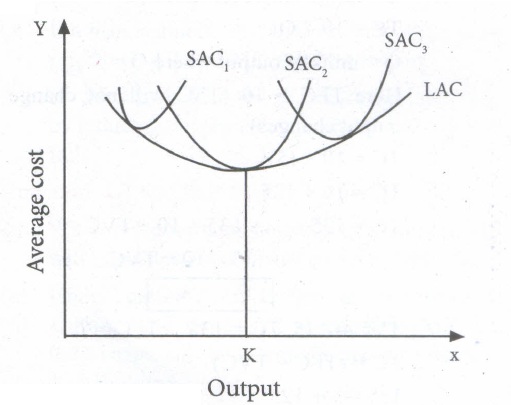
LAC = LTC/Q
(iv) It is the locus of points denoting the least cost curve of producing the corresponding output.
(v) The LAC curve is called as 'Plant curve' or Boat shape curve or planning curve or envelope curve.
22.
| S.No | Explicit cost | Implicit cost |
| 1 | Payment made to others for buying factors of production. | Payment made for the use of firm's own resource. |
| 2 | Actual expenditure of the firm in buying or hiring the inputs. | Cost of firm's self owned, self employed resources. |
| 3 | (eg) wages, rent, advertisement, depreciation. | Costs are not recorded as no cash payment takes place. |
| 4 | Also called accounting cost, out of pocket cost money cost. | Value of the own services are imputed and considered for preparing profit loss accounts. Also called imputed cost. |
23.
Poverty and inequality:
Amartya Sen studied about poverty and inequality, distribution of income among the people below the poverty line.
The concept of capability:
(i) Capability is the ability to transform Rawlsian primary goods to the achievement of well-being
(ii) This was a better index of well-being then commodities.
Entitlement:
(i) Sen included the concept of entitlement items like nutrition, food, medical and health care, employment, scarcity of food supply in times of famine.
(ii) All this is included in Amartya Sen's Welfare Economics.
24.
(i) During Nehru's period as Prime Minister planning was introduced in India.
(ii) He said planning is to find the best way to utilize all resources of manpower or money.
(iii) Planning was linked with industrialization leading to self-reliance and economic growth.
25.
In 1918, Ambedkar published a paper "Small Holdings in India and their Remedies", citing Adam Smith's "Wealth of Nations", he differentiated "Consolidation of Holdings" and "Enlargement of Holdings".

11th Standard Syllabus & Materials
11th Standard
TN 11th Tamil பீடு பெற நில் - செய்யுள் - காவடிச்சிந்து Important Questions And Answers Study Material - QB365 Set A
NEW11th Standard
TN 11th Tamil பீடு பெற நில் - உரைநடை - மலை இடப்பெயர்கள் : ஓர் ஆய்வு Important Questions And Answers Study Material - QB365 Set A
NEW11th Standard
TN 11th Tamil மாமழை போற்றுதும் - துணைப்பாடம் - யானை டாக்டர் Important Questions And Answers Study Material - QB365 Set A
NEW11th Standard
TN 11th Tamil மாமழை போற்றுதும் - செய்யுள் - ஐங்குறுநூறு Important Questions And Answers Study Material - QB365 Set A



Tamilnadu Stateboard 11th Standard Subjects

Maths

Commerce
Economics

Biology

Business Maths and Statistics

Accountancy

Computer Science

Physics

Chemistry
Maths
Biology
Economics
Physics
Chemistry

History
Business Maths and Statistics

Computer Science
Accountancy

Computer Applications
History
Computer Technology
Commerce
Computer Applications
Computer Technology

Tamil

English

French
Tamilnadu Stateboard Standards



