
 100% FREE ACCESS
11th Standard Syllabus & Materials
11th Standard
TN 11th Tamil இயற்கை வேளாண்மை,சுற்றுச்சூழல் -செய்யுள் - மனோன்மணீயம் Important Questions And Answers Study Material - QB365 Set A
NEW11th Standard
TN 11th Tamil என்னுயிர் என்பேன் -துணைப்பாடம் - இசைத்தமிழர் இருவர் Important Questions And Answers Study Material - QB365 Set A
NEW11th Standard
TN 11th Tamil மொழி கலை -செய்யுள் - ஒவ்வொரு புல்லையும் Important Questions And Answers Study Material - QB365 Set A
NEW11th Standard
TN 11th Tamil பீடு பெற நில் - இலக்கணம் - பகுபத உறுப்புகள் Important Questions And Answers Study Material - QB365 Set A
NEW11th Standard
TN 11th Tamil பீடு பெற நில் - துணைப்பாடம் - வாடிவாசல் Important Questions And Answers Study Material - QB365 Set A
NEW11th Standard
TN 11th Tamil பீடு பெற நில் - செய்யுள் - குறுந்தொகை Important Questions And Answers Study Material - QB365 Set A

Published on: 10/06/2021
QB365 provides detailed and simple solution for every book back questions in class 11 Economics subject.It will helps to get more idea about question pattern in every book back questions with solution.
Download Tamil Nadu 11th Standard Economics question papers, model tests, one-mark questions, important questions, and public exam papers in PDF format. Free study materials and answer keys for TN State Board students.
Questions + Answers key
Take MCQ Economics Test1.
Given the demand function Pd = 25 - Q2 and the supply function ps = 2Q + 1. Assuming pure competition, find (a) consumers surplus and (b) producers surplus. (Pd = Demand price; Ps = Supply price)
2.
If the demand function is P = 35 - 2x - x2 and the demand Xo is 3, what will be the consumer's surplus?
3.
4.
Elucidate the law of diminishing marginal utility with diagram.
5.
The demand and supply functions are Pd= 1600 - x2 and Ps = 2x2 + 400 respectively. Find the consumer's surplus and producer's Surplus at equilibrium point.
6.
A Research scholar researching the market for fresh cow milk assumes that Qt = f(Pt, Y, A, N, Pc) where Qt is the quantity of milk demanded, Pt is the price of fresh cow milk, Y is average household income, A is advertising expenditure on processed pocket milk, N is population and Pc is the price of processed pocket milk.
(a) What does Qt = f (Pt, Y, A, N, Pc) mean in words?
(b) Identify the independent variables.
(c) Make up a specific form for this function.
(Use your knowledge of Economics to deduce whether the coefficients of the different independent variables should be positive or negative.)
7.
8.
Explain the role of SSIs in economic development ?
9.
10.
11.
Analyse the causes for Rural Indebtedness.
12.
"The features of Rural Economy are peculiar"- Argue.
13.
Explain the internal and external economies of scale.
14.
List out the properties of iso-quants with the help of diagrams.
15.
16.
Explain the objectives and characteristics of SEZs.
17.
Explain basic problems of the economy with the help of production possibility curve.
18.
19.
Explain how price and output are determined under monopolistic competition with help of a diagram.
20.
21.
Bring out the features of perfect competition.
22.
Discuss the short run cost curves with suitable diagram.
23.
Write a brief note on the Gandhian economic ideas.
24.
Write the importance of mineral resources in India.
1.
For market equilibrium, Pd = Ps
25 - Q2 = 2Q + 1
0 = 25 + Q2 + 2Q + 1
0 = -24 + Q2 + 2Q
Q2 + 2Q - 24 = 0
Q2 + 6Q - 4Q - 24 = 0
Q(Q + 6) - 4(Q + 6) = 0
(Q + 6)(Q - 4) = 0
So, Q = 4 or Q =-6. Since Q cannot be equal to -6,
Q = 4
When Q = 4, Pd = 25 - 42 = 9;
P2 = 2(4)+ 1 = 9
Consumer's surplus =\(\int _{ 0 }^{ 4 }{ (25-Q^{ 2 })dQ)dQ-(9\times 4) } \)
=\({ \left[ 25Q-\frac { Q^{ 3 } }{ 3 } \right] }_{ 0 }^{ 4 }\)-36
=\({ \left[ (25)(4)-\frac { 1 }{ 3 } (4)^{ 3 } \right] }\)-(0)-36
=\(\left[ 100-\frac { 64 }{ 3 } \right] \)-(0)- 36 = 42.67
Producer's surplus Ps
(Ps) = (9 x 4) - \(\int _{ 0 }^{ 4 }{ (2Q+1)dQ } \)
= 36 -\(\left[ (Q^{ 2 }+Q \right] _{ 0 }^{ 4 }\)
= 36 - (16 + 4) = 16
2.
Given demand function
P = 35 - 2x - x2
for x = 3
P = 35 - 2(3) - 32
= 35 - 6 - 9
P = 20
Therefore,
CS = (Area of the curve below the demand curve from 0 to 3) - Area of the rectangle (20 x 3 = 60)
\(CS=\int_0^3(35-2x-x^2)dx=(20\times 3)\)
\(=\left[35x-2{x^2\over 2}-{x^3\over 3}\right]_0^3-60\)
\(=35(3)-2\left ( \frac{3^{2}}{2} \right )-\frac{3^{3}}{3}-60\)
= 105 - 9 - 9 - 60
= 27 Units
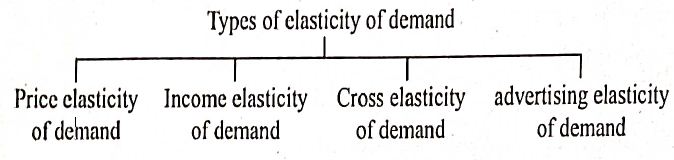
3.
.JPG)
4.
Introduction:
(i) H.H Gossen first formulated this law.
(ii) So Jevons called it "Gossen's First law of consumption"
(iii) Marshall perfected it on the basis of cardinal analysis.
(iv) It is based on the satiable character of human wants.
Definition
Marshall states the law as "the additional benefit which a person derives from a given increase of his stock of a thing, diminishes with every increase in the stock that he already has".
Assumptions
(i) Utility can be measured - 1,2,3.
(ii) Marginal utility of money is constant.
(iii) The consumer is rational. He wants maximum satisfaction.
(iv) The units consumed must be reasonable in size.
(v) The commodity must be homogeneous.
(vi) The consumption must be continuous.
(vii) There is no change in taste, habit, preferences, fashion, income & character of the consumer.
Illustration:
(i) Suppose a consumer wants to consume 7 apples one after another.
(ii) The utility from the first apple is 20.
(iii) The utility from the 2nd apple is less than the first (15), the utility from the 3rd apple is less than the 2nd (10) and so on.
(iv) Finally the utility from the 5th apple becomes zero and the utility from the 6th apple is -5.
| Number of Apples | Total utility | Marginal Utility |
| 1 | 20 | 20 |
| 2 | 35 | 15(35 - 20) |
| 3 | 45 | 10(45 - 35) |
| 4 | 50 | 5 (50 - 45) |
| 5 | 50 | 0 (50 - 50) |
| 6 | 45 | -5 (45- 50) |
| 7 | 35 | -10 (35-45) |
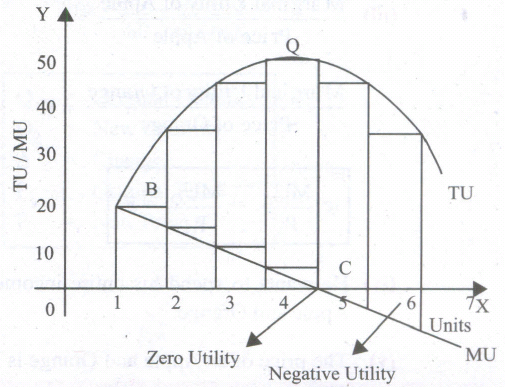
Explanation:
(i) TU goes on increasing but at a diminishing rate.
(ii) MU goes on diminishing
(iii) When MU is zero TU is maximum.
(iv) When MU becomes negative, TU diminishes.
Criticism:
(i) Utility is subjective so cannot be measured numerically.
(ii) The assumptions are unrealistic.
(iii) The law is not used for indivisible commodities.
Exceptions:
(i) Hobbies
(ii) Drunkards
(iii) Readings
(iv) Misers
(v) Music
(vi) Poetry
Importance:
(i) It is a fundamental law of consumption.
(ii) It is the basis for the law of demand, elasticity of demand, consumer's surplus.
(iii) Finance Minister uses it for progressive taxation.
(iv) Redistribution of income is justified.
(v) Adam Smith uses it for his "diamond water paradox".
Conclusion:
The law of diminishing marginal utility is of great use in our daily life.
5.
For equilibrium Pd = Ps
\(1600-x^{2} =2 x^{2}+400
\)
\(1600-400 =2 x^{2}+x^{2}
\)
\(3 x^{2} =1200
\)
\(x^{2} =400
\)
\(x =\pm 20
\)
\(P_{\mathrm{d}} =1600-(20)^{2} \)
=1600-400
=1200
\(\mathrm{P}_{\mathrm{s}} =2(20)^{2}+400 \)
= 2(400) + 400
= 800 + 400
= 1200
Consumer's surplus:
\(\mathrm{C}_{\mathrm{s}}=\int_{0}^{20}\left(1600-x^{2}\right) \mathrm{d} x-(20 \times 1200)
\)
\(=\left[1600 x-\frac{x^{3}}{3}\right]_{0}^{20}-(24000)=\left[1600(20)-\frac{20^{3}}{3}\right]-24000
\)
\(=32000-\frac{8000}{3}-24000=5,333.34\)
Producer's surplus:
\(\mathrm{P}_{\mathrm{s}} =(20 \times 1200)-\int_{0}^{20}\left(2 x^{2} +400\right) \mathrm{d} x
\)
\(=24000-\left[\frac{2 x^{3}}{3}+400 x\right]_{0}^{20}
\)
\(=24000-\left[\frac{2(20)^{3}}{3}+400(20)\right]=24000-\left[\frac{2 \times 8000}{3}+8000\right]\)
= 24000-5333.33 - 8000 = 10,666.67
6.
a) Qt = f(Pt, Y, A, N, Pc) it means the quantity of milk demand depends on the price of fresh cow milk, the average income, advertising expenditure on processed packet milk, the price of that packet milk and the populations. These are the factors which influence the demand for fresh cow milk.
b) The independent variables are price of fresh cow milk, average household income, advertising expenditure on processed packet milk, population, price of processed packet milk.
c) Qd = a + bP + cY + dA + eN + f Pc
a shows the value of Qd when the variables P, Y, A, N, Pc are all simultaneously =0. b, c, d, c, f are called slope parameter. They show the effect on quantity demanded of changing one of the variables P, Y, A, N or Pc while holding the rest of these variables constant.
| Variable | Relation to quantity demanded |
| P | inverse when price of fresh milk increases, demand decreases. |
| Y | direct when income increases the demand for fresh milk increases. |
| A | direct when advertising expenditure on processed milk increases the demand for fresh milk increases. |
| N | direct Price of packet milk increases the demand for fresh milk increases |
| Pc | direct Population increases the demand for fresh milk increases. |
7.
The concept of economic planning in India was the limited natural resources are utilized skillfully so as to achieve the desired goals.
(i) First Five Year Plan (1951 - 1956) :
Agriculture development of the country.
(ii) Second Five Year Plan (1956 - 1961) :
Industrial Development of the country.
(iii) Third Five Year Plan (1961 - 1966) :
To make the economy independent and to reach self active position to take off.
(iv) Fourth Five Year Plan (1969 - 1974) :
The two main objectives of this plan growth with stability and progressive achievement of self reliance.
(v) Fifth Five year Plan (1974 - 1979) :
In this plan top prioritity was given to agriculture, next cement industry and mines.
(vi) Sixth Five Year Plan (1980 - 1985) :
Poverty eradication and technological self reliance was the main objective of this plan.
(vii) Seventh Five Year Plan (1986 - 1991) :
The establishment of the self sufficient economy opportunities for productive employment.
(viii) Eight Five Year Plan (1992 - 1997) :
The top priority was given to development of human resources, employment, education and public health.
(ix) Ninth Five Year Plan (1997 - 2002) :
The main focus of this plan growth with justice and equity
(x) Tenth Five Year Plan (2002- 2007) :
To double the per capita income of lndia next 10 years.
(xi) Eleventh Five Year Plan (2007 - 2012) :
"Faster and more inclusive growth was the main aim of this plan"
(xii) Twelth Five Year Plan (2012 - 2017) :
Its main aim is "Faster, more inclusive and sustainable growth".
8.
Introduction :
(i) Small scale industries play an important role for the development of Indian economy.
(ii) 60 - 70% of total innovations in India comes from SSIs.
Provides employment:
(i) SSIs use labour intensive techniques.
(ii) They provide employment to artisans, technically qualified persons and professionals, people engaged in traditional arts, people in villages and unorganized sector.
(iii) The employment-capital ratio is high.
Brings balanced regional development:
(i) SSIs are set up in backward and rural areas.
(ii) This promotes decentralised development of industries.
(iii) They reduce congestion, slums, sanitation and pollution in cities since they are found outside city limits.
(iv) They improve the standard of living of people in suburban and rural areas
(v) The entrepreneurial talent is tapped from different regions.
Helps in mobilization of local resources:
(i) SSIs mobilize and use local resources like small savings, entrepreneurial talent etc of the entrepreneurs which might have remained idle.
(ii) It promotes traditional family skills and handicrafts.
Paves for optimisation of capital:
(i) SSIs needs less capital. They give quick profit due to shorter gestation period.
(ii) SSIs functions as a stabilizing force by providing high output-capital ratio and high employment capital ratio.
(iii) They encourage people living in rural areas to save and channelize them into industrial activities.
Promotes export:
(i) Since they do not need sophisticated machinery, import of machinery from abroad is not needed.
(ii) There is great demand for goods produced by SSIs.
(iii) They reduce the pressure on balance of payment as they earn foreign exchange
Complements large scale industries:
(i) They provide components, parts, accessories to large scale industries.
(ii) They serve as ancillaries to large scale units.
Meets consumer demand:
(i) SSIs produce a wide range of consumer products.
(ii) They serve as an anti-inflationary force by providing goods of daily use.
Develops entrepreneurship:
(i) SSIs help to develop entrepreneurs.
(ii) They help the job seekers to become job givers.
(iii) They promote self-employment and a spirit of self-reliance.
(iv) It increases the per capita income of India.
(v) There is development of backward areas and weaker sections.
(vi) It helps in equitable distribution of income.
9.
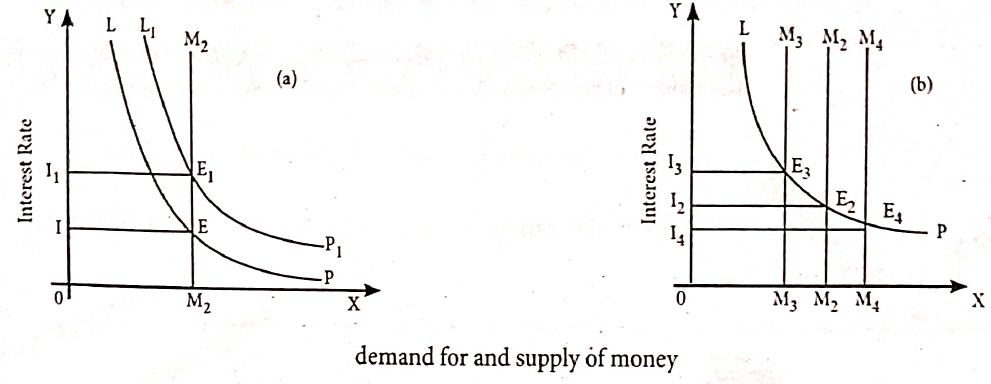
10.
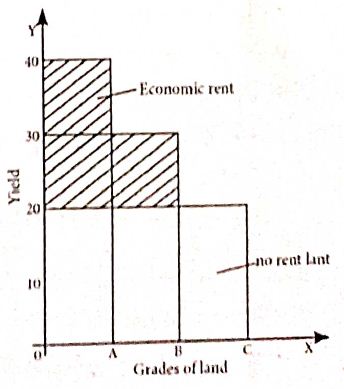
11.
Introduction:
Rural indebtedness refers to the situation where the rural people are unable to repay the loan accumulated over a period.
Causes:
Poverty of farmers:
The vicious circle of poverty forces the farmers to borrow for consumption, cultivation and celebrations. Poverty, debt and high rates of interest hold the farmer in the grip of money lenders.
Failure of monsoon:
So it is difficult to identify good years to repay their debts.
Litigation:
(i) Due to land disputes, litigation in the court compels them to borrow heavily
(ii) Being uneducated and ignorant they are caught in the litigation process and lose their savings.
Money lenders-high interest rate:
The rate of interest charged by the local money lenders is very high and the compounding of interest leads to indebtedness of the farmer.
12.
Introduction:
Rural economy refers to villages and rural community refers to people living in villages.
Features of rural economy:
Village is an institution:
(i) Village is a primary institution and it satisfies almost all the needs of the rural community.
(ii) The rural people have a feeling of belongingness and a sense of unity towards each other.
Dependence on agriculture:
The rural economy depends on nature and agricultural activities.
Life of rural people:
(i) Life style in village is very simple. Education, housing, health and sanitation, transport and communication, banking, roads and markets are limited and unavailable.
(ii) Rural people rely on faith, superstitions and traditional cultural practices.
(iii) The methods of production, social organization, political mobilization, rural sector is extremely weak and backward.
(iv) The incidence of alcohol drinking has gone up.
Population density:
Population density is very low. Houses are scattered in the entire village.
Employment:
There is unemployment, seasonal unemployment and underemployment.
Poverty:
(i) Basic needs of the people like food, clothing and shelter are not met
(ii) About 22 crores of people in rural areas are poor and live below poverty line.
Indebtedness:
(i) People in rural areas are highly indebted owing to poverty, under employment, lack of farm and non-farm employment opportunities, low wage employment, seasonality in production, poor marketing network.
(ii) Since formal loan facilities are not available to the villagers, they depend on local money lenders who squeeze the villagers.
Rural income
Large proportion of labourers are underemployed and the scope for increasing their income is limited.
Dependency:
Rural households are largely dependent on social grants and remittances from family members working in urban areas.
Dualism:
The co-existence of features of organised and unorganised, traditional and modern, regulated and unregulated, poor and rich, skilled and unskilled is very common in rural areas.
Inequality:
There is inequality in distribution of income, wealth and assets. Land, livestock are owned by a few people. Landlords dominate the rural activities.
Migration:
Rural people migrate from villages to urban areas for gainful employment. Lack of basic amenities in rural areas also push the people to urban areas.
13.
Introduction:
(i) Scale of production refers to the ratio of factors of production.
(ii) Every producer wants to reduce the cost of production.
(iii) When there is large scale production he enjoy lot of advantages.
(iv) These advantages are called economies of scale.
(v) Marshall divided them into internal economies and external economies.
Internal Economies:
They refer to advantages enjoyed by a firm.
Technical Economies:
When there is large scale production, there is more capital, new technology, research and development.
Financial Economies:
Big firms can float shares in the market for capital expansion.
Managerial Economies:
(i) Specialisation of labour is followed.
(ii) There is delegation of work.
Labour Economies:
(i) There is division of labour.
(ii) Quality and productivity increases.
Marketing Economies:
(i) Producers can buy raw materials at cheaper cost.
(ii) Transport cost is less.
(iii) They enjoy bargaining power.
Economies of survival:
(i) Product diversification is possible.
(ii) This reduces the risk in production.
(iii) Even if the market for one product falls, the market for other commodities offsets it.
External Economies:
(i) They refer to changes in any factor outside the firm causing an improvement in the production process.
(ii) These advantages are enjoyed by all the firms in the industry due to the structural growth.
Example:
1. Increased transport facilities.
2. Banking facilities.
3. Development of townships.
4. Development of information and communication.
14.
Iso and quant are derived from the Greek language, meaning 'equal' and 'quantity'.
Definition:
Isoquant curve is a locus of points representing various combinations of two inputs capital and labour yielding the same output. It is also called equal product curve or product indifference curve.
Properties:
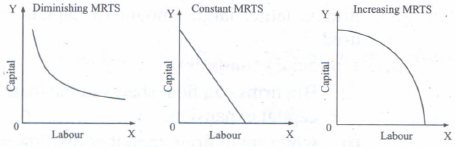
1. The isoquant curve has negative slope:
(i) Capital is being substituted by labour.
(ii) Isoquant has negative slope because of diminishing MRTS.
(iii) Constant MRTS (straight line) and increasing MRTS (concave) are also possible.
(iv) It depends on the nature of isoquant curve
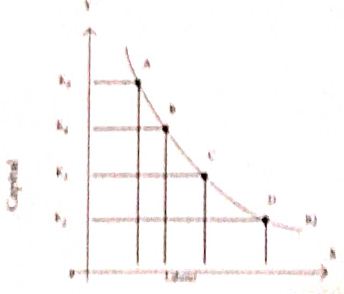
2. Isoquant curve is convex to origin:
The capital substituted per unit of labour goes on decreasing so the isoquant is convex to the origin.
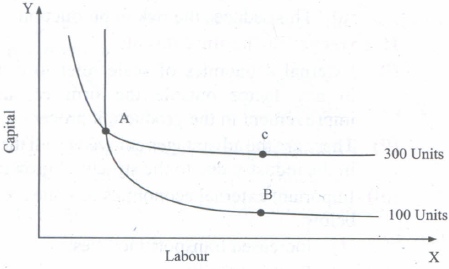
3. Isoquant curves cannot intersect each other:
Point A lies on IQ1 and IQ2, Point C lies on IQ2, showing higher output Point B
lies on IQ1, showing lower output. C = A, B = A But C > B.
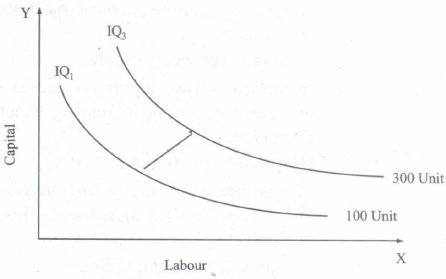
4. Upper isoquant curve represents a higher level of output:
Higher IQ2 shows higher output 200 units. Lower IQ1 shows lower output 100 units. IQ2 means the use of more sectors than IQ1. Arrow shows increase in output with a right and upward shift of an isoquant curve.
5. Isoquant curve does not touch either x axis or y axis:
In IQ2 only capital is used and in IQ1 only labour is used.
.JPG)
Conclusion:
These are the properties of isoquant curves.
15.
16.
Introduction:
(i) In order to promote export and industrial growth SEZ was introduced in many countries.
(ii) India was one of the first in Asia to set up EPZ (Kandla, 1965).
(iii) SEZ covers free trade zones, export processing zones, industrial parks, economic and technology development zones, high-tech zones, science and innovation parks, free ports, enterprise zones.
Major objectives of SEZs
(i) To enhance foreign investment, to attract foreign direct investment and increase GDP.
(ii) To increase shares in global export.
(iii) To generate additional economic activity.
(iv) To create employment opportunities.
(v) To develop infrastructure facilities.
(vi) To exchange technology in the global market.
Characteristics:
(i) Geographically demarcated area with physical security.
(ii) administered by single authority.
(iii) Streamlined procedures.
(iv) Having separate custom area.
(v) Governed by more liberal economic laws.
(vi) Greater freedom to firms located in SEZs.
(vii) They need not respect the government's rules and regulations.
(viii) The social and environmental impacts were disastrous.
17.
The Problem of Choice:
(i) The problem of choice arises because of limited resources and unlimited wants, may relate to the allocation of resources between the goods for higher income group and the lower income group and the goods for defense and the civilians.
(ii) Since PPC is the locus of the combination of the goods the problem of choice will not arises when we choose any point on PPC.
The notion of scarcity:
(i) Every economy has scarce resources which can produce only limited amount of output even with the help of best technology.
(ii) PPC reflects the constraints imposed by the element of economic scarcity.
The solution of central problems:
(i) The solution of problem of what to produce involves the decision regarding the choice of location on the PPC.
(ii) Any point inside PPC indicates that the economy is using inefficient methods of production and inefficient combination of resources.
Conclusion:
(i) Thus the basic problems of the economy are solved with the help of PPC.
18.
19.
Introduction:
E.H. Chamberlin introduced the concept of monopolistic competition.
(i) Firm under monopolistic competition has equilibrium when MC = MR & when MC cuts MR from below.
(ii) The AR curve slopes downward and is fairly elastic.
(iii) Different firms produce different varieties of the product and sell them at different prices.
Each firm seeks to get equilibrium with regard to
1) price & output 2) product adjustment 3) selling cost adjustment
Short run equilibrium
.JPG)
In fig (a) OM is the equilibrium output. OP is the price.
TR = OMQP, TC = OMRS, Abnormal Profit = PQRS
In fig (b) TR = OMQP, TC = OMLR, Loss = PQLR
Long run equilibrium:
.JPG)
(i) In short run the firm may earn super normal profit or incur loss.
(ii) In the long run the AR is more elastic.
(iii) The firms earn only normal profit.
(iv) Equilibrium output = OM. Price = OP, AR = QM, AC = QM.
(v) Equilibrium is got when AR = AC. AR is tangent to AC at Q.
20.
21.
Large number of buyers and sellers:
(i) Since there are large number of buyers and sellers each individual buyer or seller buys or sells a very very small quantity of the product found in the market.
(ii) So he has no power to fix the price of the product.
(iii) He is only a price taker.
Homogenous product & uniform price:
(i) All the units of the product are perfectly substitutable - they are of the same size, shape, colour, quality.
(ii) So a uniform price prevails in the market.
Free entry and exit:
(i) In the short run, the very efficient producer can produce the product at a very low cost & earn super normal profit.
(ii) This attracts new firms to enter.
(iii) When there are more firms, supply increases, so price falls.
(iv) Inefficient producer faces loss & so quits the market.
Absence of transport cost:
The prevalence of the uniform price is also due to the absence of the transport cost.
Perfect knowledge of the market:
(i) All buyers and sellers have a thorough knowledge of the quality of the product, prevailing price.
No government intervention:
(i) No government regulation on supply of raw materials & in price determination.
22.
Average fixed cost:
1. It refers to the fixed cost per unit of output.
2. It declines as output increases as fixed cost is constant.
3. It never touches the axis.
4. It is rectangular hyperbola.
.JPG)
Average variable cost:
1. It is the variable cost per unit of output.
2. It initially declines and then increases with the increase of output
3. This is due to law of returns.
4. AVC curve is a 'U' shaped curve.
.JPG)
Average total cost or average cost:
1. It is got by dividing TC by Q or by adding AFC and AVC.
2. It is u shaped.
3. Initially it declines, reaches minimum when the plant is used optimally & rises beyond the optimum output.
4. This is due to the law of variable proportions.
.JPG)
Marginal cost:
1. It is the change in total cost resulting from producing one extra unit of output.
2. First it falls due to more efficient use of variable factors.
3. It increases after the lowest point and it slopes upward.
4. It is 'u' shaped.
.JPG)
| Q (in unit) | TFC in (Rs) | TVC in (Rs) | TC in (in Rs)TFC + TVC | ATC (TC/Q)(in Rs) | AFC in(Rs) | AVC in(Rs) | ATC (AFC + AVC)(in Rs) |
| 0 | 1000 | 0 | 1000 | α | 0 | 0 | 0 |
| 1 | 1000 | 200 | 1200 | 1200 | 1000 | 200 | 1200 |
| 2 | 1000 | 300 | 1300 | 650 | 500 | 150 | 650 |
| 3 | 1000 | 400 | 1400 | 466 | 333 | 133 | 466 |
| 4 | 1000 | 600 | 1600 | 400 | 250 | 150 | 400 |
| 5 | 1000 | 900 | 1900 | 380 | 200 | 180 | 380 |
23.
Introduction:
(i) Gandhian economics is based on ethical foundations.
(ii) He wrote, "Economics that hurts the moral well-being of an individual or a nation is immoral and so sinful".
Village republics:
(i) To Gandhi, India lives in villages.
(ii) He was interested in developing the villages as self-sufficient units.
(iii) He opposed extensive use of machinery, urbanization and industrialization.
On machinery:
(i) Gandhi described machinery as 'Great sin'.
(ii) It is an evil and would finally end.
Industrialism:
(i) Gandhi considered industrialism as a curse on mankind and would exploit the nation.
Decentralization:
(i) He favoured production in the people's homes at a large number of places on a small scale.
Village Sarvodaya:
(i) He suggested the development of self-sufficient, self-dependent villages.
Bread labour:
(i) Gandhi realised the dignity of human labour. He believed that man should eat his bread by the sweat of his brow. Bread labour or body labour meant manual labour.
Doctrine of trusteeship:
(i) Trusteeship provides a means of transforming the present capitalist order of society into an egalitarian one.
(ii) But India today has casino and crony capitalism.
On the food problem:
(i) Gandhi was against food controls.
(ii) Such controls created artificial scarcity. Today, India tops in the world with large production of fruits, vegetables, milk, egg, meat etc.
On Population:
(i) Gandhi opposed population control through contraceptives.
(ii) He favoured birth control through Brahmacharya or self-control.
(iii) This is the remedy to over population.
On prohibition:
(i) Gandhi advocated total prohibition, regarded use of liquor as a disease.
(ii) But today many states depend on revenue from liquor sales.
Conclusion: If Gandhi's ideas are followed, India will soon become a developed nation.
24.
Introduction:
Mineral resources are valuable natural resources that play an important role in the economic development of India. Important minerals found in India include iron ore, coal, lignite, bauxite, mica, crude oil, gold, and diamonds.
1. Iron Ore
India has abundant reserves of high-quality iron ore. It is the basic raw material for the iron and steel industry. Major iron ore producing states are Odisha, Chhattisgarh, Karnataka, Jharkhand, and Goa.
2. Coal and Lignite
Coal is the most important source of commercial energy in India. It is used for electricity generation and industrial purposes. Major coal-producing states include Jharkhand, Odisha, Chhattisgarh, West Bengal, and Madhya Pradesh.
3. Bauxite
Bauxite is the chief ore of aluminium. Aluminium is widely used in transport, construction, and electrical industries. Odisha is the leading producer of bauxite in India.
4. Mica
Mica is a good insulator and heat-resistant mineral. It is used in electrical and electronic industries. India is one of the leading producers of mica.
5. Crude Oil
Crude oil is an important source of energy. It is used to produce petrol, diesel, kerosene, and other petroleum products. Major oil-producing areas are Assam, Gujarat, and offshore regions.
6. Gold and Diamonds
Gold and diamonds have high commercial value. They support the jewellery industry and contribute to exports.
Conclusion:
Mineral resources are essential for industrial development, energy production, employment generation, and economic growth. Therefore, they are a valuable asset for India's development.

11th Standard Syllabus & Materials
11th Standard
TN 11th Tamil பீடு பெற நில் - செய்யுள் - காவடிச்சிந்து Important Questions And Answers Study Material - QB365 Set A
NEW11th Standard
TN 11th Tamil பீடு பெற நில் - உரைநடை - மலை இடப்பெயர்கள் : ஓர் ஆய்வு Important Questions And Answers Study Material - QB365 Set A
NEW11th Standard
TN 11th Tamil மாமழை போற்றுதும் - துணைப்பாடம் - யானை டாக்டர் Important Questions And Answers Study Material - QB365 Set A
NEW11th Standard
TN 11th Tamil மாமழை போற்றுதும் - செய்யுள் - ஐங்குறுநூறு Important Questions And Answers Study Material - QB365 Set A



Tamilnadu Stateboard 11th Standard Subjects

Maths

Commerce
Economics

Biology

Business Maths and Statistics

Accountancy

Computer Science

Physics

Chemistry
Maths
Biology
Economics
Physics
Chemistry

History
Business Maths and Statistics

Computer Science
Accountancy

Computer Applications
History
Computer Technology
Commerce
Computer Applications
Computer Technology

Tamil

English

French
Tamilnadu Stateboard Standards



