
 100% FREE ACCESS
11th Standard Syllabus & Materials
11th Standard
TN 11th Tamil இயற்கை வேளாண்மை,சுற்றுச்சூழல் -செய்யுள் - மனோன்மணீயம் Important Questions And Answers Study Material - QB365 Set A
NEW11th Standard
TN 11th Tamil என்னுயிர் என்பேன் -துணைப்பாடம் - இசைத்தமிழர் இருவர் Important Questions And Answers Study Material - QB365 Set A
NEW11th Standard
TN 11th Tamil மொழி கலை -செய்யுள் - ஒவ்வொரு புல்லையும் Important Questions And Answers Study Material - QB365 Set A
NEW11th Standard
TN 11th Tamil பீடு பெற நில் - இலக்கணம் - பகுபத உறுப்புகள் Important Questions And Answers Study Material - QB365 Set A
NEW11th Standard
TN 11th Tamil பீடு பெற நில் - துணைப்பாடம் - வாடிவாசல் Important Questions And Answers Study Material - QB365 Set A
NEW11th Standard
TN 11th Tamil பீடு பெற நில் - செய்யுள் - குறுந்தொகை Important Questions And Answers Study Material - QB365 Set A

Published on: 13/05/2022
QB365 provides detailed and simple solution for every book back questions in class 11 Economics subject.It will helps to get more idea about question pattern in every book back questions with solution.
latest Book back QuestionsDownload Tamil Nadu 11th Standard Economics question papers, model tests, one-mark questions, important questions, and public exam papers in PDF format. Free study materials and answer keys for TN State Board students.
Questions + Answers key
Take MCQ Economics Test1.
A manufacturer estimates that, when units of a commodity are produced each month the total costs will be TC(Q) = 128 + 60Q + 8Q2. Find the marginal cost, average cost, fixed cost, variable cost, average fixed cost and average variable cost.
2.
Find the solution of the system of equation
7x1 - x2 - x3 = 0
10x1 - 2x2 + x3 = 8
6x1 + 3x2 - 2x3 = 7
3.
Explain the law of Equi - marginal utility
4.
The demand and supply functions are Pd= 1600 - x2 and Ps = 2x2 + 400 respectively. Find the consumer's surplus and producer's Surplus at equilibrium point.
5.
Calculate the elasticity of demand for the demand schedule by using differential calculus method P = 60 - 0.2Q where price is (i) zero, (ii) Rs.20, (iii) Rs.40
6.
7.
Discuss the Indian Economy during British Period.
8.
9.
Explain the Marginal Productivity Theory of Distribution.
10.
11.
"The features of Rural Economy are peculiar"- Argue.
12.
13.
Explain the public transport system in Tamil Nadu.
14.
15.
Examine the Law of Variable Proportions with the help of diagram.
16.
Describe the salient features of EXIM policy (2015 - 2020)
17.
Discuss the important initiatives taken by the Government of India towards Industrial Policy.
18.
19.
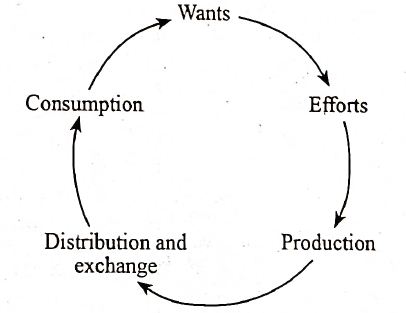
Compare and contrast various definitions of Economics.
20.
21.
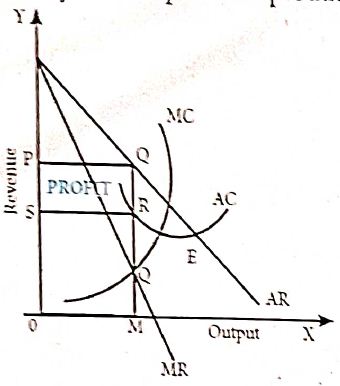
How price and output are determined under the perfect competition?
22.
Bring out the relationship between AR and MR curves under various price conditions.
23.
If total cost = 10+ Q3, find out AC, AVC, TFC, AFC when Q = 5.
24.
Bring out Jawaharlal Nehru's contribution to the idea of economic development.
25.
Explain the strong features of Indian economy.
1.
Given that TC(Q) = 128 + 60Q + 8Q2
We know TC = Fixed cost + variable cost
MC (Q) =\(\frac { d(TC) }{ dQ } \)
= 0 + 60(1)Q1-1 + 8(2)Q2-1
= 0 + 60Q0 + 16Q1(Since, Q0= 1)
MC = 60 + 16Q
Average Cost =\(\frac { TC }{ dQ } \)
=\(\frac { 128+60Q+8Q^{ 2 } }{ Q } \)
AC = \(\frac { 128 }{ Q } \) + 60 + 8Q
Constant value is known as fixed cost
Fixed cost = 128
FC = 128
Average Fixed cost = \(\frac { 128 }{ Q } \)
AFC = \(\frac { 128 }{ Q } \)
Average Variable cost = 60 + 8Q (total variable cost divided by Q)
∴ AVC = 60 + 8Q
2.
The matrix form of the given equation is written as
\(\begin{bmatrix} 7 & -1 & -1 \\ 10 & -2 & +1 \\ 6 & 3 & -2 \end{bmatrix}\left[ \begin{matrix} { x }_{ 1 } \\ { x }_{ 2 } \\ { x }_{ 3 } \end{matrix} \right]\)\(=\begin{bmatrix} 0\\ 8\\ 7\\ \end{bmatrix}\)
\(\Delta\)=\(\begin{vmatrix} 7& -1& -1\\ 10& -2& +1\\ 6& 3& -2\\ \end{vmatrix}\)
=7(4-3)-(-1)(-20-6)+(-1)(30+12)
=7(1)+1(-26)-1(42)
=7 - 26 - 42 = - 61
\(\triangle \)x1 \(=\begin{bmatrix} 0 & -1 & -1 \\ 8 & -2 & +1 \\ 7 & 3 & -2 \end{bmatrix}\)
=0(4-3)-(-1)(-16-7)+(-1)(24+14)
=0+1(-23)-1(38)
=-23-38 = - 61
\(\Delta x_2=\begin{vmatrix} 7& 0& -1\\ 10& 8& 1\\ 6& 7& -2\\ \end{vmatrix}\)
=7(-16 - 7) - (0)(-20 - 6)+(-1)(70 - 48)
=7(-23)+0 - 1 (22)
=-161 - 22 = -183
\(\triangle \)x3 \(=\begin{bmatrix} 7 & -1 & 0 \\ 10 & -2 & 8 \\ 6 &3 & 7 \end{bmatrix}\)
=7(-14-24)-(-1)(70-48)+0(30+12)
=7(-38)+1(22)+0(42)
=-266+22+0
\(\triangle \)x1 = - 244
\(x_{1}=\frac{\Delta x_{1}}{\Delta}=\frac{-61}{-61}=1\)
\(x_{2}=\frac{\Delta x_{2}}{\Delta}=\frac{-183}{-61}=3\)
\(x_{3}=\frac{\Delta x_{3}}{\Delta}=\frac{-244}{-61}=4\)
3.
Introduction:
(i) The law of diminishing marginal utility was extended and is called Law of Equi marginal utility
(ii) Law of substitution or Law of consumer's Equilibrium or Gossen's II law or law of maximum satisfaction.
Definition:
Marshall, "If a person has a thing which he can put to several uses, he will distribute it among these uses in such a way that it has the same marginal utility in all. For, if it had a greater marginal utility in one use than another, he would gain by taking away some of it from the second use and applying it to first.
Assumption
(i) Consumer is rational and wants maximum satisfaction.
(ii) Utility is measurable in cardinal numbers.
(iii) Marginal utility of money is constant.
(iv) Income of the consumer is given.
(v) There is perfect competition.
(vi) Price is given.
(vii) Law of diminishing marginal utility operates
Explanation:
(i) The consumer has Rs. 11.
(ii) He wants to spend it on apple ( Rs 1 each) and orange (Rs. 1 each)
(iii) He will be in equilibrium only when he gets maximum satisfaction ie.
\(\mathrm{K}=\frac{\text { Marginal utility of apple }}{\text { Price of apple }}=\frac{\text { Marginal utility of orange }}{\text { Price of orange }}\)
If is \(\frac{\mathrm{MU_A}}{\mathrm{P_A}}\) less than \(\frac{\mathrm{MU_O}}{\mathrm{P_O}}\) he would transfer money from apple to orange till it is equal.
He should buy 6 units of apple & 5 units of oranges. He gets (92 + 58) = 150 units satisfaction.
\(\frac{\mathrm{MU_A}}{\mathrm{P_A}}=\frac{\mathrm{MU_O}}{\mathrm{P_O}}=\frac{4}{1}=\frac{4}{1}\)
| Apple | orange | |||
| Units of Commodities | Total Utility | marginal Utility | Total Utility | marginal Utility |
| 1 | 25 | 25 | 30 | 30 |
| 2 | 45 | 20 | 41 | 11 |
| 3 | 63 | 18 | 49 | 8 |
| 4 | 78 | 15 | 54 | 5 |
| 5 | 88 | 10 | 58 | 4 |
| 6 | 92 | 4 | 61 | 3 |
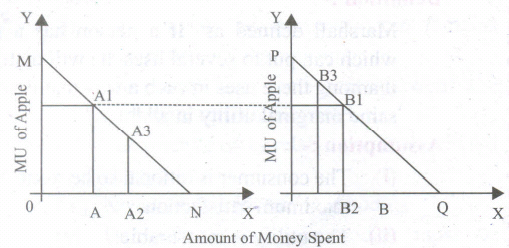
Explanation:
(i) X axis shows amount of money spent
(ii) Y axis shows marginal utility of apple and orange.
(iii) If consumer spends Rs.6 on apple and Rs.5 on orange MU will be equal.
(iv) ie. AA1 = BB1 = 4 = 4. So he gets maximum utility.
Criticisms:
(i) Utility cannot be measured.
(ii) No consumer compares the utility and disutility from each unit of the commodity while buying it.
(iii) This law cannot be applied to durable goods.
Conclusion:
(i) The law of equi marginal utility is an improvement over the law of diminishing marginal utility because it can be used for many commodities consumed at the same time.
4.
For equilibrium Pd = Ps
\(1600-x^{2} =2 x^{2}+400
\)
\(1600-400 =2 x^{2}+x^{2}
\)
\(3 x^{2} =1200
\)
\(x^{2} =400
\)
\(x =\pm 20
\)
\(P_{\mathrm{d}} =1600-(20)^{2} \)
=1600-400
=1200
\(\mathrm{P}_{\mathrm{s}} =2(20)^{2}+400 \)
= 2(400) + 400
= 800 + 400
= 1200
Consumer's surplus:
\(\mathrm{C}_{\mathrm{s}}=\int_{0}^{20}\left(1600-x^{2}\right) \mathrm{d} x-(20 \times 1200)
\)
\(=\left[1600 x-\frac{x^{3}}{3}\right]_{0}^{20}-(24000)=\left[1600(20)-\frac{20^{3}}{3}\right]-24000
\)
\(=32000-\frac{8000}{3}-24000=5,333.34\)
Producer's surplus:
\(\mathrm{P}_{\mathrm{s}} =(20 \times 1200)-\int_{0}^{20}\left(2 x^{2} +400\right) \mathrm{d} x
\)
\(=24000-\left[\frac{2 x^{3}}{3}+400 x\right]_{0}^{20}
\)
\(=24000-\left[\frac{2(20)^{3}}{3}+400(20)\right]=24000-\left[\frac{2 \times 8000}{3}+8000\right]\)
= 24000-5333.33 - 8000 = 10,666.67
5.
i) zero
\(\mathrm{P} =60-0.2 \mathrm{Q}
\)
\(0 =60-0.2 \mathrm{Q}
\)
\(0.2 \mathrm{Q} =60
\)
\(\mathrm{Q} =\frac{60}{0.2}=\frac{600}{2}=300\)
ii) Rs. 20
\(\mathrm{P} =60-0.2 \mathrm{Q}
\)
\(20 =60-0.2 \mathrm{Q}
\)
\(0.2 \mathrm{Q} =60-20=40 ; \quad \mathrm{Q}=\frac{40}{0.2}=\frac{400}{2}=200\)
iii) Rs. 40
\(\mathrm{P} =60-0.2 \mathrm{Q}
\)
\(40 =60-0.2 \mathrm{Q}
\)
\(0.2 \mathrm{Q} =60-40
\)
\(\mathrm{Q} =\frac{20}{0.2}=\frac{200}{2}=100\)
6.
7.
Introduction:
(i) In 1601 the East India Company entered India.
(ii) In 1614 Sir Thomas Roe set up factories in India with permission from Jahangir.
(iii) Hundred years after Battle of Plassey, the rule of the East India Company came to an end in 1858.
(iv) Britain exploited India for two centuries.
Period of Merchant Capital:
(i) This period was from 1757 to 1813.
(ii) The only aim of the East India Company was profit. India's riches was used to develop industrial capitalism of Britain.
(iii) The officers of the company were unscrupulous and corrupt.
Period of Industrial Capital:
(i) This period was from 1813 to 1858. India became a market for British textiles.
(ii) Raw materials were exported to England at low price.
(iii) India's traditional handicrafts started declining.
Period of Finance Capital:
(i) This period was from the end of the 19th Century till Independence.
(ii) Britain invested in rail road, postal system and limited field of education in India by plundering Indian Capital.
(iii) Indian tax payers were compelled to finance for the construction of railways.
Decline of Indian handicrafts:
(i) Through discriminatory tariff policy the British Government purposefully destroyed the handicrafts.
(ii) With the disappearance of nawabs and kings, there was no one to protect the handicrafts.
(iii) Indian handicrafts could not compete with the machine made products.
(iv) The introduction of railways increased the domestic market for the British goods.
Conclusion:
(i) Before the advent of the British, India was self sufficient.
(ii) Under the British rule only industries were allowed to develop.
(iii) This brought down the economic condition of the Indians.
8.
9.
Introduction:
(i) Marginal productivity theory of distribution was developed by Clark, Wicksteed and Walras.
(ii) This theory explains how the prices of various factors of production are determined.
Assumptions
(i) All the factors of production are homogeneous, can be substituted for each other and are perfectly mobile.
(ii) There is perfect competition in the factor & product market.
(iii) There is full employment with no technological change.
(iv) The theory is applicable only in long run.
(vi) The entrepreneurs aim at profit maximisation.
(vii) There is no government intervention in fixing the price of a factor.
Explanation:
(i) The reward for any factor of production is equal to the marginal productivity of that factor.
(ii) The greater the productivity of a factor higher will be its reward.
(iii) The price of a factor of production depends upon its productivity.
(vi) The price will be equal to marginal revenue product of that factor.
(v) Under certain conditions, the price of a factor will be equal to both the average and marginal products of that factor.
Marginal productivity under perfect competition:
.JPG)
(i) fig (a) x axis represents factor units.
(ii) y axis shows factor price & revenue.
MRP = Marginal revenue product curve.
ARP = Average revenue product curve.
AFC = Average factor cost curve.
MFC = Marginal factor cost curve.
(iii) AFC is horizontal & MFC coincides with it.
(iv) The firm is in equilibrium (maximum profit) when MFC = MRP at Q by employing ON units of factors & paying (OP price or NQ) where MFC = MRP = ARP.
(v) The price paid to the factor NQ is equal to MRP (NQ) and ARP (NQ) beyond Q no employer will employ factors because after that point, the price paid to the factor is more than MRP and ARP.
Marginal productivity under Imperfect competition:
.JPG)
(i) fig(b) AFC represents the price paid to the factors. It increases as the number of factors demanded by the employer increases.
(ii) As AFC rises, MFC lies above AFC. It represents the MC paid to the factors.
(iii) At the point Q, MFC = MRP, where the employer attains his maximum profit and so he stops employment of the factors at the point.
(iv) But the AC paid is NRSO and AR is NQ or OP
(v) Total revenue is NQPO.
(vi) Exploitation per unit of factor is RQQ
(vii) But the total number of factors is ON. Thus the total exploitation of factor by the employer is RQ XSR = PQRS (shaded area).
Criticisms:
(i) Factors of production are not homogeneous.
(ii) They cannot be substituted for each other.
(iii) It cannot be applied in the short run.
Conclusion:
This theory is also called "General Theory of Distribution" or "National Dividend Theory of distribution".
10.
11.
Introduction:
Rural economy refers to villages and rural community refers to people living in villages.
Features of rural economy:
Village is an institution:
(i) Village is a primary institution and it satisfies almost all the needs of the rural community.
(ii) The rural people have a feeling of belongingness and a sense of unity towards each other.
Dependence on agriculture:
The rural economy depends on nature and agricultural activities.
Life of rural people:
(i) Life style in village is very simple. Education, housing, health and sanitation, transport and communication, banking, roads and markets are limited and unavailable.
(ii) Rural people rely on faith, superstitions and traditional cultural practices.
(iii) The methods of production, social organization, political mobilization, rural sector is extremely weak and backward.
(iv) The incidence of alcohol drinking has gone up.
Population density:
Population density is very low. Houses are scattered in the entire village.
Employment:
There is unemployment, seasonal unemployment and underemployment.
Poverty:
(i) Basic needs of the people like food, clothing and shelter are not met
(ii) About 22 crores of people in rural areas are poor and live below poverty line.
Indebtedness:
(i) People in rural areas are highly indebted owing to poverty, under employment, lack of farm and non-farm employment opportunities, low wage employment, seasonality in production, poor marketing network.
(ii) Since formal loan facilities are not available to the villagers, they depend on local money lenders who squeeze the villagers.
Rural income
Large proportion of labourers are underemployed and the scope for increasing their income is limited.
Dependency:
Rural households are largely dependent on social grants and remittances from family members working in urban areas.
Dualism:
The co-existence of features of organised and unorganised, traditional and modern, regulated and unregulated, poor and rich, skilled and unskilled is very common in rural areas.
Inequality:
There is inequality in distribution of income, wealth and assets. Land, livestock are owned by a few people. Landlords dominate the rural activities.
Migration:
Rural people migrate from villages to urban areas for gainful employment. Lack of basic amenities in rural areas also push the people to urban areas.
12.
13.
Tamil Nadu has a well established transportation system that connects all parts of the state. Tamil Nadu has an extensive road network in terms of its spread and quality, providing links between urban centres, agricultural market places & rural habitations in the countryside.
Roadways:
There are 28 national highways. The state has a total road length of 167,000 km of which 60,628 km are maintained by Highways Department. It ranks 2nd in India with 20% in total road projects under public-private partnership model.
Railways:
(i) Tamil Nadu has a well-developed rail network under Southern Railway (HQ at Chennai).
(ii) The Southern Railway covers Tamil Nadu, Kerala, Puducherry, parts of Karnataka and Andhra Pradesh.
(iii) The total railway track length is 6,693 km.
(iv) There are 690 railway stations. It is connected to most major cities.
(v) The main rail junctions are Chennai, Coimbatore, Erode, Madurai, Salem, Tiruchirapalli, Tirunelveli, Chennai has a well established suburban railway network, a Mass Rapid Transport system and a Metro system the direct underground stretch operational since May 2017.
Airways:
Tamil Nadu has 4 major international airports (Chennai, Coimbatore, Madurai, Trichy). Chennai International airport is the III largest airport in India. Domestic airports are at Tuticorin, Salem and Madurai. Increased industrial activity has given rise to an increase in passenger traffic & freight movement.
Ports:
(i) Chennai, Ennore & Tuticorin have major ports. Nagapattinam has an intermediate port.
(ii) There are 23 minor ports.
(iii) The ports handle 73 million metric tonnes of cargo.
(iv) All the minor ports are managed by the Tamil Nadu Maritime Board.
(v) Chennai port is an artificial harbour & the second principal port in India for handling containers.
(vi) It is currently being upgraded to have a dedicated terminal for cars capable of handling 4,00,000 vehicles.
(vii) Ennore port was recently converted from an intermediate port to a major port.
(viii) It handles all the coal and ore traffic in Tamil Nadu.
14.
15.
Introduction:
The law states that if all other factors are fixed and one input is varied in the short run, the total output will increase at an increasing rate at first, then be constant and finally increase at a declining rate.
Definition:
"As equal increments of one input are added, the inputs of other productive services being held constant, beyond a certain point, the resulting increments of product will decrease (i.e) the MP will diminish". - G. Stigler
Assumptions:
1. Only one factor is variable.
2. All units of the variable factor are homogeneous.
3. The product is measured in physical units.
4. No change in technology.
5. No change in price of the product.
| Units of variable factor | Total Product (TPL) | Marginal Product (MPL) | Average Product (APL) | Stages |
| 1 2 3 |
2 6 12 |
2 4 6 |
2 3 4 |
I |
| 4 5 |
16 18 |
4 2 |
4 3.6 |
II |
| 6 7 |
18 16 |
0 -2 |
3 2.28 |
III |
x-axis represents labourers. y-axis represents TPL, MPL, APL
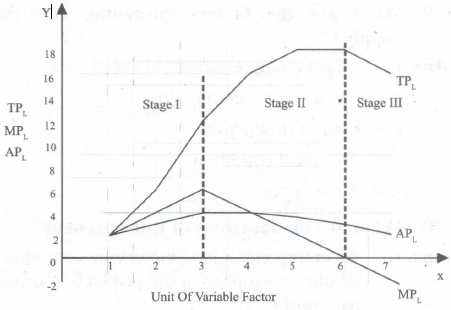
| Stages | Total Product (TP) | Marginal Product (MP) | Average Product(AP) |
| Stage I | It increases at an increasing rate. Then it increases at a decreasing rate. This is the point of inflection. |
It increases, reaches maximum and starts to decrease. | It increases, reaches maximum. |
| Stage II | It continues to increase at a diminishing rate and reaches maximum | lt continues to diminish and becomes zero. | It is equal to MP then begins to diminish. |
| Stage III | It diminishes. | It becomes negative | It diminishes but always is positive. |
Conclusion:
The law of variable proportion helps the producer to decide on the amount of factors to be employed.
16.
Introduction:
The government of India, Ministry of Commerce and Industry announced New Foreign Trade Policy on 1st April 2015 for a period 2015 - 2020.
Salient Features:
(i) Reduce export obligations by 25% and give boost to domestic manufacturing supporting the 'Make in India' concept.
(ii) As a step to Digital India concept, online procedure to upload digitally signed document by CA/CS/Cost Accountant are developed and further mobile app for filing tax, stamp duty has been developed.
(iii) Repeated submission of physical copies of documents available on Exporter Importer Profile is not required.
(iv) Export obligation period for export items related to defence, military store, aerospace and nuclear energy to be 24 months.
Conclusion: EXIM Policy 2015 - 2020 is expected to double the share of India in World Trade from present level of 3% by 2020. This is too ambitious.
17.
Introduction:
(i) The Prime Minister of India announced the new Industrial Policy in 1991.
(ii) The policy has brought changes in the following aspects.
Industrial delicensing policy:
(i) Under the industrial licensing policies, private sector firms had to secure licenses to start an industry.
(ii) The new industrial policy brought an end to industrial licensing or the license raj or red tapism.
Dereservation of the industrial sector:
(i) Previously the public sector was given reservation in capital goods and key industries.
(ii) Under industrial deregulation most of the industrial sectors were opened to the private sector as well.
(iii) Only 3 sectors ie., atomic energy, mining and railways will continue as reserved for public sector.
Reforms related to the public sector enterprises:
(i) Reforms in the public sector aimed at enhancing efficiency and competitiveness of the sector.
(ii) The government identified strategic and priority areas for the public sector to concentrate.
(iii) Loss making PSUs were sold to the private sector.
Abolition of MRTP Act:
(i) The Monopoly and Restrictive Trade Practices Act, 1969 was abolished.
(ii) In 2010, the Competition Commission monitored the competitive practices in the economy.
(iii) A strong and competitive private sector and a number of foreign companies were started in India.
Foreign Investment Policy:
(i) Foreign Investment including FDI and FPI were allowed.
(ii) In 1991, the government announced a specified list of high-technology and high-investment priority industries wherein automatic permission was granted for foreign direct investment (FDI) up to 51% foreign equity.
(iii) Later it was raised to 74% then 100%.
(iv) Foreign Investment Promotion Board was set up to negotiate with international firms and approve foreign direct investment in select areas.
18.
19.
| Wealth | Welfare | Scarcity | Growth |
| Adam Smith classical era. |
Alfred Marshall- neo classical era. |
Lionel Robbins new age. |
Paul Samuelson modern age. |
| An Inquiry into nature and causes of Wealth of Nations (1776). |
Principles of |
An Essay on the nature and Significance of Economic Science (1932). |
Economics studies how men and society choose with or without the use of money, to employ scarce productive resources which could have alternative uses, to produce various commodities over time and distribute them for consumption now and in the future among various people and groups of society. |
| Economics is the science of wealth. | Economics is a study of mankind in the ordinary business of life, it examines that part of individual and social action which is most closely connected with the attainment and with the use of material requisites of well being. It studies wealth and man. |
Economics is a science which studies human behaviour as a relationship between ends and scarce means which have alternative uses. |
Economics deals with how the society uses the limited resources for alternative uses. |
| Deals with only the goods which are scarce and have money value |
wealth and welfare of man is important. | Human behaviour regarding choice is important. |
It covers production, distribution and consumption. |
| Deals with consumption, production, exchange, distribution of wealth. |
Only material welfare is considered, differentiates between material and immaterial things. |
Economic problem arises because of scarcity of resources. |
Economics is a social science. |
| By introducing welfare, economics becomes inexact. |
Ethical aspects are not considered so Economics is exact |
||
| Welfare definition makes Economics classificatory. | Economics is a positive science. |
||
| Economics is a science of individual behaviour. |
|||
| Both material and immaterial activities are considered. |
20.
21.
Short run equilibrium:
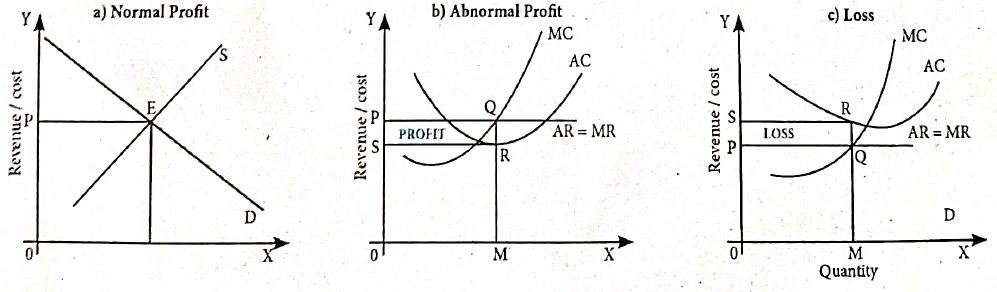
In diagram (a) the demand and supply of all firms interact and price OP is fixed.
(i) In diagram (b) the AC is less than the price.
(ii) At equilibrium MC = MR, AR = QM, AC = RM. Profit per unit is RQ
(iii) Total profit is PQRS.
(iv) In diagram (c) AC is greater than AR.
(v) At equilibrium AR = QM, AC = RM, loss per unit is RQ.
(vi) Total loss is PQRS.
(vii) When there is abnormal profit, new firms will enter the industry
(viii) Supply increases, price falls, profits become normal.
Long run equilibrium:
.JPG)
(i) All factors are variable. Firms earn normal profit.
(ii) There is no tendency for new firms to enter or leave the industry.
(iii) Equilibrium is at minimum point of LAC.
(iv) At point E, LMC = MR = AR = LAC.
(v) AC = QM, AR = QM.
(vi) Profit is normal.
(vii) Long run equilibrium price is lower than short run equilibrium price.
(viii) Long run equilibrium quantity is larger than short run equilibrium quantity.
22.
| Q | Price Rs | TR | AR | MR |
| 1 | 5 | 5 | 5 | 5 |
| 2 | 5 | 10 | 5 | 5 |
| 3 | 5 | 15 | 5 | 5 |
| 4 | 5 | 20 | 5 | 5 |
| 5 | 5 | 25 | 5 | 5 |
| 6 | 5 | 30 | 5 | 5 |
.JPG)
\(A R=\frac{T R}{Q}\)
\( M R=T R_{n}-T R_{n-1}\)
Constant AR & MR (fixed price)
When price remains constant, MR is also constant and AR / MR curves coincide.
Declining AR and MR
When a firm sells large quantities at lower prices both AR & MR will fall but the fall in MR will be steeper than the fall in AR.
| Q | AR | TR | MR |
| 1 | 10 | 10 | 10 |
| 2 | 9 | 18 | 8 |
| 3 | 8 | 24 | 6 |
| 4 | 7 | 28 | 4 |
| 5 | 6 | 30 | 2 |
| 6 | 5 | 30 | 0 |
| 7 | 4 | 28 | -2 |
.JPG)
(i) MR is lower than AR.
(ii) Both AR and MR slope downwards.
(iii) MR divides the distance between AR curve and axis into 2 equal parts.
(iv) The decline in AR need not be a straight line or linear.
(v) If the prices are declining with the increase in quantity sold, the AR can be nonlinear, taking a shape of concave or convex to the origin.
23.
\(\text { TC }=10+Q^{3} \)
\(A C=\frac{10}{Q}+\frac{Q^{3}}{Q}=\frac{10}{Q}+Q^{2}=\frac{10}{5}+5^{2}=2+25=27 \)
\(\text {AVC }=\frac{Q^{3}}{Q}=Q^{2}=5^{2}=25 \)
\(\text {TFC }=10 \)
\(\text {AFC }=\frac{10}{\mathrm{Q}}=\frac{10}{5}=2 \)
\(Ans; \mathrm{AC}=27 ; \quad \mathrm{AVC}=25 ; \quad \mathrm{TFC}=10 ; \quad \mathrm{AFC}=2.\)
24.
Introduction:
(i) Jawaharlal Nehru one of the chief builders of modern India was the first Prime Minister of Independent India.
(ii) He was a great patriot, thinker and statesman.
Democracy and secularism:
(i) Nehru believed in democracy, free speech, civil liberty, adult franchise, the Rule of law and Parliamentary democracy.
(ii) He favoured secularism.
(iii) Secularism means equal respect for all religions. In our country we have Hinduism, Islam, Christianity, Buddhism, Jainism, Sikhism and so on.
(iv) But there is no domination by religious majority.
Planning:
(i) Nehru introduced planning in our country.
(ii) Planning was linked with industrialisation and self-reliance.
(iii) Nehru contributed to the advancement of science, research, technology and industrial development.
(iv) Many IITs and Research Institutions were established.
Democratic socialism:
(i) Nehru wanted a socialistic pattern of society.
(ii) His socialism is democratic socialism.
Conclusion:
(i) Nehru's views on economics and social problems are found in his innumerable speeches and in the books he wrote.
25.
Introduction:
Indian economy is the seventh largest economy of the world. Its features are:
Mixed economy:
(i) In India private and public sectors co-exist.
(ii) Some fundamental and heavy industries are under public sector.
(iii) Due to liberalization private sector's importance has increased.
Agriculture:
(i) 60 % of Indians depend on agriculture for their livelihood.
(ii) 17 % of GDP is got from agricultural sector.
(iii) Green revolution and inventions in biotechnology have made agriculture self sufficient.
(iv) The export of fruits, vegetables, spices, tobacco, animal skin, vegetable oils also add to foreign exchange earning.
An emerging market:
(i) India has emerged as a vibrant economy sustaining stable GDP growth rate even when there was global downtrend.
(ii) This has attracted foreign capital through FDI and FII.
(iii) India is in the 7th position in terms of nominal GDP and 3rd in terms of purchasing power parity.
(iv) India is one among the G20 countries.
Fast growing economy:
(i) With a growth rate of 7.1% in GDP India is the world's fastest growing economy in 2016-17 next to China.
Fast growing service sector:
(i) There has been growth in technical sectors like Information Technology, BPO.
(ii) These emerging services have helped the country to go global.
Large domestic consumption:
(i) The standard of living has improved a lot. There is rapid increase in domestic consumption.
Rapid growth of urban areas:
(i) There has been a rapid growth of urban areas in India after Independence. Improved connectivity in transport and communication, education and health have speeded up urbanization.
Stable macroeconomy:
(i) India is one of the most stable economies of the world.
(ii) The current year's economic survey represents the Indian economy to be a "heaven of macroeconomic stability, resilience and optimism".
Demographic dividend:
(i) The human capital is young.
(ii) They are young, skilled and trained enough to maximize growth.
(iii) This has invited foreign investments and outsourcing opportunities.

11th Standard Syllabus & Materials
11th Standard
TN 11th Tamil பீடு பெற நில் - செய்யுள் - காவடிச்சிந்து Important Questions And Answers Study Material - QB365 Set A
NEW11th Standard
TN 11th Tamil பீடு பெற நில் - உரைநடை - மலை இடப்பெயர்கள் : ஓர் ஆய்வு Important Questions And Answers Study Material - QB365 Set A
NEW11th Standard
TN 11th Tamil மாமழை போற்றுதும் - துணைப்பாடம் - யானை டாக்டர் Important Questions And Answers Study Material - QB365 Set A
NEW11th Standard
TN 11th Tamil மாமழை போற்றுதும் - செய்யுள் - ஐங்குறுநூறு Important Questions And Answers Study Material - QB365 Set A



Tamilnadu Stateboard 11th Standard Subjects

Maths

Commerce
Economics

Biology

Business Maths and Statistics

Accountancy

Computer Science

Physics

Chemistry
Maths
Biology
Economics
Physics
Chemistry

History
Business Maths and Statistics

Computer Science
Accountancy

Computer Applications
History
Computer Technology
Commerce
Computer Applications
Computer Technology

Tamil

English

French
Tamilnadu Stateboard Standards



