
 100% FREE ACCESS
11th Standard Syllabus & Materials
11th Standard
TN 11th Tamil இயற்கை வேளாண்மை,சுற்றுச்சூழல் -செய்யுள் - மனோன்மணீயம் Important Questions And Answers Study Material - QB365 Set A
NEW11th Standard
TN 11th Tamil என்னுயிர் என்பேன் -துணைப்பாடம் - இசைத்தமிழர் இருவர் Important Questions And Answers Study Material - QB365 Set A
NEW11th Standard
TN 11th Tamil மொழி கலை -செய்யுள் - ஒவ்வொரு புல்லையும் Important Questions And Answers Study Material - QB365 Set A
NEW11th Standard
TN 11th Tamil பீடு பெற நில் - இலக்கணம் - பகுபத உறுப்புகள் Important Questions And Answers Study Material - QB365 Set A
NEW11th Standard
TN 11th Tamil பீடு பெற நில் - துணைப்பாடம் - வாடிவாசல் Important Questions And Answers Study Material - QB365 Set A
NEW11th Standard
TN 11th Tamil பீடு பெற நில் - செய்யுள் - குறுந்தொகை Important Questions And Answers Study Material - QB365 Set A

Published on: 09/06/2021
QB365 provides detailed and simple solution for every book back questions in class 11 Economics subject.It will helps to get more idea about question pattern in every book back questions with solution.
Download Tamil Nadu 11th Standard Economics question papers, model tests, one-mark questions, important questions, and public exam papers in PDF format. Free study materials and answer keys for TN State Board students.
Questions + Answers key
Take MCQ Economics Test1.
What are the determinants of Demand? Explain.
2.
3.
Explain the concept of consumer's equilibrium with a diagram.
4.
Mention the relationship between marginal utility and total utility.
5.
Describe the feature of human wants
1.
Determinants of Demand:
(1) Changes in Tastes and Fashions: The demand for some goods and services is very susceptible to changes in tastes and fashions
(2) Changes in Weather: An unusually dry summer results in a increase in the demand for cool drinks.
(3) Taxation and Subsidy: If fresh taxes are levied or the existing rates of taxation on commodities are increased their prices go up. The subsidies will bring down the prices. Therefore taxes reduce demand and subsidies raise demand.
(4) Changes in Expectations: Expectations also bring about a change in demand. Expectation of rise in price in future results in increase in demand.
(5) Changes in Savings: Savings and demand are inversely related.
(6) State of Trade Activity: During the periods of boom and prosperity, the demand for all commodities tends to increase. On the contrary, during times of depression there is a general slackening of demand.
(7) Advertisement: In advanced capitalistic countries advertising is a powerful instrument increasing the demand in the market.
(8) Changes in Income: An increase in family income may increase the demand for durables like video recorders and refrigerators. Equal distribution of income enables poor to get more income. As a result consumption level increases.
(9) Change in Population: The demand for goods depends on the size of population. An increase in population tends to increase the demand for goods and a decrease in population tends to decrease the demand (if other things remain constant).
2.
3.
(i) The consumer reaches equilibrium at the point where the budget line is tangent on the indifference curve.
(ii) T is the point of equilibrium as budget line AB is tangent on indifference curve IC3 the upper IC which implies maximum possible level of satisfaction.
(iii) At equilibrium point, the slope of IC refers to MRSXY and the slope of BL (Budget Line) refers to ratio of price of X to price of Y ie PX/Py. Therefore MRSx,y = PX/Py.
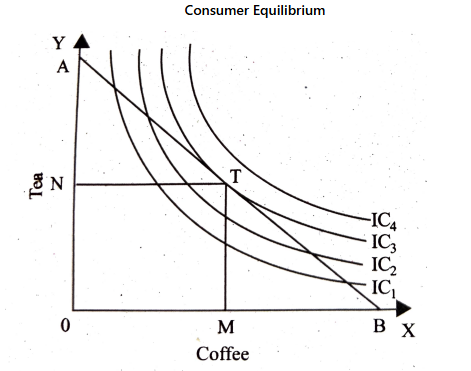
4.
| Total utility | Marginal utility |
| Increases at a diminishing rate | Goes on diminishing |
| Reaches maximum | Becomes zero |
| Diminishes | Becomes negative |
5.
Characteristics
Wants are unlimited
(i) Wants are countless and various in kinds.
(ii) When one want is satisfied another want arises.
Wants become habits
(i) When a man starts reading newspaper in the morning it becomes a habit.
Wants are satiable
(i) We can satisfy particular wants at a given time.
(ii) When one feels hungry, he takes food and that want is satisfied.
Wants are alternative
(i) There are alternative ways to satisfy a particular want (eg) idly, dosa.
Wants are competitive
(i) There is competition among wants.
(ii) So we have to choose more urgent wants and satisfy them first.
Wants are complementary
(i) Satisfaction of a particular want requires the use of more than one commodity. (eg) car and petrol.
Wants are recurring
(i) Some wants occur again and again. For ex. if we feel hungry, we take food and satisfy our want.
(ii) But after some time we again feel hungry and want food.

11th Standard Syllabus & Materials
11th Standard
TN 11th Tamil பீடு பெற நில் - செய்யுள் - காவடிச்சிந்து Important Questions And Answers Study Material - QB365 Set A
NEW11th Standard
TN 11th Tamil பீடு பெற நில் - உரைநடை - மலை இடப்பெயர்கள் : ஓர் ஆய்வு Important Questions And Answers Study Material - QB365 Set A
NEW11th Standard
TN 11th Tamil மாமழை போற்றுதும் - துணைப்பாடம் - யானை டாக்டர் Important Questions And Answers Study Material - QB365 Set A
NEW11th Standard
TN 11th Tamil மாமழை போற்றுதும் - செய்யுள் - ஐங்குறுநூறு Important Questions And Answers Study Material - QB365 Set A



Tamilnadu Stateboard 11th Standard Subjects

Maths

Commerce
Economics

Biology

Business Maths and Statistics

Accountancy

Computer Science

Physics

Chemistry
Maths
Biology
Economics
Physics
Chemistry

History
Business Maths and Statistics

Computer Science
Accountancy

Computer Applications
History
Computer Technology
Commerce
Computer Applications
Computer Technology

Tamil

English

French
Tamilnadu Stateboard Standards



