
 100% FREE ACCESS
11th Standard Syllabus & Materials
11th Standard
TN 11th Tamil இயற்கை வேளாண்மை,சுற்றுச்சூழல் -செய்யுள் - மனோன்மணீயம் Important Questions And Answers Study Material - QB365 Set A
NEW11th Standard
TN 11th Tamil என்னுயிர் என்பேன் -துணைப்பாடம் - இசைத்தமிழர் இருவர் Important Questions And Answers Study Material - QB365 Set A
NEW11th Standard
TN 11th Tamil மொழி கலை -செய்யுள் - ஒவ்வொரு புல்லையும் Important Questions And Answers Study Material - QB365 Set A
NEW11th Standard
TN 11th Tamil பீடு பெற நில் - இலக்கணம் - பகுபத உறுப்புகள் Important Questions And Answers Study Material - QB365 Set A
NEW11th Standard
TN 11th Tamil பீடு பெற நில் - துணைப்பாடம் - வாடிவாசல் Important Questions And Answers Study Material - QB365 Set A
NEW11th Standard
TN 11th Tamil பீடு பெற நில் - செய்யுள் - குறுந்தொகை Important Questions And Answers Study Material - QB365 Set A

Published on: 01/07/2021
QB365 provides detailed and simple solution for every Creative Questions in class 11 Economics Subject. It will helps to get more idea about question pattern in every Creative questions with solution.
Download Tamil Nadu 11th Standard Economics question papers, model tests, one-mark questions, important questions, and public exam papers in PDF format. Free study materials and answer keys for TN State Board students.
Questions + Answers key
Take MCQ Economics Test1.
Explain the theory of "consumer's surplus".
2.
Describe the features of human wants.
3.
Explain the shift in the demand curve with the help of a diagram?
4.
Distinguish between total and marginal utility.
5.
Explain the relationship between price elasticity of demand and slope of a linear demand curve.
1.
(i) According to Marshall," The excess of price which a person would be willing to pay a thing rather than go without the thing, over that which he actually does pay is the economic measure of this surplus satisfaction".
(ii) Consumer's surplus = potential price - actual price.
2.
Features (or) Characteristics of Human Wants:
(a) Wants are unlimited: Human wants are countless in number and various in kinds. When one want is satisfied another want crops up. Human wants multiply with the growth of civilization and development.
(b) Wants become habits: Wants become habits; for example, when a man starts reading newspaper in the morning, it becomes a habit. Same is the case with drinking tea or chewing pans.
(c) Wants are Satiable: Though we cannot satisfy all our wants, at the same time we can satisfy particular wants at a given time. When one feels hungry, he takes food and that want is satisfied.
(d) Wants are Alternative: There are alternative ways to: satisfy a particular want ego idly, dosa or chappathi.
(e) Wants are Competitive: All our wants are not equally important. So, there is competition among wants. Hence, we have to choose more urgent wants than less urgent wants.
(f) Wants are Complementary: Sometimes, satisfaction of a particular want requires the use of more than one commodity. Example: Car and Petrol, Ink and Pen.
(g) Wants are Recurring: Some wants occur again and again. For example, if we feel hungry, we take food and satisfy our want. But after sometime, we again feel hungry. and want food.
3.
Introduction: A shift in the demand curve occurs with a change in the value of a variable other than its price in the general demand function. Shifts in the Demand Curve: An increase or decrease in demand due to change in conditions of demand is shown by way of shifts in the demand curve.
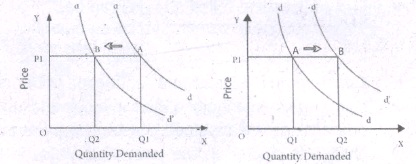
On the left hand side of the diagram the original demand curve is d1d1, the price is OP1 and the quantity demanded is OQ1. Due to change in the condition of demand (change in income, taste or change in prices of substitutes or complements) the quantity demanded decreases from OQ1 to OQ2. This is shown in the demand curve to the left. The new demand curve is d1 d1. This is called decrease in demand.
On the right hand side of the diagram the original price OP1 and the quantity demanded is OQ1.
Due to changes in other conditions the quantity purchased has increased to OQ2. Thus the demand curve shifts to the right d1d1. This is called increase in demand.
4.
Utility is defined as the power of commodity or a service to satisfy a human want.
a. Total Utility: Total Utility refers to the sum of utilities of all units of a commodity consumed. For example, if a consumer consumes ten biscuits, then the total utility is the sum of satisfaction of consuming all the ten biscuits.
b. Marginal Utility: Marginal Utility is the addition made to the total utility by consuming one more unit of a commodity. For example, if a consumer consumes 10 biscuits, the marginal utility is the utility derived from the 10th unit. It is nothing but the total utility of 10 biscuits minus the total utility of 9 biscuits.
Thus MUn = TUn - TUn-1
Where
MUn = Marginal Utility of 'nth' commodity.
TUn = Total Utility of n units.
TUn-1 = Total Utility of n-1 units.
c. Relationship between Marginal Utility and Total Utility:
| Marginal Utility | Total Utility |
| (i) Declines | Increases |
| (ii) Reaches zero | Reaches maximum |
| (iii) Becomes negative | Declines |
5.
The slope of a linear demand curve is given as \(\frac{\Delta p}{\Delta q}\)
(i) While price elasticity of demand is given as
\(Ed=\frac{\Delta Q}{\Delta P}\times \frac{P}{Q}\)
(ii) Hence, we can write above equation
(iii) (i) as \(Ed=\frac{1}{Slope\ of\ Demand\ Curve}\times \frac{P}{Q}\)
\(Ed=\frac{1}{\frac PQ}\times \frac{P}{Q}\)
(iv) The above equation states that there exist an inverse relationship between slope of a linear demand curve and Price elasticity of demand.

11th Standard Syllabus & Materials
11th Standard
TN 11th Tamil பீடு பெற நில் - செய்யுள் - காவடிச்சிந்து Important Questions And Answers Study Material - QB365 Set A
NEW11th Standard
TN 11th Tamil பீடு பெற நில் - உரைநடை - மலை இடப்பெயர்கள் : ஓர் ஆய்வு Important Questions And Answers Study Material - QB365 Set A
NEW11th Standard
TN 11th Tamil மாமழை போற்றுதும் - துணைப்பாடம் - யானை டாக்டர் Important Questions And Answers Study Material - QB365 Set A
NEW11th Standard
TN 11th Tamil மாமழை போற்றுதும் - செய்யுள் - ஐங்குறுநூறு Important Questions And Answers Study Material - QB365 Set A



Tamilnadu Stateboard 11th Standard Subjects

Maths

Commerce
Economics

Biology

Business Maths and Statistics

Accountancy

Computer Science

Physics

Chemistry
Maths
Biology
Economics
Physics
Chemistry

History
Business Maths and Statistics

Computer Science
Accountancy

Computer Applications
History
Computer Technology
Commerce
Computer Applications
Computer Technology

Tamil

English

French
Tamilnadu Stateboard Standards



