
 100% FREE ACCESS
11th Standard Syllabus & Materials
11th Standard
TN 11th Tamil இயற்கை வேளாண்மை,சுற்றுச்சூழல் -செய்யுள் - மனோன்மணீயம் Important Questions And Answers Study Material - QB365 Set A
NEW11th Standard
TN 11th Tamil என்னுயிர் என்பேன் -துணைப்பாடம் - இசைத்தமிழர் இருவர் Important Questions And Answers Study Material - QB365 Set A
NEW11th Standard
TN 11th Tamil மொழி கலை -செய்யுள் - ஒவ்வொரு புல்லையும் Important Questions And Answers Study Material - QB365 Set A
NEW11th Standard
TN 11th Tamil பீடு பெற நில் - இலக்கணம் - பகுபத உறுப்புகள் Important Questions And Answers Study Material - QB365 Set A
NEW11th Standard
TN 11th Tamil பீடு பெற நில் - துணைப்பாடம் - வாடிவாசல் Important Questions And Answers Study Material - QB365 Set A
NEW11th Standard
TN 11th Tamil பீடு பெற நில் - செய்யுள் - குறுந்தொகை Important Questions And Answers Study Material - QB365 Set A

Published on: 01/07/2021
QB365 provides detailed and simple solution for every Creative Questions in class 11 Economics Subject. It will helps to get more idea about question pattern in every Creative questions with solution.
Download Tamil Nadu 11th Standard Economics question papers, model tests, one-mark questions, important questions, and public exam papers in PDF format. Free study materials and answer keys for TN State Board students.
Questions + Answers key
Take MCQ Economics Test1.
Define Price Elasticity of demand and explain the different levels or degrees of price elasticity of demand.
2.
What are the reasons for Exceptional Demand curve?
3.
Enumerate the determinants of Demand?
4.
Explain the Importance of elasticity of Demand?
5.
What is Indifference curve map? Explain the properties of indifference curve with diagrams.
1.
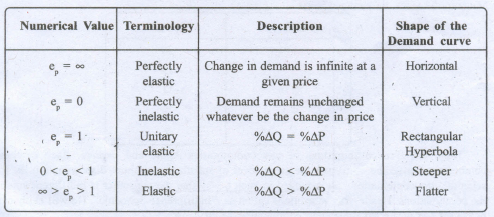
Levels or Degrees of Price Elasticity of Demand
Definition: The Price Elasticity of Demand is commonly known as the elasticity of demand, which refers to the degree of responsiveness of demand to the change in the price of the commodity.
(1) Perfectly Elastic Demand \(({ E }_{ p }=\infty )\):
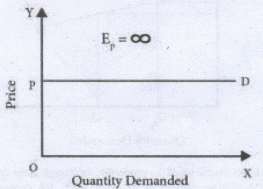
The demand is said to be perfectly elastic when a slight change in the price of a commodity causes an infinite change in its quantity demanded. Such as, even a small rise in the price of a commodity can result in greater fall in demand even to zero, In some cases a little fall in the price can result in the increase in demand to infinity. In perfectly elastic demand the demand curve is a horizontal straight line parallel to X-axis.
(2) Perfectly Inelastic Demand \(({ E }_{ p }=0)\):
When there is no change in the demand for a product due to the change in the price, then the demand is said to be perfectly inelastic
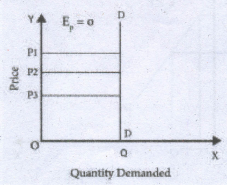
Here, the demand curve is a vertical straight line which shows that the demand remains unchanged irrespective of change in the price., i.e. quantity OQ remains unchanged at different prices, \({ P }_{ 1 }{ ,P }_{ 2 },\) and \({ P }_{ 3 }\)
(3) Relatively Elastic Demand (\({ E }_{ p }\) > 1):
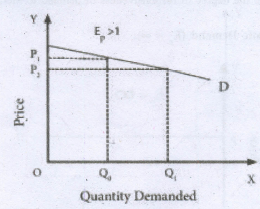
The demand is relatively elastic when the proportionate change in the demand for a commodity is greater than the proportionate change in its price. Here, the demand curve is gradually sloping which shows that a proportionate change in quantity from 5 to 10 is greater than the proportionate change in the price from 11 to 10. Change in demand is: 10 - 5/5 x 100 = 100% Change in price = 10%. Hence, it is more elastic demand.
(4) Relatively Inelastic Demand (\({ E }_{ p }\) < 1):
When the proportionate change in the demand for a product is less than the proportionate change in the price, the demand is said to be relatively inelastic.
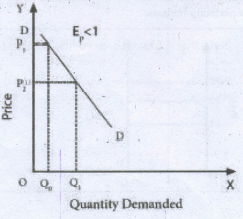
It is also called as the elasticity less than unity. Here the demand curve is steeply sloping, which shows that the change in the quantity from \(OQ_{ 0 }\) to \(OQ_{ 1 }\) is relatively smaller than the change in the price from \(OP_{ 1 }\) to \(OP_{ 2 }\)
(5) Unitary Elastic Demand (\({ E }_{ p }\) = 1):
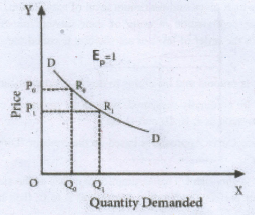
The demand is unitary elastic when the proportionate change in the price of a product results in the same proportionate change in the quantity demanded.
Here the shape of the demand curve is a rectangular hyperbola, which shows that area under the curve is equal to one.
Here \({ OP }_{ 0 }{ R }_{ 0 }{ Q }_{ 0 }={ OP }_{ 1 }{ R }_{ 1 }{ Q }_{ 1 }\)
Degrees of Price Elasticity of Demand
2.
i. Giffen Paradox: The Giffen good or inferior good is an exception to the law of demand. When the price of an inferior good falls, the poor will buy less and vice versa.
ii. Veblen or Demonstration effect: Veblen has explained the exceptional demand curve through his doctrine of conspicuous consumption. Rich people buy certain goods because it gives social prestige. For example, diamonds.
iii. Ignorance: Sometimes, the quality of the commodity is judged by its price. Consumers think that the product is superior if the price is high. As such they buy more at a higher price.
iv. Speculative effect: If the price of the commodity is increasing then the consumers will buy more of it because of the expectation that it will increase still further. Eg stock markets.
v. Fear of shortage: During times of emergency or war, people may expect shortage of a commodity and so buy more.
3.
Introduction: Demand is always related to price. Demand is always a specific quantity which a consumer is willing to purchase.
Demand Function: Demand depends upon price. This means demand for a commodity is a functions of price. D = f (P)
Determinants of Demand:
i. Changes in Tastes and Fashions:
The demand for some goods and services is very susceptible to changes in tastes and fashions.
ii. Changes in Weather:
An unusually dry summer results in a increase in the demand for cool drinks.
iii. Taxation and Subsidy:
The subsidies will bring down the prices. Therefore taxes reduce demand and subsidies raise demand.
iv. Changes in expectations:
Expectation of rise in price in future results in increase in demand,
v. Changes in savings:
Savings and demand are inversely related.
vi. State of Trade Activity:
During the period of boom and prosperity demand for all commodities tendes to increase. On the contrary, during time to depression, there is general slackening of demand.
vii. Advertisement:
Advertisement is a powerful instrument increasing the demand in the market.
viii. Changes in income:
An increase in family income may increase the demand for durables like video recorders and refrigerators. Equal distribution of income enables poor to get more income.
ix. Change in population:
The demand for goods depends on the size of population. An increase in population tends to increase the demand for goods and a decrease in population tends to decrease the demand (if other things remain constant).
4.
The concept of elasticity of demand is of much practical importance.
1. Price fixation:
Each seller under monopoly and imperfect competition has to take into account elasticity of demand while fixing the price for his product. If the demand for the product is inelastic, he can fix a higher price.
2. Production:
Producers generally decide their production level on the basis of demand for the product.
5.
a. Indifference Map:
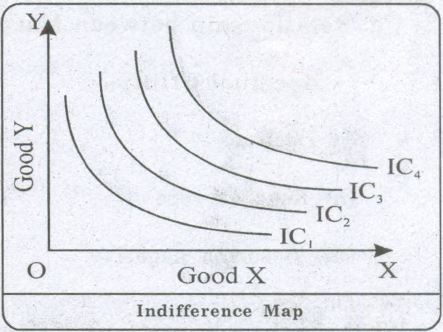
Indifference Map is a group of indifference curves for two commodities showing different levels of satisfaction. In this indifference map, it should be clearly understood that a higher indifference curve denotes higher level of satisfaction and a lower indifference curve represents lower level of satisfaction. Being rational, the consumer will always choose a higher indifference curve to get maximum satisfaction, other things being equal.
b. Properties of an Indifference curve:
i. Indifference curves slope downwards to the right
ii. Indifference curves are convex to the origin
iii. No two indifference curves can ever cut each other.
i. All indifference curves slope downwards from left to right:
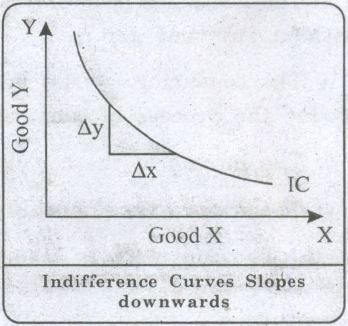
The downward slope of indifference curve must be attributed to the fact that the consumer in substituting good X by good Y, increases the amount of Y and reduces the amount of X. If the indifference curve were horizontal line running parallel to X axis then the combination which it represents is the same amount of Y but more and more of X. In that case, the satisfaction from the combination will not be equal. For the same reason, it can be said that indifference Curves will not be vertical.
ii. All indifference curves are convex to the origin:
This is because of the operation of a principle known as 'Diminishing Marginal Rate of Substitution'. The indifference curves are based on this principle. If they are concave to the origin, then it will mean that MRS is increasing. Indifference curve cannot be straight line except when the goods are perfect substitutes.
Marginal rate of substitution between X and Y refers to the amount of commodity Y to be offered in exchange for one unit of X commodity. The MRS goes on diminishing as consumer goes on substituting X for Y.
iii. No two indifference curves intersect each other:
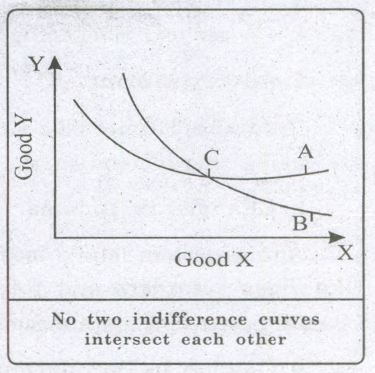
The third assumption is that no two indifference curves can ever cut each other. But in the Figure we find two indifference curves do cut each other. Point A which is on indifference curve 2 represents a higher level of satisfaction to the consumer than at point B which is on indifference curve 1. But point C lies on both curves. That means, two levels of satisfaction A and B which are unequal have become equal. That cannot be accepted. So indifference curves can never cut each other. These are the three assumptions about the shape of an indifference curve.

11th Standard Syllabus & Materials
11th Standard
TN 11th Tamil பீடு பெற நில் - செய்யுள் - காவடிச்சிந்து Important Questions And Answers Study Material - QB365 Set A
NEW11th Standard
TN 11th Tamil பீடு பெற நில் - உரைநடை - மலை இடப்பெயர்கள் : ஓர் ஆய்வு Important Questions And Answers Study Material - QB365 Set A
NEW11th Standard
TN 11th Tamil மாமழை போற்றுதும் - துணைப்பாடம் - யானை டாக்டர் Important Questions And Answers Study Material - QB365 Set A
NEW11th Standard
TN 11th Tamil மாமழை போற்றுதும் - செய்யுள் - ஐங்குறுநூறு Important Questions And Answers Study Material - QB365 Set A



Tamilnadu Stateboard 11th Standard Subjects

Maths

Commerce
Economics

Biology

Business Maths and Statistics

Accountancy

Computer Science

Physics

Chemistry
Maths
Biology
Economics
Physics
Chemistry

History
Business Maths and Statistics

Computer Science
Accountancy

Computer Applications
History
Computer Technology
Commerce
Computer Applications
Computer Technology

Tamil

English

French
Tamilnadu Stateboard Standards



