
 100% FREE ACCESS
11th Standard Syllabus & Materials
11th Standard
TN 11th Tamil இயற்கை வேளாண்மை,சுற்றுச்சூழல் -செய்யுள் - மனோன்மணீயம் Important Questions And Answers Study Material - QB365 Set A
NEW11th Standard
TN 11th Tamil என்னுயிர் என்பேன் -துணைப்பாடம் - இசைத்தமிழர் இருவர் Important Questions And Answers Study Material - QB365 Set A
NEW11th Standard
TN 11th Tamil மொழி கலை -செய்யுள் - ஒவ்வொரு புல்லையும் Important Questions And Answers Study Material - QB365 Set A
NEW11th Standard
TN 11th Tamil பீடு பெற நில் - இலக்கணம் - பகுபத உறுப்புகள் Important Questions And Answers Study Material - QB365 Set A
NEW11th Standard
TN 11th Tamil பீடு பெற நில் - துணைப்பாடம் - வாடிவாசல் Important Questions And Answers Study Material - QB365 Set A
NEW11th Standard
TN 11th Tamil பீடு பெற நில் - செய்யுள் - குறுந்தொகை Important Questions And Answers Study Material - QB365 Set A

Published on: 01/07/2021
QB365 provides detailed and simple solution for every Creative Questions in class 11 Economics Subject. It will helps to get more idea about question pattern in every Creative questions with solution.
Download Tamil Nadu 11th Standard Economics question papers, model tests, one-mark questions, important questions, and public exam papers in PDF format. Free study materials and answer keys for TN State Board students.
Questions + Answers key
Take MCQ Economics Test1.
Distinguish between Sunk Cost and Floating Cost.
2.
Distinguish between Economic cost and Social cost.
3.
Define Accounting cost.
4.
Explain the concept of 'cost minimization!
5.
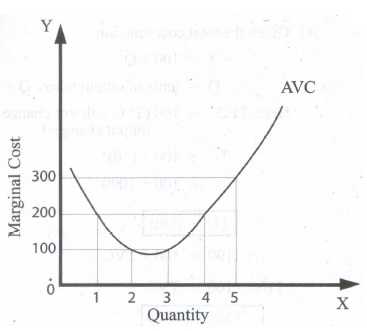
Explain Average Variable cost with the help of figure.
1.
| S.No | Sunk Cost | Floating Cost |
| (i) |
A cost incurred in the past and cannot be recovered in future is called as Sunk Cost. This is historical but irrelevant for future business decisions. |
It refers to all expenses that are directly associated with business activities but not with asset creation |
| (ii) | It is called as sunk because, they are unalterable, unrecoverable, and if once invested it should be treated as drowned. or disappeared. | It does not include the purchase of raw material as it is part of current assets |
| (iii) | For example, if a firm purchases a specialized equipment designed for a special plant, the expenditure on this equipment is a sunk cost, because it has no alternative use and its opportunity Cost is zero | It includes payments like wages to workers, transportation charges, fees for power and administration. |
| (iv) | Sunk cost is also called as 'Retrospective Cost'. | Floating cost is necessary to run the day-to-day business of a firm. |
2.
Cost: Cost refers to the total expenses incurred in the production of commodity. The functional relationship between cost and output is expressed as "Cost Function".
C = f(Q)
| S.No. | Economic Cost | Social Cost |
| 1. | It refers to all payments made to the resources to regular supply in the process of production | It refers to the total cost borne by the society due to production of a commodity. |
| 2. | It is the summation of Explicit cost and Implicit cost. | It is also called External cost. |
| 3. | It is the relevant to calculate the profit (Economic profit of a firm) | But incurred by other in the society (efforts and sacrifices undergone by the various members in the society) |
| 4. | (Ex) Payment for raw materials, rent for building | (ex) Large business firm cause air pollution, water pollution in a particular area) |
3.
Accounting costs or explicit costs are the payments made by the entrepreneur to the suppliers of various productive factors. The accounting costs are only those costs, which are directly paid out or accounted for by the producer i.e. wages to the labourers employed, prices for the raw materials purchased, fuel and power used, rent for the building hired for the production work, the rate of interest on the borrowed capital and the taxes paid.
4.
(i) As the profit is the difference between total revenue and total cost.
(ii) Cost minimization is a necessary condition for achieving the profit maximization goal of the firm.
(iii) Cost minimization implies that the costs of inputs have to be reduced for the purpose.
(iv) The costs of inputs include the prices of raw materials, wages and salaries of labour, expenditure on machinery and equipment, depreciation on machines etc.
5.
(i) It refers to the total variable cost per unit of output.
(ii) It is obtained by dividing total variable cost (TVC) by the quantity of output (Q).
(iii) AVC = TVC/Q Where AVC - Average variable cost, TVC - Total variable cost,
Q - Quantity of output.
| Q(in Unit) | TVC (in Rs) | \(AVC=\frac{TVC}{Q}(in\ Rs)\) |
| 0 | 0 | 0/0=0 |
| 1 | 200 | 200/1=200 |
| 2 | 300 | 300/2=150 |
| 3 | 400 | 400/3=133 |
| 4 | 600 | 600/4=150 |
| 5 | 900 | 900/5=180 |

11th Standard Syllabus & Materials
11th Standard
TN 11th Tamil பீடு பெற நில் - செய்யுள் - காவடிச்சிந்து Important Questions And Answers Study Material - QB365 Set A
NEW11th Standard
TN 11th Tamil பீடு பெற நில் - உரைநடை - மலை இடப்பெயர்கள் : ஓர் ஆய்வு Important Questions And Answers Study Material - QB365 Set A
NEW11th Standard
TN 11th Tamil மாமழை போற்றுதும் - துணைப்பாடம் - யானை டாக்டர் Important Questions And Answers Study Material - QB365 Set A
NEW11th Standard
TN 11th Tamil மாமழை போற்றுதும் - செய்யுள் - ஐங்குறுநூறு Important Questions And Answers Study Material - QB365 Set A



Tamilnadu Stateboard 11th Standard Subjects

Maths

Commerce
Economics

Biology

Business Maths and Statistics

Accountancy

Computer Science

Physics

Chemistry
Maths
Biology
Economics
Physics
Chemistry

History
Business Maths and Statistics

Computer Science
Accountancy

Computer Applications
History
Computer Technology
Commerce
Computer Applications
Computer Technology

Tamil

English

French
Tamilnadu Stateboard Standards



