
 100% FREE ACCESS
11th Standard Syllabus & Materials
11th Standard
TN 11th Tamil இயற்கை வேளாண்மை,சுற்றுச்சூழல் -செய்யுள் - மனோன்மணீயம் Important Questions And Answers Study Material - QB365 Set A
NEW11th Standard
TN 11th Tamil என்னுயிர் என்பேன் -துணைப்பாடம் - இசைத்தமிழர் இருவர் Important Questions And Answers Study Material - QB365 Set A
NEW11th Standard
TN 11th Tamil மொழி கலை -செய்யுள் - ஒவ்வொரு புல்லையும் Important Questions And Answers Study Material - QB365 Set A
NEW11th Standard
TN 11th Tamil பீடு பெற நில் - இலக்கணம் - பகுபத உறுப்புகள் Important Questions And Answers Study Material - QB365 Set A
NEW11th Standard
TN 11th Tamil பீடு பெற நில் - துணைப்பாடம் - வாடிவாசல் Important Questions And Answers Study Material - QB365 Set A
NEW11th Standard
TN 11th Tamil பீடு பெற நில் - செய்யுள் - குறுந்தொகை Important Questions And Answers Study Material - QB365 Set A

Published on: 13/05/2022
QB365 provides detailed and simple solution for every Creative Questions in class 11 Economics Subject. It will helps to get more idea about question pattern in every Creative questions with solution.
latest Creative QuestionsDownload Tamil Nadu 11th Standard Economics question papers, model tests, one-mark questions, important questions, and public exam papers in PDF format. Free study materials and answer keys for TN State Board students.
Questions + Answers key
Take MCQ Economics Test1.
Relationship between TR, AR, MR and Elasticity of demand.
2.
Define Total Revenue and Explain its behaviour when the price is constant and when the price is declining.
3.
Explain briefly total cost with a suitable diagram.
4.
Bring out the relationship among TR, AR, MR curves and elasticity of demand.
5.
If the total cost = 100 + Q3, find out AVC, AC, TFC, AFC and TVC when Q = 10.
1.
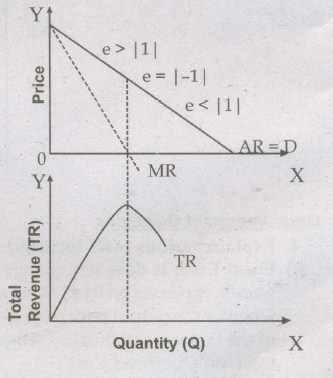
The relationship among AR, MR and elasticity of demand (e) is stated as follows. MR = AR.( e-1/e)
The relationship between the AR curve and MR curve depends upon the elasticity of AR curve (AR = DD = Price).
(i) When price elasticity of demand is greater than one, MR is positive and TR is increasing.
(ii) When price elasticity of demand is less than one, MR is negative and TR is decreasing.
(iii) When price elasticity of demand is equal to one, MR is equal to zero and TR is maximum and constant.
It is to be noted that, the output range of 1 to 5 units, the price elasticity of demand is greater than one according to total outlay method. Hence, TR is increasing and MR is positive.
At the output range of 5 to 6 units, the price elasticity of demand is equal to one. Hence, TR is maximum and MR equals to zero.
At the output range of 6 units to 10 units, the price elasticity of demand is less than unity. Hence, TR is decreasing and MR is negative.
| Quantity (Q) | Price (P) | TR | AR | MR | Elasticity |
| 0 | 11 | 0 | 11 | - | e > 1 |
| 1 | 10 | 10 | 10 | 10 | e > 1 |
| 2 | 9 | 18 | 9 | 8 | e > 1 |
| 3 | 8 | 24 | 8 | 6 | e > 1 |
| 4 | 7 | 28 | 7 | 4 | e > 1 |
| 5 | 6 | 30 | 6 | 2 | e > 1 |
| 6 | 5 | 30 | 5 | 0 | e = 1 |
| 7 | 4 | 28 | 4 | -2 | e < 1 |
| 8 | 3 | 24 | 3 | -4 | e < 1 |
| 9 | 2 | 18 | 2 | -6 | e < 1 |
| 10 | 1 | 10 | 1 | -8 | e < 1 |
| 11 | 0 | 0 | 0 | -10 | e < 1 |
2.
Total Revenue:
Total revenue is the amount of income received by the firm from the sale of its products. It is obtained by multiplying the price of the commodity by the number of units sold.
TR = p x Q
where, TR denotes Total Revenue, P denotes Price and
Q denotes Quantity sold.
For example, a cell-phone company sold 100 cell-phones at the price of t500 each. TR is
Rs.50,000. (TR= 500 x 100 = 50,000).
Total Revenue - Constant Price
| Quantity sold (Q) |
Price (P) |
Total Revenue (TR) |
|
1 |
5 |
5 10 15 20 2 30 |
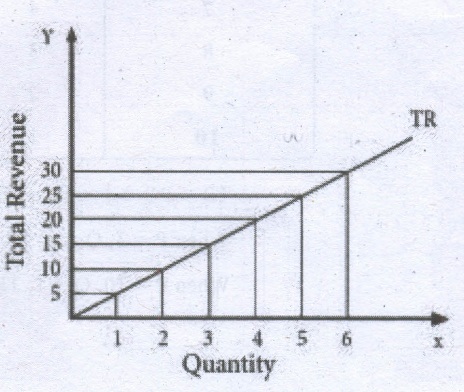
When price is constant, the behaviour of TR is shown in the table and the diagram, assuming P = 5. When P = 5; TR = PQ
When price is declining with increase in quantity sold. (Eg. Imperfect Competition on the goods market) the behaviour of TR is shown in the table and in the diagram. TR can be obtained from Demand function: If Q = 11-P, When P = 1, Q = 10
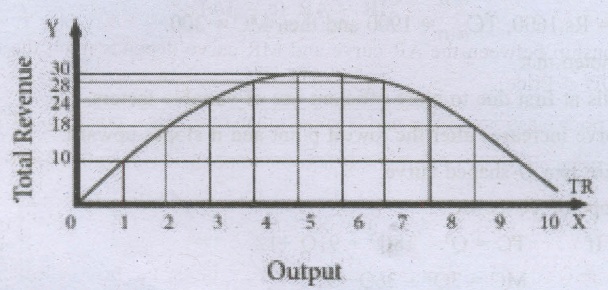
Total Revenue - Price declining
| Quantity sold (Q) | Price (P) | Total Revenue (TR) |
|
1 |
10 |
10 |
TR = PQ = 1 x 10 = 10
When P = 3, Q = 8, TR = 24
When P = 10, Q = 1, TR = 10
3.
Total Cost:
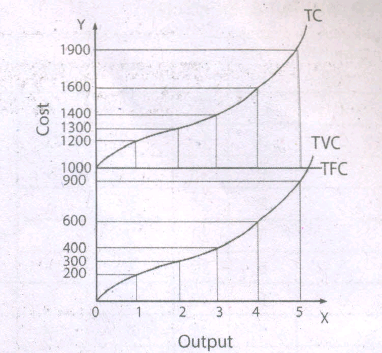
Total cost means the sum total of all payments made in the production. It is also called as total cost of production.
TC = TFC + TYC
For example, when the total fixed cost is Rs.1000 and the total variable cost is Rs. 200 then the total cost is Rs.1200 (Rs.1000 + Rs.200)
IF TFC = 12 and
TYC = Q3 -18Q2 + 91Q
TC = 12 + Q3 - 18Q2 + 91Q
| Output (in unit) |
Total Fixed Cost (TFC) (in Rs) |
Total Variable Cost (TVC) (in Rs) |
Total Cost (TC) TFC+TVC (in Rs) |
| 0 | 1000 | 0 | 1000 |
| 1 | 1000 | 200 | 1200 |
| 2 | 1000 | 300 | 1300 |
| 3 | 1000 | 400 | 1400 |
| 4 | 1000 | 500 | 1500 |
| 5 | 1000 | 600 | 1600 |
It is to be noted that,
a) The TC curve is obtained by adding TFC + TVC curves vertically.
b) TFC curve remains parallel to x-axis indicating a straight line.
c) TVC starts from the organ and move upwards as no variable cost is incurred at zero output.
d) When TFC + TVC are added, TC starts from TFC and move upwards.
e) TC curve lies above the TVC curve.
f) TVC and TC curves are the same shapes but beginning point is different.
4.
Relationship among TR, AR, MR Curves:
When marginal revenue is positive, total revenue rises, when MR is zero, the total revenue becomes maximum. When marginal revenue becomes negative, total revenue starts falling. When AR and MR both are falling, then MR falls at a faster rate than AR.
TR, AR, MR and Elasticity of Demand:
The relationship among AR, MR and elasticity of demand (e) is stated as follows.
MR = AR (e-i/e)
The relationship between the AR curve and MR curve depends upon the elasticity of AR curve (AR = DD = Price).
a) When price elasticity of demand is greater than one, MR is positive and TR is increasing.
b) When price elasticity of demand is less than one, MR is negative and TR is decreasing.
c) When price elasticity of demand is equal to one, MR is equal to zero and TR is maximum and constant.
It is to be noted that, the output range of 1 to 5 units, the price elasticity of demand is greater than one according to total out by method. Hence TR is increasing and MR is positive.
TR, AR, MR & Elasticity
| Quantity (Q) |
Price (P) |
TR | AR | MR | Elasticity |
| 0 | 11 | 0 | 11 | - | e > 1 |
| 1 | 10 | 10 | 10 | 10 | |
| 2 | 9 | 18 | 9 | 8 | |
| 3 | 8 | 24 | 8 | 6 | |
| 4 | 7 | 28 | 7 | 4 | |
| 5 | 6 | 30 | 6 | 2 | |
| 6 | 5 | 30 | 5 | 0 | e = 1 |
| 7 | 4 | 28 | 4 | -2 | e > 1 |
| 8 | 3 | 24 | 3 | -4 | |
| 9 | 2 | 18 | 2 | -6 | |
| 10 | 1 | 10 | 1 | -8 | |
| 11 | 0 | 0 | 0 | -10 |
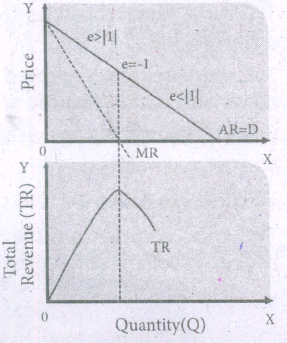
At the output range of 5 to 6 units, the price elasticity of demand is equal to one. Hence TR is maximum and MR equals to zero.
At the output range of 6 units to 10 units, the price elasticity of demand is less than unity. Hence TR is decreasing and MR is negative.
5.
TC = TFC + TVC
\(AVC=\frac{TVC}{Q}\)
\(AFC=\frac{TFC}{Q}\)
\(AC=\frac{TC}{Q}\)
(i) TC = 100 + Q3. Total cost has two components TFC and TVC.
(ii) TFC = is the total fixed cost which does not change with the level of output.
(iii) It is determined by putting the value of Q.
(iv) Given the total cost function T = 100+Q3
Q = units of output where Q = 10
Here TFC = 100 (TFC will not change with output changes)
TC 100 + (10)3
= 100 + 1000
TC = 1100
\(\therefore\)1100 = 100 + TVC
1100 - 100 = TVC
\(\therefore\)TVC = 1000
TVC = 1000, TC = 1100 \(\therefore\) TFC =?
TC = TFC + TVC
1100 = TFC + 1000
1100 - 1000 = TFC
\(\therefore\)TFC = 100
\(AFC=\frac{TFC}{Q}\)
TFC = 100, Q = 10
\(\therefore\) AFC = 10
\(AFC=\frac{TFC}{Q}\)
TVC = 1000, Q = 10
\(\therefore\) AVC = 100
\(AC=\frac{TC}{Q}\)
TC = 1100, Q = 10
\(\therefore\) AC = 110
or
AC = AFC + AVC
AFC = 10, AVC = 100
AC = 10 + 100
\(\therefore\) AC = 110

11th Standard Syllabus & Materials
11th Standard
TN 11th Tamil பீடு பெற நில் - செய்யுள் - காவடிச்சிந்து Important Questions And Answers Study Material - QB365 Set A
NEW11th Standard
TN 11th Tamil பீடு பெற நில் - உரைநடை - மலை இடப்பெயர்கள் : ஓர் ஆய்வு Important Questions And Answers Study Material - QB365 Set A
NEW11th Standard
TN 11th Tamil மாமழை போற்றுதும் - துணைப்பாடம் - யானை டாக்டர் Important Questions And Answers Study Material - QB365 Set A
NEW11th Standard
TN 11th Tamil மாமழை போற்றுதும் - செய்யுள் - ஐங்குறுநூறு Important Questions And Answers Study Material - QB365 Set A



Tamilnadu Stateboard 11th Standard Subjects

Maths

Commerce
Economics

Biology

Business Maths and Statistics

Accountancy

Computer Science

Physics

Chemistry
Maths
Biology
Economics
Physics
Chemistry

History
Business Maths and Statistics

Computer Science
Accountancy

Computer Applications
History
Computer Technology
Commerce
Computer Applications
Computer Technology

Tamil

English

French
Tamilnadu Stateboard Standards



