
 100% FREE ACCESS
11th Standard Syllabus & Materials
11th Standard
TN 11th Tamil இயற்கை வேளாண்மை,சுற்றுச்சூழல் -செய்யுள் - மனோன்மணீயம் Important Questions And Answers Study Material - QB365 Set A
NEW11th Standard
TN 11th Tamil என்னுயிர் என்பேன் -துணைப்பாடம் - இசைத்தமிழர் இருவர் Important Questions And Answers Study Material - QB365 Set A
NEW11th Standard
TN 11th Tamil மொழி கலை -செய்யுள் - ஒவ்வொரு புல்லையும் Important Questions And Answers Study Material - QB365 Set A
NEW11th Standard
TN 11th Tamil பீடு பெற நில் - இலக்கணம் - பகுபத உறுப்புகள் Important Questions And Answers Study Material - QB365 Set A
NEW11th Standard
TN 11th Tamil பீடு பெற நில் - துணைப்பாடம் - வாடிவாசல் Important Questions And Answers Study Material - QB365 Set A
NEW11th Standard
TN 11th Tamil பீடு பெற நில் - செய்யுள் - குறுந்தொகை Important Questions And Answers Study Material - QB365 Set A

Published on: 13/05/2022
QB365 provides detailed and simple solution for every Creative Questions in class 11 Economics Subject. It will helps to get more idea about question pattern in every Creative questions with solution.
latest Creative QuestionsDownload Tamil Nadu 11th Standard Economics question papers, model tests, one-mark questions, important questions, and public exam papers in PDF format. Free study materials and answer keys for TN State Board students.
Questions + Answers key
Take MCQ Economics Test1.
Explain various costs incurred by the firm.
2.
Explain the short run Average Cost curves with suitable diagrams.
3.
Describe the Total Revenue concepts under various price conditions.
4.
Explain the meaning of Fixed and Variable factors and costs.
5.
Explain the Total Revenue with the help of Diagram.
1.
(i) Fixed Cost: It does not change with the change in the quantity of output. In other words, expenses on fixed factors remain unchanged irrespective of the level of output, whether the output is increased or decreased or even it becomes zero. For example, rent of the factory, watchman's wages, worker's salary. It is also called as 'Supplementary Cost' or 'Overhead Cost'.
(ii) Variable cost: These costs vary with the level of output. Examples of variable costs are: wages of temporary workers, cost of raw materials, fuel cost, etc., Variable cost is also called as Prime Cost, Special Cost, or Direct Cost.
(iii) Money cost: Production cost expressed in money terms is called as money cost. In other words, it is the total money expenses incurred by a firm in producing a commodity. Money cost includes the expenditures such as cost of raw materials, payment of wages and salaries, payment of rent, interest on capital, expenses on fuel and power, expenses on transportation and other types of production related costs. These costs are considered as out of pocket expenses. Money costs are also called as Prime Cost or Direct Cost or Accounting Cost or Explicit Cost.
(iv) Real cost: It refers to the payment made to compensate the efforts and sacrifices of all factor owners for their services in production. It includes the efforts and sacrifices of landlords in the use of land, capitalists to save and invest, and workers in foregoing leisure.
(v) Explicit Cost: Payment made to others for the purchase of factors of production is known as Explicit Costs. It refers to the actual expenditures of the firm to purchase or hire the inputs the firm needs. ego wages, payment of raw materials, rent, interest as capital. It is also called as Accounting Cost or Out of Pocket Cost or Money Cost.
(vi) Implicit Cost: Payment made to the use of resources that the firm already owns, is known as Implicit Cost. In simple terms, Implicit Cost refers to the imputed cost of a firm's self-owned and self-employed resources. A firm or producer may use his own land, building, machinery, car and other factors in the process of production. These costs are not recorded under normal accounting practices as no cash payments takes place. It is also called as Imputed Cost or Book Cost.
2.
Short run Average Cost curves:
(i) Average Fixed Cost (AFC)
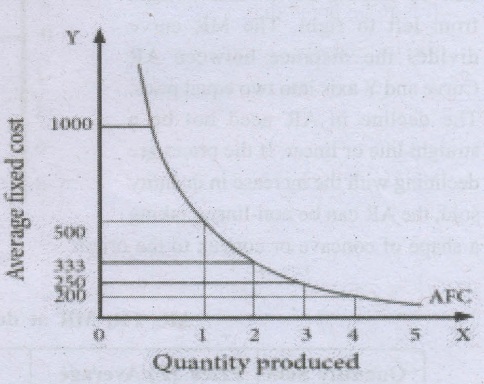
It refers to the fixed cost per unit of output. It is obtained by dividing the total fixed cost by the quantity of output. AFC = TFC / Q where, AFC denotes average fixed cost, TFC denotes total fixed cost and Q denotes quantity of output. For example, if TFC is 1000 and the quantity of output is 10, the AFC is Rs.100, obtained by dividing Rs.1000 by 10.
Table: Average Fixed Cost
| Q (in unit) |
TFC (in Rs.) |
AFC TFC/Q (in Rs.) |
|
0 |
1000 1000 1000 1000 1000 1000 |
1000/0=\(\infty \) 1000/1=1000 1000/2=500 1000/3=333 1000/4=250 1000/5=200 |
It is to be noted that
(a) AFC declines as output increases, as fixed cost remains constant
(b) AFC curve is a downward sloping throughout its length, never touching X and Y axis. It is asymptotic to both the axes.
(c) The shape of the AFC curve is a rectangular hyperbola.
Average Variable Cost (AVC)
Table: Average Variable Cost
| Q(in unit) | TVC (in Rs.) |
AVC TVC/Q (in Rs.) |
| 0 1 2 3 4 5 |
0 |
0/0=0 |
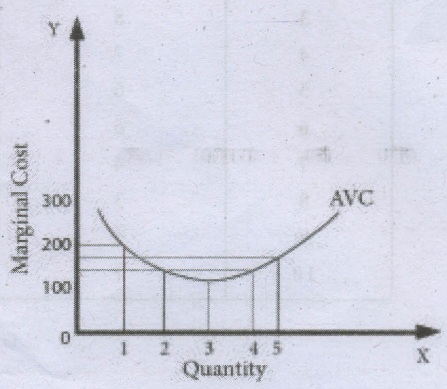
It refers to the total variable cost per unit of output. It is obtained by dividing total variable cost (TVC) by the quantity of output (Q). AVC = TVC / Q where, AVC denotes Average Variable cost, TVC denotes total variable cost and Q denotes quantity of output. For example, When the TVC is Rs. 300 and the quantity produced is 2, the AVC is f RS.150, (AVC = 300/2 = 150)
AVC is shown in table and Diagram
If TVC = Q3 - 18Q2 + 9lQ
AVC = Q2 -18Q + 91
It is to be noted that
(a) AVC declines initially and then increases with the increase of output.
(b) AVC declines up to a point and moves upwards steeply, due to the law of returns.
(c) AVC curve is a U-shaped curve.
Average Total Cost (ATC) or Average Cost (AC)
It refers to the total cost per unit of output. It can be obtained in two ways.
(1) By dividing the firm's total cost (TC) by the quantity of output (Q). ATC = TC / Q. For example, if TC is Rs. 1600 and quantity of output is Q = 4, the Average Total Cost is Rs. 400. (ATC = 1600/4 = 400)
If ATC is Q3 - 18Q2 + 91Q +12, then AC = Q2 - 18Q +91 + 12/Q
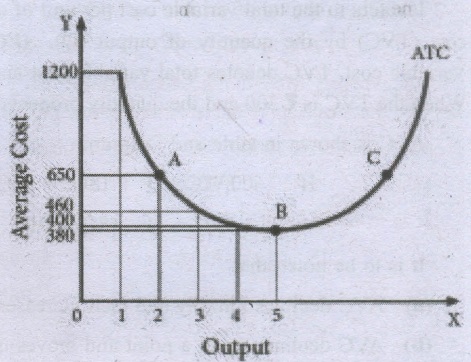
(2) By ATC is derived by adding together Average Fixed Cost (AFC) and Average Variable Cost (AVC) at each level of output ATC = AFC + AVC. For example, when Q = 2, TFC = 1000, TVC = 300; AFC = 500; AVC = 150; ATC = 650. ATC or AC is shown in table and Diagram
| Q (in unit) |
TFC (in Rs.) |
TVC (in Rs.) |
TC (in Rs.) TFC+TVC |
ATC (TC/Q) (in Rs.) |
AFC (in Rs.) |
AVC (in Rs.) |
ATC (AFC + AVC) (in Rs.) |
| 0 1 2 3 4 5 |
1000 1000 1000 1000 1000 1000 |
0 200 300 400 600 900 |
1000 1200 1300 1400 1600 1900 |
1000/0=\(\infty \) 1200/1=1200 1300/2=650 1400/3=466 1600/4=400 1900/5=380 |
0 1000 500 333 250 200 |
0 200 150 133 150 180 |
0+0=0 1000+200=1200 500+150=650 333+133=466 250+150=400 200+180=380 |
It should be noted that
(a) ATC curve is also a 'U' shaped curve.
(b) Initially the ATC declines, reaches a minimum when the plant is operated optimally, and rises beyond the optimum output.
(c) The 'U' shape of the AC reflects the law of the variable proportions.
3.
Total Revenue:
Total Revenue is the amount of income received by the firm from the sale of its product. It is obtained by multiplying the price of the commodity by the number of units sold.
Total Revenue - Constant Price
| Quantity Sold (Q) | Price (P) | Total Revenue (TR) |
| 1 | 5 | 5 |
| 2 | 5 | 10 |
| 3 | 5 | 15 |
| 4 | 5 | 20 |
| 5 | 5 | 25 |
| 6 | 5 | 30 |
TR = P x Q
where,
TR denotes Total Revenue
P denotes Price and
Q denotes Quantity Sold.
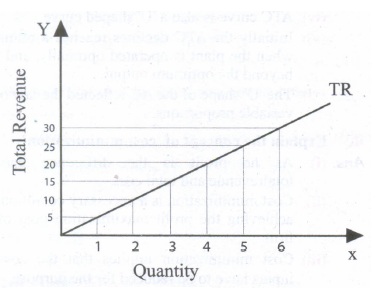
When Price is Constant, the behaviour of TR is shown in above table and diagram assuming P = 5 when P = 5, TR = PQ.
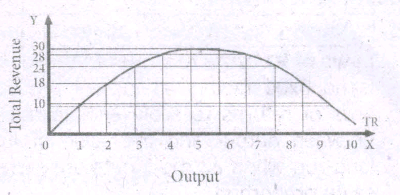
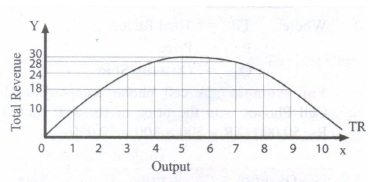
When Price is declining with increase in quantity sold (E.g imperfect competition on the goods market) the behaviour of TR can be obtained from Demand function if Q = 11 - P
TR = P Q = 1 x 10 = 10
When P = 3, Q = 8 TR = 24
When P = 0, Q = 1 TR = 10
Total Revenue - Price declining
| Quantity Sold (Q) | Price (P) | Total Revenue (TR) |
| 1 | 10 | 10 |
| 2 | 9 | 18 |
| 3 | 8 | 24 |
| 4 | 7 | 28 |
| 5 | 6 | 30 |
| 6 | 5 | 30 |
| 7 | 4 | 28 |
| 8 | 3 | 24 |
| 9 | 2 | 18 |
| 10 | 1 | 10 |
4.
Fixed cost and variable cost: Fixed cost and variable cost are helpful in understanding the behaviour of costs over different levels of output.
Meaning of Fixed and Variable factors and costs:
Fixed and variable factors are with reference to short run production function. Short run is a period of time over which certain factors of production cannot be changed, and such factors are called fixed factors. The costs incurred on fixed factors are called fixed costs. The factors whose quantity can be changed in the short run are variable factors, and the costs incurred on variable factors are called variable costs
Fixed costs are those which are independent of output, that is, they do not change with changes in output. These costs are a 'fixed' amount, which must be incurred by a firm in the short run whether the output is small or large. E.g. contractual rent, interest on capital invested, salaries to the permanent staff, insurance premia and certain taxes. Variable costs are those costs, which are incurred on the employment of variable factors of production whose amount can be altered in the short run. Thus the total variable costs change with the level of output. It rises when output expands and falls when output contracts. When output is nil, variable cost becomes zero. These costs include payments such as wages of labour employed, prices of raw materials, fuel and power used arid the transport costs.
5.
(i) Total revenue is the amount of income received by the firm from the sale of its products.
(ii) It is obtained by multiplying the price of the commodity by the number of units sold
(iii) TR = P x Q
Where TR = Total Revenue
P = Price
Q = Quantity Sold
For example: A cell phone company sold 100 Cell Phones with the price of Rs. 500 each TR is Rs. 50,000 (TR = 500 x 100 = 50,000)
| Quantity Sold(Q) | Price(P) Rs | Total Revenue(TR) Rs |
| 1 | 5 | 5 |
| 2 | 5 | 10 |
| 3 | 5 | 15 |
| 4 | 5 | 20 |
| 5 | 5 | 25 |
| 6 | 5 | 30 |
When price is declining:
With increase in quantity sold the behaviour of TR is shown in the following table and diagram
| Quantity Sold(Q) | Price(P) Rs | Total Revenue (TR) Rs |
| 1 | 10 | 10 |
| 2 | 9 | 18 |
| 3 | 8 | 24 |
| 4 | 7 | 28 |
| 5 | 6 | 30 |
| 6 | 5 | 30 |
| 7 | 4 | 28 |
| 8 | 3 | 24 |
| 9 | 2 | 18 |
| 10 | 1 | 10 |

11th Standard Syllabus & Materials
11th Standard
TN 11th Tamil பீடு பெற நில் - செய்யுள் - காவடிச்சிந்து Important Questions And Answers Study Material - QB365 Set A
NEW11th Standard
TN 11th Tamil பீடு பெற நில் - உரைநடை - மலை இடப்பெயர்கள் : ஓர் ஆய்வு Important Questions And Answers Study Material - QB365 Set A
NEW11th Standard
TN 11th Tamil மாமழை போற்றுதும் - துணைப்பாடம் - யானை டாக்டர் Important Questions And Answers Study Material - QB365 Set A
NEW11th Standard
TN 11th Tamil மாமழை போற்றுதும் - செய்யுள் - ஐங்குறுநூறு Important Questions And Answers Study Material - QB365 Set A



Tamilnadu Stateboard 11th Standard Subjects

Maths

Commerce
Economics

Biology

Business Maths and Statistics

Accountancy

Computer Science

Physics

Chemistry
Maths
Biology
Economics
Physics
Chemistry

History
Business Maths and Statistics

Computer Science
Accountancy

Computer Applications
History
Computer Technology
Commerce
Computer Applications
Computer Technology

Tamil

English

French
Tamilnadu Stateboard Standards



