
 100% FREE ACCESS
11th Standard Syllabus & Materials
11th Standard
TN 11th Tamil இயற்கை வேளாண்மை,சுற்றுச்சூழல் -செய்யுள் - மனோன்மணீயம் Important Questions And Answers Study Material - QB365 Set A
NEW11th Standard
TN 11th Tamil என்னுயிர் என்பேன் -துணைப்பாடம் - இசைத்தமிழர் இருவர் Important Questions And Answers Study Material - QB365 Set A
NEW11th Standard
TN 11th Tamil மொழி கலை -செய்யுள் - ஒவ்வொரு புல்லையும் Important Questions And Answers Study Material - QB365 Set A
NEW11th Standard
TN 11th Tamil பீடு பெற நில் - இலக்கணம் - பகுபத உறுப்புகள் Important Questions And Answers Study Material - QB365 Set A
NEW11th Standard
TN 11th Tamil பீடு பெற நில் - துணைப்பாடம் - வாடிவாசல் Important Questions And Answers Study Material - QB365 Set A
NEW11th Standard
TN 11th Tamil பீடு பெற நில் - செய்யுள் - குறுந்தொகை Important Questions And Answers Study Material - QB365 Set A

Published on: 13/05/2022
QB365 provides detailed and simple solution for every Creative Questions in class 11 Economics Subject. It will helps to get more idea about question pattern in every Creative questions with solution.
latest Creative QuestionsDownload Tamil Nadu 11th Standard Economics question papers, model tests, one-mark questions, important questions, and public exam papers in PDF format. Free study materials and answer keys for TN State Board students.
Questions + Answers key
Take MCQ Economics Test1.
Explain the Psychological Theory of interest.
2.
Describe the Automotive production in Tamil Nadu.
3.
Describe the Agriculture Position of Tamil Nadu.
4.
What are the fundamental problems faced by an economy?
5.
Explain inductive method of economic analysis.
6.
Explain the types of utility.
7.
Find the equilibrium price and quantity by using the following demand and supply functions Qd = 200 - 10P and Qs= 10P respectively.
8.
What are the triple pillars of New Economic policy? Explain.
9.
Write a short note on Rural Housing
10.
Explain the importance or the application of the Law of Diminishing Marginal Utility.
11.
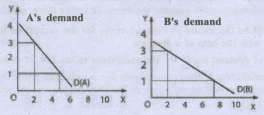
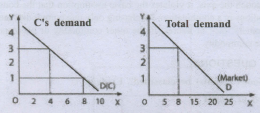
Explain the Market Demand for a commodity with, the help of a diagram.
12.
Examine the sources of Monopoly power.
13.
What are the different types of price discrimination under monopoly?
14.
Write a short note on Land Resources.
15.
What is the Kisan Credit Card Scheme?
16.
Discuss Any two points of Ninth five year plan?
17.
Discuss the second Green Revolution?
18.
Define Deforestation
19.
Bring out the distinction between short run and long run.
20.
Write the classification of wants.
21.
What are the assumptions of consumer's surplus?
22.
Write a short note on MSMEs.
23.
Explain Average cost with the help of a diagram.
24.
Explain Iso quant map with the help of diagram.
25.
What are the assumptions of Law of variable proportion.
1.
The psychological theory of interest was propounded by John Rae in 1834. But credit goes to Bohm Bawerk an Austrian School economist who has given final shape to the theory. The American economist Irving Fisher modified and gave a new theory viz Time Preference theory. According to this theory, people prefer present goods rather than future goods. Because the present goods are more certain than future goods, just" as a bird in the hand is worth two in the bush". There are many countries where no one knows what will happen next day. ASEAN crisis of 1996 and American crisis of 2007-08 were not predicted even for economists, including Nobel Laureats. So, when people save they have to postpone their present enjoyment or satisfaction. If one postpones one's present satisfaction, one has to be paid an 'Agio' or 'Premium'. This premium is 'interest'. People prefer present consumption than future consumption due to the risk increasing and uncertainties of the present world.
2.
Chennai nicknamed as 'The Detroit of Asia' is home to a large number of auto component industries. Tamil Nadu has 28% share each in automotive and auto components industries, 19% in the trucks segment and 18% each in passenger cars and two wheelers.
3.
Tamil Nadu, with seven agro climatic zones and varied soil types is better suited for the production of fruits, vegetables, spices, plantation crops, flowers and medicinal plants. The State is the largest producer of loose flowers and the third largest producer of fruits. Tamil Nadu has historically been an agricultural State. At present, Tamil Nadu is the India's second biggest producer of rice, next only to West Bengal The state is one of the major producers of turmeric. It is also the leading producer of Kambu, Corn, Groundnut, Oil seeds and Sugarcane. It ranks first in production of plantation crops and banana and coconut, second in rubber and cashew nut, third in pepper and fourth in sugarcane.
The gross cropped area under all crops was 58.97 lakh hectares in the year 2013-14. The area under food crops account for 72.9% and that of non-food crops is 27.1%. Among the food crops paddy takes a major share. Among the non-food crops, groundnut and coconut take a major share.
Net sown area has been gradually declining; and, rural land, labour and capital are moving towards urban projects. As a result, villages are emptied and cities are overcrowded and congested, leading to spatially unbalanced bulging.
4.
The fundamental problems faced by an economy are:
(i) What to produce: The first major decision relates to the quantity and the range of goods to be produced. Since resources are limited, we must choose between different alternatives collection of goods and services that may be produced.
(ii) How to produce: Having decided the quantity and the type of goods to be produced. We must next alternative determines the techniques of production to the used ego Labour or Capital.
(iii) For whom to produce: This means how the national product is to be distributed. i.e., who should get how much. This is the problem of the sharing of the national product.
(iv) Are the resources economically used: This is the problem of economic efficiency or welfare maximisation. There is to be no waste or misuse of resources since they are limited.
(v) Problem of full employment: Fullest possible use must be made of the available resources. In other words, an economy must endeavour to achieve full employment not only of labour but of all its resources.
(vi) Problem of growth: Another problem for an economy is to make sure that it keeps an expanding or developing. So that it maintain conditions of stability. It is not to be static.
5.
It is also called empirical or realistic method, is adopted by the "Historical School of Economists". viz., Roscher, Frederick list, Cliff leslie. It involves the process of reasoning from particular facts to general principle. Economic generalizations are derived in this method, on the basis of (i) Experimentations, (ii) Observations, (iii) Statistical methods.
Steps:
(a) Data are collected about a certain economic phenomenon. These are systematically arranged and the general conclusions are drawn from them.
(b) By observing the data, conclusions are easily drawn.
(c) Generalization of the data and then Hypothesis Formulation.
(d) Verification of the hypothesis (eg. Engel's law).
Merits:
(i) It can be applied for 'the verification of conclusion based on deductive reasoning.
(ii) It is more suitable since it is based on facts rather than in abstract reasoning.
(iii) It is more useful and suitable in the formulation of economic policies for particular countries and for the same country in a particular situation.
Proper method:
Modern economists, "Induction and Deduction are both needed for scientific thought as the right and left foot are both needed for walking" In short the true scientific method consists.
(a) Construction of theories.
(b) The deduction of conclusions from the theories.
(c) The testing of theories.
6.
The different types of utility are:
(i) Form utility: An individual consumer obtains utility from a good or service only when it is available in a particular form. Raw materials in their original form may not" possess utility for a consumer. But in their changed forms as they become finished products, they provide utility to him. For example, cotton as a raw material may not possess utility for a consumer; but as it gets a new form as a cloth, it yields the consumer utility.
(ii) Time utility: A sick man derives time utility from blood not at the time of its donation, but only at the operation-time, i.e., when it is used.
(iii) Place utility: A student derives place "utility from a book not at the place of its publication (production centre) but only at the place of his education (consumption centre).
(iv) Service utility: An individual consumer derives service utility from a service made available at the time when he most needs it. For example, clients obtain service utility from their lawyers, patients derive service utility from the doctors and so on.
(v) Possession utility: When a student buys a book or dictionary from a book seller, then only it gives utility.
(vi) Knowledge utility: It is the utility derived by having knowledge of a particular thing. Advertisement serves as a source of information on an object.
7.
Equilibrium is attained when,
Qd = Qs
\(\therefore\)200 - 10P = 10P
200 = 10P + 10P = 20 P
\(p=\frac { 200 }{ 20 } =10\)
When P = 10
In supply function
Qs = 10 P = 10 x 10 = 100 s
In demand function,
Hence at
Qd = 200 - 10 P
= 200 - 10 x 10 = 200 - 100 = 100
| P = 10, Qd 7 100, Qs = 100 |
8.
The triple pillars of New Economic Policy are Liberalization, Privatization and Globalization (LPG)
Liberalization: Liberalization refers to removal of relaxation of governmental restrictions in all stages in industry. Delicensing, decontrol, deregulation, subsidies (incentives) and greater role for financial institutions are the various facets of liberalization.
Privatization: Privatization means transfer of ownership and management of enterprises from public sector to private sector. Denationalization, disinvestment and opening exclusive public sector enterprises to private sector are the gateways to privatization.
Globalization: Globalization refers to the integration of the domestic (Indian) economy with the rest of the world. Import liberalization through reduction of tariff and non-tariff barriers, opening the doors to Foreign Direct. Investment (FDI) and Foreign Portfolio Investment (FPI) are some of the measures towards globalization.
9.
(i) House is one of the basic needs of every family. Provision of better housing facilities increases the productivity of labour.
(ii) The housing problem is getting aggravated due to rapid adoptation of nuclear families
(iii) Housing does not mean provision of house alone but also proper water supply, good sanitation, proper disposal of sewage, etc.
(iv) The problem of housing can be tackled by the development of low cost technology in house construction, provision of adequate housing finance and provision of land sites to landless workers in rural areas.
(v) As per the NSSO data; 38 per cent of the households lived in with one room while another 36 per cent lived with two rooms
10.
Importance or Application of the Law of DMU:
(1) The Law of DMU is one of the fundamental laws of consumption. It has applications in several fields of study.
(2) This law is the basis for other consumption laws such as Law of Demand, Elasticity of Demand, Consumer's Surplus and the Law of Substitution etc.
(3) The Finance Minister taxes a more-moneyed person more and a less-moneyed person less. When a person's income rises, the tax-rate rises because the MU of money to him falls with every rise in his income. Thus, the Law of DMU is the basis for progressive taxation.
(4) This law emphasises an equitable distribution of wealth. The MU of money to the more-moneyed is low. Hence, redistribution of income from rich to poor is justified.
(5) Adam Smith explains the famous "diamond-water paradox". Diamond is scarce, hence, its MU is high and its price is high, even though it is not very much needed. Water is abundant, hence, its MU is low and its price is low, even though it is very much essential.
11.
Market Demand for a commodity:
The market demand curve for a commodity is derived by adding the quantum demanded of the commodity by all the individuals constituting the market. In the diagram, the final market demand curve represents the addition of the demand curve of the individuals A, B and C at the same price. When Price is rs.3, the Market demand is 2 + 2 + 4 = 8
When Price is rs. 1 the Market demand is 6 + 8 + 8 = 22
As in the case of individual demand schedule the Market Demand Curve is at a price, at a place and at a time.
12.
(i) Natural Monopoly: A monopoly may arise on account of some natural causes. Some minerals are available only in certain regions. For example, South Africa has monopoly of diamonds and gold mines. Canada has monopoly of Nickel and Middle East has oil. This is natural monopoly.
(ii) State Monopoly: Government will have the sole right of producing certain goods and maintaining certain services. They are state monopolies. For example, public utilities like electricity and railways.
(iii) Legal Monopoly: A monopoly firm can get its monopoly power by getting patent rights, trade mark from the Government. This is called Legal Monopoly.
(iv) Technical: Monopoly power may be enjoyed due to technical reasons. A firm may have control over raw materials, technical knowledge, special know-how, scientific secrets and formula that enable a monopolist to produce a commodity. Example Coca-Cola.
13.
Types of Price Discrimination:
There are three types of price discrimination.
(i) Personal - Different prices· are charged for different individuals (for example, the railways give tickets at concessional rate to the 'senior citizens' for the same journey).
(ii) Geographical - Different prices are charged at different places for the same product (for example, a book sold within India at a price is sold in a foreign country at lower price). On their basis, China drops its goods in Indian market. As a result, watch and toys industries closed down their business.
(iii) On the basis of Use - Different prices are charged according to the use of a product (for example, lower rates are charged by Tamil Nadu Electricity Board for domestic uses of electricity and higher rates are charged for commercial and industrial uses.
14.
Land Resources:
(i) In terms of area India ranks seventh in the world with a total area of 32.8 lakh sq. k.m. It accounts for 2.42% of total area of the world. Land-man ratio is not favourable because of the huge population size.
(ii) According to Agricultural Census, the area operated by large holdings (10 hectares and above) has declined and area operated under marginal holding (less than one hectare) has increased. This indicates that land is being fragmented and become in economic.
15.
A Kisan Credit Card (KCC) is a credit delivery mechanism that is aimed at enabling farmers to have quick and timely access to affordable credit.
16.
The main focus of this plan was "growth with justice and equity" This plan failed to achieve the growth target of 7% and Indian economy grew only at the rate of 5.6%
17.
The Government of India had implemented Second Green revolution to achieve higher agricultural growth. The target of Second Green Revolution was to increase 400 million tons of food grain production as against about 214 million tons in 2006-07. This is to be achieved by 2020. In agricultural sector, the growth rate of 5% to 6% has to be maintained over next 15 years. There may be changes in these statistics.
18.
Clearing of forests trees and thereby forest Land is converted to a Non - forest use.
19.
Short run is a period of time over which certain factors of production cannot be changed, and such factors are called fixed factors. The factors whose quantity can be changed in the short run are variable factors. Long run is a period of time over which all factors of production can be changed, to meet the changes in demand.
20.
(i) Goods which are indispensable for the human being to exist in the world are called "necessaries" (for example food).
(ii) Goods which are not indispensable for life but to make our life easy, convenient and comfortable are called "comforts". (for example: TV)
(iii) Goods which are not very essential but are very costly are known as "Luxuries". (for example- Jewellery, Diamonds).
21.
(i) Cardinal utility of a commodity is measured in money terms.
(ii) Marshall assumes that there is definite relationship between expected satisfaction (utility) and realized satisfaction (actual).
(iii) Marginal utility of money is constant.
(iv) An absence of differences in income, taste, fashion etc.
(v) Independent goods and independent utilities.
(vi) Demand for a commodity depends on its price alone, it includes other determinants of demand.
22.
(i) The Micro, Small and Medium Enterprises are defined under the MSMEs act 2006.
(ii) The enterprises are classified as manufacturing and services enterprises based on the investment in plant and machinery and equipment (excluding land and building) the classification of Micro Small and Medium Enterprises.
23.
(i) It refers to the total cost per unit of output.
(ii) ATC=TC/Q (or)
(iii) ATC=AFC+AVC
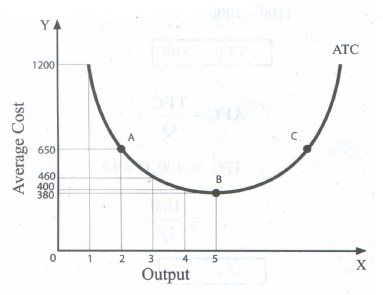
(iv) ATC curve is also a 'U' shaped curve.
(v) Initially the ATC declines reaches a minimum when the plant is operated optimally, and rises beyond the optimum output.
(vi) The 'U' shape of the AC reflected the law of the variable proportions.
24.
(i) An Iso quant map has different iso quant curves representing the different combinations of two factors yielding different levels of output.
(ii) An Iso quant is a family of iso quant
(iii) More than one iso quant is called Iso quant map.
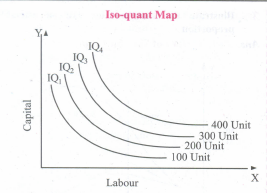
(iv) Higher the Iso quant denotes higher level of output and lower the Iso quant denotes lower level of output.
25.
(i) Only one factor is variable others are held constant.
(ii) All units of factor are homogeneous.
(iii) The product is measured in physical units.
(iv) No change in the state of technology.
(v) No change in the price.

11th Standard Syllabus & Materials
11th Standard
TN 11th Tamil பீடு பெற நில் - செய்யுள் - காவடிச்சிந்து Important Questions And Answers Study Material - QB365 Set A
NEW11th Standard
TN 11th Tamil பீடு பெற நில் - உரைநடை - மலை இடப்பெயர்கள் : ஓர் ஆய்வு Important Questions And Answers Study Material - QB365 Set A
NEW11th Standard
TN 11th Tamil மாமழை போற்றுதும் - துணைப்பாடம் - யானை டாக்டர் Important Questions And Answers Study Material - QB365 Set A
NEW11th Standard
TN 11th Tamil மாமழை போற்றுதும் - செய்யுள் - ஐங்குறுநூறு Important Questions And Answers Study Material - QB365 Set A



Tamilnadu Stateboard 11th Standard Subjects

Maths

Commerce
Economics

Biology

Business Maths and Statistics

Accountancy

Computer Science

Physics

Chemistry
Maths
Biology
Economics
Physics
Chemistry

History
Business Maths and Statistics

Computer Science
Accountancy

Computer Applications
History
Computer Technology
Commerce
Computer Applications
Computer Technology

Tamil

English

French
Tamilnadu Stateboard Standards



