
 100% FREE ACCESS
11th Standard Syllabus & Materials
11th Standard
TN 11th Tamil இயற்கை வேளாண்மை,சுற்றுச்சூழல் -செய்யுள் - மனோன்மணீயம் Important Questions And Answers Study Material - QB365 Set A
NEW11th Standard
TN 11th Tamil என்னுயிர் என்பேன் -துணைப்பாடம் - இசைத்தமிழர் இருவர் Important Questions And Answers Study Material - QB365 Set A
NEW11th Standard
TN 11th Tamil மொழி கலை -செய்யுள் - ஒவ்வொரு புல்லையும் Important Questions And Answers Study Material - QB365 Set A
NEW11th Standard
TN 11th Tamil பீடு பெற நில் - இலக்கணம் - பகுபத உறுப்புகள் Important Questions And Answers Study Material - QB365 Set A
NEW11th Standard
TN 11th Tamil பீடு பெற நில் - துணைப்பாடம் - வாடிவாசல் Important Questions And Answers Study Material - QB365 Set A
NEW11th Standard
TN 11th Tamil பீடு பெற நில் - செய்யுள் - குறுந்தொகை Important Questions And Answers Study Material - QB365 Set A

Published on: 13/05/2022
QB365 provides detailed and simple solution for every Creative Questions in class 11 Economics Subject. It will helps to get more idea about question pattern in every Creative questions with solution.
latest Creative QuestionsDownload Tamil Nadu 11th Standard Economics question papers, model tests, one-mark questions, important questions, and public exam papers in PDF format. Free study materials and answer keys for TN State Board students.
Questions + Answers key
Take MCQ Economics Test1.
Describe Wage Fund Theory of Wages.
2.
Explain deductive method of economics.
3.
What is the kinds of goods and services?
4.
Explain the determinants of Elasticity of Demand.
5.
Explain the different types of Elasticity of Demand.
6.
How can Goods (Wants) be classified? Explain.
7.
Explain the theory of "consumer's surplus".
8.
Bring out the features of Monopolistic competition.
9.
List out the kinds of profit.
10.
What are the features of Cottage Industries?
11.
What are the methods adopted to derive economic generalization in Inductive Method?
12.
What are the achievement of Green Revolution?
13.
Explain about the period of Industrial Capital.
14.
Distinguish between Economic cost and Social cost.
15.
Discuss the Stable Equilibrium with the help of a diagram?
16.
Explain briefly education system in India.
17.
Explain the Internal and External diseconomies of scale.
18.
Explain the shift in the demand curve with the help of a diagram?
19.
Define Accounting cost.
20.
Describe the characteristics of capital?
21.
Explain about J.C. Kumarappa.
22.
Explain the concept of 'cost minimization!
23.
Explain the concept of division of labour.
24.
Distinguish between internal and external economies
25.
What are the characteristics of capital?
1.
This theory was first propounded by Adam Smith. But the credit goes to J.S.Mill who perfected this theory.
According to Mill "every employer will keep a given amount of capital for payment to the workers". It is known as 'Wage Fund'. It is fixed and constant. Wages depend directly upon the fund and inversely with number of labourers employed.
The average wage of a worker can be calculated by using the formula.
Average wage per worker =\(\frac{Total \ Wage \ Fund}{Number \ of \ Workers}\)
If the number of workers increases, the wage per worker would fall and vice versa.
Criticisms:
(i) It does not explain the difference in wages in different occupations.
(ii) It ignores the role of trade unions.
(iii) Actually the capitalists will take away a large sum before making payment of wages.
2.
It is also named as analytical or abstract or prior method. It consists in deriving conclusions from general truths; it takes few general principles and applies the to draw conclusions. The classical and neo-classical school of economists notably, Ricardo, Senior, J. S. Mill, Malthus, Marshall, Pigou, applied the deductive method in their economic investigations.
Steps of Deductive Method:
(i) The analyst must have a clear and precise idea of the problem to be inquired into.
(ii) The analyst clearly defines the technical terms used in the analysis. Further, assumptions of the theory are to be precise.
(iii) Deduce hypothesis from the assumptions taken.
(iv) Hypotheses should be verified through direct observation of events in the real world and through statistical methods. ego There exists an inverse relationship between price and quantity demanded of a good.
3.
The different kinds of goods and services are
(i) Free and economic goods: Free goods are available in nature and they are not scarce. They do not command a price in the market. ego Air and sunshine. Water also an example in the past but at present it has exchange value. So it is not a free good. Economic goods are not available in plenty. They are scarce in supply. Man has to spend money to own or use them.
(ii) Consumer goods and capital goods: Consumer goods directly satisfy human wants, TV, Furniture, Automobile etc. Capital-goods (also called producer's goods) don't directly satisfy the consumer wants. They help to produce consumer goods. For example, machines do not directly satisfy the consumers, but in factories, the manufacturers need them.
(iii) Perishable goods and durable goods: Perishable goods are short-lived. Their lifespan is limited. For example fish, fruits, flower etc., do not have a long life. Durable goods and semi-durable goods have a little longer life-time than the Perishable goods. For example, a table, a chair etc.,
4.
Determinants of Elasticity of Demand:
There are many factors that determine the degree of price elasticity of demand. Some of them are described below:
(a) Availability of Substitutes: If close substitutes are available for a product, then the demand for that product tends to be very elastic. If the price of that product increases, buyers will buy its substitutes; hence fall in its demand will be very large. Hence, price elasticity will be larger. Eg. Vegetables. For salt no close substitutes are available. Hence even if price of salt increases the fall in demand may be zero or less. Hence salt is price inelastic
(b) Proportion of consumer's income spent: If smaller proportion of consumer's income is spent on particular commodity say X, price elasticity of demand for X will be smaller. Take for example salt, people spend very small proportion of their income on salt. Hence, salt will have small elasticity of demand, or inelastic.
(c) Number of uses of commodity: If a commodity is used for greater number of uses, its price elasticity will also be larger. For example, milk is used as butter milk, curd, ghee and for making ice cream etc. Hence, even the small fall in the price of milk, will tempt the consumers to use more milk for many purposes. Hence milk has greater price elasticity of demand.
(d) Complementarity between goods: For example, along with petrol, lubricating oil is also used for running automobiles. Here, a rise in the price of lubricating oil may not reduce the demand for lubricating oil. Hence, the complementary good here, lubricating oil, will be price inelastic.
(e) Time: In the long run, the price elasticity of demand for many goods will be larger. This is so because, in the long run many substitutes can be discovered or invented. Therefore, the demand is generally more elastic in the long run, than in the short run. In the short run bringing out new substitutes is difficult.
5.
Different types of Elasticity of Demand :
Price Elasticity of Demand
Price elasticity of demand is commonly known as elasticity of demand. This is because price is the most influential factor affecting demand. "Elasticity of demand measures the responsiveness of the quantity demanded to changes in the price".
(1) Price Elasticity of Demand: The price elasticity of demand; commonly known as the elasticity of demand refers to the responsiveness and sensitiveness of demand for a product to the changes in its price. In other words, the price elasticity of demand is equal to
\({ E }_{ p }=\frac { Proportionate \ change \ in \ quantity \ demanded }{ Proportionate \ change \ in \ price } \)
Numerically,
\({ E }_{ p }=\frac { \triangle Q }{ \triangle P } \times \frac { P }{ Q } \)
Where, \(\triangle Q={ Q }_{ 1 }-{ Q }_{ 0 },\triangle P={ P }_{ 1 }-{ P }_{ 0 },Q1\)=New quantity,
\({ Q }_{ 0 }\)=Original quantity, \({ P }_{ 1 }\)=New price, \({ P }_{ 0 }\)=Original price.
(2) Income 'Elasticity of Demand: The income is also a factor that influences the demand for a product. Hence, the degree of responsiveness of a change in demand for a product due to the change in the income is known as income elasticity of demand. , The formula to compute the income elasticity of demand is:
\({ E }_{ Y }=\frac { Proportionate\ change\ in\ quantity\ Demanded\ for\ a\ product }{ Proportionate\ change\ in\ Income } \)
For most of the goods, the income elasticity of demand is greater than one indicating that with the change in income the demand will also change and that too in the same direction, i.e. more income means more demand and vice-versa.
(3) Cross Elasticity of Demand The cross elasticity of demand refers to the percentage change in quantity demanded for one commodity as a result of a small change in the price of another commodity. This type of elasticity usually arises in the case of the interrelated goods such as substitutes and complementary goods. The cross elasticity of demand for goods X and Y can be expressed as:
\({ E }_{ C }=\frac { Proportionate\ change\ in\ Demanded\ of\ commodity\ X }{ Proportionate\ change\ in\ price\ of\ commodity\ Y } \)
(4) Advertising Elasticity of Demand: The responsiveness of the change in demand due to the change in advertising or other promotional expenses, is known as advertising 'elasticity-of demand. It can be expressed as:
\({ E }_{ a }=\frac { Proportionate\ change\ in\ Demand }{ Proportionate\ change\ in\ Advertising\ Expenditure } \)
6.
Classification of Goods :
Goods are broadly classified into three categories.
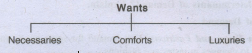
Necessaries: Goods which are indispensable for the human beings to exist in the world are called "Necessaries". For example, food, clothing and shelter.
Comforts: Goods which are not indispensable for life but to make our life easy, convenient and comfortable are called "Comforts". Example: TV, Fan, Refrigerator and Air conditioner.
Luxuries: Goods which are not very essential but are very costly are known as "Luxuries". Example: Jewellery, Diamonds and Cars. However, for people with higher income they may look necessaries or comforts.
7.
(i) According to Marshall," The excess of price which a person would be willing to pay a thing rather than go without the thing, over that which he actually does pay is the economic measure of this surplus satisfaction".
(ii) Consumer's surplus = potential price - actual price.
8.
Features of monopolistic competition :
The important features of monopolistic competition are:
(i) There are large number of buyers and many sellers.
(ii) Firms under monopolistic competition are price makers. They set their own prices.
(iii) Firms produce differentiated products. It is the key element of monopolistic competition.
(iv) There is a free entry and exit of firms.
(v) Firms compete with each other by incurring selling cost or expenditure on sales promotion of their products.
(vi) Non-price competition is an essential part of monopolistic competition.
(vii) A firm can follow an independent price policy.
9.
i) Monopoly Profit:
Profit earned by the firm because of its monopoly control.
ii) Windfall Profit:
Sometimes profit arises due to changes in price level. Profit is due to unforeseen factors.
iii) Profit as Functional Reward:
Just like rent, wage and interest profit is earned by the entrepreneur for its entrepreneurial function.
10.
Cottage Industries: Cottage industries are generally associated with agriculture and provide both part-time and full-time jobs in rural areas.
Features of Cottage Industries :
i) These industries are carried out by artisans in their own homes at their own risk and for their own benefit.
ii) Noor little outside labour is employed. Normally, the members of the household provide the necessary labour.
iii) These industries are generally hereditary and traditional in character.
iv) No or little power is used.
v) These industries usually serve the local market and generally work on the orders placed by other industries.
11.
Inductive Method: Inductive method also called empirical method. It involves the process of reasoning form particular facts to general principal.
Economic generalizations are derived in this method on the basis of
a) Experimentations.
b) Observations and
c) Staistical methods.
12.
Achievement of Green Revolution:
(i) The major achievement of the new strategy was to boost the production of major cereals. (wheat and rice)
(ii) The Green revolution was confined only to High Yielding Varieties (HYV) cereals, mainly rice, wheat, maize and jowar.
(iii) This strategy was mainly to increase the to increase the production of commercial crops (or) cash crops such as sugarcane, cotton, jute, oilseeds.
(iv) Green Revolution had positive effects on development of industries which manufactured agricultural tools like tractors, threshers and pumping sets.
(v) Green revolution had bought prosperity to rural people. (employment opportunities)
(vi) Due to multiple cropping and more use of chemical fertilizers, the demand for labour inceased.
(vii) Financial resources were provided by banks and co-operative societies. These banks provided loans to farmer on easy terms.
13.
Period of Industrial Capital:
i) The period of Industrial Capital was from 1813 to 1858.
ii) During this period India had become a market for British textiles.
iii) India's raw materials were exported to England at low price and imported finished textile commodities to India at a high price. In this way, Indians were explorted.
iv) India's traditional handcrafts were thrown out of gear.
14.
Cost: Cost refers to the total expenses incurred in the production of commodity. The functional relationship between cost and output is expressed as "Cost Function".
C = f(Q)
| S.No. | Economic Cost | Social Cost |
| 1. | It refers to all payments made to the resources to regular supply in the process of production | It refers to the total cost borne by the society due to production of a commodity. |
| 2. | It is the summation of Explicit cost and Implicit cost. | It is also called External cost. |
| 3. | It is the relevant to calculate the profit (Economic profit of a firm) | But incurred by other in the society (efforts and sacrifices undergone by the various members in the society) |
| 4. | (Ex) Payment for raw materials, rent for building | (ex) Large business firm cause air pollution, water pollution in a particular area) |
15.
Stable Equilibrium
a. Prof. Stigler states "equilibrium is a position from which there is no net tendency to move".
b. Its absence is referred to as disequilibrium.
c. A resource is in equilibrium when it gets fully employed and gets its maximum payment.
d. Static equilibrium is based on given and constant prices, quantities, income, technology, population etc.
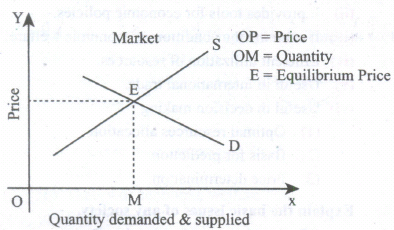
Explanation:
a. OX denotes Quantity demand and supplied and OY denotes price.
b. "DO. - Demand curve and "55" is the Supply curve.
c. At point "E" the quantity demanded is equal to Quantity supplied (0 = 5)
d. At equilibrium, price is stable because their is no tendency for change as (0 = 5).
16.
Education in India until 1976 was the responsibility of the state governments. It was then brought under concurrent list both (centre and state). The centre is represented by the Minister of Human Resource Development decides the India's education budget.
The education system in India consists of primarily six levels.
i) Nursery class.
ii) Primary class.
iii) Secondary level.
iv) Higher education.
v) Graduation.
vi) Post-Graduation.
Education Institutions in India:
Education in India follows the (10+2) pattern. For higher education, there are various state run as well as private institutions and universities providing a variety of courses and subjects. The accreditation of the universities is decided under the University Grant Commission Act. The education department consists of various school, colleges and universities imparting education on fair means for all section of the society. The budget share of the education sector is around 3% of GDP, of this largest proportion goes for school education.
17.
Diseconomies of scale: The diseconomies of the scale are a disadvantage to a firm or an industry or an organisation. This necessarily increases the cost of production of a commodity or service.
These diseconomies are of two types:
a) Internal Diseconomies of Scale and
b) External Diseconomies of Scale
a) Internal Diseconomies of Scale: When the scale of production increases beyond optimum limit, its efficiency may come down.
b) External ·Diseconomies of Scale: The term "External diseconomies of scale" refers to the threat or disturbance to a firm or an industry from factor lying outside it. For example a bus strike prevents the easy and correct entry of the workers into a firm. Similarly the rent of a firm increases very much if new economic units are established in the locality.
18.
Introduction: A shift in the demand curve occurs with a change in the value of a variable other than its price in the general demand function. Shifts in the Demand Curve: An increase or decrease in demand due to change in conditions of demand is shown by way of shifts in the demand curve.
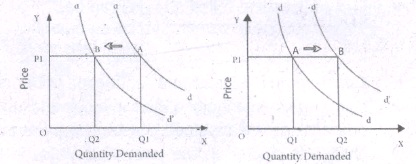
On the left hand side of the diagram the original demand curve is d1d1, the price is OP1 and the quantity demanded is OQ1. Due to change in the condition of demand (change in income, taste or change in prices of substitutes or complements) the quantity demanded decreases from OQ1 to OQ2. This is shown in the demand curve to the left. The new demand curve is d1 d1. This is called decrease in demand.
On the right hand side of the diagram the original price OP1 and the quantity demanded is OQ1.
Due to changes in other conditions the quantity purchased has increased to OQ2. Thus the demand curve shifts to the right d1d1. This is called increase in demand.
19.
Accounting costs or explicit costs are the payments made by the entrepreneur to the suppliers of various productive factors. The accounting costs are only those costs, which are directly paid out or accounted for by the producer i.e. wages to the labourers employed, prices for the raw materials purchased, fuel and power used, rent for the building hired for the production work, the rate of interest on the borrowed capital and the taxes paid.
20.
The Characteristics of capital are:
i. Capital is a passive factor of production,
ii. Capital is man-made,
iii. Capital is not an indispensable factor of production, i.e. Production is possible even without capital,
iv. Capital has the highest mobility,
v. Supply of capital is elastic,
vi. Capital is productive,
vii. Capital lasts over time (A plant may be In operation for a number of years), and
viii. Capital involves present sacrifice (cast) to get future benefits.
21.
(i) Kumarappa was a pioneer of rural economic development theories.
(ii) Kumarappa is created for developing economic theories based on Gandhism.
(iii) A school of economic thought he coined "Gandhian Economics".
(iv) Kumarappa worked as a professor of economics at the Gujarat, Vidyapith and Ahmedabad.
(v) He was serving as the editor of Young India during the salt Satyagraha.
(vi) He founded the All India Village Industries Association in 1935 and he was imprisoned for more than a year during the Quit India Movement.
(vii) He wrote during his imprisonment, Economy of Permanence and Economy and Way of Life (1945).
22.
(i) As the profit is the difference between total revenue and total cost.
(ii) Cost minimization is a necessary condition for achieving the profit maximization goal of the firm.
(iii) Cost minimization implies that the costs of inputs have to be reduced for the purpose.
(iv) The costs of inputs include the prices of raw materials, wages and salaries of labour, expenditure on machinery and equipment, depreciation on machines etc.
23.
(i) Division of labour means dividing the process of production into distinct and several component process and assigning each component in the hands of a labour or a set of labourers, who are specialists in that particular process.
(ii) For Example: A tailor stitches maximum of four shirt a day in the case of garment exports firm, it may stitch more than 100 shirts a day
24.
| Internal Economies of Scale | External Economies of Scale |
| Expansion of the firm itself | Expansion of the industry |
| Lower long run average cost | Benefits most all firms |
| Range of economies e.g. Technical and Financial | Helps to explain the rapid growth of many cities. |
25.
(i) Capital is man-made.
(ii) Capital is mobile between places and persons.
(iii) Capital is a positive factor of production.
(iv) Capital's supply is elastic.
(v) Capital's demand is derived demand.
(vi) Capital is durable.

11th Standard Syllabus & Materials
11th Standard
TN 11th Tamil பீடு பெற நில் - செய்யுள் - காவடிச்சிந்து Important Questions And Answers Study Material - QB365 Set A
NEW11th Standard
TN 11th Tamil பீடு பெற நில் - உரைநடை - மலை இடப்பெயர்கள் : ஓர் ஆய்வு Important Questions And Answers Study Material - QB365 Set A
NEW11th Standard
TN 11th Tamil மாமழை போற்றுதும் - துணைப்பாடம் - யானை டாக்டர் Important Questions And Answers Study Material - QB365 Set A
NEW11th Standard
TN 11th Tamil மாமழை போற்றுதும் - செய்யுள் - ஐங்குறுநூறு Important Questions And Answers Study Material - QB365 Set A



Tamilnadu Stateboard 11th Standard Subjects

Maths

Commerce
Economics

Biology

Business Maths and Statistics

Accountancy

Computer Science

Physics

Chemistry
Maths
Biology
Economics
Physics
Chemistry

History
Business Maths and Statistics

Computer Science
Accountancy

Computer Applications
History
Computer Technology
Commerce
Computer Applications
Computer Technology

Tamil

English

French
Tamilnadu Stateboard Standards



