
 100% FREE ACCESS
11th Standard Syllabus & Materials
11th Standard
TN 11th Tamil இயற்கை வேளாண்மை,சுற்றுச்சூழல் -செய்யுள் - மனோன்மணீயம் Important Questions And Answers Study Material - QB365 Set A
NEW11th Standard
TN 11th Tamil என்னுயிர் என்பேன் -துணைப்பாடம் - இசைத்தமிழர் இருவர் Important Questions And Answers Study Material - QB365 Set A
NEW11th Standard
TN 11th Tamil மொழி கலை -செய்யுள் - ஒவ்வொரு புல்லையும் Important Questions And Answers Study Material - QB365 Set A
NEW11th Standard
TN 11th Tamil பீடு பெற நில் - இலக்கணம் - பகுபத உறுப்புகள் Important Questions And Answers Study Material - QB365 Set A
NEW11th Standard
TN 11th Tamil பீடு பெற நில் - துணைப்பாடம் - வாடிவாசல் Important Questions And Answers Study Material - QB365 Set A
NEW11th Standard
TN 11th Tamil பீடு பெற நில் - செய்யுள் - குறுந்தொகை Important Questions And Answers Study Material - QB365 Set A

Published on: 13/05/2022
QB365 provides detailed and simple solution for every Creative Questions in class 11 Economics Subject. It will helps to get more idea about question pattern in every Creative questions with solution.
latest Creative QuestionsDownload Tamil Nadu 11th Standard Economics question papers, model tests, one-mark questions, important questions, and public exam papers in PDF format. Free study materials and answer keys for TN State Board students.
Questions + Answers key
Take MCQ Economics Test1.
Explain the equilibrium conditions for a firm with the help of diagrams.
2.
Briefly explain the classification of markets.
3.
What are kinds of wastages under monopolistic competition?
4.
What are classification of Market?
5.
Explain the comparison among the features of various markets.
1.
Equilibrium Conditions for a Firm:
Equilibrium of the firm means that the firm reaches the maximum profit. Now, there are two approaches (TC = TR) for calculating the maximum profits
(i) Total curve approach:
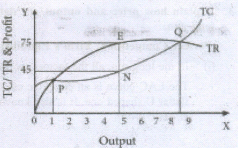
(a) In the TC-TR Approach, profit is obtained by a firm, through the difference between the TC and the TR., Equilibrium is obtained at the point where maximum difference between the TC and TR occurs.
(b) This TC- TR method is not generally adopted in the calculation of maximum profit. Hence to calculate profit/loss, economists resort to the MC = MR approach. Shaded area denotes profit. Profit is maximum when Q = 5
(ii) Marginal curve: Approach in this approach, the following two conditions are to be verified to obtain equilibrium of a firm.
(a) MC = MR
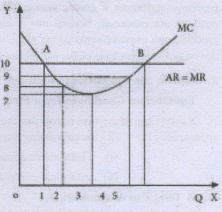
Look at the following hypothetical situation. A rational seller will not be in equilibrium at output level, though MC = MR at that point, since continuing production, his profit. increases. When he produces an output beyond 1 unit till he reaches 5 units, his MC < MR. It is advantageous for the producer to continue his production. Again, he will not be in equilibrium beyond 5 units of Q, when his MC > MR, implying that the seller incurs loss.
Therefore, he is said to be in equilibrium, i.e., at the point of maximum profit when his MC is equal to MR. Hence, MC = MR is the first condition for the equilibrium. (Note: This is a necessary condition but not a sufficient condition).
(b) MC cuts MR curve from below y_ (Sufficient conditions) A firm under perfect competition faces a horizontal price line. (It is also the AR curve and the MR curve). A firm under 10 imperfect competition focuses declining: price line. The MC is V-shaped and it 1 cuts MR at two points, both from above (i.e., at point A) and also from below (i.e., at point B) Only at point B, the equilibrium condition is fulfilled. Thus for equilibrium under all market situations the two conditions viz., MC = MR; and MC cuts MR from below.
2.
Market: The term market refers to a system of exchange between the buyers and sellers of commodity that are carried out through correspondence, telephones, online, email, etc.
Classification of Markets: Market is of various kinds. They are classified:-
On the basis of Area:
The market is classified not only on its graphical spread, but also on the nature of the goods exchanged.
i) Local Market arises when production (or) services are sold and bought in the place of their production perishable and semidurable in nature. (ex-vegetable, fruits, etc.)
ii) Provincial Market arises when products (or) services are sold arid bought in a restricted circle. (ex-provincial newspaper)
iii) National Market arises when products and services are sold and bought throughout a country. (ex-Nation wide market for tea, coffee, cement, electrical goods, etc.)
iv) International Market arises when products (or) service are sold and bought at the world level. (ex-petrol, gold, etc.)
On the basis of Time:
Alfred Marshall classifies market on the basis of time. The time here refers to the nature of factors, such as fixed and variable factors used in the production process, and how the supply of products meets with varying demand situation in the determination of price of the products.
i) Very short period (or) market period.
ii) Short period market.
iii) Long period market.
iv) Very long period (or) a secular period market.
On the basis of Quantity:
i) whole-sale market is for bulk selling and buying of goods. The price is likely to below compared to retail ma kets. (clothing)
ii) Retails market is for selling (or) buying of commodities in small quantities. (vegetable)
On the basis of Competition:
i) Perfect competition.
ii) Imperfect competition market.
(a) Monopoly market.
(b) Monopolistic competition market.
(c) Duopoly market.
(d) Oligopoly market
3.
(i) Idle Capacity:
Unutilized capacity the difference between the optimum output that can be produced and the actual output produced by the firm.
(ii) Unemployment:
Under monopolistic competition, the firm produce less than optimum output.
(iii) Advertisement:
There is a lot of waste in competitive advertisements under monopolistic competition.
(iv) Too many Varieties of goods:
Introducing too many varieties of goods is another waste of monopolistic competition.
(v) Inefficient Firms:
Under Monopolistic competition, inefficient firms charge prices higher than their marginal cost.
4.
On the basis of Area:
(i) Local Market
(ii) Provincial Market
(iii) National Market
(iv) International Market
On the basis of Time:
(i) Market period
(ii) Short period Market
(iii) Long period Market
On the Basis Quantity of the Commodity:
(i) Whole-sale market
(ii) Retail Market
On the Basis of Competition:
(i) Perfect Competition Market
(ii) Imperfect Competition Market.
5.
| SI.No | Features | Perfect Competition | Monopoly | Monopolistic Competition |
| 1 | No of producers/sellers | Large | Only one | A few (or) some |
| 2 | Nature of the product | Homogeneous | Unique | Differentiated Product |
| 3 | Control over price | Price taker | Price maker | Price variation |
| 4 | Entry/Exit | Free | Entry prevented | The existence of entry possibility |
| 5 | Profit | No ultimate profit | Monopoly profit | Profit arising due to markets special feature |
| 6 | Market knowledge | Complete | Complete | partial |
| 7 | Cost Curves | Same | Same | Same |
| 8 | AR Curves | parallel to X-axis perfectly elastic | Fairly flat more elastic | Steep (highly inelastic) |
| 9 | Quantity | Very large | Substantially large | Very small |
| 10 | Price | Very low | Low | Very high |
| 11 | Market Power | Little | Less | More |

11th Standard Syllabus & Materials
11th Standard
TN 11th Tamil பீடு பெற நில் - செய்யுள் - காவடிச்சிந்து Important Questions And Answers Study Material - QB365 Set A
NEW11th Standard
TN 11th Tamil பீடு பெற நில் - உரைநடை - மலை இடப்பெயர்கள் : ஓர் ஆய்வு Important Questions And Answers Study Material - QB365 Set A
NEW11th Standard
TN 11th Tamil மாமழை போற்றுதும் - துணைப்பாடம் - யானை டாக்டர் Important Questions And Answers Study Material - QB365 Set A
NEW11th Standard
TN 11th Tamil மாமழை போற்றுதும் - செய்யுள் - ஐங்குறுநூறு Important Questions And Answers Study Material - QB365 Set A



Tamilnadu Stateboard 11th Standard Subjects

Maths

Commerce
Economics

Biology

Business Maths and Statistics

Accountancy

Computer Science

Physics

Chemistry
Maths
Biology
Economics
Physics
Chemistry

History
Business Maths and Statistics

Computer Science
Accountancy

Computer Applications
History
Computer Technology
Commerce
Computer Applications
Computer Technology

Tamil

English

French
Tamilnadu Stateboard Standards



