
 100% FREE ACCESS
11th Standard Syllabus & Materials
11th Standard
TN 11th Tamil இயற்கை வேளாண்மை,சுற்றுச்சூழல் -செய்யுள் - மனோன்மணீயம் Important Questions And Answers Study Material - QB365 Set A
NEW11th Standard
TN 11th Tamil என்னுயிர் என்பேன் -துணைப்பாடம் - இசைத்தமிழர் இருவர் Important Questions And Answers Study Material - QB365 Set A
NEW11th Standard
TN 11th Tamil மொழி கலை -செய்யுள் - ஒவ்வொரு புல்லையும் Important Questions And Answers Study Material - QB365 Set A
NEW11th Standard
TN 11th Tamil பீடு பெற நில் - இலக்கணம் - பகுபத உறுப்புகள் Important Questions And Answers Study Material - QB365 Set A
NEW11th Standard
TN 11th Tamil பீடு பெற நில் - துணைப்பாடம் - வாடிவாசல் Important Questions And Answers Study Material - QB365 Set A
NEW11th Standard
TN 11th Tamil பீடு பெற நில் - செய்யுள் - குறுந்தொகை Important Questions And Answers Study Material - QB365 Set A

Published on: 13/05/2022
QB365 provides detailed and simple solution for every Creative Questions in class 11 Economics Subject. It will helps to get more idea about question pattern in every Creative questions with solution.
latest Creative QuestionsDownload Tamil Nadu 11th Standard Economics question papers, model tests, one-mark questions, important questions, and public exam papers in PDF format. Free study materials and answer keys for TN State Board students.
Questions + Answers key
Take MCQ Economics Test1.
Explain how price and output are determined under the perfect competition in the long run.
2.
Explain how markets are classified on the basis of Time.
3.
Comparison amoung the Features of Various Markets?
4.
Explain the types of monopoly?
5.
How is the price and output determined in the long run under monopolistic competition?
1.
Perfect Competition: Firm's Equilibrium in the Long Run (Normal Profit)
(i) In the long run, all the factors are variable. The LAC curve is an envelope curve as it contains a few average cost curves. It is a flatter U shaped one. It is also known as planning curve. First, the firms will earn only normal profit.
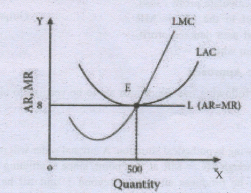
(ii) Secondly, all the firms in the market are in equilibrium. This means that there should neither be a tendency for the new firms to enter into the industry nor for any of the existing firms to exit from the industry.
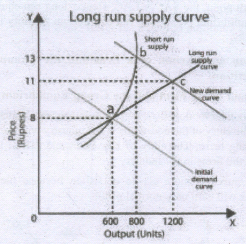
(iii) Long run supply curve is explained to determine the long run price after an increase in demand. The effect of the increase in demand in the short run is explained by the movement from point 'a' to point 'b'. The price increases from 8 to 13, and the quantity increases from 600 to 800 units. Economic profit of a firm is positive. Therefore, new firms enter the market. In the long run, new firms entry will continue until the price drops to 11 and the quantity is (1,200 units). The new long-run equilibrium is shown by point 'c', where the new demand curve intersects supply curve. At this price (level 11) and quantity (1,200 units). Due to diminishing returns, it is very difficult to increase output in the short run, as a result the price will increase to cover these higher costs of production. New firms will enter into the market. The price gradually drops to the point (11) at which each firm makes zero economic profit.
(iv) A firm under perfect competition even in the long run is a price-taker, not a price-maker. It takes the price of the product from the industry. And it superimposes its cost curves on the revenue curves.
(v) Long run equilibrium of the firm is illustrated in the diagram. Under perfect competition, long run equilibrium is only at minimum point of LAC. At point E, LMC = MR = AR = LAC.
(vi) In the above diagram, average cost is equal to average revenue. The equilibrium of the firm finally rests at point E where price is 8 and output is 500. (Numbers are hypothetical) At this point, the profit of the firm is only normal. Thus conditions for long-run equilibrium of the firm is:
Price = AR = MR = Minimum AC
(vii) At the equilibrium point, the SAC > LAC. Hence, long run equilibrium price is lower than short-run equilibrium price; long-run equilibrium quantity is larger than short-run equilibrium quantity.
2.
Markets on the basis of Time:
Alfred Marshall classifies market on the basis of time. The 'time' here refers to the nature of the factors, such as fixed factors and variable factors, used in the production process, and how the supply of the products meets with varying demand situations in the determination of price of the products.
(i) Very short period market or Market Period: It occurs when with the available time, the quantum supplied of a product cannot be increased (or decreased). Here, the supply curve is vertical; it is inelastic. In this market, the demand force is more active than the supply force in the determination of the price. For example, given an inelastic supply for food, an increase in its demand, during a flood situation, raises the price of food.
(ii) Short period market: It occurs when the quantum supplied of a product can be increased (or decreased) to some extent. Here, the supply curve is a, little more elastic. In this period, some factors continue to be fixed and they work a little more intensively to meet an increased demand.
(iii) Long period market: It occurs when the quantum supplied of a product can be increased (or decreased) to a larger extent. Here the supply curve is very much elastic. Thus, to meet an increase in demand, the quantum of all the factors becomes variable. There are no fixed factors here. Therefore, there is a possibility for larger changes in supply. The price of the product cannot be as high as in the case of short run.
(iv) Very long period market (or a Secular Period Market): It occurs when the entire economy undergoes a drastic change. Newer technologies are introduced and most modem products are produced. Several newer methods of production are adopted in the production process, with improvements taking place in technology. For example, the entry of pen-drive has driven out compact disc (CD); as CD has replaced floppies which once replaced tape cassettes.
3.
| S.No | Features | Perfect Competition | Monopoly | Monopolistic Competition |
| 1. |
Number of Producers/Sellers |
In numerable |
Only One |
Large |
| 2. | Entry/ Exit | Free | Barriers to entry | Free |
| 3. | Market knowledge | Complete | Complete | Partial |
| 4. | Price | Uniform and low | High | Moderate and varied |
| 5. | Market low | Nil | Absolute | Limited |
4.
(i) Natural Monopoly :
Ownership of the natural raw materials (E.g. Gold mines (Africa), Coal mines, Nickel (Canada) etc.)
(ii) State Monopoly:
Single supplier of some special services (E.g.Railways in India)
(iii) Legal Monopoly :
A monopoly firm can get its monopoly power by getting patent right trade market from the government.
5.
Long run equilibrium of the firm and group equilibrium:
(i) In the short run under monopolistic competition, the firm earns supernormal profit or loss.
(ii) But in the long run, the entry of new firms will wipe out supernormal profit.
(iii) And the loss experienced by existing firms, monopolists leaving the industry.
(iv) Hence, the firm will earn the only normal profit in the long run.
(v) In the long run, AR curve is more elastic or flatter due to plenty of substitutes available.
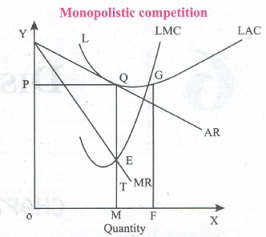
(vi) At Point E the firm achieves the equilibrium where MC = MR.
(vii) OP - Price, OM - Output
(viii) MQ - Average Cost, M = Average Revenue
\(\therefore\) MQ = MQ (AR = AC)
(ix) It means a firm earn the only normal profit in the long run.

11th Standard Syllabus & Materials
11th Standard
TN 11th Tamil பீடு பெற நில் - செய்யுள் - காவடிச்சிந்து Important Questions And Answers Study Material - QB365 Set A
NEW11th Standard
TN 11th Tamil பீடு பெற நில் - உரைநடை - மலை இடப்பெயர்கள் : ஓர் ஆய்வு Important Questions And Answers Study Material - QB365 Set A
NEW11th Standard
TN 11th Tamil மாமழை போற்றுதும் - துணைப்பாடம் - யானை டாக்டர் Important Questions And Answers Study Material - QB365 Set A
NEW11th Standard
TN 11th Tamil மாமழை போற்றுதும் - செய்யுள் - ஐங்குறுநூறு Important Questions And Answers Study Material - QB365 Set A



Tamilnadu Stateboard 11th Standard Subjects

Maths

Commerce
Economics

Biology

Business Maths and Statistics

Accountancy

Computer Science

Physics

Chemistry
Maths
Biology
Economics
Physics
Chemistry

History
Business Maths and Statistics

Computer Science
Accountancy

Computer Applications
History
Computer Technology
Commerce
Computer Applications
Computer Technology

Tamil

English

French
Tamilnadu Stateboard Standards



