
 100% FREE ACCESS
11th Standard Syllabus & Materials
11th Standard
TN 11th Tamil இயற்கை வேளாண்மை,சுற்றுச்சூழல் -செய்யுள் - மனோன்மணீயம் Important Questions And Answers Study Material - QB365 Set A
NEW11th Standard
TN 11th Tamil என்னுயிர் என்பேன் -துணைப்பாடம் - இசைத்தமிழர் இருவர் Important Questions And Answers Study Material - QB365 Set A
NEW11th Standard
TN 11th Tamil மொழி கலை -செய்யுள் - ஒவ்வொரு புல்லையும் Important Questions And Answers Study Material - QB365 Set A
NEW11th Standard
TN 11th Tamil பீடு பெற நில் - இலக்கணம் - பகுபத உறுப்புகள் Important Questions And Answers Study Material - QB365 Set A
NEW11th Standard
TN 11th Tamil பீடு பெற நில் - துணைப்பாடம் - வாடிவாசல் Important Questions And Answers Study Material - QB365 Set A
NEW11th Standard
TN 11th Tamil பீடு பெற நில் - செய்யுள் - குறுந்தொகை Important Questions And Answers Study Material - QB365 Set A

Published on: 13/05/2022
QB365 provides detailed and simple solution for every Creative Questions in class 11 Economics Subject. It will helps to get more idea about question pattern in every Creative questions with solution.
latest Creative QuestionsDownload Tamil Nadu 11th Standard Economics question papers, model tests, one-mark questions, important questions, and public exam papers in PDF format. Free study materials and answer keys for TN State Board students.
Questions + Answers key
Take MCQ Economics Test1.
Describe the law of supply in details.
2.
Explain briefly the Iso-cost Line with the help of a diagram?
3.
Explain the Law of supply with a suitable diagram?
4.
What are the factors determining supply?
5.
Explain the types of elasticity supply with the help of diagram.
1.
Meaning: It is associated with production analysis. It explains the positive relationship between the price of a commodity and the supply of that commodity. For example, if the price of cloth increases, the supply of cloth will also increase.
Definition: "Other things remaining the same, if the price of a commodity increases its quantity supplied increases and if the price of a commodity decreases, quantity supplied also decreases".
Supply Function: The supply of a commodity depends on the factors such as price of commodity, price of labour, price of capital, the state of technology, number of firms, prices of related goods, and future price expectations and so on. Mathematically the supply function is
Qs = f (Px, Pr, Pf, T, O, E )
Where Qs = Quantity supplied of x commodity
Px = Price of x Commodity
Pr = Price of related goods
Pf = Price of factors of production
T = Technology
O = Objective of the producer
E = Expected Price of the commodity.
Assumptions:
(i) There is no change in the prices of factors of production.
(ii) There is no change in price of capital goods.
(iii) Natural resources and their availability remain the same.
(iv) Prices of substitutes are constant.
(v) There is no change in technology.
(vi) Climate remains unchanged.
(vii) Political situations remains unchanged.
(viii) There is no change in tax policy.
Explanation: Supply function is Qs = f (P) or Q = 20P.
P is an independent variable. When its value changes, new values of Qs can be calculated.
Supply Schedule: It shows the different quantities of supply at different prices. This information is given in the supply schedule given below.
| Price (P) | Supply(Qs) |
| 1 | 20 |
| 2 | 40 |
| 3 | 60 |
| 4 | 80 |
| 5 | 100 |
Qs = 20 P
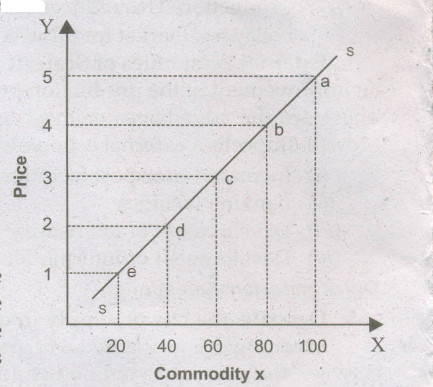
Supply Curve: A supply curve represents the data given in the supply schedule. As the price of the commodity increases, the quantum supplied of the commodity also increases. Thus-the supply curve has a positive slope from left to right.
The quantum supplied of commodity x is represented on X axis. And the price of the commodity is represented on the Y axis. The points such as e, d, c, b and a on the supply' curve 55', represent various quantities at different prices.
Factors determining supply:
(a) Price of the commodity
(b) Price of other commodities
(c) Price of factors
(d) Price expectations
(e) Technology
(f) Natural factors
(g) Discovery of new raw-materials
(h) Taxes and subsidies
(i) Objective of the firm
2.
The Iso-cost line: The iso-cost line is an important component in analysing producer's behaviour. The iso-cost line represents different combinations of inputs which shows the same amount of cost. The iso-cost line gives information on factor prices and financial resources of the firm. It is otherwise called as "lso-price line" or "iso-income line" or "iso-expenditure line" or "total outlay curve".
Suppose that a producer has a total budget of H2O and for producing a certain level of output, he has to spend this amount on two factors Labour (L) and Capital (K). Prices of factors K is no and L is HO. Iso Cost Curve can be drawn by using the following hypothetical table.
| The Iso-Cost | |||
| Combination | Units of Capital Price = Rs 30 | Units of Labour Price = Rs 10 | Total Expenditure( in Rupees) |
| A | 4 | 0 | 120 |
| B | 3 | 3 | 120 |
| C | 2 | 6 | 120 |
| D | 1 | 9 | 120 |
| E | 0 | 12 | 120 |
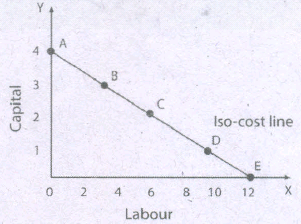
As shown in Table, there are five combinations of capital and labour such as combination A represents 4 units of capital and zero units of labour and this combination costs Rs 120.
Similarly other combinations (B, C, D and E) cost same amount of rupees (Rs 120).
Symbolically,
4K + OL = Rs.120
3K + 3 = Rs.120
2K + 6L = Rs.120
lK + 9L = Rs.120, and
OK + 12L = Rs.120.
Thus, all the combinations A, B, C, D and E cost the same total expenditure.
From the figure it is shown that the costs to be incurred on capital and labour are represented by the triangle OAE. The line AE is called as Iso-cost line.
3.
Law of Supply: Law of Supply describes a direct relation between price of a good and the supply of that good.
Definition: The Law of Supply can be stated as:
Other things remaining the same, if the price of a commodity increases its quantity supplied increases and if the price of a commodity decreases, quantity supplied also decreases".
Supply Function: Mathematically the supply function is,
Qs = f (Px' PI' Pf, T, O, E)
Px = Price of x Commodity
Pr = Price of related goods
Pf = Price of factors of production
T = Technology
O = Objective of the producer
E = Expected Price of the commodity.
Assumptions:
i. There is no change in the prices of factors of production
ii. There is no change in price of capital goods.
iii. Natural resources and their availability remain the same.
iv. Prices of substitutes are constant.
v. There is no change in technology.
vi. Climate remains unchanged.
vii. There is no change in tax policy.
Supply schedule: A supply schedule shows the different quantities of supply at different prices. This information is given in the supply schedule given below.
| Price and Supply | |
| Price (P) | Supply (Qs) |
| 1 | 20 |
| 2 | 40 |
| 3 | 60 |
| 4 | 80 |
| 5 | 100 |
Qs = 20P
Supply curve: Supply curve represents the data given in the supply schedule. As the price of the commodity increases, the quantum supplied of the The Iso-Cost commodity also increases. Thus the supply curve has a positive slope from left to right.
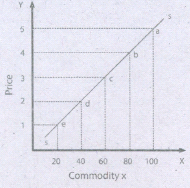
i) The Quantum supplied of commodity x is represented on X axis.
ii) The price of the commodity is represented on the y-axis.
iii) The points such as e, d, c, b and a on the supply curve "SS" represent various quantities at different prices.
4.
1. Price of the commodity
Higher the price larger the supply Price IS the incentive for the producers and sellers to supply more.
2. Price of other commodities
The supply of a commodity depends not only upon its price but also price of other commodities For instance if the price of commercial crops like cotton rise, this may result in reduction in cultivation of food crops like paddy and so its supply.
3. Price of factors
When the input prices go up, this result in rise in cost and supply will be affected.
4. Price expectations
The expectation over future prices determines present supply. If a rise in price is anticipated in future sellers tend to retain their produce for future sale and so supply in present market is reduced.
5. Technology
With advancement in technology production level improves, average cost production level improves average cost declines and as a result supply level increases.
6. Natural factors
In agriculture, natural factor like monsoon, climate etc. play a vital role in determining production level.
7. Discovery of new raw materials The discovery of new raw materials which are cheaper and of high quality tends to increase supply of the product.
8. Taxes and subsidies
Subsidies for inputs, credit, power etc. encourage the producers to produce more. Withdrawal of such incentives will hamper production. Taxes both dirt and indirect kill the ability and willingness to produce more.
9. Objective of the firm
When the goal of the firm is sales maximisation or improving market share, the supply of the product is likely to be higher.
5.
There are five types of elasticity supply. There are,
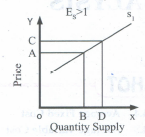
(1) Relative Elastic Supply: (ES> 1)
(i) The co-efficient of elastic supply is greater than 1 (ES> 1)
(ii) A unit change in the price causes more than one percent change in quantity supply of the commodity.
(2) Unitary Elastic Supply: (ES = 1)
(i) The co-efficient of elastic supply is equal to one (ES = 1)
(ii) A unit change in the price causes an equal change in quantity supply is called elastic supply.
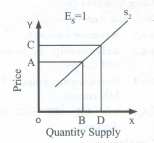
(3) Relatively Inelastic Supply: (ES < 1)
(i) The co-efficient of elasticity is less than one (ES < 1)
(ii) A unit change in the price causes and less than one percent change in the quantity supply.
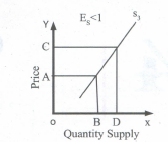
(4) Perfectly Inelastic Supply: (ES = 0) .
(i) The co-efficient of elasticity is equal to zero (ES = 0)
(ii) A unit change in the price causes no change in the quantity supply.
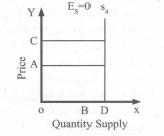
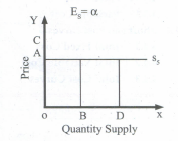
(5) Perfectly elastic supply: (ES= =)
(i) The co-efficient of elasticity of supply is infinity (ES = DC)
(ii) A unit change in the price causes an infinite change in the quantity supply.

11th Standard Syllabus & Materials
11th Standard
TN 11th Tamil பீடு பெற நில் - செய்யுள் - காவடிச்சிந்து Important Questions And Answers Study Material - QB365 Set A
NEW11th Standard
TN 11th Tamil பீடு பெற நில் - உரைநடை - மலை இடப்பெயர்கள் : ஓர் ஆய்வு Important Questions And Answers Study Material - QB365 Set A
NEW11th Standard
TN 11th Tamil மாமழை போற்றுதும் - துணைப்பாடம் - யானை டாக்டர் Important Questions And Answers Study Material - QB365 Set A
NEW11th Standard
TN 11th Tamil மாமழை போற்றுதும் - செய்யுள் - ஐங்குறுநூறு Important Questions And Answers Study Material - QB365 Set A



Tamilnadu Stateboard 11th Standard Subjects

Maths

Commerce
Economics

Biology

Business Maths and Statistics

Accountancy

Computer Science

Physics

Chemistry
Maths
Biology
Economics
Physics
Chemistry

History
Business Maths and Statistics

Computer Science
Accountancy

Computer Applications
History
Computer Technology
Commerce
Computer Applications
Computer Technology

Tamil

English

French
Tamilnadu Stateboard Standards



