
 100% FREE ACCESS
11th Standard Syllabus & Materials
11th Standard
TN 11th Tamil இயற்கை வேளாண்மை,சுற்றுச்சூழல் -செய்யுள் - மனோன்மணீயம் Important Questions And Answers Study Material - QB365 Set A
NEW11th Standard
TN 11th Tamil என்னுயிர் என்பேன் -துணைப்பாடம் - இசைத்தமிழர் இருவர் Important Questions And Answers Study Material - QB365 Set A
NEW11th Standard
TN 11th Tamil மொழி கலை -செய்யுள் - ஒவ்வொரு புல்லையும் Important Questions And Answers Study Material - QB365 Set A
NEW11th Standard
TN 11th Tamil பீடு பெற நில் - இலக்கணம் - பகுபத உறுப்புகள் Important Questions And Answers Study Material - QB365 Set A
NEW11th Standard
TN 11th Tamil பீடு பெற நில் - துணைப்பாடம் - வாடிவாசல் Important Questions And Answers Study Material - QB365 Set A
NEW11th Standard
TN 11th Tamil பீடு பெற நில் - செய்யுள் - குறுந்தொகை Important Questions And Answers Study Material - QB365 Set A

Published on: 13/05/2022
QB365 provides detailed and simple solution for every Creative Questions in class 11 Economics Subject. It will helps to get more idea about question pattern in every Creative questions with solution.
latest Creative QuestionsDownload Tamil Nadu 11th Standard Economics question papers, model tests, one-mark questions, important questions, and public exam papers in PDF format. Free study materials and answer keys for TN State Board students.
Questions + Answers key
Take MCQ Economics Test1.
Define 'Iso-Quant' and explain it with the help of a table and a diagram.
2.
Explain the Law of supply with a suitable diagram?
3.
Explain relationship among total Average and Marginal Products.
4.
Explain the types of elasticity supply with the help of diagram.
5.
1.
Definition of Iso-quant: According to Ferguson, "An iso-quant is a curve showing all possible combinations of inputs physically capable of producing a given level of output" Iso-quants are based on the following assumptions.
(1) It is assumed that only two factors are used to produce a commodity.
(2) Factors of production can be divided into small parts.
(3) Technique of production is constant.
(4) The substitution between the two factors is technically possible. That is, production function is of 'variable proportion' type rather than fixed proportion.
(5) Under the given technique, factors of production can be used with maximum efficiency
Iso-quant Schedule:
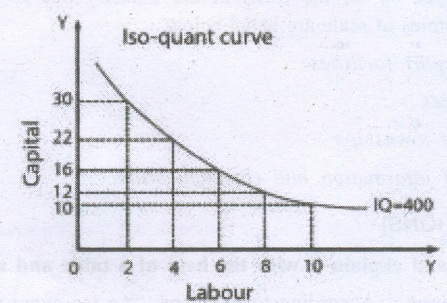
Let us suppose that there are two factors namely, labour and capital. An Iso-quant schedule shows the different combinations of these two inputs that yield the same level of output. It is seen from the table that the five combinations of labour units and units of capital yield the same level of output, i.e., 400 meters of cloth.
Table: Iso-quant
| Combination | Units of labour | Units of capital |
Output of cloth ( meters) |
| A | 2 | 30 | 400 |
| B | 4 | 22 | 400 |
| C | 6 | 16 | 400 |
| D | 8 | 12 | 400 |
| E | 10 | 10 | 400 |
Iso-quant Curve: An equal product curve represents all those combinations of two inputs which are capable of producing the same level of output. An iso-product curve can be drawn with the help of isoquant schedule
2.
Law of Supply: Law of Supply describes a direct relation between price of a good and the supply of that good.
Definition: The Law of Supply can be stated as:
Other things remaining the same, if the price of a commodity increases its quantity supplied increases and if the price of a commodity decreases, quantity supplied also decreases".
Supply Function: Mathematically the supply function is,
Qs = f (Px' PI' Pf, T, O, E)
Px = Price of x Commodity
Pr = Price of related goods
Pf = Price of factors of production
T = Technology
O = Objective of the producer
E = Expected Price of the commodity.
Assumptions:
i. There is no change in the prices of factors of production
ii. There is no change in price of capital goods.
iii. Natural resources and their availability remain the same.
iv. Prices of substitutes are constant.
v. There is no change in technology.
vi. Climate remains unchanged.
vii. There is no change in tax policy.
Supply schedule: A supply schedule shows the different quantities of supply at different prices. This information is given in the supply schedule given below.
| Price and Supply | |
| Price (P) | Supply (Qs) |
| 1 | 20 |
| 2 | 40 |
| 3 | 60 |
| 4 | 80 |
| 5 | 100 |
Qs = 20P
Supply curve: Supply curve represents the data given in the supply schedule. As the price of the commodity increases, the quantum supplied of the The Iso-Cost commodity also increases. Thus the supply curve has a positive slope from left to right.
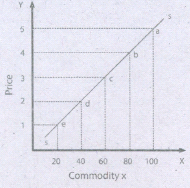
i) The Quantum supplied of commodity x is represented on X axis.
ii) The price of the commodity is represented on the y-axis.
iii) The points such as e, d, c, b and a on the supply curve "SS" represent various quantities at different prices.
3.
| Stages | Total product | Marginal Product | Average Product |
| Stage I | Initially it Increases at an increasing rate and then increases at a decreasing rate | At the beginning it increases, then reaches a maximum urn and starts to decrease | At the first instant it increases, then attains maximum |
| Stage ll | It continues to increase at a diminishing rate and reaches maximum | It continuous to diminish and becomes equal to zero | It is equal to MP and then begins to diminish |
| Stage lll | It diminishes | It becomes negative | It continues to diminish but always greater than zero(Positive) |
4.
There are five types of elasticity supply. There are,
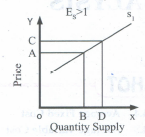
(1) Relative Elastic Supply: (ES> 1)
(i) The co-efficient of elastic supply is greater than 1 (ES> 1)
(ii) A unit change in the price causes more than one percent change in quantity supply of the commodity.
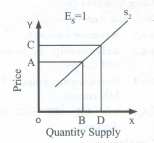
(2) Unitary Elastic Supply: (ES = 1)
(i) The co-efficient of elastic supply is equal to one (ES = 1)
(ii) A unit change in the price causes an equal change in quantity supply is called elastic supply.
(3) Relatively Inelastic Supply: (ES < 1)
(i) The co-efficient of elasticity is less than one (ES < 1)
(ii) A unit change in the price causes and less than one percent change in the quantity supply.
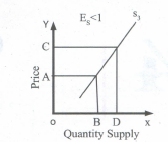
(4) Perfectly Inelastic Supply: (ES = 0) .
(i) The co-efficient of elasticity is equal to zero (ES = 0)
(ii) A unit change in the price causes no change in the quantity supply.
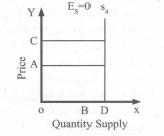
(5) Perfectly elastic supply: (ES = ∞)
(i) The co-efficient of elasticity of supply is infinity (ES = DC)
(ii) A unit change in the price causes an infinite change in the quantity supply.
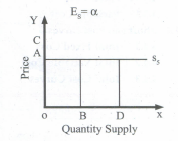
5.

11th Standard Syllabus & Materials
11th Standard
TN 11th Tamil பீடு பெற நில் - செய்யுள் - காவடிச்சிந்து Important Questions And Answers Study Material - QB365 Set A
NEW11th Standard
TN 11th Tamil பீடு பெற நில் - உரைநடை - மலை இடப்பெயர்கள் : ஓர் ஆய்வு Important Questions And Answers Study Material - QB365 Set A
NEW11th Standard
TN 11th Tamil மாமழை போற்றுதும் - துணைப்பாடம் - யானை டாக்டர் Important Questions And Answers Study Material - QB365 Set A
NEW11th Standard
TN 11th Tamil மாமழை போற்றுதும் - செய்யுள் - ஐங்குறுநூறு Important Questions And Answers Study Material - QB365 Set A



Tamilnadu Stateboard 11th Standard Subjects

Maths

Commerce
Economics

Biology

Business Maths and Statistics

Accountancy

Computer Science

Physics

Chemistry
Maths
Biology
Economics
Physics
Chemistry

History
Business Maths and Statistics

Computer Science
Accountancy

Computer Applications
History
Computer Technology
Commerce
Computer Applications
Computer Technology

Tamil

English

French
Tamilnadu Stateboard Standards



