
 100% FREE ACCESS
11th Standard Syllabus & Materials
11th Standard
TN 11th Tamil இயற்கை வேளாண்மை,சுற்றுச்சூழல் -செய்யுள் - மனோன்மணீயம் Important Questions And Answers Study Material - QB365 Set A
NEW11th Standard
TN 11th Tamil என்னுயிர் என்பேன் -துணைப்பாடம் - இசைத்தமிழர் இருவர் Important Questions And Answers Study Material - QB365 Set A
NEW11th Standard
TN 11th Tamil மொழி கலை -செய்யுள் - ஒவ்வொரு புல்லையும் Important Questions And Answers Study Material - QB365 Set A
NEW11th Standard
TN 11th Tamil பீடு பெற நில் - இலக்கணம் - பகுபத உறுப்புகள் Important Questions And Answers Study Material - QB365 Set A
NEW11th Standard
TN 11th Tamil பீடு பெற நில் - துணைப்பாடம் - வாடிவாசல் Important Questions And Answers Study Material - QB365 Set A
NEW11th Standard
TN 11th Tamil பீடு பெற நில் - செய்யுள் - குறுந்தொகை Important Questions And Answers Study Material - QB365 Set A
NEW11th Standard
TN 11th Tamil பீடு பெற நில் - செய்யுள் - காவடிச்சிந்து Important Questions And Answers Study Material - QB365 Set A
NEW11th Standard
TN 11th Tamil பீடு பெற நில் - உரைநடை - மலை இடப்பெயர்கள் : ஓர் ஆய்வு Important Questions And Answers Study Material - QB365 Set A
NEW11th Standard
TN 11th Tamil மாமழை போற்றுதும் - துணைப்பாடம் - யானை டாக்டர் Important Questions And Answers Study Material - QB365 Set A
NEW11th Standard
TN 11th Tamil மாமழை போற்றுதும் - செய்யுள் - ஐங்குறுநூறு Important Questions And Answers Study Material - QB365 Set A

Published on: 26/06/2018
Sets, Relations and Functions : Unit Test .1
Download Tamil Nadu 11th Standard Maths question papers, model tests, one-mark questions, important questions, and public exam papers in PDF format. Free study materials and answer keys for TN State Board students.
Published on: 26/06/2018
Sets, Relations and Functions : Unit Test .1
Download Tamil Nadu 11th Standard Maths question papers, model tests, one-mark questions, important questions, and public exam papers in PDF format. Free study materials and answer keys for TN State Board students.
Questions + Answers key
Take MCQ Maths Test1.
Discuss the following relations for reflexivity, symmetricity and transitivity :
The relation R defined on the set of all positive integers by "mRn if m divides n".
2.
By taking suitable sets A, B, C, verify the following results:
A \(\times\) (B\(\cup \)C) = (A\(\times\)B) \(\cup \) (A\(\times\)C)
3.
Write the following in roster form {x\(\in \)N : 4x + 9 < 52}
4.
Let R be the set of all real numbers. Consider the following subsets of the plane R x R: S = {(x, y) : y =x + 1 and 0 < x < 2} and T = {(x,y) : x - y is an integer} Then which of the following is true?
T is an equivalence relation but S is not an equivalence relation
Neither S nor T is an equivalence relation
Both S and T are equivalence relation
S is an equivalence relation but T is not an equivalence relation.
5.
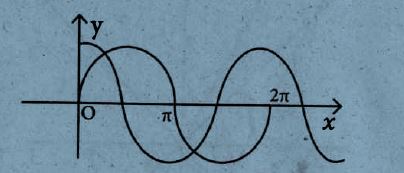
If A = {(x,y) : y = sin x, x ∈ R} and B = {(x,y) : y = cos x, x ∈ R} then A∩B contains
no element
infinitely many elements
only one element
cannot be determined
6.
Which one of the following is a finite set?
{x : x ∈ Z, x < 5}
{x : x ∈ W, x ≥ 5}
{x : x ∈ N, x > 10}
{x : x is an even prime number}
7.
If the function f:[-3,3]➝S defined by f(x) = x2 is onto, then S is
[-9,9]
R
[-3,3]
[0,9]
8.
The number of constant functions from a set containing m elements to a set containing n elements is
mn
m
n
m+n
9.
On the set of natural numbers let R be the relation defined by aRb if a + b \(\le\) 6. Write down the relation by listing all the pairs. Check whether it is reflexive
10.
Consider the function \(f:[0,{\pi\over 2}]⟶R\) given by f(x) = sin x and \(g:[0,{\pi\over 2}]⟶R\)given by g(x) = cos x. Show that f and g are one-one but (f + g) is not one-one.
11.
Let f: R ⟶ R be the signum function defined as \(f(x)=\begin{cases} 1,\ x>0\\0, x=0 \\-1, x<0 \end{cases}\)and g: R ⟶ R to the greatest integer function given by g(x) = [x]. Then prove that fog and gof coincide in [-1,0).
12.
Let R be the set of real numbers. If f: R⟶R,f(x) = x2 and g: R ⟶ R, g(x) = 2x + 1, then find fog and gof. Also show that fog ≠ gof.
13.
On the set of natural numbers let R be the relation defined by aRb if 2a + 3b = 30. Write down the relation by listing all the pairs. Check whether it is reflexive
14.
Let f and g be real functions defined by \(f(x)=\sqrt{x+2}\) and \(g(x)=\sqrt{4-x^2}\). Find fg
15.
Let f and g be real functions defined by \(f(x)=\sqrt{x+2}\)and \(g(x)=\sqrt{4-x^2}\). Find f + g
16.
Show that the relation R on the set A = {x ∈ Z : 0 < x < 12} given by R = {(a, b) : |a - b| is a multiple of 4} is an equivalence relation
17.
Show that the relation R on the set R of all real numbers defined as R = {(a, b): a < b2} is neither reflexive, nor symmetric nor transitive.
18.
The cartesian product A \(\times\) A has 9 elements among which are found (-1, 0) and (0, 1). Find the set A and the remaining elements of A \(\times\)A.
19.
For A = {0,1,2,3, 4}, B = {1, -2, 3, 4, 5, 6} and C = {2, 4, 6, 7} verify A\(B ∩ C) = (A\B) U(A\C) Using venn diagram.
20.
Let A = {a, b, c, d}, B = {a, c, e}, C = {a, e}.
Show that A ∩ (B ∩ C) = (A ∩ B) ∩ C
21.
From the curve y = sin x, graph the functions.
(i) y = sin(-x)
(ii) y = -sin(-x)
(iii) \(y=sin\left( {\pi\over 2}+x\right)\) which is cos x
(iv) \(y=sin\left({\pi\over 2}-x \right)\) which is also cos x (refer trigonometry)
22.
In the set Z of integers, define mRn if m - n is divisible by 7. Prove that R is an equivalence relation.
23.
Let A and B be two sets such that n(A) = 3 and n(B) = 2. If (x, 1) (y, 2) (z, 1) are in A\(\times\)B, find A and B, where x, y, z are distinct elements.
24.
If n (p(A)) = 1024, n(A\(\cup\)B) = 15 and n(p(B)) = 32, then find n(A\(\cap\)B).
1.
The relation R defined on the set of all positive integers by "mRn" if m divides n".
Given relation is "mRn if m divides n".
Reflexivity : mRm since m divides m for all positive integers m.
\(\therefore\) R is reflexive.
Symmetricity: mRn \(\Rightarrow\) nRm.
m divides n \(\Rightarrow\) n divides m but 'n' does not divide 'm'
\(\therefore\) R is not symmetric
Transitive : mRn and nRp \(\Rightarrow\) mRp.
m divides n and n divides p \(\Rightarrow\) m divides p.
\(\therefore\) R is transitive.
\(\therefore\) R is reflexive, and transitive.
2.
(B\(\cup \)C) = {3, 4, 5, 6 ,7, 9}
Now, A\(\times\)(B\(\cup \)C) = {1, 2, 3} \(\times\){3, 4, 5, 6, 7, 9}
= {(1,3)(1,4)(1,5)(1,6)(1,7)(1,9)(2,3)(2,4)(2,5)(2,6)(2,7)(2,9)(3,3)(3,4)(3,5)(3,6)(3,7)(3,9)} .....(1)
Now A\(\times\)B = {1,2,3} \(\times\) {4,5,6,7}
= {(1,4)(1,5)(1,6)(1,7)(2,4)(2,5)(2,6)(2,7)(3,4)(3,5)(3,6)(3,7)}
A\(\times\)C = {1,2,3} \(\times\) {3,4,5,9}
= {(1,3)(1,4)(1,5)(1,9)(2,3)(2,4)(2,5)(2,9)(3,3)(3,4)(3,5)(3,9)}
RHS(A\(\times\)B)\(\cup \)(A\(\times\)C) = {(1,3)(1,4)(1,5)(1,6)(1,7)(1,9)(2,3)(2,4)(2,5)(2,6)(2,7)(2,9)(3,3)(3,4)(3,5)(3,6)(3,7)(3,9)} .....(2)
From (1) & (2), LHS = RHS
Hence verified
3.
{x \(\in \) N : 4x + 9 < 52}
Let C = {x\(\in \)N:4x + 9 < 52}
\(\Rightarrow\) C = {x\(\in \)N:4x < 52 - 9}
\(\Rightarrow\) C = {x\(\in \)N: 4x < 43}
\(\Rightarrow\) C = \(\left\{ x\in N:x<\frac { 43 }{ 4 } \right\} \) \(\Rightarrow\) C = {x \(\in \) N : x < 10.75}
\(\Rightarrow\) C = {1,2,3,4,5,6,7,8,9,10}.
4.
\(\mathrm{T}: x-y \text { is an integer } \Rightarrow x \mathrm{R} y\)
\(\text { i) } x-x=0 \text { is an integer }\)
\(\therefore \text { T is reflexive. }\)
\(\text { ii) }(x-y) \text { is an integer } \Rightarrow y-x \text { is also an integer }\)
\(\therefore \mathrm{T} \text { is symmetry }\)
iii) If (x - y) is an integer and y- z is also an integer, by adding
x - z is also an integer.
\(\therefore \mathrm{T} \text { is transitive }\)
Thus, T is an equivalence relation.
\(\mathrm{S}: \mathrm{y}=x+1 \Rightarrow x \mathrm{~S} y\)
\(\text { i) } x=x+1 \Rightarrow x S x \text { is not true. }\)
\(\therefore S \text { is not reflexive. }\)
Hence T is an equivalence relation but S is not an equivalence relation
5.
6.
(d)
{x : x is an even prime number}
7.
f(0) = 0, f(-3) = 9 and f(3) = 9
.'. S is [0,9]
8.
(c)
n
9.
The relation is defined by aRb if a + b \(\le\) 6 for all a, b \(\in \)N.
a+b \(\le\)6 \(\Rightarrow\) a \(\le\) 6 - b
| a | 5 | 4 | 3 | 2 | 1 |
| b | 1 | 2 | 3 | 4 | 5 |
\(\therefore\) The list of ordered pairs are (5, 1) (4, 2) (3, 3) (2, 4) and (1, 5).
Reflexivity: R is not reflexive since (5, 5) \(\notin \) R.
10.
For any two distinct elements x1, x2 in \([0,{\pi\over 2}]\)
in x1 = sin x2 ⇒ x1 = x2
∴ f is one - one...(1)
Also cos x1 = cos x2 ⇒ x1 = x2
∴ g is also one-one...(2)
Now, (f + g) (x) = f(x) + g(x) = sin x + cos x
⇒ (f+g)(0) = sin0 + cos0 = 0+1=1
and \(f+g\left(\pi\over 2\right)=sin\frac{\pi}{2}+cos{\pi}{2}=1+0=1\)
(f+g)(0) = (f+g)\((\frac{\pi}{2})\) ⇒ 0 ≠ \(\frac{\pi}{2}\)
∴ (f + g) is not one-one...(3)
From (1), (2) and (3), we get f and g are one-one but (f +g) is not one-one.
11.
For any [-1, 0], we have
fog(x) = f(g(x)) = f([x]) = f( -1) = -1
gof(x) = g(f(x)) = g(-1) = [-1] = -1
⇒ fog(x) = gof(x) for all x ∈ [-1,0)
Hence fog and gof coincide on [-1, 0)
12.
Given f: R ⟶ R, given by f(x) = X2
and g: R ⟶ R given by g(x) = 2x + 1.
∴ fog (x) = f(g(x))
= f(2x + 1)
= (2x + 1)2 = 4x2 + 1+ 4x (1)
gof(x) = g(f(x) = g(x2) = 2x2 + 1 (2)
From (1) and (2), fog(x) ≠ gof(x).
13.
2a + 3b = 30
R = {(3, 8), (6, 6), (9, 4). (12, 2)}
Not reflexive, Not Symmetric, transitive, hence not an equivalence relation.
14.
Given \(f(x)=\sqrt{x+2}\)and \(g(x)=\sqrt{4-x^2}\) Clearly, f(x) is defined for all x, satisfying x + 2 > 0 ⇒x > -2 ⇒ x ∈[-2, ∞)
∴ Domain of f = [-2, ∞]
Also, g(x) is defined for all x satisfying 4 - x2 ≥ 0 ⇒ x2 - 4 < 0 ⇒ (x - 2) (x + 2) < 0
⇒ x ∈ [-2, 2]
∴ Domain of g = [-2, 2]
fg : [-2, 2] ⟶ R is given by \((f g)(x) =f(x) - g(x) =\sqrt{x+2}+\sqrt{4-x^2}=\sqrt{(x+2)^2+(2-x)}\)
\(=(x+2)\sqrt{2-x}\)
15.
Given \(f(x)=\sqrt{x+2}\)and \(g(x)=\sqrt{4-x^2}\) Clearly, f(x) is defined for all x, satisfying x + 2 > 0 ⇒x > -2 ⇒ x ∈[-2, ∞)
∴ Domain of f = [-2, ∞)
Also, g(x) is defined for all x satisfying 4 - x2 ≥ 0 ⇒ x2 - 4 < 0 ⇒ (x - 2) (x + 2) < 0
⇒ x ∈ [-2, 2]
∴ Domain of g = [-2, 2]
(f + g) : [-2, 2] ⟶ R is given by \((f+ g)(x) =f(x) + g(x) =\sqrt{x+2}+\sqrt{4-x^2}\)
16.
Given R = {(a, b) : |a - b| is a multiple of 4}
Reflexivity: Where a, b ∈ A = {0, 1, 2, ... 12}. For any a ∈ A, we have |a - a| = 0 which is a multiple of 4.
⇒ (a, a) ∈ A for all a ∈ A
∴ R is reflexive
Symmetry: Let (a, b) ∈ R. Then
(a, b) ∈ R
⇒ |a - b| is a multiple of 4.
⇒ |a - b| = 4⋋- for some ⋋∈N.
⇒ |b - a| = 4⋋- for some ⋋∈N.
⇒ (b, a) ∈N
∴ R is symmetric Transitivity: Let (a, b) ∈ R and (b, c) ∈ R
Then (a, b) ∈ R and (b, c) ∈ R
⇒ |a - b| is a multiple of 4 and |b - c| is a multiple of 4.
⇒ |a - b| = 4⋋ and |b - c| = 4μ for some ⋋ μ∈ N
⇒ a-b = ±4 -and b-c = ±4μ for some ⋋, μ ∈ N
⇒ a-c = ±4⋋ ±4μ for some ⋋, μ ∈ N
⇒ |a - c| is a multiple of 4.
⇒ (a-c)∈R
∴ R is transitive.
Hence, R is an equivalence relation.
17.
Given R = {(a, b): a < b2} where a, b ∈ R
reflexivity: We know that \(\left(1\over 2\right)\le\left(1\over 2\right)^2\)is not true
\(⇒\ \left({1\over 2},{1\over 2}\right)∉R\)
⇒ R is not reflexive
Symmetry: We know that -1< 32 but 3 ≰ (-1)2 is not true
⇒ (-1, 3) ∈ R but (3, -1)∉R
∴ R is not symmetric
Transitive: We observe that 2< (-3)2 and -3< (1)2 but 2 ≰ (1)2 is not true
⇒ (2, -3) ∈ R and (-3, 1) ∈ R but (2, 1) ∉ R
⇒ R is not transitive
∴ R is neither reflexive nor symmetric nor transitive.
18.
Given (-1, 0) ∈ A x A and (0, 1) ∈ A \(\times\) A
(-1,0) ∈ A \(\times\) A ⇒ -1,0 ∈ A and (0, 1) ∈ A \(\times\) A ⇒ 0, 1 ∈ A
∴ -1,0,1 ∈ A
∴ A = {-1, 0, 1}
Also it is given that A\(\times\) A has 9 elements.
∴ A has exactly three elements.
∴ A {-1, 0, 1}
∴ A \(\times\) A = {(-1, -1) (-1, 0) (-1, 1) (0, -1) (0, 0) (0, 1) (1, -1) (1, 0) (1, 1)}
19.
B ⋂ C = {4, 6}
A\(B ⋂ C) = {0, 1, 2, 3}
A\B = {0,2}
A\B = {0, 1, 3}
(A\B) U (A\C)= {a, 1,2, 3}
From (1) and (2), A\(B ∩ C) = (A\B) U (A\C)
Venn diagram:
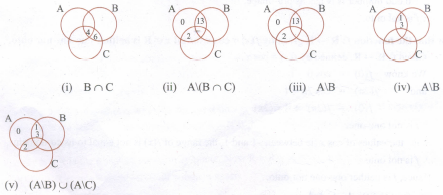
From (ii) and (v), we get
A\(B ∩ C) = (A\B) U (A\C)
20.
Given A = {a, b, c, d}, B = {a, c, e}, C = {a, e}
B∩C = {a, c}
A∩(B∩C) = {a}
A ∩ B = {a, e}
(A ∩ B) ∩ C = {a}
From (1) and (2), it is clear that A ∩ (B ∩ C) = (A ∩ B) ∩ C.
21.
(i) y = sin (-x)
.png)
Let y = sin x.
Then sin(-x) is the reflection of the graph of sin x, about y-axis.
(ii) y = -sin(-x)
.png)
-sin(-x) is the reflection of the graph of sin(-x) about the x-axis.
(iii) \(y=sin\left( {\pi\over 2}+x\right)\)
.png) Let y = sinx.
Let y = sinx.
Then \(sin\left( {\pi\over 2}+n\right)\)causes the shift to the left for \(\pi\over 2\) unit to the sin x curve.
(iv) \(y=sin\left({\pi\over 2}-x \right)\)
.png)
Let y = sin x. Then \(sin\left( {\pi\over 2}-n\right)\) causes the shift to the left for \(\pi\over 2\) unit to the sin (-x) curve.
22.
As m - m = 0,
m - m is divisible by 7 \(\Rightarrow\) mRm
\(\therefore\) R is reflexive.
Let mRn. Then m - n = 7k for some integer k
Thus n-m = 7 (-k) and hence nRm
\(\therefore\) R is symmetric.
Let mRn and nRp
\(\Rightarrow\) m-n = 7k and n - p = 7l for some
\(\Rightarrow\) m = 7k + n and - p = 7l- n integers k and l
so m-p = 7k+n+7l-n
\(\Rightarrow\) m - p = 7(k+l) \(\Rightarrow\) mRp
\(\therefore\) R is transitive.
Thus, R is an equivalence relation.
23.
Given A\(\times\)B = {(x, 1)(y, 2) (z, 1)}
Since n(A) = 3 and n(B) = 2,
A \(\times\) B will have 6 elements.
The remaining elements of A \(\times\) B will be (x, 2) (y, 1) (z, 2)
\(\therefore\) A\(\times\) B = {(x,1)(y,2)(z,1)(x,2)(y,1)(z,2)}
\(\therefore\) A = {x, y, z} and B = {1, 2}
24.
Given n(p(A)) = 1024 = 210
\(\Rightarrow\) n(A) = 10 [\(\therefore\) if n(A) = n, then n(p(A)) = 2n]
n(p(B)) = 32 = 25
\(\Rightarrow\) n(B) = 5.
We know that,
n(A\(\cup\) B) = n(A) + n(B) - n(A\(\cap\)B)
\(\Rightarrow\) 15 = 10+5 - (A\(\cap\)B)
\(\Rightarrow\) n(A\(\cap\)B) = 0.




Tamilnadu Stateboard 11th Standard Subjects
Maths

Commerce

Economics

Biology

Business Maths and Statistics

Accountancy

Computer Science

Physics

Chemistry
Maths
Biology
Economics
Physics
Chemistry

History
Business Maths and Statistics

Computer Science
Accountancy

Computer Applications
History
Computer Technology
Commerce
Computer Applications
Computer Technology

Tamil

English

French
Tamilnadu Stateboard Standards

