
 100% FREE ACCESS
11th Standard Syllabus & Materials
11th Standard
TN 11th Tamil இயற்கை வேளாண்மை,சுற்றுச்சூழல் -செய்யுள் - மனோன்மணீயம் Important Questions And Answers Study Material - QB365 Set A
NEW11th Standard
TN 11th Tamil என்னுயிர் என்பேன் -துணைப்பாடம் - இசைத்தமிழர் இருவர் Important Questions And Answers Study Material - QB365 Set A
NEW11th Standard
TN 11th Tamil மொழி கலை -செய்யுள் - ஒவ்வொரு புல்லையும் Important Questions And Answers Study Material - QB365 Set A
NEW11th Standard
TN 11th Tamil பீடு பெற நில் - இலக்கணம் - பகுபத உறுப்புகள் Important Questions And Answers Study Material - QB365 Set A
NEW11th Standard
TN 11th Tamil பீடு பெற நில் - துணைப்பாடம் - வாடிவாசல் Important Questions And Answers Study Material - QB365 Set A
NEW11th Standard
TN 11th Tamil பீடு பெற நில் - செய்யுள் - குறுந்தொகை Important Questions And Answers Study Material - QB365 Set A

Published on: 22/09/2018
Important Question paper
Download Tamil Nadu 11th Standard Maths question papers, model tests, one-mark questions, important questions, and public exam papers in PDF format. Free study materials and answer keys for TN State Board students.
Questions + Answers key
Take MCQ Maths Test1.
Find the direction cosines of the line joining (2, 3, 1) and (3, - 1, 2).
2.
Find the direction cosines of \(\overrightarrow{AB},\) where A is (2, 3, 1) and B is (3, - 1, 2).
3.
Can a vector have direction angles 30°, 45°, 60°?
4.
Simplify : \(sec \theta \begin{bmatrix} sec \theta & tan\theta \\ tan\theta & sec\theta \end{bmatrix}\)-\(tan \theta \begin{bmatrix} tan \theta & sec\theta \\ sec\theta & tan\theta \end{bmatrix}\)
5.
Five mangoes and 4 apples are in a box. If two fruits are chosen at random, find the probability that (i) one is a mango and the other is an apple (ii) both are of the same variety.
6.
Find the angle between the vectors \(2\hat{i}+3\hat{j}-6\hat{k}\) and \(6\hat{i}-3\hat{j}+2\hat{k}\)
7.
If \(\overrightarrow{a}\) and \(\overrightarrow{b}\)are two vectors such that | \(\overrightarrow{a}\) | = 10, | \(\overrightarrow{b}\) | = 15 and \(\overrightarrow{a}\).\(\overrightarrow{b}\) = 75 \(\sqrt{2}\), find the angle between \(\overrightarrow{a}\) and \(\overrightarrow{b}\).
8.
Construct the matrix \(A=[a_{ij}]_{3\times 3}\), where \(a_{ij}=i-j.\) State whether A is symmetric or skew-symmetric.
9.
If \(\begin{bmatrix} 0 & p& 3 \\ 2 & q^2 & -1 \\ r & 1 & 0 \end{bmatrix}\) is skew-symmetric, find the values of p, q, and r.
10.
If A = \(\begin{bmatrix} 4 & 2 \\ -1 & x \end{bmatrix}\) and such that (A - 2I)(A - 3I) = O, find the value of x.
11.
Consider the matrix Aa=\(\begin{bmatrix} cos \alpha & -sin\alpha \\ sin\alpha & cos\alpha \end{bmatrix}\)
Find all possible real values of α satisfying the condition \(A\alpha +A^T_{\alpha}=I\)
12.
If A =\(\begin{bmatrix} 4 & 6 & 2 \\ 0 & 1 & 5 \\ 0 & 3 & 2 \end{bmatrix}\) and B = \(\begin{bmatrix} 0 & 1 & -1 \\ 3 & -1 & 4 \\ -1 & 2 & 1 \end{bmatrix}\) verify (A - B)T = AT - BT
13.
If A =\(\begin{bmatrix} 4 & 6 & 2 \\ 0 & 1 & 5 \\ 0 & 3 & 2 \end{bmatrix}\) and B = \(\begin{bmatrix} 0 & 1 & -1 \\ 3 & -1 & 4 \\ -1 & 2 & 1 \end{bmatrix}\) verify (A+B)T = AT + BT
14.
If A =\(\begin{bmatrix} 4 & 6 & 2 \\ 0 & 1 & 5 \\ 0 & 3 & 2 \end{bmatrix}\) and B= \(\begin{bmatrix} 0 & 1 & -1 \\ 3 & -1 & 4 \\ -1 & 2 & 1 \end{bmatrix}\)
verify (AB)T = BTAT
15.
If A =\(\begin{bmatrix} 0 &c &b \\ c & 0 &a \\ b & a & 0 \end{bmatrix}\), compute A2
16.
If Ai, Bi, Ci are the cofactors of ai, bi,ci, respectively, i = 1 to 3 in
|A| = \(\begin{vmatrix} a_1 &b_1 &c_1 \\ a_2 & b_2 &c_2 \\ a_3 & b_3 & c_3 \end{vmatrix}\), show that \(\begin{vmatrix} A_1 &B_1 &C_1 \\ A_2 & B_2 &C_2 \\ A_3 & B_3 & C_3 \end{vmatrix}\) = |A|2
17.
Let A and B be two symmetric matrices. Prove that AB = BA if and only if AB is a symmetric matrix.
18.
Identify the singular and non-singular matrices:\(\begin{bmatrix} 1&2 &3 \\ 4 & 5 &6 \\ 7 & 8 & 9 \end{bmatrix}\)
19.
If \(\overrightarrow{a}=\hat{i}+2\hat{j}+2\hat{k},|\overrightarrow{b}|=5\) and the angle between \(\overrightarrow{a}\) and \(\overrightarrow{b}\) is \({\pi\over 6},\) then the area of the triangle formed by these two vectors as two sides, is
\(7\over4\)
\(15\over4\)
\(3\over4\)
\(17\over4\)
20.
Vectors \(\overrightarrow{a}\) and \(\overrightarrow{b}\) are inclined at an angle \(\theta =120^o\). If \(|\overrightarrow{a}|=1,|\overrightarrow{b}|=2,\) then \([(\overrightarrow{a}+3\overrightarrow{b})\times (3\overrightarrow{a}-\overrightarrow{b})]^2\) is equal to
225
275
325
300
21.
If \(|\overrightarrow{a}|=13,|\overrightarrow{b}|=5\) and \(\overrightarrow{a}.\overrightarrow{b}=60^o\) then \(|\overrightarrow{a}\times\overrightarrow{b}|\) is
15
35
45
25
22.
23.
The value of \(\overrightarrow{AB}+\overrightarrow{BC}+\overrightarrow{DA}+\overrightarrow{CD}\) is
\(\overrightarrow{AD}\)
\(\overrightarrow{CA}\)
\(\overrightarrow{0}\)
\(-\overrightarrow{AD}\)
24.
If a \(\neq\) b, b, c satisfy \(\begin{vmatrix} a&2b &2c \\3 & b & c \\ 4 & a & b \end{vmatrix}=0,\) then abc =
a + b + c
0
b3
ab + bc
25.
If x1, x2, x3 as well as y1, y2, y3 are in geometric progression with the same common ratio, then the points (x1, y1 ), (x2, y2), (x3, y3 ) are
vertices of an equilateral triangle
vertices of a right angled triangle
vertices of a right angled isosceles triangle
collinear
26.
The value of the determinant of A = \(\begin{bmatrix} 0&a &-b \\ -a & 0 & c \\ b & -c & 0 \end{bmatrix}is\)
-2abc
abc
0
a2 + b2 + c2
27.
What must be the matrix X, if 2x +\(\begin{bmatrix} 1& 2 \\ 3 & 4 \end{bmatrix}=\begin{bmatrix} 3 & 8 \\ 7 & 2 \end{bmatrix}?\)
\(\begin{bmatrix} 1& 3 \\ 2 &-1 \end{bmatrix}\)
\(\begin{bmatrix} 1& -3 \\ 2 &-1 \end{bmatrix}\)
\(\begin{bmatrix} 2& 6 \\ 4 &-2 \end{bmatrix}\)
\(\begin{bmatrix} 2& -6 \\ 4 &-2 \end{bmatrix}\)
28.
If aij = \({1\over2}(3i-2j)\) and A = [aij]2x2 is
\(\begin{bmatrix} {1\over 2}& 2 \\ -{1\over2} & 1 \end{bmatrix}\)
\(\begin{bmatrix} {1\over 2}& -{1\over2} \\ 2& 1 \end{bmatrix}\)
\(\begin{bmatrix} 2& 2\\ {1\over 2}& -{1\over2} \end{bmatrix}\)
\(\begin{bmatrix} -{1\over 2}& {1\over2} \\ 1& 2 \end{bmatrix}\)
1.
Let A and B be the points (2, 3, 1) and (3,-1, 2).
The direction cosines of\(\overrightarrow{AB},\) are \({1\over \sqrt{18}},{-4\over \sqrt{18}},{1\over \sqrt{18}}\).
But any point can be taken as first point.
Hence we have another set of direction cosines with opposite direction.
Thus, we have another set of direction ratio \({-1\over \sqrt{18}},{4\over \sqrt{18}},{-1\over \sqrt{18}}.\)
2.
\(\overrightarrow{AB}=\overrightarrow{OB}-\overrightarrow{OA}=\hat{i}-4\hat{j}+\hat{k}\)
Direction cosines are \({1\over \sqrt{18}},{-4\over \sqrt{18}},{1\over \sqrt{18}}\).
3.
The condition is cos2\(\alpha\) + cos2\(\beta\) + cos2\(\gamma\) = 1
Here \(\alpha =30^o,\beta =45^o,\gamma=60^o\)
cos2\(\alpha\) + cos2\(\beta\) + cos2\(\gamma\) \(={3\over 4}+{1\over2}+{1\over4}\neq1.\)
There fore they are not direction angles of any vector.
4.
If we denote the given expression by A, then using the scalar multiplication rule, we get
A =\( \begin{bmatrix} sec^2 \theta & sec\theta tan\theta \\ sec\theta tan\theta & sec^2\theta \end{bmatrix}\)-\( \begin{bmatrix} tan^2 \theta & tan\theta sec\theta \\ sec\theta tan\theta & tan^2\theta \end{bmatrix}\)=\(\begin{bmatrix}1&0 \\ 0 & 1 \end{bmatrix}\)
5.
(i) Let A be the event ofgetting one mango and one apple, Then
\(P(A)=\frac{5 C_1 \times 4 C_1}{9 C_2}=\frac{5}{9}\)
| M | A | T |
| 5 | 4 | 9 |
(ii) Let B and C be the events of getting both are mango and both are an apple respectively then
\(P(\text { Bor } C) =P(B)+P(C) \)
\(=\frac{5 C_2}{9 C_2}+\frac{4 C_2}{9 C_2}=\frac{5 \times 4}{9 \times 8}+\frac{4 \times 3}{9 \times 8} \)
\(=\frac{8}{18}=\frac{4}{9}\)
6.
Let \(2\hat{i}+3\hat{j}-6\hat{k}\) and \(6\hat{i}-3\hat{j}+2\hat{k}\)
Let \(\theta \) be the angle between the given vectors.
\(\overrightarrow{a}.\overrightarrow{b}=(2\hat{i}+3\hat{j}-6\hat{k}).(6\hat{i}-3\hat{j}+2\hat{k})\)
= 12 - 9 - 12 = -9
\(|\overrightarrow{a}|=\sqrt{2^2+3^2+(-6)^2}=\sqrt{4+9+36}=\sqrt{49}=7\)
and \(|\overrightarrow{b}|=\sqrt{6^2+(-3)^2+2^2}=\sqrt{36+9+4}=\sqrt{49}=7\)
\(\therefore cos \theta ={\overrightarrow{a}.\overrightarrow{b}\over |\overrightarrow{a}|.|\overrightarrow{b}|}={-9\over 7(7)}={-9\over 49}\)
\(\Rightarrow \theta =cos^{-1}({-9\over 49})\)
7.
Given | \(\overrightarrow{a}\) | = 10, | \(\overrightarrow{b}\) | = 15 and \(\overrightarrow{a}\).\(\overrightarrow{b}\) = 75 \(\sqrt{2}\)
Let \(\theta\) be the angle between the vector \(\overrightarrow{a}\) and \(\overrightarrow{b}\).
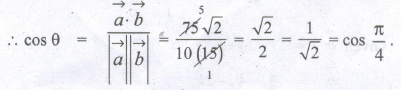
\(\theta ={\pi\over 4}.\)
8.
Given aij = i-j
Let A = [aij] 3 \(\times\) 3
Ingeneralwe can wrlte \(\Lambda=\left[\begin{array}{lll} a_{11} & a_{12} & a_{13} \\ a_{21} & a_{21} & a_{13} \\ a_{31} & a_{32} & a_{33} \end{array}\right]\)
\(a_{i j}=1-j\)
\(\therefore\) a11 = 1 - 1 = 0 a21 = 2 - 1 = 1 a31 = 3 - 1 = 2
a12 = 1 - 2 = 0 a22 = 2 - 2 = 0 a32 = 3 - 2 = 1
a13 = 1 - 3 = -2 a23 = 2 - 3 = -1 a33 = 3 - 3 = 0
\(\Rightarrow A=\left[ \begin{matrix} 0 & -1 & -2 \\ 1 & 0 & -1 \\ 2 & 1 & 0 \end{matrix} \right] \)
\(\Rightarrow A^{T}=\left[ \begin{matrix} 0 & -1 & 2 \\ -1 & 0 & 1 \\ -2 & -1 & 0 \end{matrix} \right] =-\left[ \begin{matrix} 0 & -1 & -2 \\ 1 & 0 & -1 \\ 2 & 1 & 0 \end{matrix} \right] =-A\)
Since AT = -A \(\Rightarrow\) A is a skew-symmetric matrix.
9.
Let B = \(\left[ \begin{matrix} 0 & p & 3 \\ 2 & q^{ 2 } & -1 \\ r & 1 & 0 \end{matrix} \right] \)
\(\Rightarrow { B }^{ T }=\left[ \begin{matrix} 0 & 2 & r \\ p & { q }^{ 2 } & 1 \\ 3 & -1 & 0 \end{matrix} \right] \)
Since B is a skew-symmetric matrix,
BT = -B
\(\left[ \begin{matrix} 0 & 2 & r \\ p & { q }^{ 2 } & 1 \\ 3 & -1 & 0 \end{matrix} \right] =-\left[ \begin{matrix} 0 & p & 2 \\ 2 & { q }^{ 2 } & -1 \\ r & 1 & 0 \end{matrix} \right] \)
\(\Rightarrow \left[ \begin{matrix} 0 & 2 & r \\ p & { q }^{ 2 } & 1 \\ 3 & -1 & 0 \end{matrix} \right] =-\left[ \begin{matrix} 0 & -p & -3 \\ -2 & -{ q }^{ 2 } & -1 \\ -r & -1 & 0 \end{matrix} \right] \)
Equating the corresponding entries on both sides, we get
-p = 2
p = -2
r = -3
q2 = -q2
q2 + q2 = 0
2q2 = 0
q2 = 0
q = 0
\(\therefore\) p = -2
r = -3
q = 0
10.
\(A=\left[\begin{array}{cc}
4 & 2 \\
-1 & x
\end{array}\right] ; I=\left[\begin{array}{ll}
1 & 0 \\
0 & 1
\end{array}\right]\)
\(A-2 I=\left[\begin{array}{cc}
4 & 2 \\
-1 & x
\end{array}\right]-2\left[\begin{array}{ll}
1 & 0 \\
0 & 1
\end{array}\right]=\left[\begin{array}{cc}
4-2 & 2+0 \\
-1+0 & x-2
\end{array}\right]\)
\(=\left[\begin{array}{cc}
2 & 2 \\
-1 & x-2
\end{array}\right]\)
\(A-3 I=\left[\begin{array}{rr}
4 & 2 \\
-1 & x
\end{array}\right]-3\left[\begin{array}{ll}
1 & 0 \\
0 & 1
\end{array}\right]=\left[\begin{array}{cc}
4-3 & 2+0 \\
-1+0 & x-3
\end{array}\right]\)
\(=\left[\begin{array}{cc}
1 & 2 \\
-1 & x-3
\end{array}\right]\)
Given, \((A-2 I)(A-3 I)=\left[\begin{array}{cc}
2 & 2 \\
-1 & x-2
\end{array}\right]\left[\begin{array}{cc}
1 & 2 \\
-1 & x-3
\end{array}\right]\)
\(=\left[\begin{array}{ll}
0 & 0 \\
0 & 0
\end{array}\right]\)
\(\left[\begin{array}{cc}
2-2 & 4+2 x-6 \\
-1-x+2 & -2+(x-2)(x-3)
\end{array}\right]=\left[\begin{array}{ll}
0 & 0 \\
0 & 0
\end{array}\right]\)
\(-1-x+2=0\)
\(-x+1=0\)
\(x=1\)
11.
Given A\(\alpha \) = \(\begin{bmatrix} cos \alpha & -sin\alpha \\ sin\alpha & cos\alpha \end{bmatrix}\)
\({ A }_{ \alpha }^{ T }=\left[ \begin{matrix} cos\alpha & -sin\alpha \\ -sin\alpha & cos\alpha \end{matrix} \right] \)
Also, it is given that \({ A }_{ \alpha }+{ A }_{ \alpha }^{ T }=1\)
\(\Rightarrow \left[ \begin{matrix} cos\alpha & -sin\alpha \\ sin\alpha & cos\alpha \end{matrix} \right] +\left[ \begin{matrix} cos\alpha & sin\alpha \\ -sin\alpha & cos\alpha \end{matrix} \right] =\left[ \begin{matrix} 1 & 0 \\ 0 & 1 \end{matrix} \right] \)
\(\Rightarrow \left[ \begin{matrix} 2cos\alpha & 0 \\ 0 & 2cos\alpha \end{matrix} \right] =\left[ \begin{matrix} 1 & 0 \\ 0 & 1 \end{matrix} \right] \)
Equating the corresponding entries on both sides, we get
2 cos\(\alpha\) = 1 \(\Rightarrow\) \(cos\alpha =\frac { 1 }{ 2 } =cos\frac { \pi }{ 3 } \)
\(\alpha =2n\pi \pm \frac { \pi }{ 3 } ,n\epsilon z\) \(\begin{aligned} {[\because \cos \theta} &=\cos \alpha \ \theta =2 n \pi \pm \alpha \forall n \in z] \end{aligned}\)
\(\alpha=2 n \pi \pm \frac{\pi}{3} \forall n \in z\)
12.
A -B =\(\begin{bmatrix} 4 & 6 & 2 \\ 0 & 1 & 5 \\ 0 & 3 & 2 \end{bmatrix}\)-\(\begin{bmatrix} 0 & 1 & -1 \\ 3 & -1 & 4 \\ -1 & 2 & 1 \end{bmatrix}\)=\(\begin{bmatrix} 4 & 5 & 3 \\ -3 & 2 & 1 \\1 & 1 & 1 \end{bmatrix}\)
(A - B)T =\(\begin{bmatrix} 4 & -3 & 1 \\ 5 & 2 & 1 \\3 & 1 & 1 \end{bmatrix}\) ..(1)
AT - BT =\(\begin{bmatrix} 4 & 0 & 0 \\ 6 & 1 & 3 \\ 2 & 5 & 2 \end{bmatrix}\)-\(\begin{bmatrix} 0 & 3 & -1 \\ 1 & -1 & 2 \\ -1 & 4 & 1 \end{bmatrix}\)=\(\begin{bmatrix} 4 & -3 & 1 \\ 5 & 2 & 1 \\3 & 1 & 1 \end{bmatrix}\).....(2)
From (1) and (2), (A - B)T= AT - BT.
13.
A + B =\(\begin{bmatrix} 4 & 6 & 2 \\ 0 & 1 & 5 \\ 0 & 3 & 2 \end{bmatrix}\)+\(\begin{bmatrix} 0 & 1 & -1 \\ 3 & -1 & 4 \\ -1 & 2 & 1 \end{bmatrix}\)=\(\begin{bmatrix} 4 & 7 & 1 \\ 3 & 0 & 9 \\ -1 & 5 & 3 \end{bmatrix}\)
(A+B)T =\(\begin{bmatrix} 4 & 3 & -1 \\ 7 & 0 & 5 \\ 1 & 9 & 3 \end{bmatrix}\) .....(1)
AT + BT= \(\begin{bmatrix} 4 & 0 & 0 \\ 6 & 1 & 3 \\ 2 & 5 & 2 \end{bmatrix}\)+\(\begin{bmatrix} 0 & 3 & -1 \\ 1 & -1 & 2 \\ -1 & 4 & 1 \end{bmatrix}\)=\(\begin{bmatrix} 4 & 3 & -1 \\ 7 & 0 & 5 \\ 1 & 9 & 3 \end{bmatrix}\).......(2)
From (1) and (2), (A+B)T = AT+ BT.
14.
AB =\(\begin{bmatrix} 4 & 6 & 2 \\ 0 & 1 & 5 \\ 0 & 3 & 2 \end{bmatrix}\)\(\begin{bmatrix} 0 & 1 & -1 \\ 3 & -1 & 4 \\ -1 & 2 & 1 \end{bmatrix}\)=\(\begin{bmatrix} 16 & 2 & -1 \\ -2 & 9 & 9 \\ 7 & 1 & 14 \end{bmatrix}\)
(AB)T =\(\begin{bmatrix} 16 & -2 & 7 \\ 2 & 9 & 1 \\ 22 & 9 & 14 \end{bmatrix}\)...(1)
BT = \(\begin{bmatrix} 0 & 3 & -1 \\ 1 & -1 & 2 \\ -1 & 4 & 1 \end{bmatrix}\), AT=\(\begin{bmatrix} 4 & 0 & 0 \\ 6 & 1 & 3 \\ 2 & 5 & 2 \end{bmatrix}\)
BTAT=\(\begin{bmatrix} 0 & 3 & -1 \\ 1 & -1 & 2 \\ -1 & 4 & 1 \end{bmatrix}\)\(\begin{bmatrix} 4 & 0 & 0 \\ 6 & 1 & 3 \\ 2 & 5 & 2 \end{bmatrix}\)=\(\begin{bmatrix} 16 & -2 & 7 \\ 2 & 9 & 1 \\ 22 & 9 & 14 \end{bmatrix}\)...(2)
From (1) and (2), (AB)T = BTAT.
15.
A2 = AA =\(\begin{bmatrix} 0 &c &b \\ c & 0 &a \\ b & a & 0 \end{bmatrix}\)\(\begin{bmatrix} 0 &c &b \\ c & 0 &a \\ b & a & 0 \end{bmatrix}\)=\(\begin{bmatrix} C_{11} &C_{12} &C_{13} \\ C_{21} & C_{22} &C_{23} \\ C_{31} & C_{32} & C_{33} \end{bmatrix}\)
16.
Consider the product \(\begin{vmatrix} a_1 &b_1 &c_1 \\ a_2 & b_2 &c_2 \\ a_3 & b_3 & c_3 \end{vmatrix}\)\(\begin{vmatrix} A_1 &B_1 &C_1 \\ A_2 & B_2 &C_2 \\ A_3 & B_3 & C_3 \end{vmatrix}\)
= \(\begin{vmatrix} a_1A_1+b_1B_1+c_1C_1 & a_1A_2+b_1B_2+c_1C_2& a_1A_3+b_1B_3+c_1C_3\\ a_2A_1+b_2B_1+c_2C_1 & a_2A_2+b_2B_2+c_2C_2 &a_2A_3+b_2B_3+c_2C_3 \\ a_3 A_1+b_3B_1+c_3C_1 & a_3A_2+b_3B_2+c_3C_2 &a_3A_3+b_3B_3+ c_3C_3 \end{vmatrix}\)
= \(\begin{vmatrix} |A| &0 &0 \\ 0 & |A| &0 \\ 0 & 0 & |A| \end{vmatrix}\) = |A|3.
That is, |A| \(\times\) \(\begin{vmatrix} A_1 &B_1 &C_1 \\ A_2 & B_2 &C_2 \\ A_3 & B_3 & C_3 \end{vmatrix}\) = |A|3
\(\Rightarrow\)\(\begin{vmatrix} A_1 &B_1 &C_1 \\ A_2 & B_2 &C_2 \\ A_3 & B_3 & C_3 \end{vmatrix}\) = |A|2.
17.
Given A and B be two symmetric matrices.
\(\Rightarrow A^T=A \text { and } B^T=B\)
Given AB = BA.
\(\Leftrightarrow(A B)^T=B^T A^T\)
\(\Leftrightarrow(A B)^T=B A\)
\(\Leftrightarrow(A B)^T=A B\)
\(\Leftrightarrow A B \text { is a symmetric matrix. }\)
18.
Let A =\(\begin{bmatrix} 1&2 &3 \\ 4 & 5 &6 \\ 7 & 8 & 9 \end{bmatrix}\)
= 1(45 - 48) -2(36 - 42) + 3(32 - 35)
= I(-3) - 2(-6) + 3(-3)
= -3 + 12 - 9
\(|A|=0\)
\(\therefore\) A is singular
19.
(b)
\(15\over4\)
20.
\((\vec{a}+3 \vec{b}) \times(3 \vec{a}-\vec{b}) =3(\vec{a} \times \vec{a})-\vec{a} \times \vec{b}+9 \vec{b} \times \vec{a}-3 \vec{b} \times \vec{b} \)
\(=\overrightarrow{0}+\vec{b} \times \vec{a}+9(\vec{b} \times \vec{a})-\overrightarrow{0} \)
\(=10 \vec{b} \times \vec{a} \)
\(\frac{\sqrt{3}}{2} \times 2 =|\vec{a} \times \vec{b}| \)
\(|\vec{a} \times \vec{b}| =\sqrt{3} \)
\([(\vec{a}+3 \vec{b}) \times(3 \vec{a}-\vec{b})]^{2} =100(\vec{b} \times \vec{a})^{2} \)
\(=100(\vec{a} \times \vec{b})^{2}=100(\sqrt{3})^{2} \)
\(=100 \times 3=300 \)
21.
\(\text { W.K.T }|\vec{a} \cdot \vec{b}|^{2}+|\vec{a} \times \vec{b}|^{2}=|\vec{a}|^{2} \cdot|\vec{b}|^{2}\)
\(|\vec{a} \times \vec{b}|^{2} =13^{2} \cdot 5^{2}-|\vec{a} \cdot \vec{b}|^{2} \)
\(=(169)(25)-3600=4225-3600 =625 \)
\(|\vec{a} \times \vec{b}| =25 \)
22.
(c)
23.
\(\underbrace{\overrightarrow{A B}}+ \overrightarrow{B C}+\overrightarrow{C D}+\overrightarrow{D A} \)
\(=\underbrace{\overrightarrow{A C}+\overrightarrow{C D}}+\overrightarrow{D A} \)
\(=\underbrace{\overrightarrow{A D}+\overrightarrow{D A}} \)
\(=\overrightarrow{A A}=\overrightarrow{0} . \)
24.
\(\left|\begin{array}{ccc} a & 2 b & 2 c \\ 3 & b & c \\ 4 & a & b \end{array}\right| =0 \)
\(\Rightarrow \frac{1}{2}\left|\begin{array}{lll} a & 2 b & 2 c \\ 6 & 2 b & 2 c \\ 4 & a & b \end{array}\right| =0 \quad R_{2} \rightarrow 2 R_{2} \)
\(\frac{1}{2}\left|\begin{array}{ccc} a-6 & 0 & 0 \\ 6 & 2 b & 2 c \\ 4 & a & b \end{array}\right| =0 \quad R_{1} \rightarrow R_{1}-R_{2} \)
\(\Rightarrow \frac{1}{2}\left[(a-6)\left(2 b^{2}-2 a c\right)\right] =0 \)
\((a-6)\left(2 b^{2}-2 a c\right) =0 \)
\(a=6,2 b^{2} =2 a c \)
\(b^{2} =a c \quad \therefore b^{3}=a b c \)
25.
(d)
collinear
26.
\(|A|=\left|\begin{array}{ccc} 0 & a & -b \\ -a & 0 & c \\ b & -c & 0 \end{array}\right|\)
\(=0-a(-b c)-b(a c)=a b c-a b c=0\)
27.
\(2 X=\left[\begin{array}{ll} 3 & 8 \\ 7 & 2 \end{array}\right]-\left[\begin{array}{ll} 1 & 2 \\ 3 & 4 \end{array}\right]=\left[\begin{array}{cc} 2 & 6 \\ 4 & -2 \end{array}\right]\)
\(X=\left[\begin{array}{cc} 1 & 3 \\ 2 & -1 \end{array}\right]\)
28.
\(A=\left[\begin{array}{ll} a_{11} & a_{12} \\ a_{21} & a_{22} \end{array}\right] \)
\(a_{11}=\frac{1}{2}(3-2)=\frac{1}{2} ; a_{12}=\frac{1}{2}(3-4)=\frac{-1}{2} \)
\(a_{21}=\frac{1}{2}(3(2)-2)=\frac{4}{2}=2 ; a_{22}=\frac{1}{2}(6-4)=\frac{2}{2}=1 \)
\(\therefore A=\left[\begin{array}{ll} \frac{1}{2} & -\frac{1}{2} \\ 2 & 1 \end{array}\right] \)

11th Standard Syllabus & Materials
11th Standard
TN 11th Tamil பீடு பெற நில் - செய்யுள் - காவடிச்சிந்து Important Questions And Answers Study Material - QB365 Set A
NEW11th Standard
TN 11th Tamil பீடு பெற நில் - உரைநடை - மலை இடப்பெயர்கள் : ஓர் ஆய்வு Important Questions And Answers Study Material - QB365 Set A
NEW11th Standard
TN 11th Tamil மாமழை போற்றுதும் - துணைப்பாடம் - யானை டாக்டர் Important Questions And Answers Study Material - QB365 Set A
NEW11th Standard
TN 11th Tamil மாமழை போற்றுதும் - செய்யுள் - ஐங்குறுநூறு Important Questions And Answers Study Material - QB365 Set A



Tamilnadu Stateboard 11th Standard Subjects
Maths

Commerce

Economics

Biology

Business Maths and Statistics

Accountancy

Computer Science

Physics

Chemistry
Maths
Biology
Economics
Physics
Chemistry

History
Business Maths and Statistics

Computer Science
Accountancy

Computer Applications
History
Computer Technology
Commerce
Computer Applications
Computer Technology

Tamil

English

French
Tamilnadu Stateboard Standards

