
 100% FREE ACCESS
11th Standard Syllabus & Materials
11th Standard
TN 11th Tamil இயற்கை வேளாண்மை,சுற்றுச்சூழல் -செய்யுள் - மனோன்மணீயம் Important Questions And Answers Study Material - QB365 Set A
NEW11th Standard
TN 11th Tamil என்னுயிர் என்பேன் -துணைப்பாடம் - இசைத்தமிழர் இருவர் Important Questions And Answers Study Material - QB365 Set A
NEW11th Standard
TN 11th Tamil மொழி கலை -செய்யுள் - ஒவ்வொரு புல்லையும் Important Questions And Answers Study Material - QB365 Set A
NEW11th Standard
TN 11th Tamil பீடு பெற நில் - இலக்கணம் - பகுபத உறுப்புகள் Important Questions And Answers Study Material - QB365 Set A
NEW11th Standard
TN 11th Tamil பீடு பெற நில் - துணைப்பாடம் - வாடிவாசல் Important Questions And Answers Study Material - QB365 Set A
NEW11th Standard
TN 11th Tamil பீடு பெற நில் - செய்யுள் - குறுந்தொகை Important Questions And Answers Study Material - QB365 Set A

Published on: 24/07/2018
Mid Test
Download Tamil Nadu 11th Standard Maths question papers, model tests, one-mark questions, important questions, and public exam papers in PDF format. Free study materials and answer keys for TN State Board students.
Questions + Answers key
Take MCQ Maths Test1.
Consider the 3 cities Chennai, Trichy and Tirunelveli. In order to reach Tirunelveli from Chennai, one has to pass through Trichy. There are 2 roads connecting Chennai with Trichy and there are 3 roads connecting Trichy with Tirunelveli. What are the total number of ways of travelling from Chennai to Tirunelveli?
2.
How many ways can the product a2b3c4 be expressed without exponents?
3.
Determine the number of permutations of the letters of the word SIMPLE if all are taken at a time?
4.
Three men have 4 coats, 5 waist coats and 6 caps. In how many ways can they wear them?
5.
Suppose 8 people enter an event in a swimming meet. In how many ways could the gold, silver and bronze prizes be awarded?
6.
If (n-1)P3 :n P4 = 1 : 10, find n
7.
Prove that the sum of first n positive odd numbers is n2.
8.
How many 'letter strings' together can be formed with the letters of the word "VOWELS" so that
(i) the strings begin with E
(ii) the strings begin with E and end with W.
9.
How many 4 - digit even numbers can be formed using the digits 0, 1, 2, 3 and 4, if repetition of digits are not permitted?
10.
If an electricity consumer has the consumer number say 238 :110 : 29, then describe the linking and count the number of house connections upto the 29th consumer connection linked to the larger capacity transformer number 238 subject to the condition that each smaller capacity transformer can have a maximal consumer link of say 100.
11.
If the letters of the word FUNNY are permuted in all possible ways and the strings thus formed are arranged in the dictionary order, find the rank of the word FUNNY.
12.
A coin is tossed 8 times,
(i) How many different sequences of heads and tails are possible?
(ii) How many different sequences containing six heads and two tails are possible?
13.
In how many ways can the letters of the word SUCCESS be arranged so that all Ss are together?
14.
Find the distinct permutations of the letters of the word MISSISSIPPI?
15.
How many strings can be formed from the letters of the word ARTICLE, so that vowels occupy the even places?
16.
A student appears in an objective test which contain 5 multiple choice questions. Each question has four choices out of which one correct answer.
(i) What is the maximum number of different answers can the students give?
(ii) How will the answer change if each question may have more than one correct answers?
17.
A test consists of 10 multiple choice questions. In how many ways can the test be answered if
(i) Each question has four choices?
(ii) The first four questions have three choices and the remaining have five choices?
(iii) Question number n has n + 1 choices?
18.
If 10Pr-1 = 2 \(\times\) 6Pr, find r.
19.
Using the Mathematical induction, show that for any natural number n; with the assumption i2 = -1, (r(cos ፀ + i sin ፀ))n = rn (cos nፀ+i sin nፀ)
20.
Find the number of strings of 5 letters that can be formed with the letters of the word PROPOSITION.
21.
An exam paper contains 8 questions, 4 in Part A and 4 in Part B. Examiners are required to answer 5 questions. In how many ways can this be done if
(i) There are no restrictions of choosing a number of questions in either parts.
(ii) At least two questions from Part A must be answered.
22.
If (n+2)C7 : (n-1)P4 = 13 : 24 find n.
23.
If the letters of the word IITJEE are permuted in all possible ways and the strings thus formed are arranged in the lexicographic order, find the rank of the word IITJEE.
24.
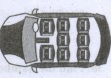
A van has 8 seats. It has two seats in the front with two rows of three seats behind. The van belongs to a family, consisting of seven members, F, M, S1, S2, S3, D1, D2. How many ways can the family sit in the van if
(i) There are no restriction?
(ii) Either F or M drives the van?
(iii) D1, D2 sits next to a window and F is driving?
25.
How many different strings can be formed together using the letters of the word "EQUATION" so that
(i) the vowels always come together?
(ii) the vowels never come together?
26.
A number of four different digits is formed with the use of the digits 1, 2, 3, 4 and 5 in all possible ways. Find the following
(i) How many such numbers can be formed?
(ii) How many of these are even?
(iii) How many of these are exactly divisible by 4?
27.
How many numbers are there between 1 and 1000 (both inclusive) which are divisible neither by 2 nor by 5?
28.
Prove that \(\frac { (2n)! }{ n! } \) = 2n (1.3.5...(2n - 1)).
29.
(i) Find the number of strings of length 4, which can be formed using the letters of the word BIRD, without repetition of the letters.
(ii) How many strings of length 5 can be formed out of the letters of the word PRIME taking all the letters at a time without repetition.
30.
Find the sum of all 4-digit numbers that can be formed using digits 0, 2, 5, 7, 8 without repetition?
31.
Find the sum of all 4-digit numbers that can be formed using digits 1, 2, 3, 4 and 5, repetitions not allowed?
32.
Find the number of strings that can be made using all letters of the word THING. If these words are written as in a dictionary, what will be the 85th string?
33.
If the letters of the word GARDEN are permuted in all possible ways and the strings thus formed are arranged in the dictionary order, then find the ranks of the words
(i) GARDEN
(ii) DANGER
34.
Each of the digits 1, 1, 2, 3, 3 and 4 is written on a separate card. The six cards are then laid out in a row to form a 6-digit number.
(i) How many distinct 6-digit numbers are there?
(ii) How many of these 6-digit numbers are even?
(iii) How many of these 6-digit numbers are divisible by 4?
35.
How many strings are there using the letters of the word INTERMEDIATE, if
(i) The vowels and consonants are alternative
(ii) All the vowels are together
(iii) Vowels are never together
(iv) No two vowels are together.
36.
In how many ways 4 mathematics books, 3 physics books, 2 chemistry books and 1 biology book can be arranged on a shelf so that all books of the same subjects are together.
37.
8 women and 6 men are standing in a line.
(i) How many arrangements are possible if any individual can stand in any position?
(ii) In how many arrangements will all 6 men be standing next to one another?
(iii) In how many arrangements will no two men be standing next to one another?
1.
There are 2 roads connecting Chennai to Trichy. Suppose these are R1 and R2. Further, there are 3 roads connecting Trichy to Tirunelveli. Let us name them as S1, S2 and S3. Suppose a person chooses R1 to travel from Chennai to Trichy and may further choose any of the 3 roads S1, S2 or S3 to travel from Trichy to Tirunelveli. Thus the possible road choices are (R1, S1), (R1, S2), (R1, S3). Similarly, if the person chooses R2 to travel from Chennai to Trichy, the choices would be (R2, S1), (R2, S2), (R2, S3).
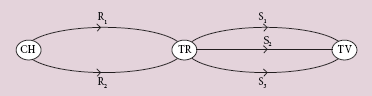
Thus there are 2 \(\times\) 3 = 6 ways of travelling from Chennai to Tirunelveli.
2.
Given factors are two a's, 3b's and 4c's
Total number of exponents = 9.
Hence, number of ways the product can be expressed without exponents
= \(\frac { 9! }{ 2!3!4! } =\frac { 9\times 8\times 7\times 6\times 5\times 4\times ! }{ 2\times 3\times 2\times 4! } \)= 1260
3.
There are 6 letters in the word 'SIMPLE'.
So, total number of words is equal to the number of arrangements of these letters, taken all at a time. Sum order of such arrangements is 6 P6 = 6! = 720
4.
4 coats can be given to 3 men in 4 p3 ways.5 waistcoats can be given to 3 men in 5P3 ways 6 caps can be given to 3 men in 6 P3 ways.
∴ Total number of ways of wearing them
= 4P3 \(\times\) 5P3 \(\times\) 6 P3
= \(\frac { 4! }{ 1! } \times \frac { 5! }{ 2! } \times \frac { 6! }{ 3! } \)
= \(4\times 3\times 2\times \frac { 5\times 4\times 3\times 2! }{ 2! } X\frac { 6\times 5\times 4\times 3! }{ 3! } \)
= 24 \(\times\) 60 \(\times\) 120
= 1,72,800
5.
Gold medal can be awarded to anyone of the 8 candidates in 8 ways.
Silver medal can be awarded to anyone of the remaining 7 candidates in 7 ways.
Bronze medal can be awarded to anyone of the remaining 6 candidates in 6 ways.
∴ Total numbers of ways of awarding the prize
= 8 \(\times\) 7 \(\times\) 6 = 336
6.
Given (n-1)P3 :n P4 = 1 : 10
⇒ \(\frac { (n-1){ P }_{ 3 } }{ n{ P }_{ 4 } } =\frac { 1 }{ 10 } \)
⇒ 10.(n-1)P3 = 1.nP4 \(\left[ \because npr\quad =\frac { n! }{ (n-r)! } \right] \)
⇒ \(10\times \frac { (n-1)! }{ (n-1-3)! } =\frac { n! }{ (n-4)! } \)
⇒ \(\frac { 10\times (n-1)! }{ (n-4)! } =\) \(\frac { 10\times (n-1)! }{ (n-4)! }\)⇒\(\frac { n(n-1)! }{ (n-4)! } \)
⇒10 = n
∴ n = 10.
7.
Let p(n) = 1 + 3 + 5 + ... + (2n- 1). Therefore P(1) = 1 = 12 is true.
We assume that P(k) = 1 + 3 + 5 +: .. (2k-1) is true for n = k.That is P(k) = k2
We need to prove P(k + 1) = (k+ 1)2
P(k+1) = 1+3+5+...(2(k+1)-1)
\(=\underbrace{1+3+5+7+.....+(2k+1)}+2k+1\)
= P(k) + 2k+1
= k2+2k+1 = (k+1)2
This implies, P(k + 1) is true. Hence, by the principle of a mathematical induction, P(n) is true for all natural numbers.
8.
The given strings contains 6 letters (V, O, W, E, L, S).
(i) Since all strings must begin with E, we have the remaining 5 letters which can be arranged in 5P5 = 5! ways.
Therefore the total number of strings with E as the starting letter is 5! =120.

(ii) Since all strings must begin with E, and end with W, we need to fix E and W. The remaining 4 letters can be arranged in 4P4 = 4! Ways.

Therefore the total number of strings with E as the starting letter and W as the final letter is 4! = 24.
9.
There are three conditions as follows:
1. It is 4-digit number and hence its 1000th place cannot be 0.
2. It is an even number and hence its unit place can be either 0, 2 or 4.
Two cases arise in this situation. Either 0 in the unit place or not.
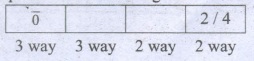
Case 1: When the unit place is filled by 0, then the 1000th place can be filled in 4 ways, 100th place can be filled in 3 ways and 10th place in 2 ways. Therefore, number of 4-digit numbers having 0 at unit place is \(4 \times 3 \times 2 \times 1=24\)
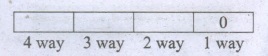
Case 2: When the unit place is filled with non-zero numbers, that is 2 or 4, the number of ways is 2, the number of ways of filling the 1000th place is in 3 ways (excluding '0'), 100th place in 3 ways and 10th place in 2 ways. Therefore, number of 4-digit numbers without 0 at unit place is \(3 \times 3 \times 2 \times 2=36\)
Hence, by the rule of sum, the required number of 4 digit even numbers is 24 + 36 = 60.
10.
The following figure illustrates the electricity distribution network.
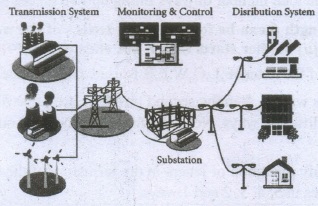
There are 110 smaller capacity transformer attached to a larger capacity transformer. As each smaller capacity transformer can be linked with only 100 consumers, we have for the 109 transformers, there will be 109 \(\times\)100 = 10900 links. For the 110th transformer, there are only 29 consumers linked. Hence, the total number of consumer linked to the 238th larger capacity transformer is 10900 + 29 = 10929.
11.
Lexicographic order of the word is F, N, N, D, Y
Number of words starting with F = \(\frac { 4! }{ 2! } \)
\(\frac{0 \times 4 !}{2 !}+\frac{2 \times 3 !}{2 !}+\frac{0 \times 2 !}{2 !}+0 \times 1 !+0 \times 0 !+1\)
\(=0+\frac{2 \times 3 \times 2 \times 1}{2}+0+0+0+1\)
= 6 + 1 = 7
Rank of FUNNY = 7
12.
(i) When coin is tossed 1 time, Possibilities of heads and tails = 11 = 1
When the coin is tossed 2 times, Possibilities of head and tails is 24.
In this way we get,
When a coin tossed at 8 times, possibilities of head and tail of different sequences is 28
(ii) Since there are 6 heads of one kind and 4 tails of other kind, required number of sequences = \(\frac { { 2 }^{ 8 } }{ 6!2! } \)
13.
Considering all S as one letter there are 5 letters containing 2 C's, one U, and one E which can be arranged in
\(\frac { 5! }{ 2!1!1! } =\frac { 5\times 4\times 3\times 2 }{ 2 } \)
= 60 Ways
14.
There are 11 letters in the given word of which 4 are S's,4 are I's and 2 are P's and 1 M
Hence total number of distinct words
= \(\frac { 11! }{ 4!4!2!1! } =\frac { 11! }{ 4!4!2! } \)
=\(\frac { 11\times 10\times 9\times 8\times 7\times 6\times 5\times 4! }{ 4\times 3\times 2\times 1\times 4!\times 2 } \) = 34650
15.
In the letters of the word, ARTICLE, there are three vowels namely A, I, E.
There are 3 even places.
3 vowels can occupy the even places in 3P3 = 3! ways.
Remaining 4 letters can occupy 4 places in 4! ways.
Hence, total number of ways of arrangement = 4! \(\times\) 3!
= \(4\times 3\times 2\times 3\times 2\)
=144
16.
(i) Since each question can be answered in 4 ways, the maximum number of different answers
= \(4\times 4\times 4\times 4\times 4={ 4 }^{ 5 }\)
(ii) When each question has more than one correct answer the maximum number of different answers \(=(5 \times 3)^{5}=15^{5}\)
17.
(i) Since each question can be answered in 4 ways, the total number of ways of answering 10 questions is 4 \(\times\) 4 \(\times\) 4 \(\times\) 4 \(\times\) 4 \(\times\) 4 \(\times\) 4 \(\times\) 4 \(\times\) 4 \(\times\) 4 = 410
(ii) Since first four question have three choices, the number of ways of answering first four questions is \(3\times 3\times 3\times 3={ 3 }^{ 4 }\)
Remaining 6 questions have 5 choices each
∴ Number of ways of answering the remaining 6 question =\(5\times 5\times 5\times 5\times 5\times 5={ 5 }^{ 6 }\)
∴ Total number of ways of answering the questions = \({ 3 }^{ 4 }\times { 5 }^{ 6 }\)
(iii) Since first four question have three choices, the number of ways of answering first four questions is \(3\times 3\times 3\times 3={ 3 }^{ 4 }\)
Remaining 6 questions have 5 choices each
∴ Number of ways of answering the remaining 6 question =\(5\times 5\times 5\times 5\times 5\times 5={ 5 }^{ 6 }\)
∴ Total number of ways of answering the questions = \({ 3 }^{ 4 }\times { 5 }^{ 6 }\)
18.
Given 10Pr-1 = 2 \(\times\) 6Pr
⇒ \(\frac { 10! }{ (10-r+1)! } =2\times \frac { 6! }{ (6-r)! } \) \(\left[ \because n{ P }_{ r }=\frac { n! }{ (n-r)! } \right] \)
⇒ \(\frac { 10\times 9\times 8\times 7\times 6! }{ (11-r)! } =\frac { 10\times 9\times 8\times 7\times 6! }{ (11-r)! } \)
⇒ \(\frac { 10\times 9\times 8\times 7 }{ (11-r)(10-r)(8-r)(7-r)(6-r) } =\frac { 2 }{ (6-r)! } \)
⇒ \(\frac { 10\times 9\times 8\times 7 }{ (11-r)(10-r)(8-r)(7-r) } =2\)
\(
\Rightarrow(11-r)(10-r)(9-r)(8-r)(7-r)=5 \times 9 \times 8 \times 7
\)
\( \Rightarrow(11-r)(10-r)(9-r)(8-r)(7-r)=7 \times 6 \times 5 \times 4 \times 3
\)
\( \Rightarrow(11-r)(10-r)(9-r)(8-r)(7-r)=(11-4)(10-4)(9-4)(8-7)(7-4)
\)
⇒ r = 4
19.
Let, P(n): = (r(cos ፀ + i sin ፀ)n = rn (cos nፀ+i sin nፀ)
Substituting the value of n = 1, in the statement we get,
P(1) =(r(cos ፀ + i sin ፀ))1 = r(cos ፀ+i sin ፀ)
Hence, P(1) is true.
Let us assume that the statement is true for n = k. Then
(r(cos ፀ + i sin ፀ))k = rk (cos kፀ + i sin kፀ)
We need to show that P(k + 1) is true. Consider,
P(k+1) = ((r(cos ፀ + i sin ፀ))k+1
=(r(cos ፀ + i sin ፀ))k+1
=(r(cos ፀ + i sin ፀ))k \(\times\) r(cosፀ+ isinፀ)
=rk(coskፀ+i sin kፀ) \(\times\) r(cosፀ+ i sinፀ)
=rk+1 x (cos kፀ cos ፀ + i2 sin kፀ sin) + i(sin kፀ cos ፀ + cos kፀ sin ፀ)
=rk+1 x (cos(k+1)ፀ + i sin(k+1)ፀ).
This implies that P(k + 1) is true. The validity of P(k + 1) follows from that of P(k).
Therefore by the principle of mathematical induction, for any natural number n,
(r(cos ፀ + i sin ፀ))n = rn(cos(nፀ) + i sin(nፀ))
20.
There are 11 letters in the word, with respect to number of repetitions of letters there are 4 distinct letters (R, S, T, N), 2 sets of two alike letters (PP, II), 1 set of three alike letters (OOO). The following table will illustrate the combination of these sets and the number of words.
| S.No | Letter options | Selections | Arrangements |
|---|---|---|---|
| 1 | 5 distinct (R, S, T, N, P, I, O) | 7C5 | 7C5 \(\times\) 5! = 2520 |
| 2 | 1 set of 3 alike (OOO), 1 set of 2 alike (PP, II) | 1C1 \(\times\)2C1 | 1C1 \(\times\)2C1 \(\times\)\(\frac { 5! }{ 3!\times 2! } =20\) |
| 3 | 1 set of 3 alike (OOO), 2 distinct (R, S, T, N, P, I) | 1C1 \(\times\)6C2 | 1C1 \(\times\)6C1 \(\times\)\(\frac { 5! }{ 3! } = 300\) |
| 4 | sets of 2 alike (PP, II, OO), 1 distinct (R, S, T, N and remaining one in 2 alike) | 3C2 \(\times\)5C1 | 3C2 \(\times\)5C1 \(\times\)\(\frac { 5! }{ 2!\times 2! } =450\) |
| 5 | 1 set of 2 alike (PP, II, OO); 3 distinct (R, S, T, N and remaining two in 2 alike) |
3C1 \(\times\)6C3 | 3C1 \(\times\)6C3 \(\times\)\(\frac { 5! }{ 2! } =3600\) |
Hence, the total number of strings are 2520 + 20 + 300 + 450 + 3600 = 6890.
21.
(i) There are no restrictions: Totally there are 8 questions in both Part A and Part B. The total number of ways of attempting 5 questions from 8 questions is 8C5 = 8C3 = 56.
(ii) At least two questions from Part A needs to be answered: Accordingly, various choices are tabulated as follows.
| Part A | Part B | Number of selections |
| 2 | 3 | 4C2 \(\times\) 4C3 |
| 3 | 3 | 4C3 \(\times\) 4C2 |
| 4 | 1 | 4C4 \(\times\) 4C1 |
Therefore, the required number of ways of answering is
4C2 \(\times\) 4C3 + 4C3 \(\times\) 4C2+ 4C4 \(\times\) 4C1 = 24 + 24 + 4 = 52.
22.
(n+2)C7 : (n-1)P4 = 13 : 24
\(\frac { { (n+2) }_{ C_{ 7 } } }{ { (n+2) }_{ P_{ 4 } } } =\frac { 13 }{ 24 } \)
\(\frac { (n+2)! }{ (n-5)!7! } \times \frac { (n-5)! }{ (n-1)! } =\frac { 13 }{ 24 } \)
\(\frac { (n+2)(n+1)n(n-1)! }{ (n-1)!.7! } =\frac { 13 }{ 24 } \)
\((n+2)(n+1)(n)=\frac{13}{24} \times 7 !=\frac{13}{24} \times 7 \times 6 \times 5 \times 4 \times 3 \times 2 \times 1\)
\((n+2)(n+1)(n)=13 \times 14 \times 15\)
n + 2 = 15 \(\Longrightarrow\) n = 13.
23.
The lexicographic order of the letters of given word is E, E, I, I, J, T. In the lexicographic order, the strings which begin with E come first. If we fill the first place with E, remaining 5 letters (E, I, I, J, T) can be arranged in \(\frac { 5! }{ 2! } \) ways. On proceeding like this we get,
E - - - - - = \(\frac { 5! }{ 2! } \) = 60 ways
IE - - - = 4! = 24 ways
IIE - - - = 3! = 6 ways
IIJ - - - = \(\frac { 3! }{ 2! } \) = 3 ways
IITE - - = 2! = 2 ways
IITJEE = 1 way
The rank of the word IITJEE is 60 + 24 + 6 + 3 + 2 + 1 = 96.
24.
(i) As there 8 seats to be occupied out of which one seat is for the one who drives. Since there are no restrictions any one can drive the van. Hence the number of ways of occupying the driver seat is 7P1 = 7 ways. The number of ways of occupying the remaining 7 seats by the remaining 6 people is 7P6 = 5040.
Hence the total number of ways the family can be seated in the car is 7 \(\times\) 5040 = 35280.
(ii) As the driver seat can be occupied by only F or M, there are only two ways it can be occupied. Hence the total number of ways the family can be seated in the car is 2 \(\times\) 5040 = 10080.
(iii) As there are only 5 window seats available for D1 & D2 to occupy the number of ways of seated near the windows by the two family members is 5P2 = 20. As the driver seat is occupied by F, the remaining 4 people can be seated in the available 5 seats in 5P4 = 120. Hence the total number of ways the family can be seated in the car is 20 \(\times\) 1 \(\times\) 120 = 2400.
25.
(i) There are 8 letters in the word "EQUATION" which includes 5 vowels (E, U, A, I, O) and 3 consonants (Q, T, N). Considering 5 vowels as one letter, we have 4 letters which can be arranged in 4P4= 4! ways. But corresponding each of these arrangements, the vowels E, U, A, I, O can be put in 5P5 = 5! ways.
Hence, by the rule of product required number of words is 4! \(\times\) 5! = 24 \(\times\) 120 = 2880.
(ii) The total number of strings formed by using all the eight letters of the word "EQUATION" is 8P8 = 8! = 40320.
So, the total number of strings in which vowels are never together is the same as the difference between the total number of strings and the number of strings in which vowels are together is 40320 - 2880 = 37440.
26.
(i) The solution for this is the same as the number of permutations taking four-digits out of 5 digits is 5P4 = 5 \(\times\) 4 \(\times\) 3 \(\times\) 2 = 120.

(ii) For even number last digits must be 2 or 4 which is filled in 2P1 ways and remaining 3 places filled from remaining 4 digits in 4P3 ways. Therefore the required number of ways is 2P1 \(\times\) 4P3 = 2 \(\times\) 24 = 48.
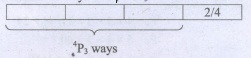
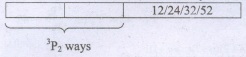
(iii) Since the number divisible by 4, then last two digit must be divisible by 4. The Last two digits become 12, 24, 32, 52 (4 ways). The remaining first two places filled from remaining 3 digits in 3p2 ways. The required number of numbers which are divisible by 4 is 4P1 \(\times\) 3P2 = 4 \(\times\) 6 = 24.
27.
n(A) = Number of numbers divisible by 2 = 500
n(B) = Number of numbers divisible by 5 = 200
n(A⋂B) = Number of numbers divisible by 10 = 100
n(AUB) = n(A) + n(B) - n(A⋂B)
Number of numbers divisible by 2 or 5
= 500 + 200 - 100 = 600
∴ Number of numbers divisible neither by 2 nor by 5
= 1000 - 600 = 400
28.
\(\frac { (2n)! }{ n! } =\frac { 1.2.3.4...(2n-2).(2n-1)2n }{ n! } \)
= \(\frac { (1.3.5...(2n-1))(2.4.6...(2n-2).2n) }{ n! } \) (Grouping the odd and even numbers separately)
= \(\frac { (1.3.5...(2n-1))\times 2^{ n }\times (1.2.3...(n-1).n) }{ n! } \) (taking out the 2's)
= \(\frac { (1.3.5...(2n-1)\times 2^{ n }\times n! }{ n! } \)
= 2n(1.3.5...(2n - 1))
29.
(i) There are as many strings as filling the 4 vacant places by the 4 letters, keeping in mind that repetition is not allowed. The first place can be filled in 4 different ways by any one of the letters B, I, R, D. Following which, the second place can be filled in by any one of the remaining 3 letters in 3 different ways, following which the third place can be filled in 2 different ways, following which fourth place can be filled in 1 way. Thus the number of ways in which the 4 places can be filled, by the rule of product is 4 \(\times\) 3 \(\times\) 2 \(\times\) 1 = 24. Hence, the required number of strings is 24.
(ii) There are 5 different letters with which 5 places are to be filled. The first place can be filled in 5 ways as any one of the five letters P, R, I, M, E can be placed there. Having filled the first place with any of the 5 letters, 4 letters are left to be placed in the second place, three letters are left for the third place and 2 letters are left to be put in the fourth place. The remaining 1 letter has to be placed in the fifth place. Hence, the total number of ways filling up five places is 5 \(\times\) 4 \(\times\) 3 \(\times\) 2 \(\times\) 1 = 120.
30.
| tho | hun | tens | uni |
| 4 | 5 | 5 | 5 |
Since 0 cannot be in the thousand's place
Let us find the sum of all these 500 numbers.
By filling 0 is the unit place, the remaining 3 places can be filled with remaining 4 digits is \(4\times 4\times 4=64\) in unit place.
∴ Sum of all the unit digits
= \((64\times 0)+(64\times 2)+(64\times 5)+(64\times 7)+(64\times 8)\)
= 64(0 + 2 + 5 + 7 + 8) = 64 (22) = 1408
Similarly sum of the tens digits =\(14408\times 10\) = 144080
Sum of all the hundred's digits = \(14408\times 100\) = 1440800
By filling 2 in the thousand's place, remaining 3 places can be filled with remaining 3 digits in \(3\times 3\times 3\) 27 ways [since 0 cannot be in thousands place]
∴ Sum of the digits in the thousands place
= \(27(2+5+7+8)=27(22)\times 1000\) = 594000
Hence sum of all the 4-digit numbers formed by using the digits 0, 2,5, 7, 8 is 1408 + 14080 + 140800 + 594000
= 1408 (1 + 10 + 100) + 594000
= \(1408\times 11+594000\)
= 750288
31.
The number of 4-digit numbers that can be formed using the 5 digits is 5P4 = 120
Let us find the sum of the digits in the unit place.
\(=5 \times 4 \times 3 \times 2=20 \times 6\)
= 120 numbers
Each of the five given numbers will be repeated 24 times. Hence, sum of digits appearing in any place
= 24 (1 + 2 + 3 + 4 + 5)
24 \(\times\) 15 = 360
Sum of all 4 digits = 360 (1000 +100 + 10 + 1)
360 \(\times\) 1111 = 399960
32.
In the word THING, there are 5 letters
The lexicographic order of the word is G, H, I, N, T
Number of words starting with G = 4! = 24
Number of words starting with H = 4! = 24
Number of words starting with I 4! = 24
Number of words starting with NG 3! = 6
Number of words starting with NGH 2! = 2
Number of words starting with NGHI = 1!
Number of words starting with NIGHT = 1!
85th string NIGHT
33.
(i) The lexicographic order of the letters of the given word is A, D, E, G, N, R.
The word GARDEN has 6 letters in which no letters are repeating.
∴ Rank \(
= (3 \times 5 !)+(0 \times 4 !)+(3 \times 3 !)+
(0 \times 2 !)+(0 \times 1 !)+(0 \times 0 !)+1
= 3 \times 120+0+18+0+0+0+1
\)
= 360 + 19 = 379
(ii) The lexicographic order of the letters of the given word is A, D, E, G, N, R.
The word GARDEN has 6 letters in 'which no letters are repeating
Rank = \((1 \times 5 !)+0+(2 \times 3 !)+(1 \times 2 !)\)
∴ Rank of DANGER = 135.
34.
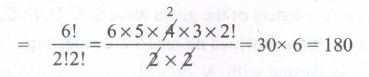
(i) Given numbers are 1, 1, 2, 3, 3, 4
Here 1 occur twice
3 occur twice
∴ Number of distinct 6-digit numbers
(ii) Unit place can be filled in 2 ways by 2 or 4.
Remaining 5 digits can be filled in \(\frac { 5! }{ 2!2! } \)
∴ Number of even 6 digit numbers
= \(\frac { 5! }{ 2!2! } \times 2\)
= \(\frac { 5\times 4\times 3\times 2 }{ 2! } \) = 60
(iii) Unit place can be filled in one ways by 4.
Remaining 5 digits can be filled in \(\frac { 5! }{ 2!2! } \) ways
∴ Number of even 6 digit numbers divisible by 4
= \(\frac { 5! }{ 2!2! } \times 1\)
= \(\frac { 5\times 4\times 3\times 2\times 1 }{ 2\times 2 } \) = 30
35.
(i) In 'INTERMEDIATE' the vowels are I, E, E, I, E, A and there are 12 letters.
Here there are 3 E's. 2' 1's and 1 A
Total number of arrangement
= \(\frac { 12! }{ 3!2!1! } =\frac { 12\times 11\times 10\times 9\times 8\times 7+6\times 5\times 4\times 3! }{ 3\times 2\times 2 } \)
= \(\frac { 479001600 }{ 2 } \) = 39916800
(ii) These 6 vowels can be arranged among themselves in 5! ways considering these vowels as one unit, and the remaining 6 consonants, required number of arrangement = \(7!\times 6!\)
(iii) The number of letters in the word INTERMEDIATE = 12 out of which 6 are vowels and 6 are consonants.
| V | C | V | V | C | V | C | V | C | V | C |
(iv) 6 consonants out of which 2 are alike can be placed in \(\frac { 6! }{ 2! } \) ways and 6 vowels out of which 3E's are alike and 21's are alike can be arranged in 7 places in \({ 7P }_{ 6 }\times \frac { 1 }{ 3! } \times \frac { 1 }{ 2! } \) ways
∴ Total number of words = \(\frac { 6! }{ 2! } \times { 7P }_{ 6 }\times \frac { 1 }{ 3! } \times \frac { 1 }{ 2! } \)
= \(\frac { 6\times 5\times 4\times 3! }{ 2 } \times \frac { 7! }{ 1! } \times \frac { 1 }{ 3! } \times \frac { 1 }{ 2 } \)
= \(30\times 7\times 6\times 5\times 4\times 3\times 2\times 1\)
= 151200
36.
Four subjects can be arranged on the shelf in 4! ways.
The books on mathematics can be arranged in 4! ways, physics on 3! ways, chemistry on 2! ways and Biology on 1! ways.
Hence, total number of ways of arranging the books
= 4! 4! 3! 2! 1!
= \((4\times 3\times 2\times 1)(4\times 3\times 2\times 1)(3\times 2)(2\times 1)\)
= (24)(24)(6)(2)
= 6912
37.
(i) Since any individual can stand in any position, 8 women and 6 men can be arrange in 14P14 = 14! ways
(ii) Considering 6 men as one unit, we have 9 people and they can be arranged in 9! ways. These 6 men can arrange among themselves in 6! ways.
∴ Total number of arrangement = \(9!\times 6!\)
(iii) 8 women can be arranged in a 8 places in 8! ways
\(\times \boxed { W } \times \boxed { W } \times \boxed { W } \times \boxed { W } \times \boxed { W } \times \boxed { W } \times \boxed { W } \times \boxed { W } \)
There are 9 (marked) places for 6 men
They can be arranged in 9P6 ways
∴ Total number of ways \(9{ P }_{ 6 }\times 8!\)

11th Standard Syllabus & Materials
11th Standard
TN 11th Tamil பீடு பெற நில் - செய்யுள் - காவடிச்சிந்து Important Questions And Answers Study Material - QB365 Set A
NEW11th Standard
TN 11th Tamil பீடு பெற நில் - உரைநடை - மலை இடப்பெயர்கள் : ஓர் ஆய்வு Important Questions And Answers Study Material - QB365 Set A
NEW11th Standard
TN 11th Tamil மாமழை போற்றுதும் - துணைப்பாடம் - யானை டாக்டர் Important Questions And Answers Study Material - QB365 Set A
NEW11th Standard
TN 11th Tamil மாமழை போற்றுதும் - செய்யுள் - ஐங்குறுநூறு Important Questions And Answers Study Material - QB365 Set A



Tamilnadu Stateboard 11th Standard Subjects
Maths

Commerce

Economics

Biology

Business Maths and Statistics

Accountancy

Computer Science

Physics

Chemistry
Maths
Biology
Economics
Physics
Chemistry

History
Business Maths and Statistics

Computer Science
Accountancy

Computer Applications
History
Computer Technology
Commerce
Computer Applications
Computer Technology

Tamil

English

French
Tamilnadu Stateboard Standards

