
 100% FREE ACCESS
11th Standard Syllabus & Materials
11th Standard
TN 11th Tamil இயற்கை வேளாண்மை,சுற்றுச்சூழல் -செய்யுள் - மனோன்மணீயம் Important Questions And Answers Study Material - QB365 Set A
NEW11th Standard
TN 11th Tamil என்னுயிர் என்பேன் -துணைப்பாடம் - இசைத்தமிழர் இருவர் Important Questions And Answers Study Material - QB365 Set A
NEW11th Standard
TN 11th Tamil மொழி கலை -செய்யுள் - ஒவ்வொரு புல்லையும் Important Questions And Answers Study Material - QB365 Set A
NEW11th Standard
TN 11th Tamil பீடு பெற நில் - இலக்கணம் - பகுபத உறுப்புகள் Important Questions And Answers Study Material - QB365 Set A
NEW11th Standard
TN 11th Tamil பீடு பெற நில் - துணைப்பாடம் - வாடிவாசல் Important Questions And Answers Study Material - QB365 Set A
NEW11th Standard
TN 11th Tamil பீடு பெற நில் - செய்யுள் - குறுந்தொகை Important Questions And Answers Study Material - QB365 Set A

Published on: 18/02/2019
+1 Public Exam March 2019 Model Question
Download Tamil Nadu 11th Standard Maths question papers, model tests, one-mark questions, important questions, and public exam papers in PDF format. Free study materials and answer keys for TN State Board students.
Questions + Answers key
Take MCQ Maths Test1.
Differentiate \(\log { (1+{ x }^{ 2 } } )\) with respect to \(\tan ^{ -1 }{ x } \)
2.
Find the integrals of the following : \({1\over \sqrt{x^2-4x+5}}\)
3.
Integrate the following functions with respect to x : e 8 - 7x
4.
Find the direction cosines and direction ratios for the following vectors \(\hat{j}\)
5.
Ravi obtained 70 and 75 marks in first two unit tests. Find the minimum marks he should get in the third test to have an average of at least 60 marks.
6.
Find the number of subsets of A if A = \(\{x :x = 4n + 1, 2 \le n \le 5, n \in N\}.\)
7.
The first three terms in the expansion of (1 + ax)n are 1 + 12x + 64x2. Find n and a
8.
Find the value of k and b, if the points P(-3, 1) and Q(2, b) lie on the locus of x2 - 5x + ky = 0.
9.
Prove that \(sinx+sin2x+sin3x=sin2x(1+2cosx)\)
10.
Evaluate \(\int { \frac { 1 }{ { x }^{ \frac { 1 }{ 2 } }+{ x }^{ \frac { 1 }{ 3 } } } } \)dx
11.
In answering a question on a multiple choice test, a student either knows the answer or guesses. Let \(\frac { 3 }{ 4 } \) be the probability that he knows the answer and \(\frac { 1 }{ 4 } \) be the probability that he guesses. Assuming that a student who guesse at the answer will be correct with probability \(\frac { 1 }{ 4 } \). What is the probability that the student knows the answer given that he answered it correctly?
12.
If \(\log { ({ x }^{ 2 }+{ y }^{ 2 }) } =2\tan ^{ -1 }{ \frac { y }{ x } , } \) Show that \(\frac { dy }{ dx } =\frac { x+y }{ x-y } .\)
13.
The chances of A, B, and C becoming manager of a certain company are 5 : 3: 2. The probabilities that the office canteen will be improved if A, B, and C become managers are 0.4, 0.5 and 0.3 respectively. If the office canteen has been improved, what is the probability that B was appointed as the manager?
14.
Do the limits of following functions exist as x\(\rightarrow 0?\) State reasons for your answer.\(x \left\lfloor x \right\rfloor \over sin |x|\)
15.
If G is the centroid of a triangle ABC, prove that \(\overrightarrow{GA}\) + \(\overrightarrow{GB}\) + \(\overrightarrow{GC}\) = \(\overrightarrow{0}\).
16.
Without expanding the determinants, show that | B | = 2| A |.
Where B =\(\begin{bmatrix} b+c & c+a & a+b \\ c+a & a+b &b+c \\a+b & b+c & c+a \end{bmatrix}\)and A =\(\begin{bmatrix} a& b & c \\ b & c & a \\ c & a & b \end{bmatrix}\)
17.
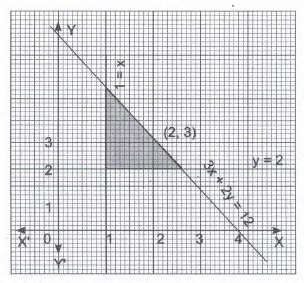
Determine the region in the Plane determined by the inequalities 3x+2y≤12,x≥1,y≥2
18.
Find the points on the line x + y = 4 which lie at a unit distance from the line 4x + 3y = 10.
19.
Prove that cos A cos 2A cos 22 A cos23 A ..... cos2n-1A\(=\frac{sin2^nA}{2^nsinA}.\)
20.
Determine the number of 5 card combinations out of a deck of 52 cards if there is exactly three aces in each combination.
21.
A photocopy store charges Rs. 1.50 per copy for the first 10 copies and Rs. 1.00 per copy after the 10th copy. Let x be the number of copies, and let y be the total cost of photocopying.
(i) Draw graph of the cost as x goes from 0 to 50 copies
(ii) Find the cost of making 40 copies.
22.
The normal boiling point of water is 100°C or 212°F· and the freezing point of water is 0 °C or 32°F.
(i) Find the linear relationship between C and F.
(ii) Find the value of C for 98.6°F and
(iii) Find the value of F for 38°C.
23.
Compute the sum of first n terms of the following series 6 + 66 + 666 + .......
24.
Prove that cos (A + B) cos C - cos (B + c) cos A = sin B sin (C - A)
25.
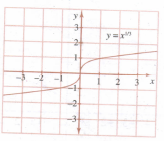
For the given curve, \(y=x^{1\over 3}\)given in figure draw
(i) \(y=-x^{ \left( \frac { 1 }{ 3 } \right) }\)
(ii) \(y=x^{ \left( \frac { 1 }{ 3 } \right) }+1\)
(iii) \(y=x^{ \left( \frac { 1 }{ 3 } \right) }-1\)
(iv) \(y=(x+1)^{1\over 3}\)
26.
Events A and B are such that P(A) = \(\frac { 1 }{ 2 } \) , P(B) = \(\frac { 7 }{ 12 } \) and P(not A or not B) = \(\frac { 1 }{ 4 } \). State whether A and B are independent?
27.
\(If\lim _{ x\rightarrow 2 }{ \frac { { x }^{ n }-{ 2 }^{ n } }{ x-2 } } =80\quad and\quad n\in N,\quad find\quad n.\)
28.
Integrate the following with respect to x : \({1\over \sqrt{1-25 x^2}}\)
29.
Find y''' if y = \({1\over x}\)
30.
If the limit of f(x) as x approaches 2 is 4, can you conclude anything about f(2)? Explain reasoning.
31.
A group consists of 4 girls and 7 boys. In how many ways can a team of 5 members be selected, if the team has at least three girls
32.
Determine the number of terms in the G. P {Tn} if T1 = 3, Tn = 96 and Sn = 189.
33.
By taking suitable sets A, B, C, verify the following results:
(A\(\times\) B)\(\cap \)(B\(\times\)A) = (A\(\cap \)B) \(\times\) (B\(\cap \)A)
34.
\(\int { \frac { \left( log{ x } \right) ^{ 3 } }{ x } } \) dx = _________+c.
\(\frac { \left( log{ x } \right) ^{ 4 } }{ 4 } \)
(sin-1 x)4
(log x)4
\(\frac { 1 }{ 3logx } \)
35.
The probabilities of a student getting I. II and III class in an examination are \(\frac { 1 }{ 10 } ,\frac { 3 }{ 5 } \) and \(\frac { 1 }{ 4 } \) respectively. The probability that the student fails in the examination is
\(\frac { 197 }{ 200 } \)
\(\frac { 27 }{ 100 } \)
\(\frac { 83 }{ 100 } \)
none of these
36.
\(\lim _{ x\rightarrow \frac { \pi }{ 2 } }{ \frac { \sin { x } }{ x } } =\)
\(\pi \)
\(\frac { \pi }{ 2 } \)
\(\frac { 2 }{ \pi } \)
1
37.
The value of\(\left| \begin{matrix} 1 & 1 & 1 \\ 1 & 1+sin\theta & 1 \\ 1 & 1 & 1+cos\theta \end{matrix} \right| \) is _____________
3
1
2
\(\frac{1}{2}\)
38.
A matrix is chosen at random from a set of all matrices of order 2, with elements 0 or 1 only. The probability that the determinant of the matrix chosen is non zero will be
\({3\over 16}\)
\({3\over 8}\)
\({1\over 4}\)
\({5\over 8}\)
39.
\(\int \frac{\sec x}{\sqrt{\cos 2 x}} d x\) is
tan-1 (sin x)+c
2sin-1(tan x)+c
tan-1(cos x)+c
sin -1(tan x)+c
40.
If y = f(x2+2) and f '(3) = 5, then \({dy\over dx}\) at x = 1 is
5
25
15
10
41.
\(\underset { x\rightarrow \infty }{ lim } \left( \cfrac { { x }^{ 2 }+5x+3 }{ { x }^{ 2 }+x+3 } \right) ^{ x }\)is
e4
e2
e3
1
42.
43.
If aij = \({1\over2}(3i-2j)\) and A = [aij]2x2 is
\(\begin{bmatrix} {1\over 2}& 2 \\ -{1\over2} & 1 \end{bmatrix}\)
\(\begin{bmatrix} {1\over 2}& -{1\over2} \\ 2& 1 \end{bmatrix}\)
\(\begin{bmatrix} 2& 2\\ {1\over 2}& -{1\over2} \end{bmatrix}\)
\(\begin{bmatrix} -{1\over 2}& {1\over2} \\ 1& 2 \end{bmatrix}\)
44.
The co-ordinates of the foot of the perpendicular drawn from the point (2, 3) to the line 3x - y + 4 = 0 is ______________
\((\frac{1}{10},\frac{37}{10})\)
\((\frac{-1}{10},-\frac{37}{10})\)
\((\frac{-1}{10},\frac{37}{10})\)
\((\frac{37}{10},\frac{-1}{10})\)
45.
If A = {x / x is an integer, x2 \(\le\) 4} then elements of A are ___________
A = {-1, 0, 1}
A = {-1, 0, 1, 2}
A = {0, 2, 4}
A = {- 2, - 1, 0, 1, 2}
46.
AM, GM, HM denote the Arithmetic mean, Geometric mean and Harmonic mean respectively the relationship between this is ______________
AM < GM < HM
AM ≤ GM ≤ HM
AM>GM>HM
AM≥GM≥HM
47.
If nPr = 720, nCr = 120 then r is _________
2
4
3
5
48.
Slope of x-axis or a line parallel to x-axis is ______________
0
positive
negative
infinity
49.
The number of permutations of n different things taking r at a time when 3 particular things are to be included is _________
n-3 Pr-3
n-3 Pr
nPr-3
r! n-3Cr-3
50.
2 sin 5x cos x _______________
sin 6x + cos 4x
sin 6x + sin 4x
cos 6x + sin 4x
cos 6x + cos 4x
51.
If 8 and 2 are the roots of x2+ ax + c = 0 and 3, 3 are the roots of x2 + dx + b = 0; then the roots of the equation x2+ ax + b = 0 are
1, 2
-1, 1
9, 1
-1, 2
52.
If \(\pi <2\theta <\frac { 3\pi }{ 2 } \), then \(\sqrt { 2+\sqrt { 2+2cos4\theta } } \) equals to
-2 cosፀ
-2 sinፀ
2 cosፀ
2 sinፀ
53.
If n((A \(\times\) B) ∩(A \(\times\) C)) = 8 and n(B ∩ C) = 2, then n(A) is
6
4
8
16
54.
Identify the singular and non-singular matrices:\(\begin{bmatrix} 2&-3 &5 \\ 6 & 0 &4 \\ 1 & 5 & -7 \end{bmatrix}\)
1.
\(Let\quad u=\log { (1+{ x }^{ 2 } } )\quad and\quad v=\tan ^{ -1 }{ x } \)
\( \Rightarrow \frac { du }{ dx } =\frac { 1 }{ 1+{ x }^{ 2 } } .\frac { d }{ dx } (1+{ x }^{ 2 })\quad \frac { dv }{ dx } =\frac { 1 }{ 1+{ x }^{ 2 } } \)
\(\frac { du }{ dx } =\frac { 2x }{ 1+{ x }^{ 2 } } \)

\(\therefore \frac { du }{ dv } =2x\)
2.
\(=x^2-4 x+5 \)
\(=\int \frac{1}{\sqrt{x^2-4 x+5}} d x\)
\(=\left(x^2-4 x\right)+5\)
Completing the square on x
\(=\left(x^2-4 x+2^2\right)-2^2+5 \)
\(=(x-2)^2+1 \)
\(=(x-2)^2+1^2\)
\(\therefore \int \frac{1}{\sqrt{x^2-4 x+5}} d x =\int \frac{1}{\sqrt{(x-2)^2+1^2}} d x\)
\(=\int \frac{1}{\sqrt{u^2+a^2}} d u, u=x-2, a=1\)
\(=\log \left|u+\sqrt{u^2+a^2}\right|+c\)
\(=\log \left|(x-2)+\sqrt{x^2-4 x+5}\right|+c\)
3.
\(\int { { e }^{ 8-7x } } dx=\frac { { e }^{ 8-7x } }{ (-7) } +c\)
4.
Given vector is \(\hat{j}\)
The direction ratio of \(\hat{j}\) are 0, 1, 0.
\(x=\sqrt{x^2+y^2+z^2}=\sqrt{0+1^2+0}=1\)
Hence, its direction cosines are \({0\over1},{1\over 1},{0\over1}\Rightarrow 0,1,0.\)
5.
Let x be the marks obtained by Ravi in the third test.
Then, \(\frac { 70+75+x }{ 3 } \ge 60\)
⇒ 145 + x ≥ 180 ⇒ x ≥ 180 - 145
⇒ x ≥ 35
Thus, Ravi must obtain a minimum of 35 marks to get an average of at least 60 marks.
Note : A minimum of 35 marks.
⇒ Marks greater than or equal to 35.
6.
Clearly A = {x: x = 4n + 1, n = 2, 3, 4, 5} = {9, 13, 17, 21}.
Hence n(A) = 4. This implies that \(n(\mathscr{P}(A))=2^4=16.\)
7.
Using binomial theorem, we have
(1 + ax)n-1 + nC1(ax) + nC2(ax)2+.......+anxn
= \(1+nax+{{n(n-1)}\over{2}}a^2x^2+....a^nx^n\)
Given (1 + ax)n = 1 + 12x + 64x2 +....
Comparing the Co-efficient of x and x2, we get
n a = 12
and \({n(n-1)\over 2}a^2=64\)
\((n-1).{na.a\over2}=64\Rightarrow(n-1){(12)a\over2}=64\)
\((n-1)6a=64\Rightarrow(n-1)a={{64}\over{6}}\) \(\left[ \because na=12\Rightarrow a={12\over n} \right]\)
\(\Rightarrow(n-1)\left( {12\over n} \right)={64 \over 6}\)
\(={n-1\over n}={ 64 \over 6\times 12}\Rightarrow{n-1\over n}={8\over 9}\)
\(\Rightarrow\) 9n - 9 = 8n
\(\Rightarrow\) n = 9 and \(a=\frac { 12 }{ n } =\frac { 12 }{ 9 } =\frac { 4 }{ 3 } \)
8.
Given that P (-3,1) lie on the locus of x2 - 5x + ky = 0.
⇒ (-3)2-5 (-3)+k(1) = 0
⇒ 9 +15 + k = 0
⇒ k = -24
Also, it is given that (2, b) lie on the locus of x2 - 5x + ky = 0.
⇒ 22 - 5 (2) + kb = 0
⇒ 4 - 10 - 24 (b) = 0
⇒ - 6 - 24b = 0
⇒ -24b = 6
⇒ b = \(\frac{-6}{24}=\frac{-1}{4}\)
9.
LHS = sin x + sin 2x + sin 3x
= (sin x + sin 3x) + sin 2x
\(=2sin\left( \frac { x+3x }{ 2 } \right) cos\left( \frac { x-3x }{ 2 } \right) +sin2x\)
= 2sin 2x.cos(-x) + sin 2x
= 2sin 2x + cos x + sin 2x
= sin 2x(1 + 2cos x) = RHS
10.
Let I = \(\int { \frac { 1 }{ { x }^{ \frac { 1 }{ 2 } }+{ x }^{ \frac { 1 }{ 3 } } } } \)dx
Here, the exponents of x are \(\frac { 1 }{ 2 } \) and \(\frac { 1 }{ 3 } \) and the LCM of their denominator is 6.
So, to remove fractional exponents put x = t6 \(\Rightarrow\) dx = 6t5 dt.
I = \(\int { \frac { { 6t }^{ 5 } }{ { t }^{ 3 }+{ t }^{ 2 } } } dt=6\int { \frac { { t }^{ 5 }dt }{ { t }^{ 2 }\left( t+1 \right) } } =6\int { \frac { { t }^{ 3 } }{ t+1 } } dr=6\int { \frac { \left( { t }^{ 3 }+1 \right) -1 }{ t+1 } } dt\)
= \(\int { \frac { \left( t+1 \right) ^{ 3 }-3t\left( t+1 \right) -1 }{ t+1 } } dt=6\) \(\int { \left[ \frac { \left( t+1 \right) ^{ 3 } }{ t+1 } -\frac { 3t(t+1) }{ t+1 } -\frac { 1 }{ t+1 } \right] dt } \)
= \(6\left[ f\left( t+1 \right) ^{ 2 }-3t-\frac { 1 }{ t+1 } dt \right] 6\left[ f{ t }^{ 2 }+2t+1-3t-\frac { 1 }{ t+1 } dt \right] =6\left( f{ t }^{ 2 }-t+1-\frac { 1 }{ t+1 } \right) dt\)
= \(6\left( \frac { { t }^{ 3 } }{ 3 } -\frac { { t }^{ 2 } }{ 2 } +t-log|t+1| \right) +c\)
= \(2.\sqrt { x } -3x^{ \frac { 1 }{ 3 } }+6x^{ \frac { 1 }{ 6 } }-6log|{ x }^{ \frac { 1 }{ 6 } }+1|+c\)
11.
E1: Student knows the answer
E2: Student guesses the answer
A: event that the answer is correct
\(P({ E }_{ 1 })=\frac { 3 }{ 4 } \) and P(E2) = \(\frac { 1 }{ 4 } \)
P(A/E1) = 1 and P(A/E2) = \(\frac { 1 }{ 4 } \)
\(\therefore\) By Bayes's theorem,
\(P({ E }_{ 1 }/A)=\frac { P({ E }_{ 1 })P(A/{ E }_{ 1 }) }{ P({ E }_{ 1 }).P(A/{ E }_{ 1 })+P({ E }_{ 2 }).P(A/{ E }_{ 2 }) } =\frac { \frac { 3 }{ 4 } \times 1 }{ \frac { 3 }{ 4 } \times 1+\frac { 1 }{ 4 } \times \frac { 1 }{ 4 } } =\frac { \frac { 3 }{ 4 } }{ \frac { 3 }{ 4 } +\frac { 1 }{ 16 } } =\frac { \frac { 3 }{ 4 } }{ \frac { 12+1 }{ 16 } } \)
\(P({ E }_{ 1 }/A)=\frac { 3 }{ 4 } \times \frac { 16 }{ 13 } =\frac { 12 }{ 13 } \)
12.
Given \(\log { ({ x }^{ 2 }+{ y }^{ 2 }) } =2\tan ^{ -1 }{ \frac { y }{ x } , } \)
Differentiating both sides, with respect to 'x' we get
\(\frac { 1 }{ { x }^{ 2 }+{ y }^{ 2 } } .\frac { d }{ dx } ({ x }^{ 2 }+{ y }^{ 2 })=2.\frac { 1 }{ 1+{ \left( \frac { y }{ x } \right) }^{ 2 } } .\frac { d }{ dx } { \left( \frac { y }{ x } \right) }\)
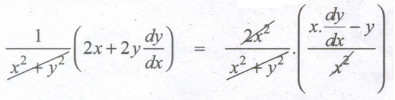
\(\Rightarrow 2x+2y\frac { dy }{ dx } =2x\frac { dy }{ dx } -2y\\ \Rightarrow x+y\frac { dy }{ dx } =x\frac { dy }{ dx } -y\\ \Rightarrow \frac { dy }{ dx } (y-x)=-x-y\\ \Rightarrow \frac { dy }{ dx } =\frac { -(x+y) }{ y-x } =\frac { x+y }{ x-y } \quad\)
Hence Proved
13.
Let A1, A2 and A3 be the event of A, B, C becoming managers of the company respectively. Let X be the event that the office canteen will be improved.
Then, \(P\left(A_1\right)=\frac{5}{10}=0.5 \)
\(P\left(A_2\right)=\frac{3}{10}=0.3 \)
\(P\left(A_3\right)=\frac{2}{10}=0.2 \)
\(P\left(X / A_1\right)=0.4 \)
\(P\left(X / A_2\right)=0.5\)
\(P\left(X / A_3\right)=0.3\)
\(P\left(A_2 / X\right)=\frac{P\left(A_2\right) P\left(X / A_2\right)}{P\left(A_1\right) P\left(X / A_1\right)+P\left(A_2\right) P\left(X / A_2\right)}+P\left(A_3\right) P\left(X / A_3\right)\)
\(=\frac{0.3(0.5)}{0.5(0.4)+0.3(0.5)+0.2(0.3)} \)
\(=\frac{0.15}{0.2+0.15+0.06} \)
\(=\frac{0.15}{0.41}=\frac{15}{41}\)
14.
\(f(x)=\frac{x\lfloor x\rfloor}{\sin |x|} = \begin{cases}\frac{-x}{\sin (-x)} & \text { if }-1<x<0 \\
\frac{x \cdot 0}{\sin x} & \text { if } 0<x<1\end{cases} \)
\(= \begin{cases}\frac{x}{\sin x} & \text { if }-1<x<0 \\
0 & \text { if } 0<x<1\end{cases}
\)
Therefore, \(lim_{x\rightarrow 0^-}f(x)=+1\)
\(lim_{x\rightarrow 0^+}f(x)=0\).
Hence the limit does not exist.
15.
Let the position vector of the vertices of the \(\triangle\) ABC be \(\overrightarrow{a},\overrightarrow{b}\) and \(\overrightarrow{c}\) respectively.
\(\therefore \overrightarrow{OA}=\overrightarrow{a},\overrightarrow{OB}=\overrightarrow{b},\overrightarrow{OC}=\overrightarrow{c}.\)
Since G is the centroid of \(\triangle\) ABC, we have
\(\Rightarrow \overrightarrow{OG}={\overrightarrow{OA}+\overrightarrow{OB}+\overrightarrow{OC}\over3}\) \(\Rightarrow 3\overrightarrow{OG}=\overrightarrow{OA}+\overrightarrow{OB}+\overrightarrow{OC}\)
Now,LHS \(=\overrightarrow{GA}+\overrightarrow{GB}+\overrightarrow{GC}\)
\(=\overrightarrow{OA}-\overrightarrow{OG}+\overrightarrow{OB}-\overrightarrow{OG}+\overrightarrow{OC}-\overrightarrow{OG}=(\overrightarrow{OA}+\overrightarrow{OB}+\overrightarrow{OC})\)\(-3\overrightarrow{OG}\)
\(=(\overrightarrow{OA}+\overrightarrow{OB}+\overrightarrow{OC})-(\overrightarrow{OA}+\overrightarrow{OB}+\overrightarrow{OC}=\overrightarrow{0}=RHS\)
Hence proved.
16.
We have |B| = \(\begin{vmatrix} 2(a+b+c) & 2(a+b+c) &2(a+b+c) \\ c+a & a+b &b+c \\ a+b & b+c & c+a \end{vmatrix}\)\((R_1 \rightarrow R_1+R_2+R_3)\)
= 2\(\begin{vmatrix} a+b+c & a+b+c & a+b+c \\ c+a & a+b &b+c \\ a+b & b+c & c+a \end{vmatrix}\)
= 2\(\begin{vmatrix} a+b+c & a+b+c & a+b+c \\ -b & -c &-a \\ -c & -a & -b \end{vmatrix}\)\((R_2 \rightarrow R_2-R_1andR_3\rightarrow R_3-R_1)\)
= 2\(\begin{vmatrix}a &b &c \\ -b & -c & -a \\ -c & -a & -b \end{vmatrix}\)\((R_1 \rightarrow R_1+R_2+R_3)\)
= 2(-1)2 \(\begin{vmatrix}a &b &c \\b &c & a \\ c & a & b \end{vmatrix}\)
= 2| A |.
17.
The given inequality is 3x+2y≤12.
Draw the graph of the line 3x+2y≤12.
Table of values satisfying the equation
3x+2y≤12
| x | 2 | 4 |
| y | 3 | 0 |
Putting (0, 0) in the given inequation, we have 3\(\times\)0+2\(\times\)0≤12 which is true
∴ Half plane of 3x+2y≤12 is towards origin
Also, the given inequality is 1
Draw the graph of the line x = 1.
Putting (0, 0) in the given inequation, we have 0 ≥1 which is false.
∴ Half plane of x≥1 is away from origin.
The given inequality is y
Putting (0, 0) in the given inequation, we have 0 ≥ 2 which is false.
∴ Half plane of is always from origin.
18.
Let (x)be any point lying in the equation x + y = 4
x1+y1=4....(i)
Distance of the point (x1, y1) from the equation 4x + 3y = 10
\(\frac { 4{ x }_{ 1 }+3{ y }_{ 1 }-10 }{ \sqrt { ({ 4 })^{ 2 }+(3)^{ 2 } } } \)=1
\(\left| \frac { 4{ x }_{ 1 }+3{ y }_{ 1 }-10 }{ 5 } \right| \)=1
4x1+3y1-10=±5
Taking 4x1+3y1-10=5
⇒ 4x1+3y1=15 ........(ii)
From equation (i) we get y1=4-x1
Putting the value of y1 in equation (ii) we get
4x1+3(4-x1)=15
⇒ 4x1+12-3x1=15
⇒ x1+12=15
x1=3 and y1=4-3=1
So, the required point is (3, 1)
Now taking(-) sign, we have
4x1+3y1-10=-5
⇒ 4x1+3y1=5.....(iii)
From equation (i) we get y1=4-x1
⇒ 4x1+3(4-x1)=5
⇒ 4x1+12-3x1=5
⇒ x1=5-12=-7
and y1=4-(-7)=11
So, the required point is (- 7, 11)
Hence, the required points on the given line are (3, 1) and (-7, 11).
19.
LHS = cos A cos 2A cos 22A cos23A ... cos 2n-1A
\(=\frac{1}{2sinA}2sin\ A\ cos\ A\ cos\ 2A\ cos2^2\ Acos2^3A....cos2^{n-1}A\)
\(=\frac{1}{2sin\ A}sin\ 2A\ cos\ 2A\ cos2^2A\ cos\ 2^3A....cos\ 2^{n-1}A\)
\(=\frac{1}{2^2\ sinA}sin\ 4A\ cos\ 2^2A\ cos\ 2^3A...cos2^{n-1}A\)
Continuing the process, we get
\(=\frac{sin2^nA}{2^nsinA}\)
20.
In a pack of 52 cards, there are four aces
3 aces will be selected from 4 cards and remaining 2 cards will be selected from rest of 48 cards.
∴ Number of ways of selecting 3 aces from 4 aces = 4C3
Number of ways of selecting 2 cards out of 48 cards = 48C2
∴ Required number of ways = 4C3 \(\times \) 48C2
= \(4\times \frac { 48\times 47 }{ 2\times 1 } \) [∵ nCr = 1Cn-r]
= \(2\times 48\times 47\)
= 4512
21.
Draw graph of the cost as x goes from 0 to 50 copies.
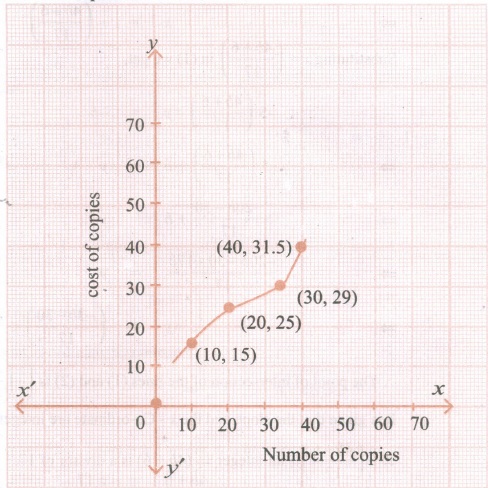
Since x and y represent the number of copies and the cost of photocopying,
\(y=1.50x,\ 0\le x\le 10\) [Given]
For x > 10,
y = 10 (1.50) + (x - 10) ...(1)
[ First 10 copies 1 Re and the remaining (x - 10) ]
= 15 + x - 10
= x + 5
\(\begin{matrix} \therefore \quad y \\ \therefore \quad y \end{matrix}=\begin{cases} x+5\ if\quad x>10 \\ 1.50x,\quad 0\le x\le 10 \end{cases}\)
\(x+5 \ if \ x>10\)
(ii) Find the cost of making 40 copies
Cost of making 40 copies which is greater than 10
y = x + 5
when x = 40
y = 40 + 5
y = Rs. 5
22.
(i) Find the linear relationship between C and F.
By the given data
x1 (100°C) y1(212°F)
x2(0°C) y2(32°F)
Using two point form, the linear relationship between C and F is
\(\frac { y-{ y }_{ 1 } }{ { y }_{ 2 }-{ y }_{ 1 } } =\frac { x-{ x }_{ 1 } }{ { x }_{ 2 }-{ x }_{ 1 } } \)
\(\frac { y-212 }{ 32-212 } =\frac { x-100 }{ 0-100 } \)
\(\Rightarrow \quad \frac { y-212 }{ -180 } =\frac { x-100 }{ -100 } \)
\(\Rightarrow \quad \frac { y-212 }{ 9 } =\frac { x-100 }{ 5 } =\frac { 5 }{ 9 } (y-212)=x-100\)
\(\Rightarrow \quad x=\frac { 5 }{ 9 } (y-212)+100\quad \Rightarrow \quad x=\frac { 5 }{ 9 } y-\frac { 5 }{ 9 } \times 212+100\)
\(\Rightarrow \quad x=\frac { 5 }{ 9 } y-118+100\quad \Rightarrow x=\frac { 5 }{ 9 } y-18\)
\(\Rightarrow \quad x=\frac { 5 }{ 9 } (y-32) \Rightarrow C=\frac { 5 }{ 9 } (F-32)\quad .....(1)\)
[\(\because \) x represents Celsius and y represents Fahrenheit]
Which is the required relationship between C and F.
(ii) Find the value of C for 98.6°F and
Find C when F = 98.6° F
Substituting F = 98.6° in (1) we get,
C = \(\frac{5}{9}(98.6-32)=\frac{5}{9}(66.6)=\frac{333}{9}=37°\)
(iii) Find the value of F for 38°C.
Substituting C = 38° in (1) we get,
38=\(\frac{5}{9}(F-32)\)
⇒ \(\frac{342}{5}+32\) = F
⇒ F = 100.4°C
23.
Let = 6 + 66 + 666 + ... upto n terms
= 6 (1 + 11 + 111+ ....) upto n terms
\(={6\over9}(9+99+999+ ...)\) upto n terms
\(={63\over 6}[(10 -1) + (10^2-1) + (10^3 -1) + ...]\) upto n terms
\(={6\over 9}[(10+ 10^2 + 10^3+ ...) - (1+ 1+1...)]\) upto n terms
\(={6\over9}\left[{ 10(10^n-1)\over 10-1}n\right]\)[In a G.P with a = 10 r = 10, \(S_n={(r^n-1)\over r-1}\)]
\(={6\over9}\left[{ 10(10^n-1)\over 10-1}n\right]={6\over9}\left[ 10(10^n-1)-9n\over9\right]\)
\({ S }_{ n }=\frac { 6 }{ 81 } \left[ 10\left( { 10 }^{ n }-1 \right) -9n \right] \)
24.
LHS = cos (A + B) cos C - cos (B + C) cos A
= (cos A cos B - sin A sin B) cos C - cos A (cos B cos C - sin B sin C)
= cos A cos B cos C - sin A sin B cos C - cos A cos B cos C + cos A sin B sin C
= cos A sin B sin C - sin A sin B cos C
= sin B (cos A sin C - sin A cos C)
= sin B (sin C cos A - cos C sin A)
= sin B sin (C - A)
= RHS
Hence proved.
25.
(i) \(y=-x^{ \left( \frac { 1 }{ 3 } \right) }\)
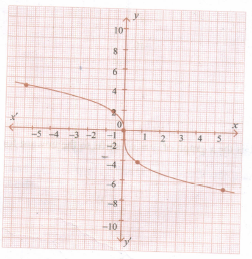
\(Let \ y=-x^{ ^{ \frac { 1 }{ 3 } } }\)
\(Then \ y=-x^{ ^{ \frac { 1 }{ 3 } } }\) is the reflection of the graph of \(y=x^{ ^{ \frac { 1 }{ 3 } } }\) about the x-axis.
(ii) \(y=x^{1\over 3}+1\)
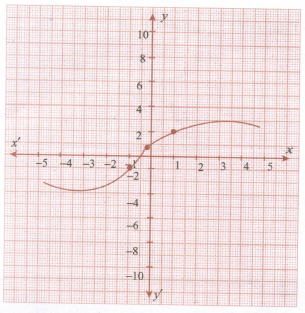
Let \(y=x^{ ^{ \frac { 1 }{ 3 } } }\)
Then \(y=x^{ ^{ \frac { 1 }{ 3 } } }+1\) is the x graph of \(y=x^{ ^{ \frac { 1 }{ 3 } } }\) shifts to the upward for one unit
(iii) \(y=x^{1\over 3}-1\)
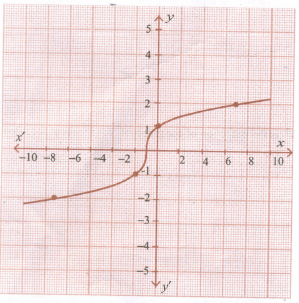
Let \(y=x^{1\over 3}\)
Then \(y=x^{1\over 3}\)-1 is the graph of \(x^{ ^{ \frac { 1 }{ 3 } } }\) shifts to the downward for one unit.
(iv) \(y=(x+1)^{1\over 3}\)
| x | 0 | 1 | 7 | -9 |
| y | 1 | 1 | 2 | -2 |
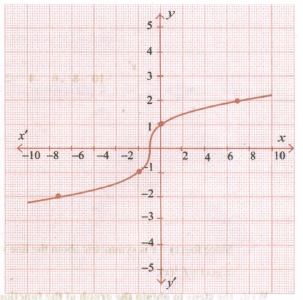
\(y=(x+1)^{1\over 3}\) causes the graph of \({x}^{\frac{1}{3}}\), shifts to the left for one unit.
26.
Given P(A) = \(\frac { 1 }{ 2 } \), P(B) = \(\frac { 7 }{ 12 } \) and P(\(\bar { A } \cup \bar { B } \)) = \(\frac { 1 }{ 4 } \).
Now, \(P(\bar { A } \cup \bar { B } )=P(\overline { A\cap B } )=1-P(A\cap B)\)
\(\Rightarrow \frac { 1 }{ 4 } =1-P(A\cap B)\quad \Rightarrow P(A\cap B)=1-\frac { 1 }{ 4 } =\frac { 3 }{ 4 } \)
Now P(A) \(\times\) P(B) = \(\frac { 1 }{ 2 } \times \frac { 7 }{ 12 } =\frac { 7 }{ 24 } \)
\(\therefore P(A\cap B)\neq P(A)\times P(B)\)
Thus, A and B are not independent.
27.
\(Given,\quad \lim _{ x\rightarrow 2 }{ \frac { { x }^{ n }-{ 2 }^{ n } }{ x-2 } } =80\)
\( \Rightarrow n.{ 2 }^{ n-1 }=80\)
By trial method, put n 5
\(\Rightarrow 5({ 2 }^{ 5-1 })=80\)
\(\Rightarrow 5({ 2 }^{ 4 })=80\)
\( \Rightarrow 5(16)=80\)
\( \Rightarrow 80=80\)
\(\therefore n=5\)
28.
\(\int {1\over \sqrt{1-25 x^2}} dx=\int {1\over \sqrt{1-(5x)^2}}dx={1\over5}sin^{-1}(5x)+c\)
29.
We have, y = \({1\over x}=x^{-1}\)
y' = -1x-2 = -\({1\over x^2}\)
y'' = (-1)(-2)x-3 \(={(-1)^22 !\over x^3}\)
and y"' = (-1)(-2)(-3)x-4 \(={(-1)^33!\over x^4}\)
30.
Limit of f(x) as x approaches 2 is the nature of (x) on both sides of 2.
It is independent ofthe nature of f(x) at x = 2.
Therefore we can not conclude anything about \(lim_{x \rightarrow 2}f(x) from f(2)=4\)
31.
When atleast 3 girls are included, then
Number of ways = 4C3 \(\times\)7C2 + 4C4 \(\times\)7CI
\(=4\times {7\times6\over2\times1}+1\times7=84+7=91ways\)
Hence the required number of ways are 91 ways
32.
Let the G.P. be a, ar, ar2 ,...
Given T1 = 31 Tn = 96 and Sn = 189
Tn = 96 ⇒ a.rn-1 = 96
Also, Sn = 189 ⇒ \(\frac{a(1-r^{n})}{1-r}=189\)
⇒ \(\frac{a-a.r^{n-1}.r}{1-r}=189\)
⇒ \(\frac{3-(96)r}{1-r}=189\) [∵a = 3 and arn-1 = 96]
⇒ 3 - 96r = 186(1-r)
⇒ 189-189r = 3 - 96r
⇒ 189 - 3 = 189r - 96r
⇒ 186 = 93r
⇒ r = 2
Substituting r = 2 in (1) we get,
a.rn-1 = 96 ⇒ 3.2n-1= 96
⇒ 2n-1= 32 ⇒ 2n-1 = 25
⇒ n-1 = 5
⇒ n = 6
33.
(A\(\times\) B) = {(1,4) (1,5) (1,6) (1,7) (2,4) (2,5) (2,6) (2,7) (3,4) (3,5) (3,6) (3,7)}
(B\(\times\)A) = {(4,1) (4,2) (4,3) (5,1) (5,2) (5,3) (6,1) (6,2) (6,3) (7,1) (7,2) (7,3)}
LHS = (A\(\times\)B)\(\cap \)(B\(\times\)A) = { }....(1)
(A\(\cap \)B) = { }, (B\(\cap \)A) = { }
\(\therefore\) RHS = (A\(\cap \)B) \(\times\) (B\(\cap \)A) = { }.....(2)
From (1) and (2), LHS = RHS
34.
(a)
\(\frac { \left( log{ x } \right) ^{ 4 } }{ 4 } \)
35.
(b)
\(\frac { 27 }{ 100 } \)
36.
(c)
\(\frac { 2 }{ \pi } \)
37.
(d)
\(\frac{1}{2}\)
38.
\(n(S) =2^{14}=16 \)
\(A =\left\{\begin{array}{ll} 1 & 0 \\ 0 & 1 \end{array}|,| \begin{array}{ll} 0 & 1 \\ 1 & 0 \end{array}|,| \begin{array}{ll} 1 & 1 \\ 0 & 1 \end{array}|,| \begin{array}{ll} 1 & 0 \\ 1 & 1 \end{array}|,| \begin{array}{ll} 0 & 1 \\ 1 & 1 \end{array}|,| \begin{array}{ll} 1 & 1 \\ 1 & 0 \end{array} \mid\right\} \)
\(n(A) =6 \)
\(P(A) =\frac{6}{16}=\frac{3}{8} \)
39.
\(\int \frac{\sec x}{\sqrt{\cos 2 x}} d x =\int \frac{\sec x}{\sqrt{\cos ^{2} x-\sin ^{2} x}} d x \)
\(=\int \frac{\sec x}{\sqrt{\cos ^{2} x\left(1-\frac{\left.\sin ^{2} x\right)}{\cos ^{2} x}\right)} d x} \)
\(=\int \frac{\sec x}{\cos x \sqrt{1-\tan ^{2} x}} d x \)
\(=\int \frac{1}{\sqrt{1-\tan ^{2} x}} \times \sec ^{2} x d x \)
\(=\int \frac{1}{\sqrt{1-u^{2}}} \times d u, u=\tan x \)
\(=\sin ^{-1} u+c \)
\(=\sin ^{-1}(\tan x)+c \)
40.
\(y=f\left(x^{2}+2\right) \)
\(\frac{d y}{d x} =f^{\prime}\left(x^{2}+2\right)(2 x) \)
\(\text { At } x =1, \frac{d y}{d x}=f^{\prime}(1+2)(2)=f^{\prime}(3)(2) \)
\(=5(2)=10 \)
41.
\(\lim _{x \rightarrow \infty}\left(\frac{x^{2}+5 x+3}{x^{2}+x+3}\right)^{x} =\lim _{x \rightarrow \infty}\left(\frac{x^{2}+5 x}{x^{2}+x}\right)^{x} \)
\(=\lim _{x \rightarrow \infty}\left(\frac{1+\frac{5}{x}}{1+1 / x}\right)^{x}=\frac{e^{5}}{e}=e^{4} \)
42.
(c)
43.
\(A=\left[\begin{array}{ll} a_{11} & a_{12} \\ a_{21} & a_{22} \end{array}\right] \)
\(a_{11}=\frac{1}{2}(3-2)=\frac{1}{2} ; a_{12}=\frac{1}{2}(3-4)=\frac{-1}{2} \)
\(a_{21}=\frac{1}{2}(3(2)-2)=\frac{4}{2}=2 ; a_{22}=\frac{1}{2}(6-4)=\frac{2}{2}=1 \)
\(\therefore A=\left[\begin{array}{ll} \frac{1}{2} & -\frac{1}{2} \\ 2 & 1 \end{array}\right] \)
44.
(c)
\((\frac{-1}{10},\frac{37}{10})\)
45.
(d)
A = {- 2, - 1, 0, 1, 2}
46.
(d)
AM≥GM≥HM
47.
(c)
3
48.
(a)
0
49.
(d)
r! n-3Cr-3
50.
(b)
sin 6x + sin 4x
51.
\(x^{2}+a x+c=0 \)
\(x^{2}+d x+b=0 \)
\(8 \& 2 \text { are the roots }\)\(\text { 3. } 3 \text { are the roots }\)
\(\therefore a=-10 ; c=16 \quad d=-6, \quad b=9\)
\(x^{2}+a x+b =0 \)
\(x^{2}-10 x+9 =0 \)
\(\Rightarrow(x-1)(x-9) =0 \)
\(\therefore x =1 \text { (or) } 9 \)
52.
\(\sqrt{2+2 \cos 4 \theta} =\sqrt{2+2\left(2 \cos ^{2} 2 \theta-1\right)} \)
\(=\sqrt{4 \cos ^{2} 2 \theta} \)
\(=2 \cos 2 \theta \)
\(\sqrt{2+\sqrt{2+2 \cos 4 \theta}} =\sqrt{2+2 \cos 2 \theta} \)
\(=\sqrt{2+2\left(2 \cos ^{2} \theta-1\right)} \)
\(=\sqrt{4 \cos ^{2} \theta} \)
\(=\pm 2 \cos \theta \)
\(\Rightarrow \pi<2 \theta<\frac{3 \pi}{2} \)
\(\Rightarrow \frac{\pi}{2}<\theta<\frac{3 \pi}{4} \text { in II quadrant. } \)
\(\therefore \sqrt{2+\sqrt{2+2 \cos 4 \theta}}=-2 \cos \theta\)
53.
\((A \times B) \cap(A \times C) =A \times(B \cap C) \)
\(n[(A \times B) \cap(A \times C)] =n(A) \times n(B \cap C) \)
\(\Rightarrow 8 =n(A) \times 2 \Rightarrow n(A)=4 \)
54.
\(|A|=\left|\begin{array}{ccc} 2 & -3 & 5 \\ 6 & 0 & 4 \\ 1 & 5 & -7 \end{array}\right|\)
\(=2(0-20)+3(-42-4)+5(30-0)\)
\(=2(-20)+3(-46)+5(30)\)
\(=-40-138+150\)
\(=-28 \neq 0\)
\(|A| \neq 0\)
\(\therefore\) A is non singular

11th Standard Syllabus & Materials
11th Standard
TN 11th Tamil பீடு பெற நில் - செய்யுள் - காவடிச்சிந்து Important Questions And Answers Study Material - QB365 Set A
NEW11th Standard
TN 11th Tamil பீடு பெற நில் - உரைநடை - மலை இடப்பெயர்கள் : ஓர் ஆய்வு Important Questions And Answers Study Material - QB365 Set A
NEW11th Standard
TN 11th Tamil மாமழை போற்றுதும் - துணைப்பாடம் - யானை டாக்டர் Important Questions And Answers Study Material - QB365 Set A
NEW11th Standard
TN 11th Tamil மாமழை போற்றுதும் - செய்யுள் - ஐங்குறுநூறு Important Questions And Answers Study Material - QB365 Set A



Tamilnadu Stateboard 11th Standard Subjects
Maths

Commerce

Economics

Biology

Business Maths and Statistics

Accountancy

Computer Science

Physics

Chemistry
Maths
Biology
Economics
Physics
Chemistry

History
Business Maths and Statistics

Computer Science
Accountancy

Computer Applications
History
Computer Technology
Commerce
Computer Applications
Computer Technology

Tamil

English

French
Tamilnadu Stateboard Standards

