
 100% FREE ACCESS
11th Standard Syllabus & Materials
11th Standard
TN 11th Tamil இயற்கை வேளாண்மை,சுற்றுச்சூழல் -செய்யுள் - மனோன்மணீயம் Important Questions And Answers Study Material - QB365 Set A
NEW11th Standard
TN 11th Tamil என்னுயிர் என்பேன் -துணைப்பாடம் - இசைத்தமிழர் இருவர் Important Questions And Answers Study Material - QB365 Set A
NEW11th Standard
TN 11th Tamil மொழி கலை -செய்யுள் - ஒவ்வொரு புல்லையும் Important Questions And Answers Study Material - QB365 Set A
NEW11th Standard
TN 11th Tamil பீடு பெற நில் - இலக்கணம் - பகுபத உறுப்புகள் Important Questions And Answers Study Material - QB365 Set A
NEW11th Standard
TN 11th Tamil பீடு பெற நில் - துணைப்பாடம் - வாடிவாசல் Important Questions And Answers Study Material - QB365 Set A
NEW11th Standard
TN 11th Tamil பீடு பெற நில் - செய்யுள் - குறுந்தொகை Important Questions And Answers Study Material - QB365 Set A

Published on: 07/06/2021
QB365 provides detailed and simple solution for every book back questions in class 11 Maths subject.It will helps to get more idea about question pattern in every book back questions with solution.
Download Tamil Nadu 11th Standard Maths question papers, model tests, one-mark questions, important questions, and public exam papers in PDF format. Free study materials and answer keys for TN State Board students.
Questions + Answers key
Take MCQ Maths Test1.
Prove that \(\sqrt [ 3 ]{ x^3+7 } -\sqrt [ 3 ]{ x^3+4 } \) is approximately equal to \({1\over x^2}\) when x is large.
2.
Find \(\sqrt [ 3 ]{ 65} .\)
3.
Find the sum of the first n terms of the series \({1\over 1+\sqrt{2}}+{1\over\sqrt{2}+\sqrt{3}}+{1\over\sqrt{3}+\sqrt{4}}+...\)
4.
Find the last two digits of the number 7400.
5.
Using Binomial theorem, prove that 6n - 5n always leaves remainder 1 when divided by 25 for all positive integer n.
6.
The 2nd, 3rd and 4th terms in the binomial expansion of (x + a)n are 240, 720 and 1080 for a suitable value of x. Find x, a and n.
7.
Find the coefficient of x4 in the expansion of \(\frac { 3-4x+{ x }^{ 2 } }{ { e }^{ 2x } } \)
8.
If p - q is small compared to either p or q, then show that \(n\sqrt { \frac { p }{ q } } =\frac { \left( n+1 \right) p+\left( n-1 \right) q }{ \left( n-1 \right) p+\left( n+1 \right) q } \)
Hence find \(8\sqrt { \frac { 15 }{ 16 } } \)
9.
In the binomial coefficient of (1+x)n the Coefficients of the 5th, 6th and 7th terms are in A.P find all values of n
10.
if the binomial co-efficients of three consecutive terms in the expansion of ( a + xn) are in the ratio 1:7:42 then find n
1.
\(\sqrt [ 3 ]{ x^3+7 } ={(x^3+7)}^{{1\over 3}}\)
\(={\left[ x^3\left( 1+{7\over x^3} \right) \right]}^{{1\over 3}}\) (\(\left |{7\over x^3}\right |<1\) as x is large)
\(=x{\left( 1+{7\over x} \right)}^{1\over 3}\)
\(=x\left( 1+{1\over 3} \times {7\over x^3}+{{{1\over3}\left( {1\over 3}-1 \right)}\over{2!}} {\left( {{7\over x^3}} \right)}^{2} +......\right)\)
\(=x\left( 1+{7\over 3}\times{1\over x^3}-{49\over 9}\times{1\over x^6}+...... \right)\)
\(=x+{7\over 3}\times{1\over x^2}-{49\over 9}\times{1\over x^5}+...\)
\(\sqrt [ 3 ]{ x^3+4 } ={(x^3+4)}^{1\over 3}\)
\(={\left[ x^3\left( 1+{4\over x^3} \right) \right]}^{1\over 3}\)
\(=x\left( 1+{4\over x^3} \right)^{1\over 3}\)
\(=x{\left( 1+{1\over3}\times{4\over x^3}+{{1\over 3}\left( {1\over3}-1 \right)\over{2!}} {\left( {4\over x^3} \right)}^{2}+... \right)}^{1\over3}\)
\(=x+{4\over 3}\times{1\over x^3}-{16\over 9}\times{1\over x^5}+...\)
Since x is large, \({1 \over x}\) is very small and hence higher powers of \({1 \over x}\) are negligible.
Thus \(\sqrt [ 3 ]{ x^3+7 } =x+{7\over 3}\times{1\over x^2}\) and \(\sqrt [ 3 ]{ x^3+4 } =x+{4\over3}\times{1\over x^3}.\) Therefore
\(\sqrt [ 3 ]{ x^3+7 } -\sqrt [ 3 ]{x^3+4 } =\left(x+{7\over 3}\times{1\over x^2} \right)-\left( x+{4\over 3}\times{1\over x^2} \right)={1\over x^2}\)
2.
We know that for |x| < 1
\((1+x)^n=1+nx+{n(n-1)\over 2!}x^2+{n(n-1)(n-2)\over3!}x^3+....\)
\(\sqrt [ 3 ]{ 65} ={65}^{{1\over3}}\)
\(={(64+1)}^{1\over 3}\)
\(={64}^{1\over 3}{\left( 1+{1\over 64} \right)}^{1\over3}\Rightarrow4{\left( 1+{1\over64} \right)}^{1\over 3}\)
\(=4\left( 1+{1\over 3}\times{1\over 64}+{{1\over 3}\left({1\over3 }-1\right)\over{2!}} \times {\left({1\over 64} \right)}^{2}+....... \right)\)
\(=4+{1\over 48}-4\times{1\over 9}\times{1\over 64}\times{1\over 64}+....\)
\(=4+{1\over 48}-{4\over 36864}+...\)
\(=4+{1\over48}-{1\over 9216}+....\)
\(\approx 4 + 0.02 \) ( since \({1\over 9216}+...\) is very small )
\(\sqrt [ 3 ]{ 65 }=4.02\) (approximately)
3.
Let tk denote the kth term of the given series.
Then \(t_k={1\over \sqrt{k}+\sqrt{k+1}}.\)
If we are successful in writing the kth term as a difference of two expressions, then we can solve using this technique.
We have
\(t_k={1\over\sqrt{k}+\sqrt{k+1}}={{\sqrt{k}-\sqrt{k+1}}\over{(\sqrt{k}+\sqrt{k+1})(\sqrt{k}-)\sqrt{k+1}}}={{\sqrt{k}-\sqrt{k+1}}\over{k-(k+1)}}=\sqrt{k+1}-\sqrt{k}\)
Thus, \(t_1+t_2+....+t_4=(\sqrt{2}-\sqrt{1})+(\sqrt{3}-\sqrt{2})+...+(\sqrt{n-1}-\sqrt{n})=\sqrt{n+1}-1\)
4.
We have 7400 = (72)200 = (50 - 1)200
= 200C0 50200 - 200C1 50199 + .... + 200C198 502(-1)198 + 200C199 50(-1)199 + 200C200(-1)200
= 502-(200C050198 - 200C150197 + ..... + 200C198(-1)198) - 200 \(\times\) 50 + 1
As 502 and 200 are divisibie By 100, the last two digits: 0, 1.
5.
To prove this it is enough to prove, 6n - 5n = 25k + 1 for some integer k. We first consider the expansion
(1+ x )n = nC0 + nC1 x + nC2 x2 + ... + nCn-1 xn-1 + nCn xn, \(n \in N\)
Taking x = 5 we get (1 + 5)n = nC0 + nC1 5 + nC2 52 + ... + nCn-1 5n-1 + nCn5n.
The above equality reduces to 6n = 1 + 5n + 25 (nC2 + 5nC3 + ... + nCn 5n-2).
That is, 6n - 5n = 1 + 25(nC2 + 5 nC3 + ... + nCn 5n-2) = 1 + 25k, \(k\in N\)
Thus 6n - 5n always leaves remainder 1 when divided by 25 for all positive integer n.
6.
It is given that T2 = 240, T3 =·720 and T4 = 1080.
T2 = nC1 xn-1 = 240 ...(1)
T3 = nC2 xn-2a2 = 720 ....(2)
T4 = nC3 xn-3 a3 = 1080 ....(3)
Dividing (2) by (1) and (3) by (2) we get
\({a\over x}={6\over n-1}\) ...(4)
\({a \over x}={9\over2(n-2)}\) .....(5)
From (4) and (5) \({6\over n-1}={9\over 2(n-2)}\)
Thus n = 5. Substituting n = 5 in (1), (4) and dividing (1) by (4)
\({{5x^4 a}\over{{{a}\over{x}}}}={{240}\over{{6}\over{4}}}\)
Thus 5x5 = 160 and hence x = 2. Substituting in (4) we get a = 3.
7.
\(\frac { 3-4x+{ x }^{ 2 } }{ { e }^{ 2x } } =\left( 3-4x+{ x }_{ 2 } \right) { e }^{ -2x }\)
\(=\left( 3-4x+{ x }^{ 2 } \right) \left( 1-\frac { 2x }{ 1! } +\frac { { \left( 2x \right) }^{ 2 } }{ 2! } -\frac { { \left( 2x \right) }^{ 3 } }{ 3! } +\frac { { \left( 2x \right) }^{ 4 } }{ 4! } -... \right) \)
\(=\left( 3-4x+{ x }^{ 2 } \right) \left( 1-2x+\frac { { 4x }^{ 2 } }{ 2 } -\frac { { 8 }^{ 3 } }{ 6 } +\frac { { 16 }^{ 4 } }{ 24 } -... \right) \)
\(=\left( 3-4x+{ x }^{ 2 } \right) \left( 1-2x+{ 2x }^{ 3 }-\frac { { 4x }^{ 3 } }{ 3 } +\frac { { 2x }^{ 4 } }{ 3 } -... \right) \)
\(=2+\frac { 16 }{ 3 } +2=\frac { 6+16+6 }{ 3 } =\frac { 28 }{ 3 } \)
Hence coefficient of x4 is \(\frac { 28 }{ 3 } \)
8.
Let p = q+h
h is numerically very small and so h12 h3 ... may be neglected
RHS \(={(n+1)p+(n-1)q\over (n-1)p+(n+1)q}={(n+1)(q+h)+(n-1)q\over (n+1)(q+h)+(n+1)q}\)
\(={nq+q-nh+h+nq-q\over nq-q+nh-h+nq+q}={2nq+(n+1)h\over2nq+(n-1)h}\)
\(={1+{n+1\over2n}.{q\over h}\over1+{n-1\over2n}.{h\over q}}=\left(1+{n+1\over2n}.{h\over q}\right)\left(1+{n-1\over2n}.{h\over q}\right)^{-1}\)
\(=\left({1+{n+1\over2n}.{h\over q}}\right)\left(1-{n-1\over2n}.{h\over q}\right)=1+\left({n+1\over 2n}-{n-1\over2n}\right){h\over q}\)
\(={1+{1\over n}}.{h\over q}\)
LHS \(={p\over q}^{1\over n}=\left(q+h\over q\right)^{1\over n}=\left(1+{h\over q}\right)^{1\over n}=1+{1\over n}.{h\over q}\)
From (1) and (2), LHS = RHS
Now \(\sqrt[8]{15\over16}={(8+1)(15)+(8-1)(16)\over(8-1)(15)+(8+1)(16)}\) [n = 8, p = 15 and q = 16]
\(={(9)(15)+7(16)\over(7)(15)+9(16)}={135+112\over105+144}={247\over 249}\)
\(\left( \frac { 15 }{ 16 } \right) =0.9919\)
9.
In (1 + x)n, the general term is
Tr+1 = nCr (1)n-r xr ....(1)
To find the co-efficients of 5th... , 6th .. and 7th ... terms, put r = 4, 5, 6 in (1) respectively.
∴Coefficients of 5th ... , 6th .... and 7th ... terms in (1 +x)n are nC4, nC5 and nC6 respectively.
Given that nC4, nC5 and nC6 are in A.P
\(∴\ 2nC_5=nC_4+nC_6\)
\(⇒\ 2={nC_4\over nC_5}+{nC_6\over nC_5}\) \(\left[∵{nC_r\over nC_{r-1}}={n-r+1\over r}\right]\)
\(⇒ 2={5\over n-4}+{n-5\over 6}\)
\(⇒\ 12={30+(n-5)(n-4)\over 6(n-4)}\)
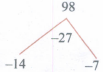
⇒ 12(n - 4) = 30 + n2 - 4n - 5n + 20
⇒ 12n - 48 = n2 - 9n + 50
⇒ n2 - 9n + 50 - 12n + 48 = 0
⇒ n2 - 21n + 98 = 0
⇒ (n - 14)(n - 7) = 0
⇒ n = 7 or 14.
10.
Let the three consecutive terms be rth... (r + 1)th ... and (r + 2)th... terms.
General term in (x + a)n is Tr+ 1 = nCrxn-r ar ... (1)
Then, co-efficients of rth.. (r + 1)th .. and (r + 2)th .. terms are nCr-1, nCr and nCr+1 respectively.
Given that nCr-1 : nCr: nCr+1 = 1:7:42
Consider \({nC_{r-1}\over nC_r}={1\over7}\)
\({{n!\over (r-1)!(n-r+1)!}\over {n!\over r!(n-r)!}}={1\over 7}\) \(\left[ ∵ nC_r \right]={n!\over r!(n-r)!}\)
\({n!\over(r-1)!(n-r+1)(n-r)!}\times{r(r-1)!(n-r)!\over n1}={1\over 7}\)
\({r\over n-r+1}={1\over 7}\)
⇒ 7r = n-r+1
⇒ n - 8r+ 1 = 0 ....(2)
and \({nC_r\over nC_{r+1}}r+1{}={7\over 42}\)
\({r+1\over n-r}={1\over 6}\) \(\left[ ∴{nC_{r+1}\over nC_r}={n-r\over r+1}\right]\)
⇒ 6r + 6 = n-r
⇒ n -7r- 6 = 0 ....(3)
(2) - (3)
(n - 8r+ 1) - (n -7r- 6) = 0
⇒ -r + 7 = 0
⇒ r = 7
Substituting r = 7 in (2) we get
n - 8(7) + 1 = 0
⇒ n - 56 + 1 = 0
⇒ n-55 = 0
⇒ n = 55
Hence n = 55 and r = 7.

11th Standard Syllabus & Materials
11th Standard
TN 11th Tamil பீடு பெற நில் - செய்யுள் - காவடிச்சிந்து Important Questions And Answers Study Material - QB365 Set A
NEW11th Standard
TN 11th Tamil பீடு பெற நில் - உரைநடை - மலை இடப்பெயர்கள் : ஓர் ஆய்வு Important Questions And Answers Study Material - QB365 Set A
NEW11th Standard
TN 11th Tamil மாமழை போற்றுதும் - துணைப்பாடம் - யானை டாக்டர் Important Questions And Answers Study Material - QB365 Set A
NEW11th Standard
TN 11th Tamil மாமழை போற்றுதும் - செய்யுள் - ஐங்குறுநூறு Important Questions And Answers Study Material - QB365 Set A



Tamilnadu Stateboard 11th Standard Subjects
Maths

Commerce

Economics

Biology

Business Maths and Statistics

Accountancy

Computer Science

Physics

Chemistry
Maths
Biology
Economics
Physics
Chemistry

History
Business Maths and Statistics

Computer Science
Accountancy

Computer Applications
History
Computer Technology
Commerce
Computer Applications
Computer Technology

Tamil

English

French
Tamilnadu Stateboard Standards



