
 100% FREE ACCESS
11th Standard Syllabus & Materials
11th Standard
TN 11th Tamil இயற்கை வேளாண்மை,சுற்றுச்சூழல் -செய்யுள் - மனோன்மணீயம் Important Questions And Answers Study Material - QB365 Set A
NEW11th Standard
TN 11th Tamil என்னுயிர் என்பேன் -துணைப்பாடம் - இசைத்தமிழர் இருவர் Important Questions And Answers Study Material - QB365 Set A
NEW11th Standard
TN 11th Tamil மொழி கலை -செய்யுள் - ஒவ்வொரு புல்லையும் Important Questions And Answers Study Material - QB365 Set A
NEW11th Standard
TN 11th Tamil பீடு பெற நில் - இலக்கணம் - பகுபத உறுப்புகள் Important Questions And Answers Study Material - QB365 Set A
NEW11th Standard
TN 11th Tamil பீடு பெற நில் - துணைப்பாடம் - வாடிவாசல் Important Questions And Answers Study Material - QB365 Set A
NEW11th Standard
TN 11th Tamil பீடு பெற நில் - செய்யுள் - குறுந்தொகை Important Questions And Answers Study Material - QB365 Set A

Published on: 13/05/2022
QB365 provides detailed and simple solution for every book back questions in class 11 Maths subject.It will helps to get more idea about question pattern in every book back questions with solution.
latest Book back QuestionsDownload Tamil Nadu 11th Standard Maths question papers, model tests, one-mark questions, important questions, and public exam papers in PDF format. Free study materials and answer keys for TN State Board students.
Questions + Answers key
Take MCQ Maths Test1.
Evaluate: \(\underset { x\rightarrow \infty }{ lim } \sqrt { x } \left( \sqrt { x+c } -\sqrt { x } \right) \)
2.
Integrate the following with respect to x : 25xe-5x
3.
Evaluate the following integrals : \(\int e^{-x^2}xdx\)
4.
Write the general form of a 3 \(\times\) 3 skew-symmetric matrix and prove that its determinant is 0.
5.
Construct a 2 \(\times\) 3 matrix whose (i, j)th element is given by \(a_ij={\sqrt{3}\over 2}|2i-3j|(1\le i\le2,1\le j\le3)\) .
6.
Consider the functions:
i) \(f(x)=x^2,\)
ii) \(f(x)={1\over 2}x^2,\)
iii) \(f(x)=2x^2\)
7.
Solve the equation \(\sqrt{6-4x-x^2}=x+4\)
8.
Solve 3x2 + 5x - 2 ≤ 0.
9.
A polygon has 90 diagonals. Find the number of its sides?
10.
Find the value of k and b, if the points P(-3, 1) and Q(2, b) lie on the locus of x2 - 5x + ky = 0.
11.
Let A = {1, 2, 3, 4} and B = {a, b, c, d}. Give a function from A\(\rightarrow\)B for each of the following:
one-to-one but not onto.
12.
Solve the following equation cos 2\(\theta\)=\(\frac { \sqrt { 5+1 } }{ 4 } \)
13.
Resolve the following rational expressions into partial fractions.
\({{3x+1}\over{(x-2)(x+1)}}\)
14.
If x = -2 is one root of x3 - x2- 17x = 22, then find the other roots of the equation.
15.
Solve \(-{ x }^{ 2 }+3x-2\ge 0\)
16.
The owner of a small restaurant can prepare a particular meal at a cost of Rupee 100. He estimate that if the menu price of the meal is x rupees, then the number of customers who will order that meal at that price in an evening is given by the function D(x) = 200 - x. Express his day revenue total cost and profit on this meal as a function of x.
17.
If \(\sin { x } =\frac { 15 }{ 17 } \) and \(\cos {y } =\frac { 12 }{ 13 } \), 0 < x < \(\frac{\pi}{2}\), 0 < y < \(\frac{\pi}{2}\), find the value of sin (x + y)
18.
Find the derivatives of the following functions with respect to corresponding independent variables: y = (x2 + 5)log(1 + x)e-3x
19.
A tank contains 5000 litres of pure water. Brine (very salty water) that contains 30 grams of salt per litre of water is pumped into the tank at a rate of 25 litres per minute. The concentration of salt water after t minutes (in grams per litre) is\(C(t)={30t\over 200+t}\) What happens to the concentration as \(t\rightarrow \infty?\)
20.
In a race, 20 balls are placed in a line at intervals of 4 meters, with the first ball 24 meters away from the starting point. A contestant is required to bring the balls back to the starting place one at a time. How far would the contestant run to bring back all balls?
21.
Prove that sin2 (A + B) - sin2 (A - B) = sin 2A sin 2B
22.
(i) The odds that the event A occurs is 5 to 7, find P(A)..
(ii) Suppose \(P(B)=\frac{2}{5},\) Express the odds that the event B occurs.
23.
If P(A) = 0.5, P(B) = 0.8 and P(B/A) = 0.8, find P(A/B) and P(A\(\cup \)B)
24.
Integrate the following with respect to x : \(5x^2-4+{7\over x}+{2\over \sqrt{x}}\)
1.
The given expression of the form ∞-∞ So we first we first write in the rational form \(\cfrac { f(x) }{ g(x) } \)
So that it reduces to either \(\cfrac { 0 }{ 0 } \) form \(\cfrac { \infty }{ \infty } \) form.
\(\therefore \underset { x\rightarrow \infty }{ lim } \sqrt { x } \left\{ \sqrt { x+c } -\sqrt { x } \right\} =\underset { x\rightarrow \infty }{ lim } \cfrac { \sqrt { x } \left\{ \sqrt { x+c } -\sqrt { x } \right\} \left\{ \sqrt { x+c } +\sqrt { x } \right\} }{ \left\{ \sqrt { x+c } +\sqrt { x } \right\} } \)
= \(\underset { x\rightarrow \infty }{ lim } \cfrac { \sqrt { x } \left( x+c-x \right) }{ \sqrt { x } +c+\sqrt { x } } \)
= \(\underset { x\rightarrow \infty }{ lim } \cfrac { c\sqrt { x } }{ \sqrt { x+c } +\sqrt { x } } \)
= \(\underset { x\rightarrow \infty }{ lim } \cfrac { c }{ \sqrt { 1+\frac { c }{ x } } +1 } \)
= \(\underset { x\rightarrow \infty }{ lim } \cfrac { c }{ \sqrt { 1+\frac { c }{ x } } +1 } =\cfrac { c }{ 2 } \)
2.
\(=\int 25 x e^{-5 x} d x \)
\(=25 x\left(\frac{e^{-5 x}}{-5}\right)-25\left(\frac{e^{-5 x}}{-5 x-5}\right)+c \)
\(=-5 x e^{-5 x}-e^{-5 x}+c\)
3.
\(\int e^{-x^2}xdx\)
Putting x2 = u then 2x dx = du
Therefore, \(\int e^{-x^2}xdx=\int e^{-u}{du\over 2}\)
\(={1\over2}\int e^{-u}du={1\over2}(-e^{-u})+c=-{1\over2}e^{-u}+c=-{1\over2}e^{-x^2}+c\)
4.
Let A be a 3 \(\times\) 3 skew symmetric matrix. Thus we have \(A^T=-A\) (by defined)
\(\text {If } \mathrm{A}=\left[\mathrm{a}_{\mathrm{ij}}\right]_{\mathrm{n} \times \mathrm{n}}\) is a skew symmetric matrix, then aij = -aji for all i anddj.
This means that all the diagonal elements of a skew symmetric matric are 'zero.
The general form of 3 \(\times\) 3 skew symmetric matric are 'zero.
The general form of 3 \(\times\) 3 skew symmetric matrix is
\(A=\left[\begin{array}{ccc}
0 & a_{12} & a_{13} \\
a_{21} & 0 & a_{23} \\
a_{31} & a_{32} & 0
\end{array}\right]\)
We&now that
\(\operatorname{det}(A)=\operatorname{det}\left(A^T\right) \quad \text { [by property (1)] }\)
\(=\operatorname{det}(-A)\)
since A is skew symmetric
\(=(-1)^3 \operatorname{det} A\
[by \ property (2)]\)
\(\operatorname{det} A=-\operatorname{det} A\)
\(\operatorname{det} A+\operatorname{det} A=0\)
\(2 \operatorname{det} A=0\)
\(\operatorname{det} A=0\)
Hence proved.
5.
In general, a 2 \(\times\) 3 matrix is given by A = \(\begin{bmatrix} { a }_{ 11 } & { a }_{ 12 } & { a }_{ 13 } \\ { a }_{ 21 } & { a }_{ 22 } & { a }_{ 23 } \end{bmatrix}\)
By definition of aij, we easily have a11 = \({\sqrt{3}\over 2}|2-3|={\sqrt{3}\over 2} \) and other entries of the matrix
A may be computed similarly. Thus, the required matrix A is\(\begin{bmatrix} {\sqrt{3}\over 2} & 2\sqrt{3} & {7\sqrt{3}\over 2} \\ {\sqrt{3}\over 2}&\sqrt{3} &{5\sqrt{3}\over 2} \end{bmatrix}\)
6.
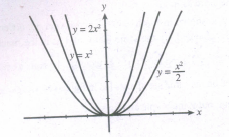
\(f(x)={1\over 2}x^2\) causes the graph of the function \(f(x)=x^2\) stretches towards x-axis since the multiplying factor is \({1\over 2}\) which is less than one. \(f(x)=2x^2\)causes the graph of the function \(f(x)=x^2\) compresses towards the y-axis that is, moves away from the x-axis since the multiplying factor is 2 which is greater than one.
7.
The given equation is equivalent to the system (x + 4) ≥ 0 and 6 - 4x - x2 = (x + 4)2
This implies x ≥ -4 and x2 + 6x + 5 = 0. Thus x = -1, -5.
But only x = -1 satisfies both the conditions. Hence, x = -1.
8.
On factorizing the quadratic polynomial we get 3(x + 2)\((x-\frac{1}{3})\le0\) . Draw the number line.
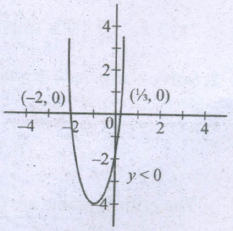
Mark the critical points -2 and \(\frac{1}{3}\) where the factors vanish. On each sub-interval check the sign of (x + 2) \((x-\frac{1}{3})\) . To do this pick an arbitrary point in anywhere in the interval. Whatever sign the resulting value has, the polynomial has the same sign throughout the whole corresponding interval. (Otherwise, there would be another critical point within the interval). This process is easily organized in the following table.
| Interval | Sign of (x+2) | Sign of (x-\(\frac{1}3\)) | Sign of 3x2+5x-2 |
| (-∞,-2) | - | - | + |
| \((-2,\frac{1}{3})\) | + | - | - |
| \((\frac{1}{3},\infty)\) | + | + | + |
You can see the inequality is satisfied in \([-2,\frac{1}{3}]\)
9.
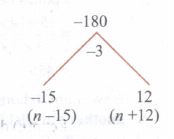
Let there be n sides of the polygon. We know that the number of diagonals of n sided polygon is \(\frac { n(n-3) }{ 2 } \)
⇒ Given \(\frac { n(n-3) }{ 2 } =90\)
⇒ n2-2n = 180
⇒ n2-3n-180 = 0
⇒ (n-15) (n+12) = 0
⇒ n = 15 or n = -12
⇒ There are 15 sides for the polygon which has 90 diagonals.
10.
Given that P (-3,1) lie on the locus of x2 - 5x + ky = 0.
⇒ (-3)2-5 (-3)+k(1) = 0
⇒ 9 +15 + k = 0
⇒ k = -24
Also, it is given that (2, b) lie on the locus of x2 - 5x + ky = 0.
⇒ 22 - 5 (2) + kb = 0
⇒ 4 - 10 - 24 (b) = 0
⇒ - 6 - 24b = 0
⇒ -24b = 6
⇒ b = \(\frac{-6}{24}=\frac{-1}{4}\)
11.
The function does not exist for one-to-one but not onto.
Since f = A\(\rightarrow\) B, f is one-one \(\Rightarrow\) f must be onto [\(\therefore\) n(A) = n(B)]
12.
cos 2\(\theta\)=\(\frac { \sqrt { 5+1 } }{ 4 } \)=cos 360
\(\Rightarrow\) cos2\(\theta\)=cos\(\left( \frac { \pi }{ 5 } \right) \)
\(\Rightarrow 2\theta =2n\pi +\frac { \pi }{ 5 } ,n\epsilon z\)
\(\Rightarrow \theta =n\pi \pm \frac { \pi }{ 10 } ,n\epsilon z\)
13.
\({{3x+1}\over{(x-2)(x+1)}}={{A}\over{(x-2)}}+{{B}\over{(x+1)}}\)
\(\Rightarrow\) \({{3x+1}\over{(x-2)(x+1)}}={{A(x+1)+B(x-2)}\over{(x-2)(x+1)}}\)
\(\Rightarrow\) 3x + 1 = A(x + 1) B(x - 2)
Putting x = -1 in (1) we get,
-3 + 1 = B(-3)
\(\Rightarrow\) -2 = -3B \(\Rightarrow\) \(\boxed{B={{2}\over{}3}}\)
Putting x = 2 in (1) we get,
6 + 1 = A(2 + 1)
\(\Rightarrow\) 7 = 3A \(\Rightarrow\) \(\boxed{{{7}\over{3}}=A}\)
\(\therefore\) \({{3x+1}\over{(x-2)(x+1)}}={{3}\over{x-2}}+{{3}\over{x+1}}={{7}\over{3(x-2)}}+{{2}\over{3(x+1)}}\)
14.
x3 - x2- 17x = 22
⇒ x3 - x2 - 17x - 22 = 0
Since x = -2 is one root of the equation, (x + 2) is a divisor of - x2 - 17x - 22 = 0
∴ Using synthetic division,
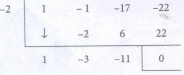
∴ Consider x2 - 3x - 11
Here a = 1, b = -3, c = -11
\(∴ x = {3\pm\sqrt{(.3)^2-4(1)(-11)}\over 2}\)
\(={3\pm\sqrt{9+44}\over2}={3\pm\sqrt{53}\over 2}\)
Hence the other roots are \({3+\sqrt{53}\over 2},{3-\sqrt{53}\over 2}\)
15.
Given in equality is -x2 + 3x - 2 > 0.
⇒ x2 - 3x + 2 < 0 [∴ a > b ⇒ -a < -b].
⇒ (x -1) (x -2) < 0.
The critical numbers are 1 and 2 and the possible intervals are (-∞ ,1) (1, 2) and (2, ∞)

| Internals | Sign of (x -1) | Sign of (x - 2) | Sign of x2 - 3x + 2 |
|---|---|---|---|
| (- ∞, 1) (say x = 0) | - | - | + |
| (1, 2)(say x = 1.5) | + | - | - |
| (2,∞) (say x = 3) | + | + | + |
The in equality x2 - 3 x + 2 < 0 is satisfied only in the interval (1, 2).
∴ Solution set is (1, 2).
16.
Given cost of one meal = Rs. 100
Number of customers is given by the function D(x) = 200 - x
∴ Day cost function = (200 - x)(100)
= 20000 - 100x
17.
Since 0 < x<\(\frac{\pi}{2}\) and y = 0
ஃ All the trigonometric ratios are positive.
\(\sqrt { { 17 }^{ 2 }-{ 15 }^{ 2 } }\) \(\sqrt { { 13 }^{ 2 }-12^{ 2 } } \)
\(\sqrt { 289-225 } \) = 5
= \(\sqrt { 64 } \)
= 8
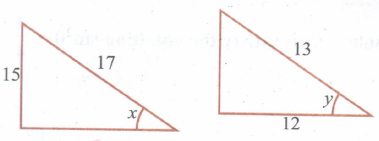
\(sin\quad x=\frac { 15 }{ 17 } \quad sin\quad y=\frac { 5 }{ 13 } \)
\(cos\quad x=\frac { 8 }{ 17 } \quad cos\quad y=\frac { 12 }{ 13 } \)
\(tan\quad x=\frac { 15 }{ 8 } \quad tan\quad y=\frac { 5 }{ 12 } \)
= sin x cos y + cos x sin y
=\(\frac { 15 }{ 17 } +\frac { 12 }{ 13 } +\frac { 8 }{ 17 } .\frac { 5 }{ 13 } \)
=\(\frac { 180 }{ 221 } +\frac { 40 }{ 221 } =\frac { 220 }{ 221 } \)
18.
\(y=\left(x^2+5\right) \log (1+e) e^{-3 x}\)
\(
\frac{d y}{d x}=\frac{d}{d x}\left[\left(x^2+5\right)\right] \log (1+x) e^{-3 x}
+\left(x^2+5\right) \frac{d}{d x}[\log (1+x)] e^{-3 x}
+\left(x^2+5\right) \log (1+x) \frac{d}{d x}\left(e^{-3 x}\right)
\)
\(\begin{array}{r}
=(2 x+0) \log (1+x) e^{-3 x}+\left(x^2+5\right) \cdot\left[\frac{1}{1+x}\right] e^{-3 x}
+\left(x^2+5\right) \log (1+x)\left[e^{-3 x}(-3)\right]
\end{array}\)
\(\begin{aligned}
=e^{-3 x}[2 x \log (1+x)+& \frac{\left(x^2+5\right)}{(1+x)}
\left.-3\left(x^2+5\right) \log (1+x)\right]
\end{aligned}\)
19.
Given \(C(t)={30t\over 200+t}\)
\(lim_{t\rightarrow \infty}C(t)={30t\over 200+t}\)
\(lim_{t\rightarrow \infty}C(t)=lim_{t\rightarrow \infty}{30t\over 200+t}\)
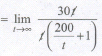
\(=lim_{t\rightarrow \infty}{30\over {200\over t}+1}=lim_{{1\over t}\rightarrow 0}{30\over {{200\over t}+1}}\) \([\because \ when \ t \rightarrow \infty,{1\over t}\rightarrow 0]\)
\(={30\over 0+1}=30\)
when t \(\rightarrow \infty\), the concentration of salt is 30 gram.
20.
According to the given information, we have the following diagram.

Distance travelled to bring first ball = 24 + 24 = 2 \(\times\) 24 = 48 m
Distance travelled to bring second ball = 2 (24 + 4) = 2(28) = 56 m
Distance travelled to bring third ball = 2 (24 + 4 + 4) = 2(32) = 64 m
\(\therefore\) The series of distances are 48, 56, 64 ...
Here a = 48, d = 56 - 48 = 8 and n = 20.
To find the total distance that he runs in bringing back all balls, we have to find the sum of 20 terms of the above series
\(\therefore\) \({ S }_{ 20 }=\frac { 20 }{ 2 } \left[ 2\left( 48 \right) +19\left( 8 \right) \right] \)
= 10[96 + 152]
= 10[248]
S20 = 2480 m.
21.
sin2 (A + B) - sin2 (A - B) = sin 2A sin 2B
LHS = sin2 (A + B) - sin2 (A - B)
= sin (A + B + A - B) sin (A + B - A + B)
= sin (2A), sin (2B) = RHS
Hence proved.
22.
\((i) a=5, b=7, P(A)=\frac{a}{a+b}=\frac{5}{5+7}=\frac{5}{1 \cdot 2}\)
\( (ii) P(B)=\frac{2}{5}=\frac{a}{a+b}\)
\(a=2, a+b=5\)
\(b=3\)
The odds that the event B occurs is 2 to 3.
23.
Given P(A) = 0.5, P(B) = 0.8
⇒ P(B/A) = 0.8
We kmow P(B/A) = \(\frac{P(A\cap B)}{P(A)}\)
⇒ 0.8 = \(\frac{P(A\cap B)}{0.5}\)
⇒ \(P(A\cap B)=(0.8)(0.5)=0.4\)
(i) Now P(A./B) = \(\frac{P(A\cap B)}{P(B)}=\frac{0.4}{0.8} =\frac{1}{2}=0.5\)
(ii) \(P(A\cup B)=P(A)+P(B)-P(A\cap B)\)
= 0.5 + 0.8 - 0.4 = 1.3 - 0.4
= 0.9
24.
\(
\int\left(5 x^2-4+\frac{7}{x}+\frac{2}{\sqrt{x}}\right) d x =5 \int x^2 d x-4 \int d x+7 \int \frac{1}{x} d x+2 \int \frac{1}{\sqrt{x}} d x\)
\(=5 \frac{x^{2+1}}{2+1}-4 x+7 \log |x|+2 \frac{x^{-\frac{1}{2}+1}}{-\frac{1}{2}+1}+c \)
\(=\frac{5}{3} x^3-4 x+7 \log |x|+4 \sqrt{x}+c
\)

11th Standard Syllabus & Materials
11th Standard
TN 11th Tamil பீடு பெற நில் - செய்யுள் - காவடிச்சிந்து Important Questions And Answers Study Material - QB365 Set A
NEW11th Standard
TN 11th Tamil பீடு பெற நில் - உரைநடை - மலை இடப்பெயர்கள் : ஓர் ஆய்வு Important Questions And Answers Study Material - QB365 Set A
NEW11th Standard
TN 11th Tamil மாமழை போற்றுதும் - துணைப்பாடம் - யானை டாக்டர் Important Questions And Answers Study Material - QB365 Set A
NEW11th Standard
TN 11th Tamil மாமழை போற்றுதும் - செய்யுள் - ஐங்குறுநூறு Important Questions And Answers Study Material - QB365 Set A



Tamilnadu Stateboard 11th Standard Subjects
Maths

Commerce

Economics

Biology

Business Maths and Statistics

Accountancy

Computer Science

Physics

Chemistry
Maths
Biology
Economics
Physics
Chemistry

History
Business Maths and Statistics

Computer Science
Accountancy

Computer Applications
History
Computer Technology
Commerce
Computer Applications
Computer Technology

Tamil

English

French
Tamilnadu Stateboard Standards



