
 100% FREE ACCESS
11th Standard Syllabus & Materials
11th Standard
TN 11th Tamil இயற்கை வேளாண்மை,சுற்றுச்சூழல் -செய்யுள் - மனோன்மணீயம் Important Questions And Answers Study Material - QB365 Set A
NEW11th Standard
TN 11th Tamil என்னுயிர் என்பேன் -துணைப்பாடம் - இசைத்தமிழர் இருவர் Important Questions And Answers Study Material - QB365 Set A
NEW11th Standard
TN 11th Tamil மொழி கலை -செய்யுள் - ஒவ்வொரு புல்லையும் Important Questions And Answers Study Material - QB365 Set A
NEW11th Standard
TN 11th Tamil பீடு பெற நில் - இலக்கணம் - பகுபத உறுப்புகள் Important Questions And Answers Study Material - QB365 Set A
NEW11th Standard
TN 11th Tamil பீடு பெற நில் - துணைப்பாடம் - வாடிவாசல் Important Questions And Answers Study Material - QB365 Set A
NEW11th Standard
TN 11th Tamil பீடு பெற நில் - செய்யுள் - குறுந்தொகை Important Questions And Answers Study Material - QB365 Set A

Published on: 13/05/2022
QB365 provides detailed and simple solution for every book back questions in class 11 Maths subject.It will helps to get more idea about question pattern in every book back questions with solution.
latest Book back QuestionsDownload Tamil Nadu 11th Standard Maths question papers, model tests, one-mark questions, important questions, and public exam papers in PDF format. Free study materials and answer keys for TN State Board students.
Questions + Answers key
Take MCQ Maths Test1.
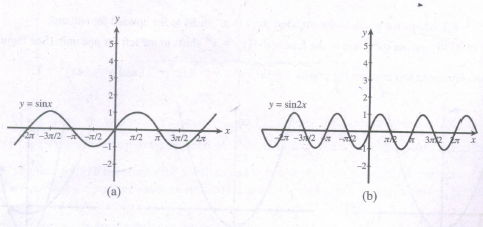
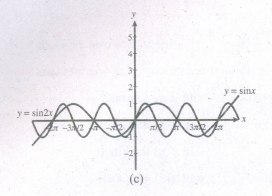
By using the same concept applied in previous example, graphs of y = sin x and y = sin 2x, and also their combined graphs are given figures (a), (b) and (c). The minimum and maximum values of sin x and sin 2x are the same. But they have different x-intercepts. The x-intercepts for y = sin x are \(\pm n\pi\) and for y = sin 2x are \(\pm{1\over 2}n\pi,\ n\in Z.\)
2.
A circular wire of radius 3 cm is cut and bent so as to lie along the circumference of a sector whose radius is 48 cm, Find in degrees the angle which is subtended at the centre of the sector.
3.
Solve \(x^{log_3x}=9\)
4.
Prove that 10C2 + 2 x 10C3 + 10C4 = 12C4
5.
Resolve into partial fractions: \(\frac{x}{(x+3)(x-4)}\)
6.
Prove that tan 315° cot (-405°) + cot 495° tan (-585°) = 2.
7.
Find the value of sin 7650.
8.
Solve x = \(\sqrt{x+20}\) for x ∈ R
9.
Solve the following system of linear inequalities 3x - 9 ≥ 0, 4x -10 ≤ 6;
10.
There are 10 bulbs in a room. Each one of them can be operated independently. Find the number of ways in which the room can be illuminated.
11.
If an electricity consumer has the consumer number say 238 :110 : 29, then describe the linking and count the number of house connections upto the 29th consumer connection linked to the larger capacity transformer number 238 subject to the condition that each smaller capacity transformer can have a maximal consumer link of say 100.
12.
There are 5 teachers and 20 students. Out of them a committee of 2 teachers and 3 students is to be formed. Find the number of ways in which this can be done. Further find in how many of these committees
(i) a particular teacher is included?
(ii) a particular student is excluded?
13.
In any \(\triangle\)ABC, prove that the area \(\triangle\) = \(\frac { { b }^{ 2 }+{ c }^{ 2 }-{ a }^{ 2 } }{ 4cotA } \)
14.
In a \(\triangle\)ABC, if a = \(\sqrt { 3 } -1\), b =\(\sqrt { 3 } +1\) and C = 60o
15.
Four children are running a race.
(i) In how many ways can the first two places be filled?
(ii) In how many different ways could they finish the race?
16.
If \(\cos { \theta } =\frac { 1 }{ 2 } \left( a+\frac { 1 }{ a } \right) \), show that \(\cos {3\theta } =\frac { 1 }{ 2 } \left( { a }^{ 3 }+\frac { 1 }{ { a }^{ 3 } } \right) \)
17.
Prove that sin (30o + \(\theta\)) + cos (60o + \(\theta\)) = cos θ
18.
Find a quadratic equation whose roots are sin 15o and cos 15o
19.
Find sin (x - y) given that sin x = \(\frac{8}{17}\) with 0 < x < \(\frac{\pi}{2}\)and cos y = \(-\frac{24}{25}\)with π < y < \(\frac{3\pi}{2}\)
20.
If sin A = \(\frac{3}{5}\) and cos B = \(\frac{9}{41}\), 0 < A < \(\frac{\pi}{2}\), 0 < B < \(\frac{\pi}{2}\). Find the value of sin (A + B)
22.
A model rocket is launched from the ground. The height 'h' reached by the rocket after t seconds from lift off is given by h(t) = -5t2 + 100t , \(0\le t\le 20\). At what time the rocket is 495 feet above the ground?
23.
If sin \(\theta\) + cos \(\theta\) = m, show that cos6\(\theta\) + sin6\(\theta\) = \(\frac { 4-3({ m }^{ 2 }-1)^{ 2 } }{ 4 } \), where m2 \(\le \) 2
24.
Find the largest possible domain for the real valued function f defined by \(f(x)=\sqrt{x^2-5x+6}.\)
1.
2.
Length of arc = Circumference of wire of radius = 3 cm
\(\therefore l=2\pi r=2\pi\times3\ cm=6\pi cm\)
The radius of the sector (r) = 48cm
\(\theta=\frac{l}{r}=\frac{6\pi}{48}=\frac{\pi}{8}\ radians\)
\(\therefore\) Angle in degrees which is subtended at the centre of the sector
\(=(\frac{\pi}{8}\times\frac{180^°}{\pi})^°=(\frac{45}{2})^°=22°30'\)
3.
Let log3x = y
Then x = 3y and so, \({ 3 }^{ { y }^{ 2 } }\)= 9.
Thus, y2 = 2, which implies y =\(\sqrt{2},-\sqrt{2}\). Hence, x = \({ 3 }^{ \sqrt { 2 } },{ 3 }^{ -\sqrt { 2 } }\)
4.
10C2 + 2 x 10C3 + 10C4 = 10C2 + (10C3 + 10C3) + 10C4
= (10C2 + 10C3) + (10C3 + 10C4)
= 11C3 + 11C4
= 12C4.
5.
Let \(\frac{x}{(x+3)(x-4)}=\frac{A}{x+3}+\frac{B}{x-4}\) where A and B are constants.
Then, \(\frac{x}{(x+3)(x-4)}=\frac{A(x-4)+B(x+3)}{(x+3)(x-4)}\) which gives x = A(x - 4) + B(x + 3)
When x = 4, we have B = \(\frac{4}{7}\)
When x = -3 we have A = \(\frac{3}{7}\)
Hence, \(\frac{x}{(x+3)(x-4)}=\frac{3}{7(x+3)}+\frac{4}{7(x-4)}\)
6.
LHS = tan (360° - 45°) [-cot (360° + 45°)] + cot (360° + 135°) [-tan (360° + 225°)]
= [-tan 45°] [-cot 45°] + [- tan 45°] [-tan 45°]
= (-1) (-1) + (-1) (-1) = 2
7.
sin 765° = sin (2 x 360° + 45°)
= sin 450 = \(\frac{1}{\sqrt 2}\)
8.
Observe that \(\sqrt{x+20}\) is defined only if x + 20 ≥ 0
By definition, \(\sqrt{x+20}\ge0\). So, x is positive.
Now squaring we get x2= x + 20. x2- x - 20 = 0
(x - 5)(x + 4) = 0, which gives x = 5, x = -4
Since, x is positive, the required solution is x = 5
9.
Note that 3x - 9 ≥ 0 implies 3x ≥ 9, by multiplying both sides by \(\frac{1}{3}\) we get x ≥ 3.
Similarly, 4x - 10 ≤ 6 implies 4x ≤ 16 and hence x ≤ 4
So the solution set of 3x - 9 ≥ 0, 4x -10 ≤ 6 is the intersection of [3, ∞) and (-∞, 4]. Clearly, the intersection of these intervals give [3, 4].
10.
Each of the 10 bulbs are operated independently means that each bulb can be operated in two ways. That is in off mode or on mode. The total number of doing this are 210 which includes the case in which 10 bulbs are off. Keeping all 10 bulbs in "off" mode, the room cannot be illuminated. Hence, the total number of ways are 210 - 1 = 1024 - 1 = 1023.
11.
The following figure illustrates the electricity distribution network.
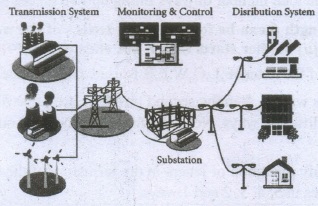
There are 110 smaller capacity transformer attached to a larger capacity transformer. As each smaller capacity transformer can be linked with only 100 consumers, we have for the 109 transformers, there will be 109 \(\times\)100 = 10900 links. For the 110th transformer, there are only 29 consumers linked. Hence, the total number of consumer linked to the 238th larger capacity transformer is 10900 + 29 = 10929.
12.
(i) a particular teacher is included?
There are 5 teachers and 20 students 2 teachers out of 5 teachers can be selected in 5C2 ways.
3 students out of 20 students can be selected in 20C3 ways
Hence, total number of committees = 20C3 \(\times \) 5C2
= \(\frac { 20\times 19\times 18 }{ 3\times 2\times 1 } \times \frac { 5\times 4 }{ 2\times 1 } \)
= \(10\times 19\times 6\times 5\times 2\)
= 11400
Since a particular teacher is included, the committee will have 1 teacher and 3 students.
∴ 1 teacher can be selected from 4'teachers in 4C1 = 4 ways.
3 students out of 20 students can be selected in 20C3 ways.
Hence, required number of committees
= 4C1 \(\times \) 20C3
= \(4\times \frac { 20\times 19\times 18 }{ 3\times 2\times 1 } \)
= 4560
(ii) 2 teachers can be selected from 5 teachers in 5C2 ways
Since a particular student is excluded, 3 students can be selected from 19 students in 19C3 ways
Hence required number of committees = 19C3 \(\times \) 5C2
=\(\frac { 19\times 18\times 17 }{ 3\times 2\times 1 } \times \frac { 5\times 4 }{ 2\times 1 } \)
= 19 \(\times \)6\(\times \)17\(\times \)5
= 9690
13.
RHS = \(\frac { { b }^{ 2 }+{ c }^{ 2 }-{ a }^{ 2 } }{ 4cotA } \)
\(=\frac { { b }^{ 2 }+{ c }^{ 2 }-{ a }^{ 2 } }{ 4\frac { cosA }{ SinA } } =\frac { { b }^{ 2 }+{ c }^{ 2 }-{ a }^{ 2 } }{ 4cosA } \times sinA=\frac { { b }^{ 2 }+{ c }^{ 2 }-{ a }^{ 2 } }{ 4\left( \frac { { b }^{ 2 }+{ c }^{ 2 }-{ a }^{ 2 } }{ 2bc } \right) } sina\)
= \(\frac { sinA }{ 4 } \times 2bc=\frac { 1 }{ 2 } bcsinA=area\quad of\quad ABC\)
∴ △ = \(\frac { { b }^{ 2 }+{ c }^{ 2 }-{ a }^{ 2 } }{ 4cotA } \)
14.
by Napier's formula we have
\(\left( \frac { A-B }{ 2 } \right) = \frac { a-b }{ a+b } cot\frac { C }{ 2 } =\frac { (\sqrt { 3 } +1)-(\sqrt { 3 } -1) }{ \sqrt { 3 } +1)+(\sqrt { 3 } -1) } cot\frac { 60 }{ 2 } \)
\(\frac { 2 }{ 2\sqrt { 3 } } cot30=\frac { 1 }{ \sqrt { 3 } } x\sqrt { 3 } =1\)
\(\frac { A-B }{ 2 } =45\quad A-B=90\)
Also A+ B = 1800 - C = 180 - 600 = 1200
Adding (1) and (2), 2A = 2100 Substituting A = 1050 in (2) we get
1050 + B = 1200 B = 120 - 105 = 150
Now by sine Formula
\(\frac { c }{ sinC } =\frac { a }{ sinA } C=a\frac { sinC }{ SinA } \)
\(=\frac { (\sqrt { 3 } +1)sin60 }{ sin105 } =\frac { (\sqrt { 3 } +1)\frac { \sqrt { 3 } }{ 2 } }{ \frac { \sqrt { 3 } +1 }{ 2\sqrt { 2 } } } =\frac { \sqrt { 3 } }{ 2 } \times 2\sqrt { 2 } =6\)
0, 0 and C = \(\sqrt { 6 } \)
15.
(i) First place can be given to anyone of the 4 children and second place can be given to anyone of the 3 remain children.
(ii) The race can be finished in 4 \(\times\) 3 \(\times\) 2 \(\times\) 1 = 4! = 24 ways.
16.
Given \(cos\theta =\frac { 1 }{ 2 } \left( a+\frac { 1 }{ a } \right) \)
LHS = cos 3θ = 4cos3θ-3cosθ
= \(4\left[ \frac { 1 }{ 2 } { \left( a+\frac { 1 }{ a } \right) }^{ 3 } \right] -3.\frac { 1 }{ 2 } \left( a+\frac { 1 }{ a } \right) \)
= \(4\left( \frac { 1 }{ 8 } \left( { a }^{ 3 }+{ 3a }^{ 2 }\left( \frac { 1 }{ a } \right) +3a\left( \frac { 1 }{ { a }^{ 2 } } \right) +\left( \frac { 1 }{ { a }^{ 3 } } \right) \right) \right) -\frac { 3 }{ 2 } \left( a+\frac { 1 }{ a } \right) \)
= \(\frac { 1 }{ 2 } \left( { a }^{ 3 }+3a+\frac { 3 }{ a } +\frac { 1 }{ { a }^{ 3 } } \right) -\frac { 3 }{ 2 } \left( a+\frac { 1 }{ a } \right) =\frac { 1 }{ 2 } \left( { a }^{ 3 }+\frac { 1 }{ a } \right) +\frac { 1 }{ 2 } \left( 3a+\frac { 3 }{ a } \right) -\frac { 3 }{ 2 } \left( a+\frac { 1 }{ a } \right) \)
= \(\frac { 1 }{ 2 } \left( { a }^{ 3 }+\frac { 1 }{ { a }^{ 3 } } \right) +\frac { 3 }{ 2 } \left( a+\frac { 1 }{ a } \right) -\frac { 3 }{ 2 } \left( a+\frac { 1 }{ a } \right) \)
\(\frac { 1 }{ 2 } \left( { a }^{ 3 }+\frac { 1 }{ { a }^{ 3 } } \right) \) = RHS
Hence proved.
17.
sin (30o + \(\theta\)) + cos (60o + \(\theta\))
LHS = sin (30o + \(\theta\)) + cos (60o + \(\theta\))
= sin 30 cos \(\theta\) + cos 30 . sin \(\theta\) + cos 60 cos \(\theta\) - sin 60 sin \(\theta\)
= \(\frac { 1 }{ 2 } \cos { \theta } +\frac { \sqrt { 3 } }{ 2 } \sin { \theta } +\frac { 1 }{ 2 } \cos { \theta } -\frac { \sqrt { 3 } }{ 2 } \sin { \theta } =\frac { 1 }{ 2 } \cos { \theta } +\frac { 1 }{ 2 } \cos { \theta } =\frac { 2\cos { \theta } }{ 2 } =\cos { \theta } \) LHS
Hence proved.
18.
Sum of the roots = sin 15o + cos 15o
= sin (45 - 30) + cos (45 - 30)
= (sin 45 cos 30 - cos 45 sin 30) + (cos 45 cos 30 + sin 45 sin 30)
= \(\left( \frac { 1 }{ \sqrt { 2 } } .\frac { \sqrt { 3 } }{ 2 } -\frac { 1 }{ \sqrt { 2 } } .\frac { 1 }{ 2 } \right) +\left( \frac { 1 }{ \sqrt { 2 } } .\frac { \sqrt { 3 } }{ 2 } -\frac { 1 }{ \sqrt { 2 } } .\frac { 1 }{ 2 } \right) \)
= \(\frac { \sqrt { 3 } }{ 2\sqrt { 2 } } -\frac { 1 }{ 2\sqrt { 2 } } +\frac { \sqrt { 3 } }{ 2\sqrt { 2 } } +\frac { 1 }{ 2\sqrt { 2 } } =\frac { 2\sqrt { 3 } }{ 2\sqrt { 2 } } =\frac { \sqrt { 3 } }{ \sqrt { 2 } } \times \frac { \sqrt { 2 } }{ \sqrt { 2 } } =\frac { \sqrt { 6 } }{ 2 } \)
Product of the roots = sin 15o cos 15o = \(\frac { 2\sin { { 15 }^{ o } } \cos { { 15 }^{ o } } }{ 2 } \)
= \(\frac { \sin { { 30 }^{ o } } }{ 2 } =\frac { 1 }{ 2 } \times \frac { 1 }{ 2 } =\frac { 1 }{ 4 } \left[ \begin{matrix} since & \sin { 2A } \\ =2\sin { A } & \cos { A } \end{matrix} \right] \)
Required equation is
x2 - x (sum of the roots) + product of the roots = 0
\(\Rightarrow { x }^{ 2 }-x\left( \frac { \sqrt { 6 } }{ 2 } \right) +\frac { 1 }{ 4 } =0\)
Multiplying by 4 we get \({ 4x }^{ 2 }-2\sqrt { 6x } +1=0\)
19.
Since \(0
ஃ All the trigonometric ratios are positive.
Also \(\pi
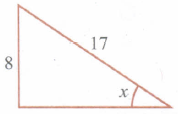
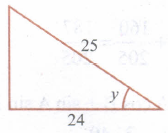
= \(\sqrt { { 25 }^{ 2 }-{ 24 }^{ 2 } } \)
= 7
\(sinx=\frac { 8 }{ 17 } \quad siny=-\frac { 7 }{ 25 } \)
\(cosx=\frac { 15 }{ 17 } \quad cosy=-\frac { 24 }{ 25 } \)
ஃ
\(\left( \frac { 8 }{ 17 } \right) \left( -\frac { 24 }{ 25 } \right) -\left( \frac { 15 }{ 17 } \right) \left( -\frac { 7 }{ 25 } \right) \)
\(=-\frac { 192 }{ 425 } +\frac { 105 }{ 425 } =-\frac { 87 }{ 425 } \)
20.
Since 0
ஃ All the trigonometric ratios are positive
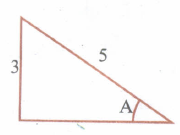
=\(\sqrt { { 5 }^{ 2 }-{ 3 }^{ 2 } } =4\)
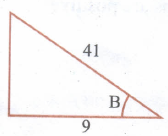
=\(\sqrt { { 41 }^{ 2 }-{ 9 }^{ 2 } } \)
=40
\(sinA=\frac { 3 }{ 5 } \quad sinB=\frac { 40 }{ 41 } \)
\(cosA=\frac { 4 }{ 5 } \quad cosB=\frac { 9 }{ 41 } \)
sin (A + B) = sinA cosB + cosA sinB
=\(\frac { 3 }{ 5 } .\frac { 9 }{ 41 } +\frac { 4 }{ 5 } .\frac { 40 }{ 41 } \)
\(=\frac { 27 }{ 205 } +\frac { 160 }{ 205 } =\frac { 187 }{ 205 } \)
21.
We have A + B + C = 180°
B + C = 180° - A = 180° - 60° = 120°
\(\Rightarrow \frac { B+C }{ 2 } =60°\)...(1)
Using sine formula, \(\frac { a }{ sinA } =\frac { b }{ sinB } =\frac { c }{ sinC } =k\)
a = k sin A, b = k sin B, c = k sin C
RHS = 2a cos\(\left( \frac { B-C }{ 2 } \right) \)...(2)
= 2.K sin A cos\(\left( \frac { B-C }{ 2 } \right) \)
=2.K sin 60° cos \(\left( \frac { B-C }{ 2 } \right) \)
= 2K.sin\(\left( \frac { B+C }{ 2 } \right) \)cos\(\left( \frac { B-C }{ 2 } \right) \)
= K\(\left[ sin\left( \frac { B+C+B-C }{ 2 } \right) +sin\left( \frac { B+C-B-C }{ 2 } \right) \right] \)
= K[sin B + sin C]
= K sin B + K sin C
= b + c [From(2)]
LHS Hence proved.
22.
h(t) = -5t2 + 100t , \(0\le t\le 20\)
Let the time be 't' see, when the rocket is 495 feet above the ground
\(\therefore\) 0 < h(t) < 495
\(\Rightarrow\) 0< -5t2 + 100t < 495
\(\Rightarrow\) 0<- 5t2 + 100t- 495 < 0 [subtracting 495]
\(\Rightarrow\) -5t2 + 100t- 495 = 0
\(\Rightarrow\) t2- 20t + 99 =0 [Divided by -5]
\(\Rightarrow\) (t-11) (t-9) = 0
\(\Rightarrow\) t = 11 or 9.
\(\therefore\) At 11 or 9 sec, the rocket is 495 feet above the ground.
23.
Given sin θ + cos θ = m
LHS = cos6 θ + sin6θ
= (cos2θ)3+ (sin2 θ)3
= (cos2θ + sin2θ)(cos4θ - cos2θ sin2θ + sin4θ)
= 1(cos4θ - cos2θ sin2θ + sin4θ)
= (cos2θ)2+ (sin2θ)2 - cos2θsin2θ
= (cos2θ)2+ (sin2θ)2- cos2θ sin2θ
= 1 - 3 sin2\(\theta\) cos2\(\theta\) ....(1)
RHS = \(\frac { 4-3{ \left( { m }^{ 2 }-1 \right) }^{ 2 } }{ 4 } \)
= \(\frac { 4-3{ \left[ { \left( sin\theta +cos\theta \right) }^{ 2 }-1 \right] }^{ 2 } }{ 4 } =\frac { 4-3\left[ { sin }^{ 2 }\theta +{ cos }^{ 2 }\theta +2sin\theta cos\theta -1 \right] }{ 4 } \)
= \(\frac { 4-12{ sin }^{ 2 }\theta { cos }^{ 2 }\theta }{ 4 } =\frac { 4 }{ 4 } -\frac { 12 }{ 4 } { sin }^{ 2 }\theta { cos }^{ 2 }\theta \)
= 1 - 3 sin2\(\theta\) cos2\(\theta\) ...(2)
From (1) and (2), LHS = RHS
24.
As we are finding the square root of x2 - 5x + 6, we must have \(x^2-5x+6\ge0\) for all x in the domain.
Solving x2 - 5x + 6 = 0, we get x = 2 and 3. Now draw the number line as below:
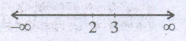
Now we have three intervals. (\(-\infty,\)2), (2, 3) and (3, \(\infty\)).
(i) Take any point in (\(-\infty,\) 2), say x = 1. Clearly x2 - 5x + 6 is positive.
(ii) Take any point in (2, 3), say x = 2.5. Clearly x2 - 5x + 6 is negative.
(iii) Take anypoint in (3, \(\infty\)) say x = 4. Clearly x2 - 5x + 6 is positive.
For all x, in the intervals \((-\infty,2)\) and \((3,\infty)\),x2 - 5x + 6 is positive. At x = 2,3 the value of x2 -5x + 6 is zero. Thus, \(\sqrt{x^2-5x+6}\) is defined for all x in \((-\infty,2]\cup[3,\infty).\) Hence the domain of \(\sqrt{x^2-5x+6}\) is \((-\infty,2]\cup[3,\infty).\)

11th Standard Syllabus & Materials
11th Standard
TN 11th Tamil பீடு பெற நில் - செய்யுள் - காவடிச்சிந்து Important Questions And Answers Study Material - QB365 Set A
NEW11th Standard
TN 11th Tamil பீடு பெற நில் - உரைநடை - மலை இடப்பெயர்கள் : ஓர் ஆய்வு Important Questions And Answers Study Material - QB365 Set A
NEW11th Standard
TN 11th Tamil மாமழை போற்றுதும் - துணைப்பாடம் - யானை டாக்டர் Important Questions And Answers Study Material - QB365 Set A
NEW11th Standard
TN 11th Tamil மாமழை போற்றுதும் - செய்யுள் - ஐங்குறுநூறு Important Questions And Answers Study Material - QB365 Set A



Tamilnadu Stateboard 11th Standard Subjects
Maths

Commerce

Economics

Biology

Business Maths and Statistics

Accountancy

Computer Science

Physics

Chemistry
Maths
Biology
Economics
Physics
Chemistry

History
Business Maths and Statistics

Computer Science
Accountancy

Computer Applications
History
Computer Technology
Commerce
Computer Applications
Computer Technology

Tamil

English

French
Tamilnadu Stateboard Standards



