
 100% FREE ACCESS
11th Standard Syllabus & Materials
11th Standard
TN 11th Tamil இயற்கை வேளாண்மை,சுற்றுச்சூழல் -செய்யுள் - மனோன்மணீயம் Important Questions And Answers Study Material - QB365 Set A
NEW11th Standard
TN 11th Tamil என்னுயிர் என்பேன் -துணைப்பாடம் - இசைத்தமிழர் இருவர் Important Questions And Answers Study Material - QB365 Set A
NEW11th Standard
TN 11th Tamil மொழி கலை -செய்யுள் - ஒவ்வொரு புல்லையும் Important Questions And Answers Study Material - QB365 Set A
NEW11th Standard
TN 11th Tamil பீடு பெற நில் - இலக்கணம் - பகுபத உறுப்புகள் Important Questions And Answers Study Material - QB365 Set A
NEW11th Standard
TN 11th Tamil பீடு பெற நில் - துணைப்பாடம் - வாடிவாசல் Important Questions And Answers Study Material - QB365 Set A
NEW11th Standard
TN 11th Tamil பீடு பெற நில் - செய்யுள் - குறுந்தொகை Important Questions And Answers Study Material - QB365 Set A

Published on: 13/05/2022
QB365 provides detailed and simple solution for every book back questions in class 11 Maths subject.It will helps to get more idea about question pattern in every book back questions with solution.
latest Book back QuestionsDownload Tamil Nadu 11th Standard Maths question papers, model tests, one-mark questions, important questions, and public exam papers in PDF format. Free study materials and answer keys for TN State Board students.
Questions + Answers key
Take MCQ Maths Test1.
At the given point xo discover whether the given function is continuous or discontinuous citing the reasons for your answer :\(x_{0}=3, f(x)= \begin{cases}\frac{x^{2}-9}{x-3}, & \text { if } x \neq 3 \\ 5, & \text { if } x=3\end{cases}\)
2.
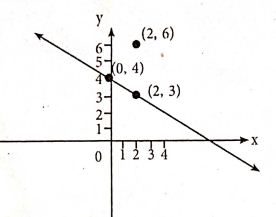
Sketch the graph of a function f that satisfies the given values :
f(0) is undefined
\(lim_{x\rightarrow0}f(x)=4\)
f(2) = 6
\(lim_{x\rightarrow2}f(x)=3\)
3.
Solve the following problems by using Factor Theorem :
Solve \(\begin{vmatrix} 4-x & 4+x & 4+x \\ 4+x & 4-x & 4+x \\ 4+x & 4+x & 4-x \end{vmatrix}=0\) .
4.
Prove that\(\begin{vmatrix} 1+a & 1 & 1 \\ 1 & 1+b &1 \\1 &1 &1+c \end{vmatrix}=abc\left( 1+{1\over a}+{1\over b}+{1\over c} \right) .\)
5.
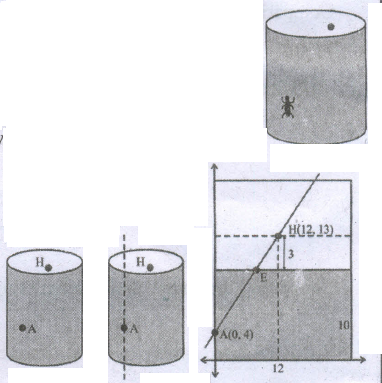
Consider a hollow cylindrical vessel, with circumference 24 cm and height 10 cm. An ant is located on the outside of vessel 4 cm from the bottom. There is a drop of honey at the diagrammatically opposite inside of the vessel, 3 cm from the top.
(i) What is the shortest distance the ant would need to crawl to get the honey drop?
(ii) Equation of the path traced out by the ant.
(iii) Where the ant enter in to the cylinder? Here is a picture that illustrates the position of the ant and the honey.
6.
If the pair of lines represented by x2 - 2cxy -y2 = 0 and x2 - 2dxy -y2 = 0 be such that each pair bisects the angle between the other pair, prove that cd = -1.
7.
Using Heron's formula, show that the equilateral triangle has the maximum area for any fixed perimeter. [Hint: In xyz \(\le\) k, maximum occurs when x = y = z]
8.
If \(y=\frac{2\ sin\alpha}{1+cos\alpha+sin\alpha}\) then prove that \(\frac{1-cos\alpha+sin\alpha}{1+sin\alpha}=y\).
9.
A box contains two white balls, three black balls and four red balls. In how many ways can three balls be drawn from the box, if atleast one black ball is to be included in the draw?
10.
The normal boiling point of water is 100°C or 212°F· and the freezing point of water is 0 °C or 32°F.
(i) Find the linear relationship between C and F.
(ii) Find the value of C for 98.6°F and
(iii) Find the value of F for 38°C.
11.
The number of bacteria in a certain culture doubles every hour. If there were 30 bacteria present in the culture originally, how many bacteria will be present at the end of 2nd hour, 4th hour and nth hour?
12.
13.
Determine the region in the plane determined by the inequalities.
\(x-2y\ge 0,\ 2x-y\le -2,\ x\ge 0,\ y\ge 0.\)
14.
Solve the following equations sin \(\theta\) + cos \(\theta\) = \(\sqrt { 2 } \)
15.
Solve the following equations cos \(\theta\) + cos 3\(\theta\) = 2 cos2\(\theta\)
16.
Find all values of x that satisfies the inequality \({{2x-3}\over{(x-2)(x-4)}}<0.\)
17.
Prove that cos 5\(\theta\) = 16 cos2 \(\theta\) - 20 cos3 \(\theta\) + 5 cos \(\theta\).
18.
Write the values of f at -4, 1, -2, 7, 0 if
19.
If cosec \(\theta\) - sin \(\theta\) = a3 and sec \(\theta\) - cos \(\theta\) = b3, then prove that a2b2 (a2+ b2) = 1
20.
From the curve y = sin x, draw y = sin |x|. (Hint: sin (-x) = -sin x)
21.
From the curve y = sin x, graph the functions.
(i) y = sin(-x)
(ii) y = -sin(-x)
(iii) \(y=sin\left( {\pi\over 2}+x\right)\) which is cos x
(iv) \(y=sin\left({\pi\over 2}-x \right)\) which is also cos x (refer trigonometry)
22.
Graph the function f(x) = x3 and \(g(x)=\sqrt[3]x\) on the same co-ordinate plane. Find f o g and graph it on the plane as well. Explain your results.
23.
A simple cipher takes a number and codes it, using the function f(x) = 3x - 4. Find the inverse of this function, determine whether the inverse is also a function and verify the symmetrical property about the line y = x(by drawing the lines)
24.
Find the separate equation of the following pair of straight lines.
3x2 + 2xy - y2 = 0
25.
1.
Given \(x_{0}=3, f(x)= \begin{cases}\frac{x^{2}-9}{x-3}, & \text { if } x \neq 3 \\ 5, & \text { if } x=3\end{cases}\)
\(lim_{x\rightarrow 3^-}f(x)=lim_{x\rightarrow 3^-}{x^2-9\over x-3}=lim_{x\rightarrow 3^-}{(x+3)(x-3)\over x-3}=lim_{x\rightarrow 3^-}x+3=6\)
\(lim_{x\rightarrow 3^+}f(x)=lim_{x\rightarrow 3^+}{x^2-9\over x-3}=lim_{x\rightarrow 3^+}(x+3)=6\)
But f(3)=5
\(\therefore lim_{x\rightarrow 3^-}f(x)=lim_{x\rightarrow 3^+}f(x)\neq f(3)\)
\(\therefore f(x)\) continuous at xo=3
2.
i) Given: f(0) is undefined
\(\lim _{x \rightarrow 0} f(x)=4, f(2)=6, \lim _{x \rightarrow 2} f(x)=3\)
To sketch the graph of y = f(x)
(i) Consider the points (0, 4) and (2, 3)
(ii) Draw a curve straight. line passing through (0, 4) and (2, 3)
(iii) Remove (0, 4), (2, 3) and plot the point (2, 6)
3.
\(|A|=\left|\begin{array}{ccc}
4-x & 4+x & 4+x \\
4+x & 4-x & 4+x \\
4+x & 4+x & 4-x
\end{array}\right|\)
Put x = 0
\(|A|=\left|\begin{array}{lll}
4 & 4 & 4 \\
4 & 4 & 4 \\
4 & 4 & 4
\end{array}\right|=0 \quad\left(C_1 \cong C_2 \cong C_3\right)\)
Since all the three rows are identical.
\(\therefore(x-0)^2=x^2 \text { is a factor of }|A|\)
\(\text { Applying } C_1 \rightarrow C_1+C_2+C_3\)
\(|A|=\left|\begin{array}{ccc}
12+x & 4+x & 4+x \\
12+x & 4-x & 4+x \\
12+x & 4+x & 4-x
\end{array}\right|\)
Put x = -12
\(=\left|\begin{array}{lll}
0 & 4+x & 4+x \\
0 & 4-x & 4+x \\
0 & 4+x & 4-x
\end{array}\right|=0\)
\(\therefore\) (x+12) is an other factor of lA|.
The number of roots must be 3
\(\therefore\) x= 0,0,-12
4.
\(\mathrm{LHS}=\left|\begin{array}{ccc} 1+a & 1 & 1 \\ 1 & 1+b & 1 \\ 1 & 1 & 1+c \end{array}\right|\)
\(\text { Applying } C_1 \rightarrow C_1-C_2 \& C_2 \rightarrow C_2-C_3\)
\(=\left|\begin{array}{ccc} a & 0 & 1 \\ -b & b & 1 \\ 0 & -c & 1+c \end{array}\right|\)
\(=a(b+b c+c)+0+1(b c-0)\)
\(=a b+a b c+a c+b c\)
\(=\frac{1}{a b c}\left(\frac{1}{c}+1+\frac{1}{b}+\frac{1}{a}\right)\)
\(=\frac{1}{a b c}\left(1+\frac{1}{a}+\frac{1}{b}+\frac{1}{c}\right)=\mathrm{RHS}\)
Hence proved.
5.
By unrolling the hollow cylinder and flattening it into a rectangle, and with a single reflection allows us to determine the ant's path, as shown the figure. Let the baseline x-axis in cm and the vertical line through A (initial position of the ant) be the y-axis. Let H be the position of honey drop and E be the entry point of ant inside the vessel. From the given information we have
Let A(x1, y1) and H(x2, y2) be (0, 4) and (12, 13) respectively.
(i) The shortest distance between A and H is
\(\sqrt{(x_2-x_1)^2+(y_2-y_1)^2}=\sqrt{12^2+9^2}=15\)
the ant would need to crawl 15 cm to get the honey.
(ii) The equation of the path AH is \(\frac{y-4}{13-4}=\frac{x-0}{12-0}\)
y = 0.75x + 4
(iii) At the entry point E, y = 10 ⇒ x = 8
E = (8, 10)
6.
Given that the pair of straight lines,
x2- 2cxy - y2 = 0 ...(1)
x2- 2dxy - y2 = 0 ...(2)
The equation of the angle bisectors of equation (1) is
\(\frac { { x }^{ 2 }-{ y }^{ 2 } }{ 2 } =\frac { xy }{ -c } \)
⇒ cx2 + 2xy - cy2 = 0
Given that the angle bisector of equation (1) is (2) Therefore equations
x2- 2dxy - y2 = 0
cx2 + 2xy - cy2 = 0
represent the same equation as the angle bisector of equation (1)
Comparing the like terms of the above two equations, we get
\(\frac { 1 }{ c } =\frac { -2d }{ 2 } =\frac { -1 }{ -c } \)
⇒ cd = -1
7.
Let ABC be a triangle with constant perimeter 2s. Thus s is constant.
We know that \(\triangle =\sqrt{s(s-a)(s-b)(s-c)}\)
Observe that \(\triangle\) is maximum, when (s - a) (s - b) (s - c) is maximum.
Now, (s-a)(s-b)(s-c)\(\le\)\(({(s-a)+(s-b)+(s-c)\over 3})^3\) = \({s^3\over 27}\) [G.M\(\le\) A.M]
Thus, we get (s - a) (s - b) (s - c) \(\le\) \({s^3\over 27}\)
Equality occurs when s - a = s - b = s - c. That is, when a = b = c maximum of (s - a) (s - b) (s - c) is \({s^3\over 27}\)
Thus, for a fixed perimeter 2s, the area of a triangle is maximum when a = b = c.
Hence, for a fixed perimeter, the equilateral triangle has the maximum area and the maximum area is given by \(\triangle =\sqrt {s(s)^3\over 27}={s^2\over3\sqrt{3}}sq.units\)
8.
\(y=\frac{2\ sin\alpha}{1+cos\alpha+sin\alpha}\)
\(=\frac{2sin\alpha[1+sin\alpha-cos\alpha]}{[(1+sin\alpha)+cos\alpha](1+sin\alpha-cos\alpha)}\)
\(=\frac{2sin\alpha(1-cos\alpha+sin\alpha)}{(1+sin\alpha)^2-cos^2\alpha}\)
\(=\frac{2sin\alpha(1-cos\alpha+sin\alpha)}{1+2sin\alpha+sin^2\alpha-(1-sin^2\alpha)}\)
\(=\frac{2sin\alpha(1-cos\alpha+sin\alpha)}{2sin\alpha+2sin^2\alpha}\)
\(=\frac{2sin\alpha(1-cos\alpha+sin\alpha)}{2sin\alpha(1+sin\alpha)}\)
\(=\frac{1-cos\alpha+sin\alpha}{1+sin\alpha}\)
9.
Three balls must be drawn with atleast one black ball.
The possible choices are as follows
| White balls(2) | Black balls(3) | Red balls(4) | Combination |
| 2 | 1 | 0 | 2C2\(\times \)3C1\(\times \)4C0 |
| 0 | 1 | 2 | 2C0\(\times \)3C1\(\times \)4C2 |
| 1 | 1 | 1 | 2C1\(\times \)3C1\(\times \)4C1 |
| 1 | 2 | 0 | 2C1\(\times \)3C2\(\times \)4C0 |
| 0 | 2 | 1 | 2C0\(\times \)3C2\(\times \)4C1 |
| 0 | 3 | 0 | 2C0\(\times \)3C3\(\times \)4C0 |
∴ Required number of ways of drawing 3 balls?
= \(2{ C }_{ 2 }\times { 3C }_{ 1 }\times { 4C }_{ 0 }+2C_{ 0 }\times { 3C }_{ 1 }\times { 4C }_{ 2 }+2C_{ 1 }\times { 3C }_{ 1 }\times { 4C }_{ 1 }\)\(\times \) \({ 2C }_{ 1 }\times 3C_{ 2 }\times { 4C }_{ 0 }+{ 2C }_{ 0 }\times { 3C }_{ 2 }\times { 4C }_{ 1 }+{ 2C }_{ 0 }\times { 3C }_{ 3 }\times { 4C }_{ 0 }\)
= 1\(\times \)3\(\times \)1+1\(\times \)3\(\times \)6+2\(\times \)3\(\times \)4+2\(\times \)3\(\times \)1+1\(\times \)3\(\times \)4+1\(\times \)1
= 3 + 18 + 24 + 6 + 12 + 1 = 64
10.
(i) Find the linear relationship between C and F.
By the given data
x1 (100°C) y1(212°F)
x2(0°C) y2(32°F)
Using two point form, the linear relationship between C and F is
\(\frac { y-{ y }_{ 1 } }{ { y }_{ 2 }-{ y }_{ 1 } } =\frac { x-{ x }_{ 1 } }{ { x }_{ 2 }-{ x }_{ 1 } } \)
\(\frac { y-212 }{ 32-212 } =\frac { x-100 }{ 0-100 } \)
\(\Rightarrow \quad \frac { y-212 }{ -180 } =\frac { x-100 }{ -100 } \)
\(\Rightarrow \quad \frac { y-212 }{ 9 } =\frac { x-100 }{ 5 } =\frac { 5 }{ 9 } (y-212)=x-100\)
\(\Rightarrow \quad x=\frac { 5 }{ 9 } (y-212)+100\quad \Rightarrow \quad x=\frac { 5 }{ 9 } y-\frac { 5 }{ 9 } \times 212+100\)
\(\Rightarrow \quad x=\frac { 5 }{ 9 } y-118+100\quad \Rightarrow x=\frac { 5 }{ 9 } y-18\)
\(\Rightarrow \quad x=\frac { 5 }{ 9 } (y-32) \Rightarrow C=\frac { 5 }{ 9 } (F-32)\quad .....(1)\)
[\(\because \) x represents Celsius and y represents Fahrenheit]
Which is the required relationship between C and F.
(ii) Find the value of C for 98.6°F and
Find C when F = 98.6° F
Substituting F = 98.6° in (1) we get,
C = \(\frac{5}{9}(98.6-32)=\frac{5}{9}(66.6)=\frac{333}{9}=37°\)
(iii) Find the value of F for 38°C.
Substituting C = 38° in (1) we get,
38=\(\frac{5}{9}(F-32)\)
⇒ \(\frac{342}{5}+32\) = F
⇒ F = 100.4°C
11.
Clearly, number of bacteria at the end of different hours forms a G.P. with
a = 30 and r = 2.
Number of bacteria present at the end of 2nd hour
t3 = a . r2 = 30 \(\times\) 22 = 30 \(\times\) 4 = 120.
Number of bacteria present at the end of 4th hour
t5 = a . r4 = 30 (24) = 30 (16) = 480.
Number of bacteria present at the end of nth hour
tn+1 = a . rn = 30 (2n).
12.
13.
If x - 2y = 0
| x | 0 | 2 | -2 |
| y | 0 | 1 | -1 |
2x - y = -2
| x | 0 | -1 |
| y | 2 | 0 |
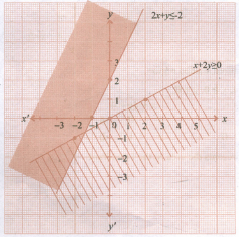
x > 0, y > 0 represents the portion in the I quadrant only.
Hence, OABC is the required shaded region.
14.
Dividing by \(\sqrt { 2 } \) we get,
\(\frac { 1 }{ \sqrt { 2 } } \)sin \(\theta\) + \(\frac { 1 }{ \sqrt { 2 } } \)cos\(\theta\) = 1
sin\(\frac { \pi }{ 4 } \) sin \(\theta\) + cos\(\frac { \pi }{ 4 } \) cos\(\theta\) = 1
\(\Rightarrow cos\left( \theta -\frac { \pi }{ 4 } \right) =1=cos\theta \)
\(\Rightarrow cos\left( \theta -\frac { \pi }{ 4 } \right) =cos\theta \)
\(\Rightarrow \theta -\frac { \pi }{ 4 } =2n\pi \pm 0,n\in z\)
\(\Rightarrow \theta =2n\pi +\frac { \pi }{ 4 } ,,n\in z\)
\(\Rightarrow \theta =\frac { 8n\pi +\pi }{ 4 } ,n\in z\)
\(\Rightarrow \theta =(8n+1)\frac { \pi }{ 4 } ,n\in z\)
15.
\(2cos\left( \frac { \theta +3\theta }{ 2 } \right) .cos\left( \frac { 3\theta -\theta }{ 2 } \right) -2cos2\theta =0\)
2cos2θ.cosθ-2cos2θ = 0
cos2θ(cosθ-1) = 0
cos2θ = 0
or cosθ = 1
cos2θ = 0 or cosθ = 1
cos2θ = 0
2θ = (2n + 1)\(\frac{\pi}{2}\), n∈z
θ = (2n + 1)\(\frac{\pi}{4}\), n∈z
θ = (2n + 1)\(\frac{\pi}{4}\)
cos θ = 1
cos θ = cos0
θ = 2nπ土0, n∈z
θ = 2nπ, n∈z
ஃ The solutions are θ = (2n+1)\(\frac{\pi}{4}\)or 2nπ, n∈z
16.
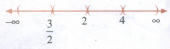
Given inequality is \({{2x-3}\over{(x-2)(x-4)}}<0.\)
The critical numbers are x = \(\frac { 3 }{ 2 }\), 2, 4
∴ The possible intervals are \(\left(-\infty, {3\over 2}\right)\left({3\over 2},2\right)(2, 4)\) and \( (4, ∞)\)
| Intervals | Sign of 2x -3 | Sign of x-1 | Sign of x-2 | Sign of \(2x-3\over (x-2)(x-4)\) |
|---|---|---|---|---|
| \(\left(-\infty,{3\over 2}\right)\) Say x = 0 | - | - | - | - |
| \(\left(-\infty,{3\over 2}\right)\) Say \(x={7\over 4}\) | + | + | - | - |
| (2,4) Say x = 3 | + | + | + | + |
| \( (4, ∞)\) Say x = 5 | + | + | + | + |
The inequality \({2x-3\over (x-2(x-4))}<0\) is satisfied by the intervals \(\left(-\infty,{3\over 2} \right)\) and \((2,4)\)
17.
LHS = cos 5\(\theta\) = cos (3\(\theta\) + 2\(\theta\))
= cos 3\(\theta\) cos 2\(\theta\) - sin 3\(\theta\) sin 2\(\theta\)
= (4 cos3 \(\theta\) - 3 cos \(\theta\)) (2 cos2 \(\theta\) -1) - [3 sin\(\theta\) - 4 sin3 \(\theta\)] 2 sin \(\theta\) cos \(\theta\)
= 8 cos5 \(\theta\) - 10 cos3 \(\theta\) + 3 cos \(\theta\) -6 cos \(\theta\) + 6 cos3 \(\theta\) + 8 cos \(\theta\) (1 + cos4 \(\theta\) - 2 cos2 \(\theta\))
= 16 cos5 \(\theta\) - 20 cos3 \(\theta\) + 5 cos \(\theta\)
= RHS
Hence proved.
18.
f(-4) = +4 + 4 [\(\therefore\) f(x) = -x + 4 when x = -4]
=8
f(1) = 1-12 [\(\therefore\) f(x) = x-x2 when x = 1]
f(1) = 0
f(-2) = (-2)2-(-2) [\(\therefore\) f(x) = x2-x when x = -2]
= 4+2 = 6
f(7) = 0 [\(\therefore\) f(x) = 0 when x = 7]
f(0 = 02-0 [\(\therefore\) f(x) = x2 - x when x = 0]
=0
\(\therefore\) f(-4) = 8, f(1) = 0, f(-2) = 6, f(7) = 0 and f(0) = 1
19.
Given a3= cosec θ - sin θ =\(\frac{1}{sinθ}-sinθ\)=\(\frac{1-sin^2θ}{sinθ}=\frac{cos^2θ}{sinθ}\)
a = \((\frac{cos^2θ}{sinθ})^{1/3}\)
and b3 = sec θ - cos θ =\(\frac{1}{cosθ}-cosθ=\frac{1-cos^2θ}{cosθ}=\frac{sin^2θ}{cosθ}\)
b = \((\frac{sin^2θ}{cosθ})^{1/3}\)
Now, LHS = a2b2(a2+ b2)
= \((\frac{cos^2θ}{sinθ})^{2/3}.(\frac{sin^2θ}{cosθ})^{2/3}[(\frac{cos^2θ}{sinθ})^{2/3}+(\frac{sin^2θ}{cosθ})^{2/3}]\)
= \(\frac { { cos }_{ \theta }^{ 4/3 } }{ { sin }_{ \theta }^{ 2/3 } } .\frac { { sin }_{ \theta }^{ 4/3 } }{ { cos }_{ \theta }^{ 2/3 } } \left[ \frac { { cos }_{ \theta }^{ 4/3 } }{ { sin }_{ \theta }^{ 2/3 } } +\frac { { sin }_{ \theta }^{ 4/3 } }{ { cos }_{ \theta }^{ 2/3 } } \right] \)
= \({ cos }_{ \theta }^{ 4/3+2/3 }+{ sin }_{ \theta }^{ 4/3+2/3 }\)
cos2\(\theta\) + sin2\(\theta\) = 1 = RHS
20.
y = sin |x|
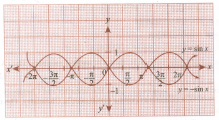
We know \(|x| =\begin{cases}x\ if\ x\ge0 \\-x\ if\ x<0 \end{cases}\)
∴ sin |x| = sin x if x > 0 and sin |x| = sin (-x) = -sin x if x < 0.
The graph of y = sin (-x) = - sin x is the reflection of the graph of sin x about Y-axis.
21.
(i) y = sin (-x)
.png)
Let y = sin x.
Then sin(-x) is the reflection of the graph of sin x, about y-axis.
(ii) y = -sin(-x)
.png)
-sin(-x) is the reflection of the graph of sin(-x) about the x-axis.
(iii) \(y=sin\left( {\pi\over 2}+x\right)\)
.png) Let y = sinx.
Let y = sinx.
Then \(sin\left( {\pi\over 2}+n\right)\)causes the shift to the left for \(\pi\over 2\) unit to the sin x curve.
(iv) \(y=sin\left({\pi\over 2}-x \right)\)
.png)
Let y = sin x. Then \(sin\left( {\pi\over 2}-n\right)\) causes the shift to the left for \(\pi\over 2\) unit to the sin (-x) curve.
22.
Given functions are f(x) = x3 and g(x) = \(x^{ ^{ \frac { 1 }{ 3 } } }\)
Now, f o g(x) = f(g(x)
= \(f\left( { x }^{ \frac { 1 }{ 3 } } \right) \)
= \(\left( { x }^{ 3 } \right) ^{ \frac { 1 }{ 3 } }=x\)
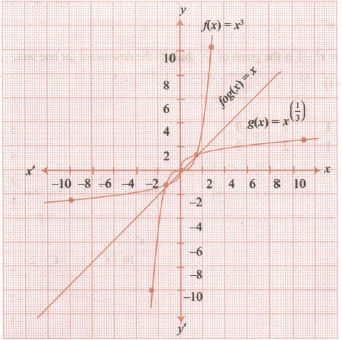
Since f o g(x) = x is symmetric about the line y = x, g(x) is the inverse of f(x)
∴ g(x) = f-1(x).
where f o g(x) = g o f(x) = x so that
(i) f o g is bijective.
(ii) both f(x) and g(x) also bijective.
(iii) f and g are symmetrical about y = x
23.
Given f(x) = 3x - 4
Let y = 3x - 4 ⇒ y + 4 = 3x
\(⇒ x={y+4\over 3}\)
Let g(y) = \(y+4\over 3\)
Now gof(n) = g(f(n)) = g(3\(\times\) -4) = \({3x-4+4\over 3}={3x\over 3}=x\)
and fog(y) = f(g(y)) = \(f\left(y+4\over 4\right)=3\left(y+4\over 3\right)-4=y+4-4=y\)
Thus, gof(x) = Ix and fog (y) = Iy
This implies that f and g are bijections and inverses to each other
Hence f is bijection and \(f^{-1} (x)={y+4\over 3}\)
Replacing y by x, we get f-1 (x) = \(\frac { x+4 }{ 3 } \)
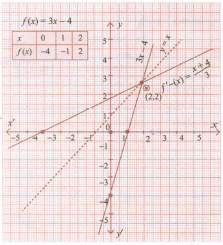
Hence, the graph of y = f-1(x) is the reflection of the graph of f in y = x
24.
3x2 + 2xy - y2 = 0
Consider 3x2 + 2xy - y2 = 0
\(\Rightarrow\) (x +y) (3x - y) = 0 [By factorizing]
.jpg)
Hence the separate equations are
x + y = 0 and 3x - y = 0
25.

11th Standard Syllabus & Materials
11th Standard
TN 11th Tamil பீடு பெற நில் - செய்யுள் - காவடிச்சிந்து Important Questions And Answers Study Material - QB365 Set A
NEW11th Standard
TN 11th Tamil பீடு பெற நில் - உரைநடை - மலை இடப்பெயர்கள் : ஓர் ஆய்வு Important Questions And Answers Study Material - QB365 Set A
NEW11th Standard
TN 11th Tamil மாமழை போற்றுதும் - துணைப்பாடம் - யானை டாக்டர் Important Questions And Answers Study Material - QB365 Set A
NEW11th Standard
TN 11th Tamil மாமழை போற்றுதும் - செய்யுள் - ஐங்குறுநூறு Important Questions And Answers Study Material - QB365 Set A



Tamilnadu Stateboard 11th Standard Subjects
Maths

Commerce

Economics

Biology

Business Maths and Statistics

Accountancy

Computer Science

Physics

Chemistry
Maths
Biology
Economics
Physics
Chemistry

History
Business Maths and Statistics

Computer Science
Accountancy

Computer Applications
History
Computer Technology
Commerce
Computer Applications
Computer Technology

Tamil

English

French
Tamilnadu Stateboard Standards



