
 100% FREE ACCESS
11th Standard Syllabus & Materials
11th Standard
TN 11th Tamil இயற்கை வேளாண்மை,சுற்றுச்சூழல் -செய்யுள் - மனோன்மணீயம் Important Questions And Answers Study Material - QB365 Set A
NEW11th Standard
TN 11th Tamil என்னுயிர் என்பேன் -துணைப்பாடம் - இசைத்தமிழர் இருவர் Important Questions And Answers Study Material - QB365 Set A
NEW11th Standard
TN 11th Tamil மொழி கலை -செய்யுள் - ஒவ்வொரு புல்லையும் Important Questions And Answers Study Material - QB365 Set A
NEW11th Standard
TN 11th Tamil பீடு பெற நில் - இலக்கணம் - பகுபத உறுப்புகள் Important Questions And Answers Study Material - QB365 Set A
NEW11th Standard
TN 11th Tamil பீடு பெற நில் - துணைப்பாடம் - வாடிவாசல் Important Questions And Answers Study Material - QB365 Set A
NEW11th Standard
TN 11th Tamil பீடு பெற நில் - செய்யுள் - குறுந்தொகை Important Questions And Answers Study Material - QB365 Set A

Published on: 07/06/2021
QB365 provides detailed and simple solution for every book back questions in class 11 Maths subject.It will helps to get more idea about question pattern in every book back questions with solution.
Download Tamil Nadu 11th Standard Maths question papers, model tests, one-mark questions, important questions, and public exam papers in PDF format. Free study materials and answer keys for TN State Board students.
Questions + Answers key
Take MCQ Maths Test1.
Prove that the smallar angle between any two diagonals of a cube is cos-1 \(({1\over3})\).
2.
Three candidates X, Y, and Z are going to play in a chess competition to win FIDE (World chess Federation) cup this year. X is thrice as likely to win as Y and Y is twice as likely as to win Z. Find the respective probability of X,Y and Z to win the cup.

3.
X speaks truth in 70 percent of cases, and Y in 90 percent of cases. What is the probability that they likely to contradict each other in stating the same fact?
4.
The chances of A, B, and C becoming manager of a certain company are 5 : 3: 2. The probabilities that the office canteen will be improved if A, B, and C become managers are 0.4, 0.5 and 0.3 respectively. If the office canteen has been improved, what is the probability that B was appointed as the manager?
5.
There are two identical urns containing respectively 6 black and 4 red balls, 2 black and 2 red balls. An urn is chosen at random and a ball is drawn from it.
(i) find the probability that the ball is black
(ii) if the ball is black, what is the probability that it is from the first urn?
6.
Evaluate the following integrals : \(\int{2x+3\over \sqrt{x^2+x+1}}dx\)
7.
Evaluate the following integrals : \(\int{3x+5\over x^2+4x+7}dx\)
8.
Evaluate : \(\int tan^{-1}({2x\over 1-x^2})dx\)
9.
A tree is growing so that, after t - years its height is increasing at a rate of \({18\over \sqrt{t}}\) cm per year Assume that when t = 0, the height is 5 cm.
(i) Find the height of the tree after 4 years.
(ii) After how many years will the height be 149 cm?
10.
If \(y={sin^{-1}x\over \sqrt{1-x^2}}\) , Show that (1 - x2) y2 - 3x y1 - y = 0.
11.
Find y' if x4 + y4 = 16.
12.
Which of the following functions f has a removable discontinuity at x = x0? If the discontinuity is removable, find a function g that agrees with f for x ≠ x0 and is continuous on R
\(f(x)={x^3+64\over x+4},x_o=-4\)
13.
For what value of \(\alpha\)is this function \(f(x)= \begin{cases}\frac{x^{4}-1}{x-1}, & \text { if } x \neq 1 \\ \alpha, & \text { if } x=1\end{cases}\) continuous at x = 1?
14.
Show that the function \(\begin{cases}\frac{x^{3}-1}{x-1}, & \text { if } x \neq 1 \\ 3, & \text { if } x=1\end{cases}\) is continuous on \((-\infty,\infty)\)
15.
Do the limits of following functions exist as x\(\rightarrow 0?\) State reasons for your answer.\(x \left\lfloor x \right\rfloor \over sin |x|\)
16.
According to Einstein’s theory of relativity, the mass m of a body moving with velocity v is m = \({m_O\over \sqrt{1-{v^2\over c^2}}},\) where m0 is the initial mass and c is the speed of light. What happens to m as \(v\rightarrow{c}^-\). Why is a left hand limit necessary?
17.
Evaluate the following limits : \(lim_{x\rightarrow2}{2-\sqrt{x+2}\over 3\sqrt{2}-3\sqrt{4-x}}\)
18.
Show that \(\begin{vmatrix} 1 &1 &1 \\ x & y & z \\ x^2 & y^2 & z^2 \end{vmatrix}\) = (x - y)( y - z)(z - x).
19.
Prove that |A| = \(\begin{vmatrix} (q+r)^2& p^2 &p^2 \\ q^2 & (r+p)^2 & q^2 \\ r^2 &r^2 & (p+q)^2 \end{vmatrix}\) = 2pqr(p + q + r)3.
20.
Show that f(x) f(y) = f(x + y), where f(x) =\(\begin{bmatrix} cos \ x & -sin \ x & 0 \\ sin x & cos x & 0 \\ 0 & 0 & 1 \end{bmatrix}\).
21.
The probability that a girl, preparing for competitive examination will get a State Government service is 0.12, the probability that she will get a Central Government job is 0.25, and the probability that she will get both is 0.07. Find the probability that (i) she will get atleast one of the two jobs (ii) she will get only one of the two jobs.
22.
Integrate the following with respect to x : \({log \ x \over (1+log x)^2}\)
23.
Integrate the following with respect to x: : \({x sin^{-1}\over \sqrt{1-x^2}}\)
24.
If y = tan-1\(({1+x\over 1-x}), \) find y'.
25.
Show that the following functions are not differentiable at the indicated value of x.

1.
Let OABCDEFG be a unit cube.
Keeping O as origin.
Let \(\overrightarrow{OA}=\hat{i},\overrightarrow{OC}=\hat{j}\) and \(\overrightarrow{OG}=\hat{k}\)
Consider the diagonals OE and BG.
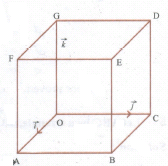
\(\overrightarrow{OE}=\overrightarrow{OB}+\overrightarrow{BE}=\overrightarrow{OA}+\overrightarrow{AB}+\overrightarrow{BE}\)
\(=\overrightarrow{OA}+\overrightarrow{OC}+\overrightarrow{OG}=\hat{i}+\hat{j}+\hat{k}\) \([\because \overrightarrow{AB}= \overrightarrow{OC}, \overrightarrow{BE}= \overrightarrow{OG}]\)
and \(\overrightarrow{GB}=\overrightarrow{GO}+\overrightarrow{OB}=-\hat{k}+\overrightarrow{OA}+\overrightarrow{AB}=\)\(\hat{i}+\hat{j}-\hat{k}\)
Let \(\theta\) be the smaller angle between the diagonals OE and GB, then
cos \(\theta\)=\({\overrightarrow{OE}.\overrightarrow{GB}\over|\overrightarrow{OE}||\overrightarrow{GB}|}=\)\({1(1)+1(1)+1(-1)\over \sqrt{1^2+1^2+1^2}.\sqrt{1^2+1^2+(-1)^2}}={2-1\over \sqrt{3}\sqrt{3}}={1\over3}\)
Thus \(\theta=\)cos-1 \(({1\over3})\)
2.
Let A, B, C be the event of winning FIDE cup respectively by X,Y, and Z this year.
Given that X is thrice as likely to win as Y.
A : B :: 3 : 1 (1)
Y is twice as likely as to win Z
B : C :: 2 : 1 (2)
From (1) and (2)
A : B : C :: 6 : 2 : 1
A = 6k, B = 2k, C = k, where k is proportional constant.
Probability to win the cup by X is \(P(A)=\frac { 6k }{ 9k } =\frac { 2 }{ 3 } \)
Probability to win the cup by Y is \(P(B)=\frac { 2k }{ 9k } =\frac { 2 }{ 9 } \) and
Probability to win the cup by Z is \(P(C)=\frac { k }{ 9k } =\frac { 1 }{ 9 } \)
3.
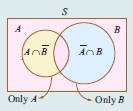
Let be the event of speaks the truth, be the event of speaks the truth
∴ \(\bar { A } \) is the event of X not speaking the truth and \(\bar { B } \) is the event of Y not speaking the truth.
Let C be the event that they will contradict each other.
Given that
P(A) = 0.70 ⇒ P(\(\bar { A } \)) = 1 - P(A) = 0.30
P(B) = 0.90 ⇒ P(\(\bar { B } \)) = 1 - P(B) = 0.10
C = (A speaks truth and B does not speak truth or B speaks truth and A does not speak truth)
C =\(\left[ (A\cap \bar { B } )\cup (\bar { A } \cap B) \right] \) (see figure)
since \((A\cap \bar { B } )\) and \((\bar { A } \cap B)\) are mutually exclusively,
P(C) = \((A\cap \bar { B } )+(\bar { A } \cap B)\)
= P(A)P(\(\bar { B } \)) + P(\(\bar { A } \))P(B)
( Since A, B are independent event A, \(\bar { B } \) are also independent events
= (0.70) (0.10) + (0.30) (0.90)
= 0.070 + 0.270 = 0.34
P(C) = 0.34
4.
Let A1, A2 and A3 be the event of A, B, C becoming managers of the company respectively. Let X be the event that the office canteen will be improved.
Then, \(P\left(A_1\right)=\frac{5}{10}=0.5 \)
\(P\left(A_2\right)=\frac{3}{10}=0.3 \)
\(P\left(A_3\right)=\frac{2}{10}=0.2 \)
\(P\left(X / A_1\right)=0.4 \)
\(P\left(X / A_2\right)=0.5\)
\(P\left(X / A_3\right)=0.3\)
\(P\left(A_2 / X\right)=\frac{P\left(A_2\right) P\left(X / A_2\right)}{P\left(A_1\right) P\left(X / A_1\right)+P\left(A_2\right) P\left(X / A_2\right)}+P\left(A_3\right) P\left(X / A_3\right)\)
\(=\frac{0.3(0.5)}{0.5(0.4)+0.3(0.5)+0.2(0.3)} \)
\(=\frac{0.15}{0.2+0.15+0.06} \)
\(=\frac{0.15}{0.41}=\frac{15}{41}\)
5.
Let A1 be the event of selecting balls from urn I and A2 be the event of selecting urn II.
Let B be the event of a black ball is drawn from it.
Then we have \(P\left(A_1\right)=P\left(A_2\right)=\frac{1}{2}\)
\(P\left(B / A_1\right)=\frac{6 C_1}{10 C_1} ; P\left(B / A_2\right)=\frac{2 C_1}{1 C_1}\)
\(\text {(i) } P(B)=P\left(A_1\right) \cdot P\left(B / A_1\right)+P\left(A_2\right): P\left(B / A_2\right)\)
\(=\frac{1}{2} \cdot \frac{6 C_1}{10 C_1}+\frac{1}{2} \cdot \frac{2 C_1}{4 C_1} \)
\(=\frac{1}{2}\left[\frac{6}{10}+\frac{2}{4}\right]=\frac{1}{2}\left[\frac{3}{5}+\frac{1}{2}\right]=\frac{1}{2}\left[\frac{6+5}{10}\right]\)
\(=\frac{11}{20} \)
(ii) P(I/B)
\(=\frac{P(B/I)P(I)}{P(B)}\)
\(=\frac{\frac{6}{10}\times \frac{1}{2}}{\frac{11}{20}}=\frac{6}{20}/\frac{11}{20}=\frac{6}{11}\)
6.
Let I = \(\int{2x+3\over \sqrt{x^2+x+1}}dx\)
\(2x+3=A{d\over dx}(x^2+x+1)+B\)
\(2x+3=A(2x+1)+B\)
Comparing the coefficients of like terms, we get
2A = 2 \(\Rightarrow \ A=1; A+B=3 \Rightarrow B=2\)
I =\(\int{(2x+1)+2\over \sqrt{x^2+x+1}}dx\)
I = \(\int{2x+1\over \sqrt{x^2+x+1}}dx+2\int{1\over \sqrt{x^2+x+1}}dx\)
\(=2\sqrt{x^2+x+1}+2\int{1\over \sqrt{(x+{1\over 2})^2}+({\sqrt{3}\over2})^2}dx\)
\(=2\sqrt{x^2+x+1}+2log|x+{1\over2}+\sqrt{(x+{1\over2})^2+({\sqrt{3}\over2})^2}|+c\)
Therefore, I = \(2\sqrt{x^2+x+1}+2log|x+{1\over2}+\sqrt{x^2+x+1}|+c\)
7.
Let I = \(\int{3x+5\over x^2+4x+7}dx\)
3x + 5 = A\({d\over dx}(x^2+4x+7)+B\)
3x + 5 = A(2x+4)+ B
Comparing the coefficients of like terms, we get
2A = 3\(\Rightarrow\)A = \({3\over2};4A+B=5\Rightarrow B=-1\)
\(I=\int{{3\over2}(2x+4)-1\over x^2+4x+7}dx\)
\(I={3\over2}\int{2x+4\over x^2+4x+7}dx-\int {1\over x^2+4x+7}dx\)
\(={3\over2}log|x^2+4x+7|-\int {1\over (x+2)^2+(\sqrt{3})^2}dx\)
\(={3\over2}log|x^2+4x+7|-{1\over \sqrt{3}tan^{-1}}({x+2\over \sqrt{3}})+c\)
8.
Let I =\(\int tan^{-1}({2x\over 1-x^2})dx\)
Putting x = \(tan \theta \Rightarrow dx=sec^2 \theta d \theta\)
Therefore, \(I=\int tan^{-1}({{2tan \theta}\over 1-tan^2 \theta})sec^2 \theta d\theta\)
\(=\int tan^{-1}(tan 2\theta)sec^2\theta d \theta\)
\(=\int 2\theta sec^2\theta d \theta\)
\(=2\int (\theta )(sec^2\theta d \theta)\)

Applying integration by parts
I = 2[\(\theta tan \theta- \int tan \theta d \theta\)] \(tan \theta =x\)
= 2\((\theta tan \theta- log|sec \theta | )+c\) \(sec \theta =\sqrt{1+x^2}\)
\(\int tan^{-1}({2x\over 1-x^2})dx=2x tan ^{-1}x-2log|\sqrt{1+x^2}|+c\)
9.
The rate of change of height h with respect to time t is the derivative of h with respect to t.
Therefore,\({dh\over dt}={18\over \sqrt{t}}=18t^{-{1\over2}}\)
So, to get a general expression for the height, integrating the above equation with respect to t.
\(h=\int {18t^{-{1\over 2}}}dt=18(2t^{1\over2})+c=36\sqrt{t}+c\)
Given that when t = 0, the height h = 5 cm.
\(5=0+c \Rightarrow c=5\)
\(h=36\sqrt{t}+5\).
(i) To find the height of the tree after 4 years.
When t = 4 years,
\(h=36\sqrt{t}+5\Rightarrow h=36\sqrt{4}+5=77\)
The height of the tree after 4 years is 77 cm .
(ii) When h = 149 cm
\(h=36 \sqrt{t}+5 \Rightarrow 149=36 \sqrt{t}+5\)
\(\sqrt{t}=\frac{149-5}{36}=4 \Rightarrow t=16\)
Thus after 16 years the height of the tree will be 149 cm.
10.
Given \(y_1=\frac{\sin ^{-1} x}{\sqrt{1-x^2}} .....(1)\)
\(\sqrt{1-x^2} y=\left(\sin ^{-1} x\right)\)
Squaring on both sides, (1 - x2) y2 = (sin-1 x)2
Differentiate W.R.T x
\(\left(1-x^2\right)\left(2 y y_1\right)+y^2(-2 x)=2 \sin ^{-1} x \frac{1}{\sqrt{1-x^2}}\) (using (1))
\(\left(1-x^2\right)\left(2 y y_1\right)-2 x y^2=2 y\)
The above equation divided by 2y.
(1 - x2) y1 - ay = 1.
Diffrentiate W. R. To x
\(
\left(1-x^2\right) y_2+y_1(-2 x)-x y_1-y(1)=0 \)
\(\left(1-x^2\right) y_2-2 x y_1-x y_1-y=0 \)
\(\left(1-x^2\right) y_2-3 x y_1-y=0\)
Hence proved.
11.
We have x4 + y4 = 16.
Differentiating implicitly, 4x3 +4y3y' = 0
Solving for y' gives
\(y'=-{x^3\over y^3}\)
To find y'' we differentiate this expression for y' using the quotient rule and remembering that y is a function of x.
\( y^{\prime \prime}=\frac{d}{d x}\left(\frac{-x^3}{y^3}\right) =\frac{-\left[y^3 \frac{d}{d x}\left(x^3\right)-x^3 \frac{d}{d x}\left(y^3\right)\right]}{\left.\left(y^3\right)^2\right]} \\ \)
\(=-\frac{\left[y^3 \cdot 3 x^2-x^3\left(3 y^2 y^{\prime}\right)\right]}{y^6} \)
\( =-\frac{3 x^2 y^3-3 x^3 y^2\left(-\frac{x^3}{y^3}\right)}{y^6} \)
\( =-\frac{3\left(x^2 y^4+x^6\right)}{y^7}=\frac{-3 x^2\left[x^4+y^4\right]}{y^7} \)
\( = \frac{-3 x^2(16)}{y^7}=\frac{-48 x^2}{y^7} . \)
12.
Given \(f(x)={x^3+64\over x+4}\)
The given function does not exist at x = - 4.
Hence, f(x) has a removable discontinuity at x = -4
\(lim_{x\rightarrow -4}f(x)=lim_{x\rightarrow -4}{x^3+64\over x+4}\)
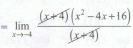
\(=lim_{x\rightarrow -4}\) x2-4x+16 = (-4)2-4(-4)+ 16 = 16+ 16+ 16
=48
\(\therefore\) The continuous function g(x) can be written as
g(x) = {\(\begin{matrix} \frac { { x }^{ 3 }+64 }{ x+4 } & if\ x\ \neq -4 \\ 48 & if\ x=-4 \end{matrix}\)
13.
Given \(f(x)= \begin{cases}\frac{x^{4}-1}{x-1}, & \text { if } x \neq 1 \\ \alpha, & \text { if } x=1\end{cases}\)
\(lim_{x\rightarrow 1^-}f(x)=lim_{x\rightarrow 1^-}{x^4-1\over x-1}=lim_{x\rightarrow1^-}{(x^2+1)(x^2-1)\over (x-1)}\)
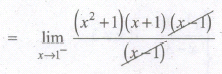
\(=lim_{x\rightarrow1^-}(x^2+1)(x+1)=(2)(2)=4\)
\(lim_{x\rightarrow 1^+}f(x)=lim_{x\rightarrow 1^+}{x^4-1\over x-1}=lim_{x\rightarrow1^+}{(x^2+1)(x+1)}=4\)
\(\therefore lim_{x\rightarrow 1^-}f(x)=lim_{x\rightarrow 1^+}f(x)=4\)
Since f(x) is continuous at x = 1, one sided limits = value of the function.
\(\Rightarrow \therefore f(1)=\alpha=4\)
\(\alpha =4\)
14.
Let f(x) = \(\begin{cases}\frac{x^{3}-1}{x-1}, & \text { if } x \neq 1 \\ 3, & \text { if } x=1\end{cases}\)
\(lim_{x\rightarrow 1^-}f(x)=lim_{x-1^-}{(x-1)(x^2+x+1)\over x-1}=lim_{x\rightarrow 1^-}x^2+x+1=3\)
\(lim_{x\rightarrow 1^+}f(x)=lim_{x\rightarrow 1^+}x^2+x+1=3\)
and f(1) = 3
\(lim_{x\rightarrow 1^-}f(x)=lim_{x\rightarrow 1^+}f(x)=f(1)=3\)
\(\therefore f(x)\) is continuous on \((-\infty,\infty)\)
15.
\(f(x)=\frac{x\lfloor x\rfloor}{\sin |x|} = \begin{cases}\frac{-x}{\sin (-x)} & \text { if }-1<x<0 \\
\frac{x \cdot 0}{\sin x} & \text { if } 0<x<1\end{cases} \)
\(= \begin{cases}\frac{x}{\sin x} & \text { if }-1<x<0 \\
0 & \text { if } 0<x<1\end{cases}
\)
Therefore, \(lim_{x\rightarrow 0^-}f(x)=+1\)
\(lim_{x\rightarrow 0^+}f(x)=0\).
Hence the limit does not exist.
16.
\(\lim _{v \rightarrow c^{-}}(m)=\lim _{v \rightarrow c^{-}} \frac{m_0}{\sqrt{1-\frac{v^2}{c^2}}}=\frac{m_0}{\sqrt{\lim _{v \rightarrow c^{-}}\left(1-\frac{v^2}{c^2}\right)}}\)
For h > 0, c- h < v < c . This implies,(c-h)2 \(<v^2<c^2\)
That is, \(\frac{(c-h)^2}{c^2}<\frac{v^2}{c^2}<1\)
That is, \(\lim _{h \rightarrow 0} \frac{(c-h)^2}{c^2}<\lim _{h \rightarrow 0} \frac{v^2}{c^2}<\lim _{h \rightarrow 0} 1\)
That is, \(1<\lim _{h \rightarrow 0} \frac{v^2}{c^2}<1\)
That is \(1<\lim _{v \rightarrow c^{-}} \frac{v^2}{c^2}<1\). By Sandwich theorem, \(lim_{v\rightarrow c^-}=1.\)
Therefore, \(lim_{v-c^-}(m)\rightarrow \infty.\)
That is, the mass becomes very very large (infinite) as \(v\rightarrow c^-.\)
The left hand limit is necessary.
Otherwise as\(v \rightarrow c^+\) makes \(1-{v^2\over c^2}<0\) and consequently we cannot find the mass.
17.
\(lim_{x\rightarrow2}{2-\sqrt{x+2}\over 3\sqrt{2}-3\sqrt{4-x}}\)\(=lim_{x\rightarrow2}{\sqrt{x+2}-2\over 3\sqrt{4-x}-3\sqrt{2}}=lim_{x\rightarrow2} {(x+2)^{1/2}-(2^2)^{1/2}\over (4-x)^{1/3}-(2)^{1/3}}\)
Multiplying and dividing by (x - 2) we get,
\(=lim_{x\rightarrow2} {(x+2)^{1/2}-(4)^{1/2}\over x-2}\times {x-2\over (4-x)^{1/3}-2^{1/3}}\)
\(=lim_{x\rightarrow2} {(x+2)^{1/2}-(4)^{1/2}\over x+2-4}\times {-(2-x)\over (4-x)^{1/3}-2^{1/3}}\)
\(=[lim_{x\rightarrow2+4} {(x+2)^{1/2}-(4)^{1/2}\over x+2-4}]\times [{-1\over lim_{x\rightarrow2} {(4-x)^{1/3}-2^{1/3}\over 4-x-2}}]\)
\(={1\over2}\times 4^{{1\over2}-1}\times [{-1\over {1\over3}\times 2^{{1\over3}-1}}]\)\(=-{1\over2}(4^{-1\over2})\times {1\over {1\over3}2^{-2\over3}}\)
\(=-{1\over2}\times 4^{{1\over2}-1}\times [{-1\over {1\over3}\times 2^{{1\over3}-1}}]=-{1\over2}(4^{-1/2})\times {1\over {1\over3}2^{-2\over3}}\)
\(=-{1\over2}\times {3\over1}\times {1\over \sqrt{4}}\times 2^{2/3}={-3\over4}\times (2^2)^{1/3}=-{3\over4}{\sqrt[3]{4}}\)
18.
\(|A|=\left|\begin{array}{ccc}
1 & 1 & 1 \\
x & y & z \\
x^2 & y^2 & z^2
\end{array}\right|\)
Put x = Y
\(|A|=\left|\begin{array}{ccc}
1 & 1 & 1 \\
y & y & z \\
y^2 & y^2 & z^2
\end{array}\right|=0 \quad\left(C_1 \cong C_2\right)\)
\(\therefore(x-y) \text { is a factor of }|A|\)
The given determinant is in cyclic symmetric form in x, y and z.
\(\therefore\) (y - 2) and (z - x) are also factors.
The degree of the product of the factors (x - y)y - z)(z - x) is 3 and the degree of the product of the leading diagonal elements 1 - y , z2 = 3
The other factor is k
\(\therefore\left|\begin{array}{ccc}
1 & 1 & 1 \\
x & y & z \\
x^2 & y^2 & z^2
\end{array}\right|=k(x-y)(y-z)(z-x)\)
Put x = 1, y = -1, z = 0
\(\left|\begin{array}{ccc}
1 & 1 & 1 \\
1 & -1 & 0 \\
1 & 1 & 0
\end{array}\right|=k(2)(-1)(-1)\)
1(1 + 1) = 2k
2 = 2k
k = 1
Put in (1)
\(|A|=(x-y)(y-z)(z-x)\)
Hence proved.
19.
Taking p = 0, we get | A | = \(\begin{vmatrix} (q+r)^2& 0&0 \\ q^2 & r^2 & q^2 \\ r^2 &r^2 & q^2 \end{vmatrix}=0\)
Therefore, (p - 0) is a factor. That is, p is a factor.
Since | A | is in cyclic symmetric form in p, q, r and hence q and r also factors.
Putting p + q + r = 0 \(\Rightarrow\) q + r = - p ; r + p = - q ; and p + q = - r.
| A | = \(\begin{vmatrix} p^2& p^2&p^2 \\ q^2 & q^2 & q^2 \\ r^2 &r^2 & r^2 \end{vmatrix}=0\) since 3 columns are identical.
Therefore, (p + q + r)2 is a factor of | A | .
The degree of the obtained factor pqr (p + q + r)2 is 5. The degree of | A | is 6.
Therefore, required factor is k (p + q + r).
\(\begin{vmatrix} (q+r)^2& p^2 &p^2 \\ q^2 & (r+p)^2 & q^2 \\ r^2 &r^2 & (p+q)^2 \end{vmatrix}\) = k(p + q + r) (p + q + r)2 x pqr
Taking p = 1, q = 1, c = 1, we get
\(\begin{vmatrix} 4 &1 &1 \\ 1 & 4 &1 \\ 1 & 1 & 4 \end{vmatrix}\) = k(1 +1 + 1)3 (1) (1) (1).
4(16 - 1) - 1(4 - 1) + 1(1 - 4) = 27k
60 - 3 - 3 = 27 k \(\Rightarrow\) k = 2.
| A | = 2pqr (p + q + r)3.
20.
Given f(x) = \(\begin{bmatrix} cos \ x & -sin \ x & 0 \\ sin x & cos x & 0 \\ 0 & 0 & 1 \end{bmatrix}\)
f(x) \(\times\) f(y) = \(\begin{bmatrix} cos \ x & -sin \ x & 0 \\ sin x & cos x & 0 \\ 0 & 0 & 1 \end{bmatrix}\)\(\left[ \begin{matrix} cosy & -siny & 0 \\ siny & cosy & 0 \\ 0 & 0 & 1 \end{matrix} \right] \)
= \(\left[ \begin{matrix} cosxcosy-sinxcosy & -cosxsiny-sinxcosy & 0 \\ sin \ x cos \ y+cos \ xsin \ y & -sin \ x \ sin \ y+cos \ x \ cos \ y & 0 \\ 0 & 0 & 1 \end{matrix} \right] \)
= \(\left[ \begin{matrix} cos(x+y) & -sin(x+y) & 0 \\ sin(x+y) & cos(x+y) & 0 \\ 0 & 0 & 1 \end{matrix} \right] \)
[\(\therefore\)cos(x + y) = cos x cos y - sin x sin y]
sin(x + y) = sin x cos y + cos x sin y]
= f(x + y)
21.
Let I be the event of getting State Government service and C be the event of getting Central Government job.
Given that P(I) = 0.12, P(C) = 0.25, and \(P(I \cap C)\) = 0.07
(i) P( at least one of the two jobs) \(=P(I \text { or } C)=P(I \cup C)\)
\(=P(I)+P(C)-P(I \cap C) \)
\(=0.12+0.25-0.07=0.30\)
(ii) P(only one of the two jobs) = P [only I or only C]
=\(P\left( I\cap \overline { C } \right) +P\left( \overline { I } \cup C \right) \)
\(=\{0.12-0.07\}+\{0.25-0.07\}\)
\(=0.23 \)

22.
Let u = log x
Then eu = x and
\(\frac{d u}{d x}=\frac{1}{x}\)
\(\therefore \frac{d u}{d x}=\frac{1}{e^u}\)
\(\therefore e^u d u=d x\)
\(
\int \frac{\log x}{(1+\log x)^2} d x =\int \frac{u}{(1+u)^2} \times e^u d u\)
\(=\int e^u\left(\frac{(1+u)-1}{(1+u)^2}\right) d u \)
\(=\int e^u\left(\frac{1}{1+u}-\frac{1}{(1+u)^2}\right) d u \)
\(=e^u\left(\frac{1}{1+u}\right)+c
\)
Putting u = log x and eu = u
\(=x\left(\frac{1}{1+\log x}\right)+c \)
\(=\frac{x}{1+\log x}+c\)
23.
\(\int \frac{x \sin ^{-1} x}{\sqrt{1-x^2}} d x=\int \sin ^{-1} x \times \frac{x}{\sqrt{1-x^2}} d x \)
\(Let\ u=\sin ^{-1} x\)
Differentiating on both sides
\(\frac{d u}{d x}=\frac{1}{\sqrt{1-x^2}}\)
\(d u=\frac{1}{\sqrt{1-x^2}} d x \)
\(d v=\frac{x}{\sqrt{1-x^2}} \)
\(v=\int \frac{x}{\sqrt{1-x^2}} d x\)
Take \(t=\sqrt{1-x^2}\)
\( \mathrm{t}^2 =1-x^2\)
\(2 \mathrm{td} t =-2 x \mathrm{~d} x \)
\(\mathrm{tdt} =-x \mathrm{~d} x \)
\(x \mathrm{~d} x =-\mathrm{t} \mathrm{dt}\)
\( v =\int \frac{1-1 d }{1} \)
\(=-\int d=-1 \)
\(v =-\sqrt{1-x^2} \)
\(\therefore \int \frac{x \sin ^{-1} x}{\sqrt{1-x^2}} d x =\sin ^{-1} x\left(-\sqrt{1-x^2}\right)- \int\left(-\sqrt{1-x^2}\right) \times \frac{1}{\sqrt{1-x^2}} d x \ {\left[\because \int u d v=u v-\int v d u\right] } \)
\(=-\sqrt{1-x^2} \sin ^{-1} x+\int d x\)
\( =-\sqrt{1-x^2} \sin ^{-1} x+x+c\)
24.
Let x = tan \(\theta\)
Then \({1+x\over 1-x}={1+tan \theta \over 1- tan \theta}=tan({\pi\over 4}+\theta)\).
\(tan^{-1}({1+x\over 1-x})=tan^{-1}[tan({\pi\over 4}+\theta)]={\pi\over 4}+\theta={\pi\over 4}+tan^{-1}x\)
\(y={\pi\over 4}+tan^{-1}x\)
\(y'={1\over 1+x^2}\).
25.
\(\therefore\) f'(x) = \(\underset { x\rightarrow 0^{ - } }{ lim } \frac { f(x)-f(0) }{ x-0 } =\underset { x\rightarrow 0^{ - } }{ lim } \frac { 3x-0 }{ x } =\underset { x\rightarrow 0^{ - } }{ lim } \frac { 3x }{ x } = 3\) [f(x) = 3x] .....(1)
\(\therefore\) f'(0+) = \(\underset { x\rightarrow 0^{ - } }{ lim } \frac { f(x)-f(0) }{ x-0 } =\underset { x\rightarrow 0^{ - } }{ lim } \frac { -4x-0 }{ x } \)
= \(\underset { x\rightarrow 0^{ - } }{ lim } \frac { -4x }{ x } \) = -4 .........(2)
by (1) & (2), f'(0-) ≠ f'(0+)
\(\therefore\) It is not differentiable.

11th Standard Syllabus & Materials
11th Standard
TN 11th Tamil பீடு பெற நில் - செய்யுள் - காவடிச்சிந்து Important Questions And Answers Study Material - QB365 Set A
NEW11th Standard
TN 11th Tamil பீடு பெற நில் - உரைநடை - மலை இடப்பெயர்கள் : ஓர் ஆய்வு Important Questions And Answers Study Material - QB365 Set A
NEW11th Standard
TN 11th Tamil மாமழை போற்றுதும் - துணைப்பாடம் - யானை டாக்டர் Important Questions And Answers Study Material - QB365 Set A
NEW11th Standard
TN 11th Tamil மாமழை போற்றுதும் - செய்யுள் - ஐங்குறுநூறு Important Questions And Answers Study Material - QB365 Set A



Tamilnadu Stateboard 11th Standard Subjects
Maths

Commerce

Economics

Biology

Business Maths and Statistics

Accountancy

Computer Science

Physics

Chemistry
Maths
Biology
Economics
Physics
Chemistry

History
Business Maths and Statistics

Computer Science
Accountancy

Computer Applications
History
Computer Technology
Commerce
Computer Applications
Computer Technology

Tamil

English

French
Tamilnadu Stateboard Standards



