
 100% FREE ACCESS
11th Standard Syllabus & Materials
11th Standard
TN 11th Tamil இயற்கை வேளாண்மை,சுற்றுச்சூழல் -செய்யுள் - மனோன்மணீயம் Important Questions And Answers Study Material - QB365 Set A
NEW11th Standard
TN 11th Tamil என்னுயிர் என்பேன் -துணைப்பாடம் - இசைத்தமிழர் இருவர் Important Questions And Answers Study Material - QB365 Set A
NEW11th Standard
TN 11th Tamil மொழி கலை -செய்யுள் - ஒவ்வொரு புல்லையும் Important Questions And Answers Study Material - QB365 Set A
NEW11th Standard
TN 11th Tamil பீடு பெற நில் - இலக்கணம் - பகுபத உறுப்புகள் Important Questions And Answers Study Material - QB365 Set A
NEW11th Standard
TN 11th Tamil பீடு பெற நில் - துணைப்பாடம் - வாடிவாசல் Important Questions And Answers Study Material - QB365 Set A
NEW11th Standard
TN 11th Tamil பீடு பெற நில் - செய்யுள் - குறுந்தொகை Important Questions And Answers Study Material - QB365 Set A

Published on: 13/05/2022
QB365 provides detailed and simple solution for every book back questions in class 11 Maths subject.It will helps to get more idea about question pattern in every book back questions with solution.
latest Book back QuestionsDownload Tamil Nadu 11th Standard Maths question papers, model tests, one-mark questions, important questions, and public exam papers in PDF format. Free study materials and answer keys for TN State Board students.
Questions + Answers key
Take MCQ Maths Test1.
8 women and 6 men are standing in a line.
(i) How many arrangements are possible if any individual can stand in any position?
(ii) In how many arrangements will all 6 men be standing next to one another?
(iii) In how many arrangements will no two men be standing next to one another?
2.
Using the mathematical induction, show that for any natural number n
\({1\over 2.5}+{1\over 5.8}+{1\over 8.11}+...+{1\over (3n-1)(3n+2)}={n\over 6n+4}\)
3.
Using the mathematical induction, show that for any natural number n > 2
\({1\over 1+2}+{1\over 1+2+3}+{1\over 1+2+3+4}+...+{1\over 1+2+3..+n}={n-1\over n+1}\)
4.
5.
How many strings can be formed using the letters of the word LOTUS if the word
(i) either starts with L or ends with S?
(ii) neither starts with L nor ends with S?
6.
To travel from a place A to place B, there are two different bus routes B1, B2, two different train routes T1, T2 and one air route A1. From place B to place C there is one bus route say B'1, two different train routes say T'1, T'2 and one air route A'1. Find the number of routes of commuting from place A to place C via place B without using similar mode of transportation.
7.
Count the numbers between 999 and 10000 subject to the condition that there are
(i) no restriction.
(ii) no digit is repeated.
(iii) at least one of the digits is repeated.
8.
How many three-digit odd numbers can be formed using the digits 0, 1, 2, 3, 4, 5? if
The repetition of digits is allowed
9.
How many three-digit odd numbers can be formed using the digits 0, 1, 2, 3, 4, 5? if
The Repetition of digits is not allowed
10.
How many numbers are there between 100 and 500 with the digits 0, 1, 2, 3, 4, 5 ? if
(i) repetition of digits allowed
(ii) the repetition of digits is not allowed.
1.
(i) Since any individual can stand in any position, 8 women and 6 men can be arrange in 14P14 = 14! ways
(ii) Considering 6 men as one unit, we have 9 people and they can be arranged in 9! ways. These 6 men can arrange among themselves in 6! ways.
∴ Total number of arrangement = \(9!\times 6!\)
(iii) 8 women can be arranged in a 8 places in 8! ways
\(\times \boxed { W } \times \boxed { W } \times \boxed { W } \times \boxed { W } \times \boxed { W } \times \boxed { W } \times \boxed { W } \times \boxed { W } \)
There are 9 (marked) places for 6 men
They can be arranged in 9P6 ways
∴ Total number of ways \(9{ P }_{ 6 }\times 8!\)
2.
Let p(n) be the statement
\({1\over 2.5}+{1\over 5.8}+{1\over 8.11}+...+{1\over {(3n-1)(3n+2)}}={n\over 6n+4}\)
Step 1: Putting n = 1, we get
\({1\over 2.5}={1\over 6(1)+4}⇒{1\over 10}={1\over 10}\)
∵ p(1) is true
Step 2: Let us assume that p(K) is true
\(∵\ {1\over 2.5}+{1\over 5.8}+...+{1\over (3K-1)(3K+2)}={K\over 6K+4}\)
Step. 3: To show that p(K + 1) is true
ie to P.T \({1\over 2.5+}+{1\over 5.8}+...+{1\over{(3K-1)(3K+2)}}={K\over 6+4}\)
ie to P.T \({1\over 2.5}+{1\over 5.8}+...+{1\over (3K-1)(3K+2)}+{1\over (3K+2)(3K+5)}={K+1\over 6K+10}\)
LHS = \({1\over 2.5}+{1\over 5.8}+...+{1\over (3k-1)(3k+2)}+{1\over (3k+2)(3k+5)}\)
\(={k\over 6k+4}+{1\over 5.8}+...+{1\over (3k-1)(3k+2)}+{1\over (3K+2)(3k+5)}\)
\(={k\over 6k+4}+{1\over (3k+2)(3k+5)}\) [using (1)]
\(={k\over 2(3k+2)}+{1\over (3k+2)(3k+5)}\)
\(={1\over 3k+2}\left[{k\over 2}+{1\over 3k+5}\right]\)
\(={1\over 3k+2}\left[k(3k+5)+2\over 2(3k+5)\right]={1\over 3k+2}\left[3k^2+5k+2\over 2(3k+5)\right]\)
\(={1\over 2(3k+5)(3k+5)}(k+1)(3k+2)\)
\(={k+1\over 2(3k+5)}={k+1\over 6k+10}=RHS\)
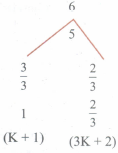
∴ p (k + 1) is line.
Hence, by the principle mathematical induction p(n) is true for all values of n.
3.
Adding 1 both sides to the given statement
p(n): \(1+{1\over 1+2}+{1\over 1+2+3}+..+{1\over 1+2+3+.+n}=1+{n-1\over n+1}={n+1+n-1\over n+1}={2n\over n+1}\)
Step 1:
Putting n = 2
\(1+{1\over 1+2}={2(2)\over 2+1}⇒1+{1\over 3}={4\over 3}⇒{4\over3}={4\over 3}\)
∵ p(1) is true
Step 2:
Let us assume that p(K) is true
\(∵\ 1+{1\over 1+2}+...+{1\over 1+2+3+...+K}={2K\over K+1}\)
Step 3:
To prove that p(K+1) is true
ie \(1+{1\over 2}+...+{1\over 1+2+3+K}+{1\over 1+2+...+K+1}={2(K+1)\over K+2}\)
LHS = \(1+{1\over 1+2}+...+{1\over 1+2+3+...+K}+{1\over 1+2+...+(K+1)}\)
\(={2K\over K+1}+{1\over 1+2+3+..+(K+1)}\) [using (1)]
\(={2K\over K+1}+{1\over {(K+1)(K+2)\over2}}\) \(\left[ ∵\ \sum n={n(n+1)\over2} \right]\)
\(={2K\over K+1}+{2\over (K+1)(K+2)}={2\over K+1}\left[ K+{1\over K+2}\right]={2\over K+1}\left(K^2+2K+1\over K+2\right)\)
\(={2(K+1)^2\over (K+1)(K+2)}={2(K+1)\over K+2}=RHS\)
∵ p(K+1) is true
Hence, by mathematical induction, p(n) is true for all values of n
4.
5.
(i) Either starts with L or ends with S.
| 1 | 4 | 3 | 2 | 1 |
| L |
Since the words starts with L, the remaining 4 boxes can be filled in 4 x 3 x 2 x 1 ways by the remaining letters 0, T, U, S.
∴ Number of words starting with L
= 1 \(\times\) 4 \(\times\) 3 \(\times\) 2 \(\times\) 1 = 24.
| 1 | 2 | 3 | 4 | 1 |
| S |
Here also, the remaining 4 boxes can be filled in 4 \(\times\) 3 \(\times\) 2 \(\times\) 1 ways = 24.......(1)
Number of words ending with S = 24 ....(2)
Number of words starting with L and end with S are 3 \(\times\) 2 \(\times\) 1 = 6...(3)
∴ By fundamental principle of addition, number of words either starts with L nor ends with S = 24 + 24 - 6 = 48 - 6 = 42
| 3 | 2 | 1 | ||
| F | S |
(ii) Neither starts with L nor ends with S.
Total number of words formed by the letters of the word LOTUS is 5 \(\times\) 4 \(\times\) 3 \(\times\) 2\(\times\) 1 = 120.
Now, number of words neither starts with L nor end with S.
= (Total number of words) - (Number of words starts with either L nor ends with S)
= 120 - 42
= 78.
6.
The given data can be converted as a route map diagram as follows:
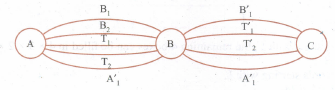
The possible choices for number of routes commuting from A to place C via place b, without using similar mode of transportation are
( B1, T'1) ( B2, T'2 ) ( B1, A1 ) ( B2, T'1 ) ( B2, T'2 ) ( B2, A'1 ) ( T1, A'1 ) ( T2, B'1 ) ( T2, A'1 ) ( A1, B'1 ) ( A1, T'1 ) and ( A2, T'2 )
Required number of routes of commuting from place A to place C via place 'B'
\(=(2 \times 3)+(2 \times 2)+(1 \times 3)\)
= 6+4 + 0 = 7
Required number of routes = 20 - 7 = 13
7.
(i) No restriction.
Given digits are 0, 1, 2, 3, 4, 5, 6, 7, 8, 9.
Since we need numbers between 999 and 10000, it has only 4 digits.
| thousands | hundreds | tens | ones |
| 9 | 10 | 10 | 10 |
Thousands place can be filled in 9 ways (excluding 0) since there is no restriction, hundreds, place, tens place and unit place can be filled in 10 ways each using all the digits.
∴ By fundamental principle of multiplication, 9 required number of 4 - digit numbers.
= 9 \(\times\) 10 \(\times\) 10 \(\times\) 10
= 9000.
(ii) No digit is repeated.
| thousands | hundreds | tens | ones |
| 9 | 10 | 10 | 10 |
Thousands place can be filled in 9 ways (excluding 0)
Since repetition is not allowed, unit place can be filled in 9 ways tens place can be filled in 8 ways and hundreds place can be filled in 7 ways.
∴ By fundamental principle of multiplication, required number of 4 digit numbers
= 9 \(\times\) 7 \(\times\) 8 \(\times\) 9
= 4536.
(iii) At least one of the digits is repeated.
Required number of numbers = Total number of 4 digit numbers - number of 4 digit numbers when no digit is repeated
= 900 - 4536 = 4464
8.
The repetition of digits is allowed
| Hundreds | tens | unit |
| 5 | 6 | 3 |
The unit place can be filled in 3 ways using the digits 1, 3, or 5 since we need 3 digit odd numeric Hundreds place can be filled in 5 ways excluding 0 and repetition of digits is allowed.
Tens place can be filled in 6 ways .
∴ By fundamental principle of multiplication, required number of 3 = digit odd numbers
= 5 \(\times\) 6 \(\times\) 3 = 30 \(\times\) 3 = 90.
9.
The Repetition of digits is not allowed
| Hundreds | tens | unit |
| 4 | 4 | 3 |
Since we need 3 - digit odd numbers, the unit place can be filled in 3 ways using the digits 1, 3 or 5.
Hundred's place can be filled in 4 ways (excluding 0 and the number used for one's place) since repetition is not allowed.
Ten's place can be filled 4 ways including 0.
∴ By fundamental principle of multiplication, number of required 3 = digit odd numbers
= 4 \(\times\) 4 \(\times\) 3 = 48
10.
(i) Repetition of digit is allowed
| 4 | 6 | 6 |
Since we are going to find numbers between 100 and 500 it has 3 = digits
The unit place can be filled in 6 ways using the digits 0, 1, 2, 3, 4, 5
The tens place also can be filled in 6 ways since repetition of digits is allowed.
The hundreds place can be filled in 4 ways using the digits 1, 2, 3, 4 [excluding 0 and 5]
∴ By fundamental principle of multiplication, required number of 3 - digit numbers = 4 \(\times\) 6 \(\times\) 6 = 144.
(ii) Repetition of digits is not allowed.
| 4 | 5 | 4 |
Hundreds place can be filled in 4 ways excluding 0 and 5
Tens place can be filled in 5 ways since repetition of digits is not allowed
Unit place can be filled in 4 ways.
∴ By fundamental principle of multiplication, required number of three-digit numbers = 4 \(\times\) 5 \(\times\) 4 = 80.

11th Standard Syllabus & Materials
11th Standard
TN 11th Tamil பீடு பெற நில் - செய்யுள் - காவடிச்சிந்து Important Questions And Answers Study Material - QB365 Set A
NEW11th Standard
TN 11th Tamil பீடு பெற நில் - உரைநடை - மலை இடப்பெயர்கள் : ஓர் ஆய்வு Important Questions And Answers Study Material - QB365 Set A
NEW11th Standard
TN 11th Tamil மாமழை போற்றுதும் - துணைப்பாடம் - யானை டாக்டர் Important Questions And Answers Study Material - QB365 Set A
NEW11th Standard
TN 11th Tamil மாமழை போற்றுதும் - செய்யுள் - ஐங்குறுநூறு Important Questions And Answers Study Material - QB365 Set A



Tamilnadu Stateboard 11th Standard Subjects
Maths

Commerce

Economics

Biology

Business Maths and Statistics

Accountancy

Computer Science

Physics

Chemistry
Maths
Biology
Economics
Physics
Chemistry

History
Business Maths and Statistics

Computer Science
Accountancy

Computer Applications
History
Computer Technology
Commerce
Computer Applications
Computer Technology

Tamil

English

French
Tamilnadu Stateboard Standards



