
 100% FREE ACCESS
11th Standard Syllabus & Materials
11th Standard
TN 11th Tamil இயற்கை வேளாண்மை,சுற்றுச்சூழல் -செய்யுள் - மனோன்மணீயம் Important Questions And Answers Study Material - QB365 Set A
NEW11th Standard
TN 11th Tamil என்னுயிர் என்பேன் -துணைப்பாடம் - இசைத்தமிழர் இருவர் Important Questions And Answers Study Material - QB365 Set A
NEW11th Standard
TN 11th Tamil மொழி கலை -செய்யுள் - ஒவ்வொரு புல்லையும் Important Questions And Answers Study Material - QB365 Set A
NEW11th Standard
TN 11th Tamil பீடு பெற நில் - இலக்கணம் - பகுபத உறுப்புகள் Important Questions And Answers Study Material - QB365 Set A
NEW11th Standard
TN 11th Tamil பீடு பெற நில் - துணைப்பாடம் - வாடிவாசல் Important Questions And Answers Study Material - QB365 Set A
NEW11th Standard
TN 11th Tamil பீடு பெற நில் - செய்யுள் - குறுந்தொகை Important Questions And Answers Study Material - QB365 Set A

Published on: 25/06/2021
QB365 provides detailed and simple solution for every Creative Questions in class 11 Maths Subject. It will helps to get more idea about question pattern in every Creative questions with solution.
Download Tamil Nadu 11th Standard Maths question papers, model tests, one-mark questions, important questions, and public exam papers in PDF format. Free study materials and answer keys for TN State Board students.
Questions + Answers key
Take MCQ Maths Test1.
Prove that \(\left| \begin{matrix} 1 & 1 & 1 \\ 1 & 1+x & 1 \\ 1 & 1 & 1+y \end{matrix} \right| =xy\)
2.
Transform the equation 3x + 4y + 12 = 0 in to normal form.
3.
Solve: (x - 2)(x + 3)2< 0
4.
Find the domain and range of the real valued function f(x) = \(\frac{5-x}{x-5}\).
5.
Show that the function is \(f\left( x \right) =\begin{cases} \frac { \sin { x } }{ x } +\cos { x,\quad x\neq 0 } \\ 2,\quad \quad \quad x=0 \end{cases}\) continuous at x =0.
6.
\(If\lim _{ x\rightarrow 2 }{ \frac { { x }^{ n }-{ 2 }^{ n } }{ x-2 } } =80\quad and\quad n\in N,\quad find\quad n.\)
7.
Evaluate\(\lim _{ x\rightarrow 0 }{ \frac { { x }^{ \frac { 2 }{ 3 } }-9 }{ x-27 } } \)
8.
Prove that \(\left| \begin{matrix} 1 & 1+p & 1+p+q \\ 2 & 3+2p & 4+4p+2q \\ 3 & 6+3p & 10+6p+3q \end{matrix} \right| =1\)
9.
Solve\(\left[ \begin{matrix} { x }^{ 2 } \\ { y }^{ 2 } \end{matrix} \right] -3\left[ \begin{matrix} x \\ 2y \end{matrix} \right] =\left[ \begin{matrix} -2 \\ 9 \end{matrix} \right] \)
10.
Find the domain and range of the function f(x) = \(\frac { { x }^{ 2 }-9 }{ x-3 } \).
11.
If \(f(x)=\frac { x-1 }{ x+1 } \), then show that \(f\left( \frac { 1 }{ x } \right) =-f(x)\)
12.
Let P denote the set of all straight lines in a plane. Let R be the relation defined on P as lR m if I is parallel to m
13.
Let S = {1, 2, 3,....,10}. Define 'm is related to n' if m divides n.
14.
If 5Pr = 7Pr-1 find r.
15.
Solve \(\frac{1}{|3x-2|}<2\) and express using interval notching.
16.
Solve |3x - 4| = |x-2|
17.
Write down the series whose rth term is \(\frac{1}{3}r\). Is it an arithmetic series?
18.
Find the greatest term in (1 + 2x)8 when x = 2.
19.
Let p(n) be the statement "7 divides 23n-1" What is p(n+1) =?
20.
Prove that \(\frac { 1+sinx-cosx }{ 1+sinx+cosx } =tan\frac { x }{ 2 } \) .
21.
Prove that 2\(cos\left( \frac { \pi }{ 13 } \right) cos\left( \frac { 9\pi }{ 13 } \right) +cos\frac { 3\pi }{ 13 } +cos\frac { 5\pi }{ 13 } \) = 0
22.
Show that the function f : N➝N given by f(x) = 2x is one-one but not onto.
23.
Show that the relation R on the set A = {1, 2, 3} given by R = {(1, 1) (2, 2) (3, 3) (1, 2) (2, 3)} is reflexive but neither symmetric nor transitive.
24.
If A⊂B then find A⋂B and A\B (using venn diagram)
25.
Check whether the following sets are disjoint where p = {x : x is a prime < 15} and Q = {x : x is a multiple of 2 and x < 16}
1.
\(\left| \begin{matrix} 1 & 1 & 1 \\ 1 & 1+x & 1 \\ 1 & 1 & 1+y \end{matrix} \right| =\left| \begin{matrix} 1 & 1 & 1 \\ 0 & x & 0 \\ 0 & 0 & y \end{matrix} \right| \begin{matrix} { R }_{ 2 }\rightarrow { R }_{ 2 }-{ R }_{ 1 } \\ { R }_{ 3 }\rightarrow { R }_{ 3 }-{ R }_{ 1 } \end{matrix}\)
= xy [∵ upper diagonal matrix]
2.
4x - 3y + 1= 0; l ∈ R
3.
(x- 2) (x + 3)2 < 0 Critical numbers 2, - 3
We have three intervals (-\(\infty\), -3), (-3, 2), (2, \(\infty\))

| Interval | Sign of (x -2) | Sign of (x - 3)2 | Sign of (x-2)(x+3)2 |
|---|---|---|---|
| (-∞, 3) x = -5 | - | + | - |
| (-3,2)x = 0 | - | + | - |
| (2,∞)x = 3 | + | + | + |
The inequality is satisfied in the interval (∞, -3) and (-3, 2)
∴ Solution set is(∞, -3) ∪ (-3, 2)
4.
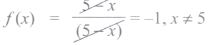
Domain = R-{5}
Range = {-1}
5.
Given f(0) =2
\(\lim _{ x\rightarrow 0 }{ f\left( x \right) } =\lim _{ x\rightarrow 0 }{ \left( \frac { \sin { x } }{ x } +\cos { x } \right) } =\lim _{ x\rightarrow 0 }{ \frac { \sin { x } }{ x } +\lim _{ x\rightarrow 0 }{ \cos { x } } } =1+1=2\)
\(\therefore \lim _{ x\rightarrow 0 }{ f\left( x \right) } =f\left( 0 \right) =2\)
\(\therefore f\left( x \right) is\quad continuous\quad at\quad x=2.\)
6.
\(Given,\quad \lim _{ x\rightarrow 2 }{ \frac { { x }^{ n }-{ 2 }^{ n } }{ x-2 } } =80\)
\( \Rightarrow n.{ 2 }^{ n-1 }=80\)
By trial method, put n 5
\(\Rightarrow 5({ 2 }^{ 5-1 })=80\)
\(\Rightarrow 5({ 2 }^{ 4 })=80\)
\( \Rightarrow 5(16)=80\)
\( \Rightarrow 80=80\)
\(\therefore n=5\)
7.
\(\lim _{ x\rightarrow 0 }{ \frac { { x }^{ \frac { 2 }{ 3 } }-9 }{ x-27 } } =\lim _{ x\rightarrow 0 }{ \frac { { x }^{ \frac { 2 }{ 3 } }-{ (27) }^{ \frac { 2 }{ 3 } } }{ x-27 } } =\frac { 2 }{ 3 } { (27) }^{ \frac { 2 }{ 3 } -1 }=\frac { 2 }{ 3 } { (27) }^{ \frac { -1 }{ 3 } }\)
\(=\frac { 2 }{ 3(27)^{ \frac { 1 }{ 3 } } } =\frac { 2 }{ 3({ 3 }^{ 3 })^{ \frac { 1 }{ 3 } } } =\frac { 2 }{ 3(3) } =\frac { 2 }{ 9 } \)
8.
Let \(\triangle =\left| \begin{matrix} 1 & 1+p & 1+p+q \\ 2 & 3+2p & 4+4p+2q \\ 3 & 6+3p & 10+6p+3q \end{matrix} \right| \)
Applying C2 ⟶ C2 - pC1 and C3 ⟶ C3 - qC1, we get
\(\triangle =\left| \begin{matrix} 1 & 1 & 1+p \\ 2 & 3 & 4+3p \\ 3 & 6 & 10+6p \end{matrix} \right| \)
Applying C3 ⟶ C3 - pC2, we get
= \(\left| \begin{matrix} 1 & 1 & 1 \\ 2 & 3 & 4 \\ 3 & 6 & 10 \end{matrix} \right| \)
Applying C2 ⟶ C2 - Cland C3 ⟶ C3 - C, we get,
\(\triangle =\left| \begin{matrix} 1 & 0 & 0 \\ 2 & 1 & 1 \\ 3 & 3 & 7 \end{matrix} \right| \)
Expanding along |Rl we get,
\(\triangle =1\left| \begin{matrix} 1 & 2 \\ 3 & 7 \end{matrix} \right| \)+ 0 + = 1(7-6) = 1
\(\therefore \triangle =1\)
9.
Given \(\left[ \begin{matrix} { x }^{ 2 } \\ { y }^{ 2 } \end{matrix} \right] -3\left[ \begin{matrix} x \\ 2y \end{matrix} \right] =\left[ \begin{matrix} -2 \\ 9 \end{matrix} \right] \)
\(\Rightarrow \left[ \begin{matrix} { x }^{ 2 } & 3x \\ { y }^{ 2 } & -6y \end{matrix} \right] =\left[ \begin{matrix} -2 \\ 9 \end{matrix} \right] \)
\(\Rightarrow\)x2-3x =-2 and y2-6y=9
\(\Rightarrow\)x2-3x+2 =0
\(\Rightarrow\)(x-1)(x-2) = 0
\(\Rightarrow\)x = 1,2
Also, y2-6y-9 = 0
y =\(\frac { 6\pm \sqrt { 36+36 } }{ 2 } =\frac { 6+6\sqrt { 2 } }{ 2 } =\frac { 3(3\pm 3\sqrt { 2 } ) }{ 2 } \)
y=3 \(\pm \) 3\(\sqrt { 2 } \)
x =1, 2 and y= 3\(\pm \)3\(\sqrt { 2 } \)
10.
We have f(x) = \(\frac { { x }^{ 2 }-9 }{ x-3 } \)
Domain of f : Clearly f(x) is not defined for x - 3 = 0 i.e. x = 3. Therefore, Domain (f) = R- {3}
Range of f: Let f(x) = y. Then,
f(x) = y ⇒ \(\frac { { x }^{ 2 }-9 }{ x-3 } \)=y ⇒ x+3 = y
it follows from the above relation that y takes all real values except 6 when x takes values in the ser R - {3}. Therefore, Range (f) = R {6}.
11.
Given that \(f(x)=\frac { x-1 }{ x+1 } \)
\(f\left( \frac { 1 }{ x } \right) =\frac { \frac { 1 }{ x } -1 }{ \frac { 1 }{ x } +1 } =\frac { 1-x }{ 1+x } =\frac { -(x+1) }{ x+1 } =-f(x)\)
Hence, \(f\left( \frac { 1 }{ x } \right) =-f(x)\)
12.
This relation is reflexive, symmetric and transitive. Thus it is an equivalence relation.
13.
Then clearly this relation is reflexive as every number in S divides itself.
(i.e.,) 1R1 as 1 divides 1; 2R2 as 2 divides 2 and so on.
14.
9
15.
x>\(\frac{5}{6}\)
16.
x = 1 or \(\frac{3}{2}\)
17.
Given Tr = \(\frac{1}{3}r+\frac{1}{6}\)
T1 = \(\frac{1}{3}+\frac{1}{6}=\frac{3}{6}=\frac{1}{2}\)
T2 = \(\frac{1}{3}(2)+\frac{1}{6}=\frac{5}{6}\)
T3 = \(\frac{1}{3}(3)+\frac{1}{6}=\frac{7}{6}\)
The series is \(\frac{1}{2}+\frac{5}{6}+\frac{7}{6}+..\)
Here T2 - T1 = \(\frac{5}{6}-\frac{1}{2}=\frac{5-3}{6}=\frac{2}{6}=\frac{1}{3}\)
and T3 - T2 = \(\frac{7}{6}-\frac{5}{6}=\frac{2}{6}=\frac{1}{3}\)
The series is an arithmetic series with common difference \(\frac{1}{3}\).
18.
In (1+2x)8 , we have n = 8, x = 1, a = 2x.
Tr+1 = nCr xn-r ar
⇒ Tr+1 = 8Cr(1)8-r.(2x)r = 8Cr 2r.xr --- (1)
and Tr-1 = 8Cr-1.(2x)r-1 = 8Cr-1.2r-1xr-1 ----- (2)
Dividing (2) ÷ (1) we get,
\(\frac{T_{r+1}}{T_r}=\frac{8C_r.2^{r}.x^{r}}{8C_{r-1}.2^{r-1}.x_{r-1}}=\frac{8!}{r!(8-r)!}.\frac{(r-1)!(8-r+1)}{8!}2x\)
= \(\frac{8-r+1}{r}.2r=\frac{9-r}{r}.2(2)\) [since x=2]
= \(\frac{36-4r}{r}\)
Now Tr+1 ≥T r if \(\frac{T_{r+1}}{T_{r}}\ge1\)
⇒ \(\frac{36-4r}{r}\ge1\)
⇒ 36 - 4r≥1
⇒ 5r ≤ 36
⇒ r ≤ \(\frac{36}{5}\)
⇒ r ≤ 7.2
∴ the greatest possible value of r is 7.
The greatest possible value of r is 7.
19.
Given p(n) :"7 divides 23n- 1"
\(\Rightarrow\) 23n- 1 = 7k [where k is a constant]
\(\Rightarrow\) 23n = 7k+1 ...(1)
Now, p(n+1) is 7 divides 23(n+1)-1
23(n+1)-1 = 7k1
23n.23-1 = 7k1
8(23n) = 7k1+1 which is the required statement.
20.
LHS = \(\frac { 1+sinx-cosx }{ 1+sinx+cosx } =\frac { (1-cosx)+sinx }{ (1+cosx)+sinx } \)
= \(\frac { 2sin^{ 2 }\left( \frac { x }{ 2 } \right) +2sin\frac { x }{ 2 } .cos\frac { x }{ 2 } }{ 2cos^{ 2 }\left( \frac { x }{ 2 } \right) +2sin\frac { x }{ 2 } .cos\frac { x }{ 2 } } =\frac { 2sin\frac { x }{ 2 } \left( sin\frac { x }{ 2 } +cos\frac { x }{ 2 } \right) }{ 2cos\frac { x }{ 2 } \left( cos\frac { x }{ 2 } +sin\frac { x }{ 2 } \right) } \)
\(\left[ \because 1-cosx=2sin^{ 2 }\frac { x }{ 2 } \\ 1+cosx=2cos^{ 2 }\frac { x }{ 2 } \\ sinx=2sin\frac { x }{ 2 } cos\frac { x }{ 2 } \right] \)
= \(\frac { sin\frac { x }{ 2 } }{ cos\frac { x }{ 2 } } =tan\frac { x }{ 2 } \) = RHS
21.
LHS = \(cos\left( \frac { \pi }{ 13 } \right) cos\left( \frac { 9\pi }{ 13 } \right) +cos\frac { 3\pi }{ 13 } +cos\frac { 5\pi }{ 13 } \)
\(cos\left( \frac { 9\pi }{ 13 } +\frac { \pi }{ 13 } \right) +cos\left( \frac { 9\pi }{ 13 } -\frac { \pi }{ 13 } \right) +cos\left( \frac { 3\pi }{ 13 } \right) +cos\left( \frac { 5\pi }{ 13 } \right) \) [2cos A cos B = cos(A + B) + cos(A - B)
= \(cos\left( \frac { 10\pi }{ 13 } \right) +cos\left( \frac { 8\pi }{ 13 } \right) +cos\left( \frac { 3\pi }{ 13 } \right) +cos\left( \frac { 5\pi }{ 13 } \right) \)
= \(cos\left( \pi -\frac { 3\pi }{ 13 } \right) +cos\left( \pi -\frac { 5\pi }{ 13 } \right) +cos\left( \frac { 3\pi }{ 13 } \right) +cos\left( \frac { 3\pi }{ 13 } \right) =-cos\left( \frac { 3\pi }{ 13 } \right) -cos\left( \frac { 5\pi }{ 13 } \right) +cos\left( \frac { 3\pi }{ 13 } \right) +cos\left( \frac { 5\pi }{ 13 } \right) \)
= 0 = RHS
\(\left[ \because cos(\pi -A)=-cosA \right] \)
22.
f(x1) = f(x2)
⇒ 2x1= 2x2
⇒ x1 = x2
ஃ f is one-one.
For 1∈N, there does not exist any x in N such that f(x) = 2x = 1
ஃ f is not onto.
23.
Since A = {1, 2, 3}
(1,1) (2, 2) (3, 3) ∈ R ⇒ is reflexive.
Also (1, 2) ∈ R but (2, 1) ∉ R ⇒ R is not symmetric.
And (1, 2) ∈ R, (2, 3) ∈ R but (1, 3) ∉ R ⇒ R is not transitive.
R is reflexive but neither symmetric nor transitive.
24.
Given A⊂B

(i) From the diagram A ∩ B =A
(ii) A\B = Ø
25.
Given P = {1, 2, 3, 5, 7, 11, 13}
and Q = {2, 4, 6, 8, 10, 12, 14}
Now P⋂Q = {2}
Since P⋂Q ≠ Ø, the given sets are not disjoint.

11th Standard Syllabus & Materials
11th Standard
TN 11th Tamil பீடு பெற நில் - செய்யுள் - காவடிச்சிந்து Important Questions And Answers Study Material - QB365 Set A
NEW11th Standard
TN 11th Tamil பீடு பெற நில் - உரைநடை - மலை இடப்பெயர்கள் : ஓர் ஆய்வு Important Questions And Answers Study Material - QB365 Set A
NEW11th Standard
TN 11th Tamil மாமழை போற்றுதும் - துணைப்பாடம் - யானை டாக்டர் Important Questions And Answers Study Material - QB365 Set A
NEW11th Standard
TN 11th Tamil மாமழை போற்றுதும் - செய்யுள் - ஐங்குறுநூறு Important Questions And Answers Study Material - QB365 Set A



Tamilnadu Stateboard 11th Standard Subjects
Maths

Commerce

Economics

Biology

Business Maths and Statistics

Accountancy

Computer Science

Physics

Chemistry
Maths
Biology
Economics
Physics
Chemistry

History
Business Maths and Statistics

Computer Science
Accountancy

Computer Applications
History
Computer Technology
Commerce
Computer Applications
Computer Technology

Tamil

English

French
Tamilnadu Stateboard Standards



