
 100% FREE ACCESS
11th Standard Syllabus & Materials
11th Standard
TN 11th Tamil இயற்கை வேளாண்மை,சுற்றுச்சூழல் -செய்யுள் - மனோன்மணீயம் Important Questions And Answers Study Material - QB365 Set A
NEW11th Standard
TN 11th Tamil என்னுயிர் என்பேன் -துணைப்பாடம் - இசைத்தமிழர் இருவர் Important Questions And Answers Study Material - QB365 Set A
NEW11th Standard
TN 11th Tamil மொழி கலை -செய்யுள் - ஒவ்வொரு புல்லையும் Important Questions And Answers Study Material - QB365 Set A
NEW11th Standard
TN 11th Tamil பீடு பெற நில் - இலக்கணம் - பகுபத உறுப்புகள் Important Questions And Answers Study Material - QB365 Set A
NEW11th Standard
TN 11th Tamil பீடு பெற நில் - துணைப்பாடம் - வாடிவாசல் Important Questions And Answers Study Material - QB365 Set A
NEW11th Standard
TN 11th Tamil பீடு பெற நில் - செய்யுள் - குறுந்தொகை Important Questions And Answers Study Material - QB365 Set A

Published on: 25/06/2021
QB365 provides detailed and simple solution for every Creative Questions in class 11 Maths Subject. It will helps to get more idea about question pattern in every Creative questions with solution.
Download Tamil Nadu 11th Standard Maths question papers, model tests, one-mark questions, important questions, and public exam papers in PDF format. Free study materials and answer keys for TN State Board students.
Questions + Answers key
Take MCQ Maths Test1.
In any triangle ABC, prove that \(\frac { { a }^{ 2 }sin(B-C) }{ sinA } +\frac { { b }^{ 2 }sin(C-A) }{ sinB } +\frac { { c }^{ 2 }sin(A-B) }{ sinC } =0\)
2.
Prove that \(\frac { sin(A-B) }{ sin(A+B) } =\frac { { a }^{ 2 }-{ b }^{ 2 } }{ { c }^{ 2 } } \)
3.
Find the number of 4-digt numbers that can be formed using the digits 1, 2, 3, 4, 5 if no digit is repeated. How many of these will be even?
4.
Find n if n - 1P3 : nP4 = 1 : 9
5.
The sum of first three terms of a G.P. is to the sum of the first six terms as 125: 152. Find the common ratio of the G.P.
6.
Prove that \([1+cot\alpha-sec(\alpha+\frac{\pi}{2})][1+cot\alpha+sec(\alpha+\frac{\pi}{2})]=2cot\alpha\)
7.
If the pth, qth and rth terms of an A.P. are a, b, c respectively, prove that a (q - r) + b (r - p) + c (p - q) = 0.
8.
Find the equation of the line passing through the point (5, 2) and perpendicular to the line joining the points (2, 3) and (3, -1).
9.
Find the coefficient of the term involving x32 and x-17 in the expansion of \((x^{4}-\frac{1}{x^{3}})^{15}\).
10.
If pth term of an AP is q and qth term is p, find (p + q)th term.
11.
If a, b, c are in A.P b, c, d are in G.P, c, d, e are in H.P then show that a, c, e in G.P
12.
Find the A.P in which the sum of any number of terms is always three times the square of the number of these terms
13.
Let p(n) be the statement "3n>n". If p(n) is true, prove that p(n+1) is true.
14.
Show that the sequence where log a,\(log\frac { { a }^{ 2 } }{ b^{ 1 } } log\frac { { a }^{ 2 } }{ { b }^{ 2 } } \) ..is an A.P
15.
The first three terms in the expansion of (1 + ax)n are 1 + 12x + 64x2. Find n and a
16.
A question paper has two parts A and B, each containing 10 questions. If a student has to choose 8 from part A, 5 from Part B, in how many ways can he choose the questions?
17.
In how many ways can 9 examination papers be arranged so that the best and the worst papers are never together?
18.
If (n+2)! = 60(n-1)! find n.
19.
Prove that \(cos\left( \frac { \pi }{ 4 } -A \right) cos\left( \frac { \pi }{ 4 } -B \right) -sin\left( \frac { \pi }{ 4 } -A \right) sin\left( \frac { \pi }{ 4 } -B \right) \)
20.
If R is the set of all real numbers, what do the cartesian products R \(\times\) R and R \(\times\)R \(\times\)R represent?
21.
Draw venn diagram of three sets A, B and C which illustrates the following:
A and B disjoint but both are subsets of C.
22.
Write a description of each shaded area. Use symbols U, A, B, C, U, ∩, and as necessary.
.png)
23.
Resolve into partial fractions: \({{x^3+1}\over{x(x+1)^2}}\)
24.
Solve the quadratic equation 52x- 5x + 3+ 125 = 5x.
25.
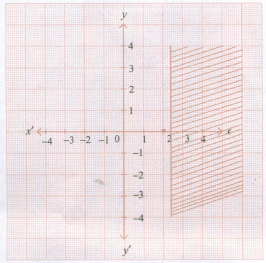
Solve the inequation x \(\ge\) 2 graphically.
1.
\(\frac { { a }^{ 2 }sin(B-C) }{ sinA } =\frac { { (2RsinA) }^{ 2 }sin(B-C) }{ sinA } =\frac { { 4R }^{ 2 }{ sin }^{ 2 }Asin(B-C) }{ sinA } \)
= 4R2sin A sin(B- C) = 4R2sin(B + C) sin (B - C)
= 4R2(sin2B - sin2C) = 4R2sin2B - 4R2sin2C
= b2- c2
Similarly, \(\frac { { b }^{ 2 }sin(C-A) }{ sinB } ={ c }^{ 2 }-{ a }^{ 2 }\)
\(\frac { { c }^{ 2 }sin(A-B) }{ sinC } ={ a }^{ 2 }-{ b }^{ 2 }\)
\(\frac { { a }^{ 2 }sin(B-C) }{ sinA } +\frac { { b }^{ 2 }sin(C-A) }{ sinB } +\frac { { c }^{ 2 }sin(A-B) }{ sinC } ={ b }^{ 2 }-{ c }^{ 2 }+{ c }^{ 2 }-{ a }^{ 2 }+{ a }^{ 2 }-{ b }^{ 2 }=0\)
2.
By sine formula \(\frac { a }{ sinA } =\frac { b }{ sinB } =\frac { c }{ sinC } =2R\)
\(\frac { { a }^{ 2 }-{ b }^{ 2 } }{ { c }^{ 2 } } =\frac { { (2RsinA) }^{ 2 }-{ (2RsinB) }^{ 2 } }{ { (2RsinC) }^{ 2 } } \)
\(=\frac { 4{ R }^{ 2 }{ sin }^{ 2 }A-4{ R }^{ 2 }{ sin }^{ 2 }B }{ 4{ R }^{ 2 }{ sin }^{ 2 }C } =\frac { { sin }^{ 2 }A-{ sin }^{ 2 }B }{ { sin }^{ 2 }C } \)
\(=\frac { sin(A+B)sin(A-B) }{ { sin }^{ 2 }C } [\because sinC=sin(A+B)]\)
\(=\frac { sin(A+B)sin(A-B) }{ { sin }^{ 2 }(A+B) } =\frac { sin(A-B) }{ sin(A+B) } \)
3.
For 4 digit numbers, we have to arrange the given 5 digits in 4 vacant places. This can be done in 5p4 = 5 \(\times\) 4 \(\times\) 3 \(\times\) 2 = 120 ways.
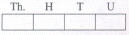
For 4-digit even numbers, the unit's place can be occupied by one of the 2 digits 2 or 4. The remaining 4 digits can be arranged in the remaining 3 places in 4p3 ways.
\(\therefore\) By the multiplication rule, the required number of 4-digit even numbers is 2 x 4P3 = 2 \(\times\) 4 \(\times\) 3 \(\times\) 2 = 48.
4.
Here n - 1P3 : nP4 = 1 : 9
\(\therefore {(n-1)!\over(n-4)!}:{n!\over(n-4)!}=1:9\)
\(\Rightarrow {(n-1)!\over(n-4)!}\times{(n-4)!\over n!}={1\over9} \Rightarrow {(n-1)!\over n!}={1\over9} \Rightarrow {(n-1)!\over n(n-1)!}={1\over9}\)
\(\Rightarrow {1\over n}={1\over9}\Rightarrow n=9\)
5.
Here, \(\frac{S_{3}}{S_{6}}=\frac{125}{152}\)
⇒ \(\frac{a(r^{3}-1)/(r-1)}{a(r^{6}-1)/(r-1)}=\frac{125}{152}\Rightarrow \frac{r^{3}-1}{r^{6}-1}=\frac{125}{152}\)
∴ \(\frac{r^{3}-1}{(r^{3}-1)(r^{3}+1)}=\frac{125}{152}\Rightarrow \frac{1}{r^{3}+1}=\frac{125}{152}\)
∴ 152 = 125 r3 + 125 or 125r3 = 27
ஃ r3=\(\frac{27}{125}=(\frac{3}{5})^{3}\)
⇒ r = {\((\frac{3}{5})^{3}\)}1/3 = \(\frac{3}{5}\)
Hence, the common ratio of the G.P. is \(\frac{3}{5}\)
6.
\(sec(\alpha+\frac{\pi}{2})=-cosec\alpha\)
\(LHS=[(1+cot\alpha)+cosec\alpha][(1+cot\alpha)-cosec\alpha]\)
\(=(1+cot\alpha)^2-cosec^2\alpha\)
\(=1+cot^2\alpha+2cot\alpha-cosec^2\alpha \ [\because 1+cot^2\alpha=cosec^2\alpha]\)
\(=cosec^2\alpha+2cot\alpha-cosec^2\alpha\)
\(=2cot\alpha=RHS\)
7.
Let A be the first term and D, the common difference of A.P.
ap = a, ∴ A + (p -1)D = a --- (1)
aq = b, ∴ A+(q-1)D = b --- (2)
a, = c, ∴ A+(r-1)D = c --- (3)
∴ a (q - r) + b (r - p) + c (p - q) = [A + (p - 1) D] (q - r) + [A + (q -1) D]
(r - p) + [A + (r - 1) D] (p - q) [Using (1), (2) and (3)]
= (q - r + r - p + P - q) A + [ (p -1)(q - r) + (q -1)(r - p) + (r -1) (p - q)] D
= (0) A + (pq - pr - q + r + qr - pq - r + p + pr - p - qr + q) D
= (0) A + (0) D =0.
8.
Slope of the line joining the points (2, 3) and (3, -1) is
\(\frac { -1-3 }{ 3-2 } \)=-4
Slope of the required line which is perpendicular to it
=\(\frac { -1 }{ -4 } =\frac { 1 }{ 4 } \) [∵ m1m2=-1]
Equation of the line passing through the point (5, 2) is
y-2 =\(\frac { 1 }{ 4 } \)(x-5) [y-y1=m(x-x1)]
⇒ 4y-8=x-5
⇒ x-4y+3=0
9.
Let Tr+1 be the term in whichx32 and x-17 occurs,
\(\therefore T_{r+1}= {^{15}C_{r}}.(x^{4})^{15-r}(-\frac{1}{x^{3}})^{r}\)
= \({^{15}C_{r}},(-1)^{r},x^{60-4r},x^{-3r}={^{15}C_r},(-1)^{r}, x^{60-7r}\)
(i) Since x32 occurs in this term
∴ Exponent of x = 32
⇒ 60 - 7r = 32 ⇒ 7r = 28
∴ r = 28 ÷ 7 = 4
∴ Coefficient ofthe term containing x32 is = 15C4(-1)4 = 1365
(ii) Since x-17occurs in this term
∴ Exponent of x = -17
⇒ 60-7r = -17
⇒ 7r = 77, ∴ r = 11
∴ Coeffiicciient of the term containing x-17=15C11(-1)11= -15C11(-1)11 = -15C15-11 = -15C4= -1365.
10.
zero
11.
Since a, b, c are in A.P
\(b=\left( \frac { a+c }{ 2 } \right) \)....(1)
and b, c, d are in G.P\(\Rightarrow\) c = \(\sqrt { bd } \)......(2)
Also c,d,e in H.P \(\Rightarrow\) d\(\frac { 2ce }{ c+e } \)
From (2), C2 = bd = \(\left( \frac { a+c }{ 2 } \right) \left( \frac { 2ce }{ c+e } \right) \)
\(=\left( \frac { (a+c)ce }{ c+e } \right) \)
\(\Rightarrow\) \(c=\frac { (a+c)e }{ c+e } \)
\(\Rightarrow\) C2+ c e = ae + ce
\(\Rightarrow\) c2 = ae
a, c, e are in G.P
12.
Let the A,P be a, a+d, a + 2d,...
Given Sn = 3n2
We have Tn = n-Sn-1
⇒ Tn = 3n2-3(n-1)2
⇒ Tn = 3n2-3(n2-2n + 1)
⇒ Tn = 3n2- 3n2 + 6n - 3
⇒ Tn = 6n - 3
∴ T1 = 6(1)-3 = 3
T2 = 6(2)-3 = 9
T3 = 6(3)-3 = 15
∴ The A.P is 3, 9, 15...
13.
Given p(n): 3n>n. to P.T. p(n+1) is true
i.e to P.T. 3n+1 > n+1
Since p(n) is true, 3n>n
\(\Rightarrow\) 3.3n > 3n [multiply by 3 both sides]
\(\Rightarrow\) 3n+1>n+2n
\(\Rightarrow\) 3n+1 > n+1 \(\left[ \because \quad 2n>1\ for\ every\ n\in N\Rightarrow 2n+n>n+1\ for\ every\ n\in N \right] \)
\(\Rightarrow\) p(n+1) is true.
14.
Here T2-T1 = \(log\frac { { a }^{ 2 } }{ b } -log\quad a=log\frac { { a }^{ 2 }/b }{ a } \)
= \(log\frac { a }{ b } \)
T3-T2 = \(log\frac { a^{ 3 } }{ b^{ 2 } } -log\frac { a^{ 2 } }{ b^{ 2 } } =log\frac { a^{ 3 } }{ b^{ 2 } } +log\frac { a^{ 2 } }{ b^{ 2 } } \)
= \(log\frac { a^{ 3 } }{ b^{ 2 } } \times \frac { b }{ { a }^{ 2 } } =log\frac { a }{ b } \)
∴ T2-T1 = T3-T2 = \(log\left( \frac { a }{ b } \right) \)
∴ The given sequences is an A.P
15.
Using binomial theorem, we have
(1 + ax)n-1 + nC1(ax) + nC2(ax)2+.......+anxn
= \(1+nax+{{n(n-1)}\over{2}}a^2x^2+....a^nx^n\)
Given (1 + ax)n = 1 + 12x + 64x2 +....
Conparing the Co-efficient of x and x2, we get
n a = 12
and \({n(n-1)\over 2}a^2=64\)
\((n-1).{na.a\over2}=64\Rightarrow(n-1){(12)a\over2}=64\)
\((n-1)6a=64\Rightarrow(n-1)a={{64}\over{6}}\) \(\left[ \because na=12\Rightarrow a={12\over n} \right]\)
\(\Rightarrow(n-1)\left( {12\over n} \right)={64 \over 6}\)
\(={n-1\over n}={ 64 \over 6\times 12}\Rightarrow{n-1\over n}={8\over 9}\)
\(\Rightarrow\) 9n - 9 = 8n
\(\Rightarrow\) n = 9 and \(a=\frac { 12 }{ n } =\frac { 12 }{ 9 } =\frac { 4 }{ 3 } \)
16.
There are 10 questions in Part-A, out of which 8 questions can be chosen in 10C8 ways.
Similarly from Part-B, contains using 10 questions, 5 questions can be chosen in 10C5 ways.
Hence, the total number of ways of selecting 8 questions from Part-A and 5 from Part-B.
= 10C8 \(\times\)10C5 = \(\frac { 10! }{ 8!2! } \times \frac { 10! }{ 5!\times 5! } \)

= 11340.
17.
The number of arrangements in which the best and the worst papers never come together can be obtained by subtracting from the total number of arrangements, the number of arrangements in which the best and worst come together.
Number of arrangements of 9 papers = 9P9 = 9!
Considering the best and the worst paper as one paper, we have 8 papers which can be arranged in 8P8 = 8! ways.
But the best and worst papers can be put together in 2! ways.
So, the number of permutations in which the best and worst papers can be put together = 2! \(\times\) 8! ways.
Hence, the number of ways in which the best and the worst papers never come together.
= 9! - 2! 8!
=9 \(\times\) 8! - 2! 8! =8! (9 - 2) [\(\because\) 9! = 9\(\times\)8!]
= 8! \(\times\) 7 = 8 \(\times\) 7 \(\times\) 6 \(\times\) 5 \(\times\) 4 \(\times\) 3 \(\times\) 2 \(\times\) 1 \(\times\) 7
= 282240
18.
Given (n+2)! = 60(n-1)!

\(\Rightarrow \) (n+2) (n+1)(n) = 60
\(\Rightarrow \) (n+2)(n+1)(n) = 5 \(\times\)4 \(\times\)3
Equating the terms both sides we get, n = 0
19.
LHS = \(cos\left( \frac { \pi }{ 4 } -A \right) cos\left( \frac { \pi }{ 4 } -B \right) -sin\left( \frac { \pi }{ 4 } -A \right) sin\left( \frac { \pi }{ 4 } -B \right) \)
= \(cos\left\{ \left( \frac { \pi }{ 4 } -A \right) \left( \frac { \pi }{ 4 } -B \right) \right\} \) [cos A cos B - sin A sin B = cos(A + B)
= \(cos\left( \frac { \pi }{ 2 } -A-B \right) \) where A = \(\frac { \pi }{ 4 } -A,B=\frac { \pi }{ 4 } -B\)
= \(cos\left( \frac { \pi }{ 2 } -(A+B \right) \)
sin(A + B) = RHS
20.
Given R is the set of all real numbers. Then R x R is the set of all ordered pairs (x, y) where x, y ∈ R.
R \(\times\)R = {(x,y): x, y ∈ R}
Clearly R \(\times\)R is the set of all points in xy-plane. Now R \(\times\)R \(\times\)R = {(x, y, z) : x,y, x ∈ R}.
∴ R \(\times\)R \(\times\)R represents the set of all points in space.
21.
The venn diagram of A and B are disjoint sets but both are subsets of C is
.png)
22.
The shaded region is A' U (A ∩ B) or (A\B)'
23.
\({x^2+1\over x(x+1)^2}={A\over x}+{B\over x+1}+{c\over x(x+1)^2}\) [Since the denominator is linear factor of repeated factors]
\(⇒\ {x^2+1\over x(x+1)^2}={A(x+)^2+Bx(x+1)+Cx\over x(x+1)^2}\)
⇒ x2+ 1 = A(x + 1)2 + Bx(x + 1) + Cx
Putting x = 0, we get
1 = A ⇒ = 1
Putting x = -1, we get
1 + 1 = C(-1) ⇒ 2 = -C ⇒ C = -2
Putting x = 1 in (1) we get
2 = A(4) + B(2) + C
⇒ 24A + 2B + C [∴ A = 1, C = -2]
⇒ 2 = 4 + 2B - 2
⇒ 2 + 2 - 4 = 2B ⇒ B =0
\(∴\ {x^2+1\over x(x+1)^2}={1\over x}+{0\over x+1}-{2\over (x+1)^2}\)
\(\frac { { x }^{ 2 }+1 }{ x\left( x+1 \right) ^{ 2 } } =\frac { 1 }{ x } \frac { 2 }{ \left( x+1 \right) ^{ 2 } } \)
24.
Given quadratic equation is
52x-5x+3 + 125 = 5x
\(\Rightarrow\) (5x)2-5x 53- 5x + 125 = 0
\(\Rightarrow\) (5x)2-125 5x- 5x + 125 = 0
\(\Rightarrow\) (5x)2-126.5x+125=0
Let 5x=y
\(\Rightarrow\)y2-126y + 125 = 0
\(\Rightarrow\)(y-1)(y-125) = 0
\(\Rightarrow\) y = 1 or 125
\(\Rightarrow\) 5x = 1 or 125
Case (i) When 5x = 1 \(\Rightarrow\) 50 \(\Rightarrow\) x = 0
Case (ii) When 5x = 125 \(\Rightarrow\) 5x = 53\(\Rightarrow\) x = 3
\(\therefore\) The roots are 0, 3.
25.
Given x > 2
Converting the into equation, we get x = 2.
Clearly it is a line parallel to y-axis at a distance of 2 units from it.
Also, we find that the point (0, 0) does not satisfy the inequation x > 2
So, the region represented by the given equation is the shaded region.

11th Standard Syllabus & Materials
11th Standard
TN 11th Tamil பீடு பெற நில் - செய்யுள் - காவடிச்சிந்து Important Questions And Answers Study Material - QB365 Set A
NEW11th Standard
TN 11th Tamil பீடு பெற நில் - உரைநடை - மலை இடப்பெயர்கள் : ஓர் ஆய்வு Important Questions And Answers Study Material - QB365 Set A
NEW11th Standard
TN 11th Tamil மாமழை போற்றுதும் - துணைப்பாடம் - யானை டாக்டர் Important Questions And Answers Study Material - QB365 Set A
NEW11th Standard
TN 11th Tamil மாமழை போற்றுதும் - செய்யுள் - ஐங்குறுநூறு Important Questions And Answers Study Material - QB365 Set A



Tamilnadu Stateboard 11th Standard Subjects
Maths

Commerce

Economics

Biology

Business Maths and Statistics

Accountancy

Computer Science

Physics

Chemistry
Maths
Biology
Economics
Physics
Chemistry

History
Business Maths and Statistics

Computer Science
Accountancy

Computer Applications
History
Computer Technology
Commerce
Computer Applications
Computer Technology

Tamil

English

French
Tamilnadu Stateboard Standards



