
 100% FREE ACCESS
11th Standard Syllabus & Materials
11th Standard
TN 11th Tamil இயற்கை வேளாண்மை,சுற்றுச்சூழல் -செய்யுள் - மனோன்மணீயம் Important Questions And Answers Study Material - QB365 Set A
NEW11th Standard
TN 11th Tamil என்னுயிர் என்பேன் -துணைப்பாடம் - இசைத்தமிழர் இருவர் Important Questions And Answers Study Material - QB365 Set A
NEW11th Standard
TN 11th Tamil மொழி கலை -செய்யுள் - ஒவ்வொரு புல்லையும் Important Questions And Answers Study Material - QB365 Set A
NEW11th Standard
TN 11th Tamil பீடு பெற நில் - இலக்கணம் - பகுபத உறுப்புகள் Important Questions And Answers Study Material - QB365 Set A
NEW11th Standard
TN 11th Tamil பீடு பெற நில் - துணைப்பாடம் - வாடிவாசல் Important Questions And Answers Study Material - QB365 Set A
NEW11th Standard
TN 11th Tamil பீடு பெற நில் - செய்யுள் - குறுந்தொகை Important Questions And Answers Study Material - QB365 Set A

Published on: 13/05/2022
QB365 provides detailed and simple solution for every Creative Questions in class 11 Maths Subject. It will helps to get more idea about question pattern in every Creative questions with solution.
latest Creative QuestionsDownload Tamil Nadu 11th Standard Maths question papers, model tests, one-mark questions, important questions, and public exam papers in PDF format. Free study materials and answer keys for TN State Board students.
Questions + Answers key
Take MCQ Maths Test1.
Solve \({ tan }^{ -1 }\left( \frac { 2x }{ 1-{ x }^{ 2 } } \right) +{ cot }^{ -1 }\left( \frac { 1-{ x }^{ 2 } }{ 2x } \right) =\frac { \pi }{ 3 } ,wherex>0\)
2.
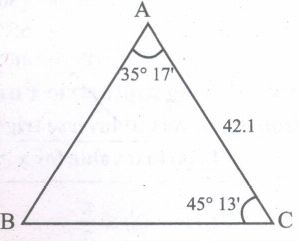
In a triangle ABC, A = 35° 17' ; C = 45° 13' ; b = 42.1 Solve the triangle
3.
Prove by induction the inequality (1 + x)n\(\ge\) 1 + nx, whenever x is positive and n is a positive integer.
4.
A + B + C =\(\pi\), prove that sin 2A - sin 2B + sin 2C = 4 cos A sin B cos C
5.
Resolve into partial fractions \(\frac { { x }^{ 3 }-1 }{ { x }^{ 2 }+x+1 } \)
6.
Resolve into partial fractions \(\frac { 9 }{ (x-1)(x+2)^{ 2 } } \)
7.
Prove that (i) cos 20° cos 40° cos 80° \(=\frac{1}{8}\)
8.
Determine n if 2nC3 : nC3 = 11 : 1
9.
A committee of 6 is to be choosen from 10 men and 7 women so as to contain atleast 3 men and 2 women. In how many different ways can this be done it two particular women refuse to serve on the same committee?
10.
Find the range of the function.
f = {1, x), (1, y), (2, x), (2, y), (3, z)}
11.
Prove that \(\left( 1+\frac { 1 }{ 1 } \right) \left( 1+\frac { 1 }{ 2 } \right) \left( 1+\frac { 1 }{ 3 } \right) ...\left( 1+\frac { 1 }{ n } \right) =\left( n+1 \right) \) for all \(n\in N\) by the principle of mathematical induction.
12.
Using principle of mathematical induction, prove that x2n-y2n is divisible by x+y for all n∈N.
13.
If the first two terms of a H. P are \(\frac { 2 }{ 5 } \) and\(\frac { 12 }{ 13 } \) respectively, find the largest term of the H.P.
14.
If S n denotes that Sum of n terms of a G. P., prove that (s10-s20 )2 = s10 (s30 - s20)
15.
If (p+1) th term of an A.P is twice the (q+1)th terms prove that the (3p+1)th term is twice the (p+q+1)th term
16.
Two trees A and B are on the same side of a river. From a point C in the river the distance of trees A and B are 250 m and 300 m respectively. If the angle C is 45o, find the distance between the trees.
17.
In \(\Delta ABC\), if a = 18, b = 24, c = 30 and \(\angle\)c = 90o, find \(\sin { A, } \sin { B } \) and \(\sin { C } \)
18.
Solve : \(2\left(x+{{1}\over{x}} \right)^2-7\left(x+{{1}\over{x}} \right)+5=0.\)
19.
Factorize: x4-14x2y2-51y4
20.
Find the sum and difference of the identity function and the modulus function?
21.
If a \(\in\) {-1, 2, 3, 4, 5} and b \(\in\) {0,3, 6}. Write the set of all ordered pairs (a, b) such that a + b = 5.
22.
Two finite sets have m and n elements. The total number of subsets of the first set is 56 more than the total number of subsets of the second set. Find the values of m and n.
23.
Let A = {a, b, c, d}, B = {a, c, e}, C = {a, e}.
Verify using Venn diagram.
24.
If \({{{log}_{e}^{x}}\over{b-c}}={{{log}_{e}^{y}}\over{c-a}}={{{log}_{e}^{z}}\over{a-b}},\) show that xyz = 1
25.
Solve: \(\sqrt{x+5}+\sqrt{x+21}=\sqrt{6x+40}\)
1.
\({ tan }^{ -1 }\left( \frac { 2x }{ 1-{ x }^{ 2 } } \right) +{ cot }^{ -1 }\left( \frac { 1-{ x }^{ 2 } }{ 2x } \right) =\frac { \pi }{ 3 } \)
\({ cot }^{ -1 }\left( \frac { 1 }{ x } \right) ={ tan }^{ -1 }x\)
Therefore \({ cot }^{ -1 }\left( \frac { 1-{ x }^{ 2 } }{ 2x } \right) ={ tan }^{ -1 }\left( \frac { 2x }{ 1-{ x }^{ 2 } } \right) \)
Hence, \(LHS={ tan }^{ -1 }\left( \frac { 2x }{ 1-{ x }^{ 2 } } \right) +{ tan }^{ -1 }\left( \frac { 2x }{ 1-{ x }^{ 2 } } \right) =\frac { \pi }{ 3 } \)
\(\Rightarrow { tan }^{ -1 }\frac { 2x }{ 1-{ x }^{ 2 } } =\frac { \pi }{ 6 } \)
\(\frac { 2x }{ 1-{ x }^{ 2 } } =tan\frac { \pi }{ 6 } =\frac { 1 }{ \sqrt { 3 } } \)
1-x2 = 2\(\sqrt3\)x ⇒ x2 + 2\(\sqrt3\)x - 1 = 0
\(x=\frac { -2\sqrt { 3 } \pm \sqrt { 12+4 } }{ 2 } =\frac { -2\sqrt { 3 } \pm 4 }{ 2 } \)
= 2 -\(\sqrt3\) (or) - 2\(\sqrt3\)
∴ x = 2\(\sqrt3\)
2.
The unknown parts are B, a, c,
B = 180 - (A + C) = 180- (35° 17' + 45° 13')
= 99° 30'
To find sides, use sine formula
\(\frac { a }{ sinA } =\frac { b }{ sinB } =\frac { c }{ sinC } \)
\(\Rightarrow \frac { bsinA }{ sinB } =\frac { 42.1\times sin{ 35 }^{ 0 }17' }{ sin{ 99 }^{ 0 }30' } \)
log a = log 42.1 + log sin 36° 17' - log sin 99° 30'
= 1.6243 + 1.7616 - 1.9940
= 1.3859 - 1.9940
= 1.3859 - [-1 + 0.9940] = 1.3919
⇒ a = 24.650
Again \(\Rightarrow \frac { bsinC }{ sinB } =\frac { 42.1\times sin{ 45 }^{ 0 }13' }{ sin{ 99 }^{ 0 }30' } \)
log c = log 42.1 + log sin 45° 31' - log sin 99° 30'
= 1.6243 + 1.8511 - 1.9940
= 1.4754 - 1.9940
= 1.4754 - [-1 + 0.9940] = 1.4814
⇒ c = 30.3°
Thus B = 99° 30' ; a = 24.65° ; C = 30.3°
3.
P(n) : (11 + x)n \(\ge\) 1 + nx
P(1): (1 +x)1\(\ge\)1 +n
\(\Rightarrow\)1 + x\(\ge\)1 + x, which is true.
Hence, P( 1) is true.
Let P(k) be true
(i.e.) (1 +x)k \(\ge\)1 + kx
We have to prove that P(k + 1) is true.
(i.e.) (1+x)k+1\(\ge\) 1+(k+l)x
Now, (1 +x)k+1\(\ge\) 1 + kx [\(\because\)P(k) is true]
Multiplying both sides by (1 + x), we get
(1 + x)k (1 + x)\(\ge\)(1 + kx) (1 + x)
\(\Rightarrow\)(1 + x)k + 1\(\ge\) 1 + kx + x + kx2
\(\Rightarrow\) (1 + X)k+ 1 \(\ge\) 1 + (k + 1) x + kx2....(1)
Now, 1 + (k+ 1)x + kx2 \(\ge\)1 + (k+ 1)x ...(2)
From (1) and (2), we get
(1+x)k+1\(\ge\) 1+(k+1)x
\(\therefore\) P(k+ 1) is true if P(k) is true.
Hence, by the principle of mathematical induction, p(n) is true for all values, of n.
4.
LHS = sin2A - sin2B+ sin2C
= sin2A+ sin2C- sin2B
\(=2sin\frac{2A+2C}{2}cos\frac{2A-2C}{2}-sin2B\)
= 2 sin(A + C) cos (A -C) - 2 sin B cos B
= 2 sin (180° - B) cos (A - C) -2 sin B cos B
= 2 sin B cos (A - C) - 2 sin B cos B
= 2 sin B [cos(A - C) - cos B]
= 2 sin B [cos (A- C) - cos (180° - (A+ C)]
= 2 sin B[cos(A - C)+ cos(A+ C)]
= 2 sin B [2cos A cos C]
= 4 cos A sinB cos C = 1 RHS
5.
\(\frac { { x }^{ 3 }-1 }{ { x }^{ 2 }+x+1 } \)= \(\frac { { x }^{ 3 }-1 }{ (x+2)(x-1) } =\frac { A }{ x+2 } +\frac { B }{ x-1 } \)
\(\frac { { x }^{ 3 }-1 }{ { x }^{ 2 }+x+1 } =\frac { A(x-1) }{ (x+2) } +\frac { B(x+2) }{ (x-1) } \)
Equating numerator on both sides
x3-1=A(x-1)+B(x+2)
put x = 1
0 = 0+B(1+2)
3B =0 ⇒ \(\boxed{B =0}\)
put x = -2
(-2)3-1 =A(-2-1)+B(0)
-8-1 = -3A
-9 = -3A
A= 9/3 ⇒ \(\boxed{A=3}\)
∴ \(\frac { { x }^{ 3 }-1 }{ { x }^{ 2 }+x+1 } =\frac { 3 }{ x+2 } +\frac { 0 }{ x-1 } \)
\(\frac { { x }^{ 3 }-1 }{ { x }^{ 2 }+x+1 } =\frac { 3 }{ x+2 } \)
6.
\(\frac { 9 }{ (x-1)(x+2)^{ 2 } } =\frac { A }{ x-1 } +\frac { B }{ x+2 } +\frac { C }{ (\quad ) } \)
= \(\frac { A(x+2)^{ 2 }+B(x-1)(x+2)+C(x-1) }{ (x-1)(x+2)(x+2)^{ 2 } } \)
Equating numerator on b/s
9=A(x+2)2+B(x-1)(x+2)+C(x-1)
put x =-2
9 = A(0)+B(0)+C(-3)
-3C = 9 ⇒ C=-3
put x =1
9 - A(1+2)2 +B(0)+C(0)
9A =9
A =1
put x =0
9 =4A-2B-C
9=4(1)-2B+3
9-7 =-2B
2 = -2B
B =-1
∴ \(\frac { 9 }{ (x-1)(x+2)^{ 2 } } =\frac { 1 }{ x-1 } \frac { 1 }{ x+2 } \frac { -3 }{ (x+2)^{ 2 } } \)
7.
LHS = cos 20° cos 40° cos 80°
\(=\frac{1}{2}\)cos 20° (2 cos 80° cos 40°)
\(=\frac{1}{2}\)cos 20° [ cos 80° + 40°) + cos (80° - 40°)]
[\(\because\) 2 cos A cos B = cos (A + B) + cos (A - B)]
\(=\frac{1}{2}\) cos 20° (cos 120° + cos 40°)
\(=-cos 20°(-\frac{1}{2}+cos 40°)\)
\(=-\frac{1}{4}cos 20°+\frac{1}{2}cos40°cos20°\)
\(=-\frac{1}{4}cos20°+\frac{1}{4}[cos(40°+20°)+cos(40°-20°)]\)
\(=-\frac{1}{4}cos20°+\frac{1}{4}(cos60°+cos20°)\)
\(=-\frac{1}{4}cos20°+\frac{1}{4}cos60°+\frac{1}{4}cos20°\)
\(=\frac{1}{4}cos60°=\frac{1}{4}(\frac{1}{2})=\frac{1}{8}=RHS\)
8.
Here 2nC3 : nC3 = 11 : 1
\(\Rightarrow {(2n)!\over 3!(2n-3)!}\times {2!(n-3)!\over n!}={11\over 1}\)
\(\Rightarrow {(2n)(2n-1)(2n-2)(2n-3)!\over 3!(2n-3)!}\times {3!(n-3)!\over n(n-1)(n-2)(n-3)!}={11\over 1}\)
\(\Rightarrow {(2n)(2n-1)(2n-2)\over n(n-1)(n-2) }={11\over 1}\)
\(\Rightarrow {4(2n-1)\over n-2}={11\over1}\)
\(\Rightarrow \) 8n - 4 = 11n - 22
\(\Rightarrow \) 3n = 18 \(\Rightarrow \) n = 6
9.
We have 10 men and 7 women out of which a committee of 6 is to be formed which contain atleast 3 men and 2 women
Therefore, Number of ways =10C3 \(\times\) 7C3 + 10C4\(\times\)7C2
\(={10\times9\times8\over3\times2\times1}\times{7\times6\times5\over3\times2\times1}+{10\times9\times8\times7\over4\times3\times2\times1}\times{7\times6\over2\times1}\)
= (120 x 35) + (210 x 21) = 4200 + 4410 = 8610
If 2 particular women to be always present, then the number of ways
=10C4 \(\times\) 5C0 + 10C3 \(\times\) 5C4 \(\times\)5C1
\(={10\times9\times8\times7\times\over 4\times3\times2\times1}1+{10\times9\times8\over3\times2\times1}\times5=\) 210 + 120 x 5 = 210 + 600 = 810
\(\therefore\)Total number of committee = 8610 - 810 = 7800
Hence, the value of the filler is 7800
10.
The range of the function is {x, y, z}.
11.
Let p(n): be \(\left( 1+\frac { 1 }{ 1 } \right) \left( 1+\frac { 1 }{ 2 } \right) \left( 1+\frac { 1 }{ 3 } \right) ...\left( 1+\frac { 1 }{ n } \right) =\left( n+1 \right) \)
Step 1: p(1): \(( 1+\frac { 1 }{ 1 }) =\left( 1+1 \right) \)
\(\Rightarrow\) p(1):2 = 2
\(\Rightarrow\) p(1) is true.
Step 2: Let p(m) be true
\(\left( 1+\frac { 1 }{ 1 } \right) \left( 1+\frac { 1 }{ 2 } \right) \left( 1+\frac { 1 }{ 3 } \right) ...\left( 1+\frac { 1 }{ m } \right) =\left( m+1 \right) \)
Step 3: To prove that p(m + 1) is true
i.e. to prove that \(\left( 1+\frac { 1 }{ 1 } \right) \left( 1+\frac { 1 }{ 2 } \right) ...\left( 1+\frac { 1 }{ m } \right)\left( 1+\frac { 1 }{ m+1 } \right) =\left( m+2 \right) \)
LHS = \(\left( 1+\frac { 1 }{ 1 } \right) \left( 1+\frac { 1 }{ 2 } \right) ...\left( 1+\frac { 1 }{ m } \right)\left( 1+\frac { 1 }{ m+1 } \right) \)
= (m + 1) \(\left( 1+\frac { 1 }{ m+1 } \right)\) = m + 1 + 1
= (m + 2) = RHS
p(m + 1) is true.
By the principle of mathematical induction, p(n) is true for all \(n\in N\)
12.
Let p(n): be x2n - y2n is divisible by (x + y).
Step 1: p(1): x2 - y2 is divisible by (x + y)
⇒ p(1): (x + y) (x - y) is divisible by (x + y)
⇒ p(1) is true.
Step 2: Let p(m) be true.
x2m - y2m is divisible by (x + y)
x2m - y2m = ⋋ (x +y) where A is a constant
Step 3: To prove that p(m + 1) is true
i.e. to prove that x2(m+1) - y2(m+1) is divisible by (x + y)
Consider x2(m+1) - y2(m+1)
= x2m+2 - y2m+2
= x2m . x2 - y2m .y2
x2m . x2 - x2m .y2 + x2m . y2 -y2m .y2 [Adding and subtracting x2m . y2m]
x2m (x2 - y2) +y2 (x2m - y2m)
x2m (x2 - y2) + y2 ⋋ (x +y) [by (1)]
x2m (x +y) (x - y) + ⋋ . y2m (x +y)
(x + y) (x2m (x - y) + ⋋y2) which is divisible by (x + y)
⇒ p(m + 1) is true.
Hence, by the principle of mathematical induction, p(n) is true for all n ∈ N.
13.
Let the H.P. be \({{1}\over{a}},{1\over a+d},{1\over a+2d},...\)
\(\therefore\) \({T}_{1}={1\over a}={2 \over 5}\) and \({T}_{2}={ 1 \over a+d}={12 \over 13}\)
\(\Rightarrow\) \(a={5\over 2}\) and \(a+d={13 \over 12}\)
\(\Rightarrow\) \(a={5\over 2}\) and \({5\over 2}+d={13 \over 12}\Rightarrow d{13 \over 12}-{5\over 2}\Rightarrow d={13-20\over12 }={-17\over 12}\)
Now, \({T}_{n}-{1 \over {a+(n-1)d}}={{1}\over{{{5}\over{2}}+(n-1)\left( {{-17}\over{12}} \right)}}={12\over30-17n+17}\)
\(={12\over47-17n}\)
Tn is largest when 47 - 17n is least and positive
For n = 2, 47 - 17n is least and positive
\(\therefore\) Tn is largest when n = 2
\(\therefore\) The largest term \(={12\over 47-17(2)}={12\over13}.\)
14.
Let a and r be the first term and common ratio of the G.P.
\(\therefore\) \({S}_{n}={a(1-r^n)\over1-r},n\epsilon N\)
LHS \(={{S}_{10}-{S}_{20}}^{2}=\left[ {a(1-{r}^{10})\over1-r}-{a(1-{r}^{20})\over1-r} \right]^{2}\)
\(={{a}^{2}\over{{(1-r)}^{2}}}[1-{r}^{10}-1+{r}^{20}]^2\)
\(={{a}^{2}\over{(1-r)}^{2}}.{r}^{20}{({r}^{10}-1)}^{2}={{a^2.{r}^{20}.{({r}^{10}-1)}^{2}}\over{{(1-r)}^{2}}}\)
RHS = S10 (S30 - S20)
\(={a(1-{r}^{10}\over1-r)}\left[ {a(1-{r}^{30})\over1-r}-{{a(1-{r}^{30})}\over{1-r}} \right]\)
\(={{a^2}\over{(1-r^2)}}(1-{r}^{10})[1-{r}^{30}-1+{r}^{20}]={{a^2(1-{r}^{10})}\over{{(1-r)}^{2}}}.{r}^{20}(1-{r}^{10})\)
\(={{a^3.{r}^{20}(1-{r}^{10})^2}\over{{(1-r)}^{2}}}={{{a}^{2}.{r}^{20}{({r}^{10}-1)}^{2}}\over{{(1-r)}^{2}}}\)
\(\therefore\) LHS = RHS.
15.
Given Tp+1 = 2.Tq+1
\(\Rightarrow\) a+(+1-1)d = 2[a+(q+1-1)d] [ \(\because\) Tn = a + ( n - 1) d ]
\(\Rightarrow\) a + pd = 2a +2qd
\(\Rightarrow\) a = ( p - 2q ) d ...(1)
Now T3p+1 = a+ ( 3p + 1 - 1 )d = a + 3pd
= ( p - 2q ) d + 3pd (using (1))
= 4pd - 2qd
= 2d (2p-q) ...(2)
Also Tp+q+1 = a + (p+q+1-1)d
= a+(p+q)d
= (p-2q)d + (p+q)d (using (1))
= d(p-2q+p+q) = d(2p-q) ...(3)
From (2) and (3), T3p+1 = 2. Tp+q+1.
16.
We have
AB2 = AC2 + BC2 - 2AC . BC.cos\(\frac{\pi}{4}\)
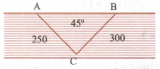
⇒ AB2 = 2502 + 3002 - 2 . 250 \(\times\) 300 \(\times\) \(\frac{1}{\sqrt{2}}\)
⇒ AB2 = 62500 + 90000 - 75000√2
⇒ AB2 = 152500 - 75000 \(\times\) 1.44
⇒ AB2 = 44500
⇒ AB = \(\sqrt{44500}\) = 210.95 m
17.
Given a = 18, b = 24, c = 30 and ㄥc = 90°
By sine formula,
\(\frac { a }{ sinA } =\frac { b }{ sinB } =\frac { c }{ sinC } \)
\(\Rightarrow \frac { 18 }{ sinA } =\frac { 24 }{ sinB } =\frac { 30° }{ sin90° } \)
\(\Rightarrow \frac { 18 }{ sinA } =\frac { 24 }{ sinB } =\frac { 30 }{ 1 } \)
From I and III,\(\frac { 18 }{ sinA } =30°\)
\(\Rightarrow sinA=\frac { 18 }{ 30 } \)
\(\Rightarrow sinA=\frac { 3 }{ 5 } \)
From II and III, \(\frac { 24 }{ sinB } =30°\)
\(\Rightarrow sinB=\frac { 24 }{ 30 } =\frac { 4 }{ 5 } \)
And sin C = sin 90° = 1
⇒ sin A = \(\frac{3}{5}\) , sin B = \(\frac{4}{5}\), sin C = 1
18.
Given \(2\left(x+{{1}\over{x}} \right)^2-7\left(x+{{1}\over{x}} \right)+5=0.\)
Let \(x+{1\over x}=y\)
2y2-7y + 5 = 0
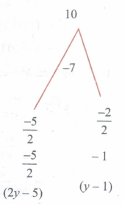
(2y - 5) (y - 1) = 0
2y = 5 or y = 1
\(y={5\over 2}\ or\ y=1\)
\({x+{1\over x}}{={5\over2}}\ or\ y=1\)
Case(i) when \({x+{1\over x}}{={5\over2}}\)
⇒ \({x^2+1\over x}={5\over2}\)
⇒ 2x2+2 = 5x
⇒ 2x2-5x+ 2 = 0
⇒ (x-2) (2x-1) = 0
⇒ \(x=2\ or\ {1\over2}\)
Case (ii) \(x+{1\over x}=1\)
⇒ \({x^2+1\over x}=1\)
⇒ x2+1 = x
⇒ x2-x+1 = 0
⇒ \(x={+1\pm\sqrt{1-4(1)(1)}\over 2}\)
⇒ \(x={1\pm\sqrt{-3}\over2}\)
Which is not possible
∴ The real roots of the given equation are 2 and \(\frac{1}{2}\)
19.
Given polynomial is
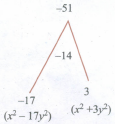
x4 - 14x2y2 - 51y4
= (x2 - 17y2) (x2 + 3y2)
= [x2 - (17y)2] [x2+ 3y2]
\(=(x-\sqrt{17}y)(x+\sqrt{17}y)(x^2+3y^2)[\because\ a^2-b^2 =(a+b)(a-b)]\)
20.
f + g : R ⟶ R and f - g : R ⟶ R
Now (f + g) (x) = f(x) + g(x)
⇒ ( f+ g)(x) = x + |x|
\(⇒\ \left( f+g \right) x =\begin{cases}x +x\quad if\quad x\ge 0 \\ x-x \ if\quad x<0\quad \end{cases}\)
\(⇒\ \left( f+g \right) x =\begin{cases}2x\quad if\quad x\ge 0 \\ 0 \ if\quad x<0\quad \end{cases}\)
Similarly (f - g) (x) = f(x) - g(x) = x - |x|
\(⇒\ \left( f-g \right) x =\begin{cases}x -x\quad if\quad x\ge 0 \\ x-(-x )\ if\quad x<0\quad \end{cases}\)
\(⇒\ \left( f-g \right) \left( x \right) =\begin{cases} 0 \quad if\quad x\ge 0 \\ 2x \ if\quad x<0\quad \end{cases}\)
21.
Let A= {-1, 2, 3,4, 5}, and B = {0,3, 6}
A \(\times\) B = {(-1, 0) (-1,3) (-1, 6) (2, 0) (2, 3) (2, 6) (3, 0) (3, 3) (3, 6) (4, 0) (4, 3) (4, 6) (5, 0) (5, 3) (5,6)}
The set of all ordered pairs (a, b) such that a + b = 5 is R = {(-1, 6) (2, 3) (5, 0)}
22.
Let A and B be two sets having elements m and n respectively
Then, number of subsets of set A = 2m
Number of subsets of set B = 2n
Given 2m - 2n = 56
\(⇒\ 2^n\left({2^m\over 2^n}-1\right)=56\)
⇒ 2n(2m-n - 1) = 8 \(\times\) 7
⇒ 2n(2m-n - 1) = 23 \(\times\)(23 - 1)
Equating both sides we get
n = 3 and m - n = 3
⇒ n = 3 and m - 3 = 3
⇒ n = 3 and m = 6
23.
Venn diagram
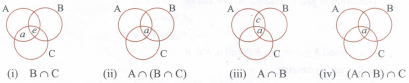
From (ii) and (iv), it is clear that A ∩ (B ∩ C) = (A ∩ B) ∩ C.
24.
Let \({{{log}_{e}^{x}}\over{b-c}}={{{log}_{e}^{y}}\over{c-a}}={{{log}_{e}^{z}}\over{a-b}}=k\)
\({log}_{e}^{x}= k(b-c),{log}_{e}^{y}=k(c-a)\) and
\({log}_{e}^{z}=k(a-b)\) ...(1)
\(\Rightarrow\) x = ek(b-c),y=ek(c-a)and z = ek(a-b) ....(2)
xyz = ek(b-c).ek(c-a).ek(a-b)
= ek(b-c+c-a+a-b) = ek(0) = e0 = 1
\(\Rightarrow\) xyz = 1
25.
Given \(\sqrt{x+5}+\sqrt{x+21}=\sqrt{6x+40}\)
Squaring both sides we get
\((\sqrt{x+5}+\sqrt {x+21})^2=(\sqrt{6x+40})^2\)
⇒ \(z+5+z+21+2\sqrt{(x+5)(x+21)}=6x+40\)
⇒ \( 2x+26+2\sqrt{(x+5)(x+21)}=6x+40\)
⇒ \(2\sqrt{(x+5)(x+21)}=6x+40-2x-26\)
⇒ \(2\sqrt{(x+5)(x+21)}=4x+14\)
\(\sqrt{(x+5)(x+21)}=2x+7\)
Squaring again we get
(x + 5)(x + 21) = (2x + 7)2
⇒ x2 + 21x + 5x + 105 = 4x2+ 49 + 28x
⇒ x2 + 26x + 105 = 4x2 +49 + 28x
⇒ 3x2 + 2x- 56 = 0
\(x = {-2 \pm \sqrt{4-4(3)(-56)} \over 6}\)
\(x = {-2 \pm \sqrt{4+672)} \over 6}\)
\(x={-2\pm26\over 6}⇒x=4,{-14\over 3}\)
⇒ When x = 4
Case (i) :
\(\sqrt{4+5}+\sqrt{4+21}=\sqrt{6(4)}+40\)
\(\sqrt9+\sqrt{25}=\sqrt{64}\)
3 + 5 = 8
8 = 8 which is true ⇒ x = 4 is a root
Case (ii) : When x = \(-14\over 3\)
\(\sqrt{{1-\over3}+5}+\sqrt{{-14\over 3}+21}=\sqrt{+6\left(-14\over 3\right)+40}\)
\(\sqrt{1\over 3}+\sqrt{49\over 3}=\sqrt{12}\) which is not true
\(\therefore\) x \(={{-14}\over{3}}\) is not a root.

11th Standard Syllabus & Materials
11th Standard
TN 11th Tamil பீடு பெற நில் - செய்யுள் - காவடிச்சிந்து Important Questions And Answers Study Material - QB365 Set A
NEW11th Standard
TN 11th Tamil பீடு பெற நில் - உரைநடை - மலை இடப்பெயர்கள் : ஓர் ஆய்வு Important Questions And Answers Study Material - QB365 Set A
NEW11th Standard
TN 11th Tamil மாமழை போற்றுதும் - துணைப்பாடம் - யானை டாக்டர் Important Questions And Answers Study Material - QB365 Set A
NEW11th Standard
TN 11th Tamil மாமழை போற்றுதும் - செய்யுள் - ஐங்குறுநூறு Important Questions And Answers Study Material - QB365 Set A



Tamilnadu Stateboard 11th Standard Subjects
Maths

Commerce

Economics

Biology

Business Maths and Statistics

Accountancy

Computer Science

Physics

Chemistry
Maths
Biology
Economics
Physics
Chemistry

History
Business Maths and Statistics

Computer Science
Accountancy

Computer Applications
History
Computer Technology
Commerce
Computer Applications
Computer Technology

Tamil

English

French
Tamilnadu Stateboard Standards



