
 100% FREE ACCESS
11th Standard Syllabus & Materials
11th Standard
TN 11th Tamil இயற்கை வேளாண்மை,சுற்றுச்சூழல் -செய்யுள் - மனோன்மணீயம் Important Questions And Answers Study Material - QB365 Set A
NEW11th Standard
TN 11th Tamil என்னுயிர் என்பேன் -துணைப்பாடம் - இசைத்தமிழர் இருவர் Important Questions And Answers Study Material - QB365 Set A
NEW11th Standard
TN 11th Tamil மொழி கலை -செய்யுள் - ஒவ்வொரு புல்லையும் Important Questions And Answers Study Material - QB365 Set A
NEW11th Standard
TN 11th Tamil பீடு பெற நில் - இலக்கணம் - பகுபத உறுப்புகள் Important Questions And Answers Study Material - QB365 Set A
NEW11th Standard
TN 11th Tamil பீடு பெற நில் - துணைப்பாடம் - வாடிவாசல் Important Questions And Answers Study Material - QB365 Set A
NEW11th Standard
TN 11th Tamil பீடு பெற நில் - செய்யுள் - குறுந்தொகை Important Questions And Answers Study Material - QB365 Set A

Published on: 13/05/2022
QB365 provides detailed and simple solution for every book back questions in class 11 Maths subject.It will helps to get more idea about question pattern in every book back questions with solution.
latest Book back QuestionsDownload Tamil Nadu 11th Standard Maths question papers, model tests, one-mark questions, important questions, and public exam papers in PDF format. Free study materials and answer keys for TN State Board students.
Questions + Answers key
Take MCQ Maths Test1.
If \(f:R\rightarrow R\) is defined by f(x) = 2x- 3, prove that f is a bijection and find its inverse
2.
Let f, g: \(R \rightarrow R\) be defined as f (x) = 2x -|x| and g(x) = 2x + |x|. find f o g.
3.
Write the values of f at -3, 5, 2, -1, 0 if
\(f(x)=\begin{cases} x^2+x-5\quad if\ x \in(-\infty, 0) \\x^2+3x-2\quad if\ x\in(3,\infty) \\x^2\quad \quad \quad \quad \quad if\ x\ \in(0,2) \\x^2-3 \quad \quad \quad otherwise \end{cases}\)
4.
From the curve y = x, draw
(i) y = - x
(ii) y = 2x
(iii) y = x + 1
(iv) \(y={1\over 2}x+1\)
(v) 2x + y + 3 = 0
5.
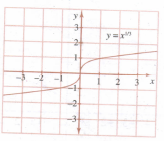
For the given curve, \(y=x^{1\over 3}\)given in figure draw
(i) \(y=-x^{ \left( \frac { 1 }{ 3 } \right) }\)
(ii) \(y=x^{ \left( \frac { 1 }{ 3 } \right) }+1\)
(iii) \(y=x^{ \left( \frac { 1 }{ 3 } \right) }-1\)
(iii) \(y=(x+1)^{1\over 3}\)
6.
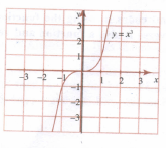
For the given curve y = x3 given in figure draw, try to draw with the same scale
(i) y = -x3
(ii) y = x3+1
(iii) y = x3-1
(iv) y = (x + 1)3
7.
Find the largest possible domain for the real valued function given by \(f(x)={\sqrt{9-x^2}\over{x^2-1}}.\)
8.
Find the range of the function \(\frac { 1 }{ 2cosx-1 } \)
9.
Check the following functions for one-to-oneness and ontoness.
(i) \(f:N\rightarrow N\) defined by f(n) = n2.
(ii) \(f: \mathbb{R} \rightarrow \mathbb{R}\) defined by f(n) = n2.
1.
Method 1:
One-to-one: Let f(x) = f(y). Then 2x - 3 = 2y - 3; this implies that x = y. That is, f(x) = f(y) implies that x = y. Thus f is one-to-one.
Onto: Let y \(\in\) R. Let x \(={y+3 \over 2}.\) Then \(f(x)=2\left( {y+3\over2} \right)-3=y.\) Thus f is onto. This also can be proved by saying the following statement. The range of f is R (how?) which is equal to the co-domain and hence f is onto.
Inverse: Let y = 2x - 3. Then y + 3 = 2x and hence \(x={y+3\over 2}.\) Thus \({f}^{-1}(y)={y+3\over2}\). By replacing y as x, we get \({f}^{-1}(x)={x+3\over 2}.\)
Method 2:
Let y = 2x − 3. Then \(x=\frac{y+3}{2}\). Let \(g(y)=\frac{y+3}{2}\)
Now
\((g \circ f)(x)=g(f(x))=g(2 x-3)=\frac{(2 x-3)+3}{2}=x .\)
\((f \circ g)(y)=f(g(y))=f\left(\frac{y+3}{2}\right)=2\left(\frac{y+3}{2}\right)-3=y\)
Thus, \(g \circ f=I_{X} \text { and } f \circ g=I_{Y}\)
This implies that f and g are bijections and inverses to each other. Hence f is a bijection and \(f^{-1}(y)=\frac{y+3}{2}\). Replacing y by x we get \(f^{-1}(x)=\frac{x+3}{2}\)
2.
We know \(|x|=\begin{cases} -x\ \ if\ x\le0 \\ x\quad if\ x>0 \end{cases}\)
So, \(f(x)=\begin{cases} 2x-(-x)\quad if x \le 0\\ 2x-x\quad if\ x>0 \end{cases}\)
Thus, \(f(x)=\begin{cases}3x\quad ifx\le0\\x\quad if\ x>0 \end{cases}\)
Also, \(g(x)=\begin{cases} 2x+(-x)\quad if \ x\le 0\\2x+x\quad if\ x>0 \end{cases}\)
Thus, \(g(x)=\begin{cases} x\quad if x \le 0\\3x\quad if x >0 \end{cases}\)
Let \(x\le0.\) Then
(f o g) (x) = f(g{x)) = f(x) = 3x.,
The last equality is taken because \(3x\le0\) whenever \(x\le0.\)
Let x > 0. Then
(f o g)(x) = f(g(x)) = f(3x) = 3x.
Thus (f o g)(x) = 3x for all x.
3.
f(-3) = (-3)2 - 3 \(\left[ \therefore \ f(x)={ x }^{ 2 }-3\quad when\ x=-3 \right] \)
= 9 - 3 = 6
f(5) = 52 + 3(5)-2 \(\left[ \therefore f(x)={ x }^{ 2 }+3x-2\quad when\quad x=5 \right] \)
= 25 + 15 - 2
= 38
f(2) = 22 - 3
= 4 - 3 = 1 \(\left[ \therefore \ f(x)={ x }^{ 2 }-3\ when\ x=2 \right] \)
f(-1) = (-1)2 + (-1) -5 \(\left[ \therefore \ f(x)={ x }^{ 2 }+x-5\ when\ x=-1 \right] \)
= 1-1-5 = -5
f(0) = 02-3 = -3 \(\left[ \therefore \ f(x)={ x }^{ 2 }-3\ when\ x=0 \right] \)
\(\therefore\) f(-3) = 6, f(5) = 38, f(2) = 1, f(-1) = -5, f(0) = -3
4.
(i) y = -x
.png)
Graph of y = - x is the reflection of the graph of y = x about the X - axis.
(ii) y = 2x
.png)
The graph of y = 2x compresses towards the Y-axis that is moves away from the X-axis since the multiplying factor is 2, which is greater than 1.
(iii) y = x + 1
.png)
The graph of y = x + 1, causes the shift to the upward for one unit.
(iv) \(y={1\over 2}x+1\)
.png)
The graph of y = \(\frac{1}{2}\) x + 1, stretches towards the X-axis since the multiplying factor is \(\frac{1}{2}\) which is less than one and shift to the upward for one unit.
(v) ⇒ y = -2x - 3
.png)
The graph of y = -2x - 3, stretches towards the X-axis since the multiplying factor is - 2 which is less than one and causes the shifts to the downward for 3 units.
5.
(i) \(y=-x^{ \left( \frac { 1 }{ 3 } \right) }\)
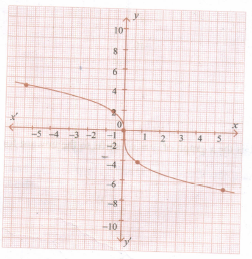
\(Let \ y=-x^{ ^{ \frac { 1 }{ 3 } } }\)
\(Then \ y=-x^{ ^{ \frac { 1 }{ 3 } } }\) is the reflection of the graph of \(y=x^{ ^{ \frac { 1 }{ 3 } } }\) about the x-axis.
(ii) \(y=x^{1\over 3}+1\)
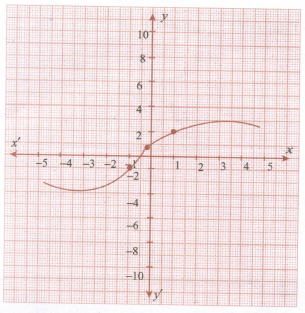
Let \(y=x^{ ^{ \frac { 1 }{ 3 } } }\)
Then \(y=x^{ ^{ \frac { 1 }{ 3 } } }+1\) is the x graph of \(y=x^{ ^{ \frac { 1 }{ 3 } } }\) shifts to the upward for one unit
(iii) \(y=x^{1\over 3}-1\)
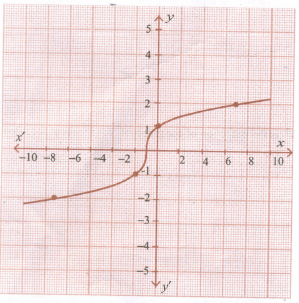
Let \(y=x^{1\over 3}\)
Then \(y=x^{1\over 3}\)-1 is the graph of \(x^{ ^{ \frac { 1 }{ 3 } } }\) shifts to the downward for one unit.
(iv) \(y=(x+1)^{1\over 3}\)
| x | 0 | 1 | 7 | -9 |
| y | 1 | 1 | 2 | -2 |
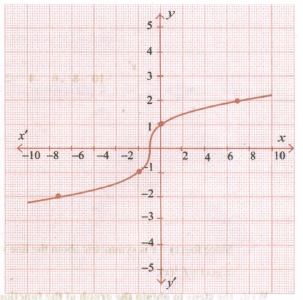
\(y=(x+1)^{1\over 3}\) causes the graph of \({x}^{\frac{1}{3}}\), shifts to the left for one unit.
6.
(i) y = -x3
| x | 0 | 1 | -1 | 2 | -2 |
| y | 0 | -1 | 1 | -8 | 8 |
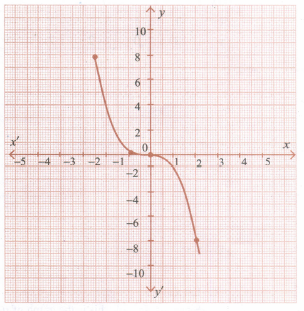
Let f(x) = x3
Since y = -f(x), this is the reflection of the graph off about the x-axis.
(ii) y = x3+1
| x | 0 | 1 | -1 | 2 | -2 |
| y | 1 | 2 | 9 | 9 | -7 |
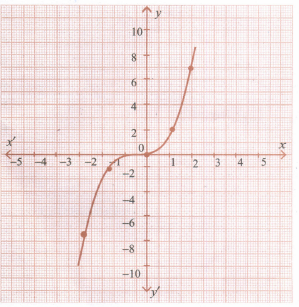
Let f(x) = x3
Since y = f(x) + 1, this is the graph of f(x) shifts to the upward for one unit.
(iii) y=x3-1
| x | 0 | 1 | -1 | 2 | -2 |
| y | -1 | 0 | -2 | 7 | -9 |
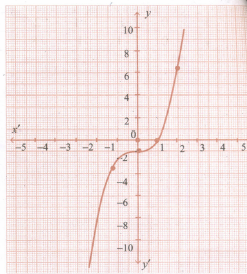
Let f(x) = x3
Since y = f(x) -1, this is the graph of (x) shifts to the downward for one unit.
(iv) y = (x + 1)3
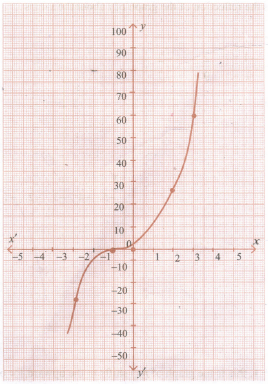
Let f(x) = x3
y = (x + 1)3, causes the graph of f(x) shifts to the left for one unit.
7.
If x < -3 or x > 3, then x2 will be greater than 9 and hence 9 - x2 will become negative which has no square root in R.
So x must lie on the interval [- 3, 3].
Also if \(x\ge-1\) or \(x\le 1,\) then x2-1 will become negative or zero. If it is negative, x2 - 1 has no square root in R. If it is zero, f is not defined. So, x must lie outside [- 1, 1].
That is x must lie on \(( -\infty,-1 ]\cup[1,\infty),\) Combining these two conditions, the largest possible domain for f is \([-3,3]\cap((-\infty, -1)\cup(1,\infty)).\) That is \([-3,-1)\cup(1, 3].\)
8.
Range of cosine function is -1 \(\le \)cos x \(\le \) 1
\(\Rightarrow\) -2 \(\le \) 2 cos x \(\le \) 2 (Multiplied by 2)
\(\Rightarrow\) -2 -1 \(\le \) 2 cos x -1 \(\le \) 2-1
\(\Rightarrow\) -3 \(\le \) 2 cos x-1 \(\le \) 1
\(\Rightarrow \frac { -1 }{ 3 } >\frac { 1 }{ 2cosx-1 } >\frac { 1 }{ 1 } \)
\(\Rightarrow \frac { -1 }{ 3 } f(x)>1\)
\(\therefore \ Range \) \(=\left(-\infty,-\frac{1}{3}\right] \cup[1, \infty)\)
9.
(i) f( m) = f( n) \(\Rightarrow\) m2 = n2 \(\Rightarrow\) m = n since \(m,\ n\in N.\) Thus f is one-to-one. But, non-perfect square elements in the co-domain do not have pre-images and hence not onto.
(ii) Two different elements in the domain have same images and hence f is not one-to-one. Clearly the range of f is a proper subset of R. Thus it is not onto.

11th Standard Syllabus & Materials
11th Standard
TN 11th Tamil பீடு பெற நில் - செய்யுள் - காவடிச்சிந்து Important Questions And Answers Study Material - QB365 Set A
NEW11th Standard
TN 11th Tamil பீடு பெற நில் - உரைநடை - மலை இடப்பெயர்கள் : ஓர் ஆய்வு Important Questions And Answers Study Material - QB365 Set A
NEW11th Standard
TN 11th Tamil மாமழை போற்றுதும் - துணைப்பாடம் - யானை டாக்டர் Important Questions And Answers Study Material - QB365 Set A
NEW11th Standard
TN 11th Tamil மாமழை போற்றுதும் - செய்யுள் - ஐங்குறுநூறு Important Questions And Answers Study Material - QB365 Set A



Tamilnadu Stateboard 11th Standard Subjects
Maths

Commerce

Economics

Biology

Business Maths and Statistics

Accountancy

Computer Science

Physics

Chemistry
Maths
Biology
Economics
Physics
Chemistry

History
Business Maths and Statistics

Computer Science
Accountancy

Computer Applications
History
Computer Technology
Commerce
Computer Applications
Computer Technology

Tamil

English

French
Tamilnadu Stateboard Standards



