
 100% FREE ACCESS
11th Standard Syllabus & Materials
11th Standard
TN 11th Tamil இயற்கை வேளாண்மை,சுற்றுச்சூழல் -செய்யுள் - மனோன்மணீயம் Important Questions And Answers Study Material - QB365 Set A
NEW11th Standard
TN 11th Tamil என்னுயிர் என்பேன் -துணைப்பாடம் - இசைத்தமிழர் இருவர் Important Questions And Answers Study Material - QB365 Set A
NEW11th Standard
TN 11th Tamil மொழி கலை -செய்யுள் - ஒவ்வொரு புல்லையும் Important Questions And Answers Study Material - QB365 Set A
NEW11th Standard
TN 11th Tamil பீடு பெற நில் - இலக்கணம் - பகுபத உறுப்புகள் Important Questions And Answers Study Material - QB365 Set A
NEW11th Standard
TN 11th Tamil பீடு பெற நில் - துணைப்பாடம் - வாடிவாசல் Important Questions And Answers Study Material - QB365 Set A
NEW11th Standard
TN 11th Tamil பீடு பெற நில் - செய்யுள் - குறுந்தொகை Important Questions And Answers Study Material - QB365 Set A

Published on: 07/06/2021
QB365 provides detailed and simple solution for every book back questions in class 11 Maths subject.It will helps to get more idea about question pattern in every book back questions with solution.
Download Tamil Nadu 11th Standard Maths question papers, model tests, one-mark questions, important questions, and public exam papers in PDF format. Free study materials and answer keys for TN State Board students.
Questions + Answers key
Take MCQ Maths Test1.
If θ is a parameter, find the equation of the locus of a moving point, whose coordinates are x = a cos3 θ, y = a sin3 θ.
2.
A ray of light coming from the point (1, 2)is reflected at a point A on the x-axis and it passes through the point (5, 3). Find the co-ordinates of the point A.
3.
An object was launched from a place P in constant speed to hit a target. At the 15th second it was1400m away from the target and at the 18th second 800m away. Find
(i) the distance between the place and the target.
(ii) the distance covered by it in 15 seconds.
(iii) time taken to hit the target.
4.
The normal boiling point of water is 100°C or 212°F· and the freezing point of water is 0 °C or 32°F.
(i) Find the linear relationship between C and F.
(ii) Find the value of C for 98.6°F and
(iii) Find the value of F for 38°C.
5.
The sum of the distance of a moving point from the points (4, 0) and (-4, 0) is always 10 units. Find the equation to the locus of the moving point.
6.
If Q is a point on the locus of x2 + y2+ 4x - 3y + 7 = 0, then find the equation of locus of P which divides segment OQ externally in the ratio 3 : 4, where O is origin.
7.
lf P(2,-7) is a given point and Q is a point on (2x2 + 9y2 = 18), then find the equations of the locus of the mid-point of PQ.
8.
Find the equation of the locus of the point P such that the line segment AB, joining the points A(1, -6) and B(4,-2), subtends a right angle at P.
9.
Find the equation of the locus of a point such that the sum of the squares of the distance from the points (3, 5), (1, -1) is equal to 20.
10.
A straight rod of length 8 units slides with its ends A and B always on the x and y axes respectively. Find the locus of the mid point of the line segment AB.
1.
Given x = a cos3 \(\theta\) , y = a sin3 \(\theta\)
\(\Rightarrow \quad \frac { x }{ a } ={ cos }^{ 3 }\theta \quad and\quad \frac { y }{ a } ={ sin }^{ 3 }\quad \theta \)
Taking power \(\left( \frac { 2 }{ 3 } \right) \)for both the equations, we get
\({ \left( \frac { x }{ a } \right) }^{ \frac { 2 }{ 3 } }={ \left( { cos }^{ 3 }\theta \right) }^{ \frac { 2 }{ 3 } }and\)
\({ \left( \frac { y }{ a } \right) }^{ \frac { 2 }{ 3 } }={ { (sin }^{ 3 }\theta })^{ \frac { 2 }{ 3 } }\)
\({ \left( \frac { x }{ a } \right) }^{ \frac { 2 }{ 3 } }={ cos }^{ 2 }\theta \quad and\quad { \left( \frac { y }{ a } \right) }^{ \frac { 2 }{ 3 } }={ sin }^{ 2 }\theta \)
We know that cos2 \(\theta\) + sin2 \(\theta\) = 1
\(\therefore { \left( \frac { x }{ a } \right) }^{ \frac { 2 }{ 3 } }+{ \left( \frac { y }{ a } \right) }^{ \frac { 2 }{ 3 } }=1\)
\(\Rightarrow \quad \frac { { x }^{ \frac { 2 }{ 3 } } }{ { x }^{ \frac { 2 }{ 3 } } } +\frac { { x }^{ \frac { 2 }{ 3 } } }{ { x }^{ \frac { 2 }{ 3 } } } =1\)
\(\Rightarrow \quad \frac { { x }^{ \frac { 2 }{ 3 } }+{ y }^{ \frac { 2 }{ 3 } } }{ { a }^{ \frac { 2 }{ 3 } } } =1\)
\(\Rightarrow \quad { x }^{ \frac { 2 }{ 3 } }+{ y }^{ \frac { 2 }{ 3 } }={ a }^{ \frac { 2 }{ 3 } }\)
\(\therefore \) The required point is (0, 12)
2.
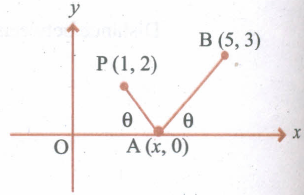
Let P(1, 2) and B(5, 3) are the given points.
By the property of reflector \(\angle \) XAB = \(\angle \) OAP = \(\theta\)
Let m1 be the slope of the x-axis, m2 and m3 be the slopes of the lines AP and AB.
To find XAB,
Clearly m1 = 0 Since it represents slope of x-axis.
\({ m }_{ 2 }=\frac { 2-0 }{ 1-x } =\frac { 2 }{ 1-x } and\left[ m=\frac { { y }_{ 2 }-{ y }_{ 1 } }{ { x }_{ 2 }-{ x }_{ 1 } } \right] \)
\({ m }_{ 3 }=\frac { 3-0 }{ 5-x } =\frac { 3 }{ 5-x } \)
\(tan\ \theta =\left| \frac { { m }_{ 1 }-{ m }_{ 3 } }{ 1+{ m }_{ 1 }.{ m }_{ 3 } } \right| \)
\(tan\ \theta =\left| \frac { 0-\frac { 3 }{ 5-x } }{ 1+0\left( \frac { 3 }{ 5 } -x \right) } \right| =\frac { 3 }{ 5-x } \)
To find \(\angle \)OAP,
\(tan(-\theta )=\left| \frac { { m }_{ 1 }-{ m }_{ 2 } }{ 1+{ m }_{ 1 }{ m }_{ 2 } } \right| =\left| \frac { 0-\frac { 2 }{ 1-x } }{ 1+0\left( \frac { 2 }{ 1-x } \right) } \right| =\frac { 2 }{ 1-x } \) [Since OAP is in the clockwise direction]
\(\Rightarrow \ -tan\theta =\frac { 2 }{ 1-x } \ \quad [\because tan\theta (-\theta )=tan\quad \theta ]\)
\(\Rightarrow \quad tan\quad \theta =\frac { -2 }{ 1-x } \)
From (1) and (2),
\(\frac { 3 }{ 5-x } =\frac { -2 }{ 1-x } \Rightarrow 3-3x=-10+2x\)
\(\Rightarrow\) 3 + 10 = 2x + 3x
\(\Rightarrow\) 13 = 5x
\(\Rightarrow \ x=\frac { 13 }{ 5 } \)
The required co-ordinates of A is \( \left( \frac { 13 }{ 5 } ,0 \right) \)
3.
(i) the distance between the place and the target.
| Time | distance |
|---|---|
| 15 | d-1400 |
| 18 | d-800 |
Let d be the distance between the place and the target.
Since the speed IS constant and speed = \(\frac{distance}{time}\) we get
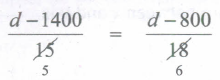
⇒ 6(d-1400) = 5(d-800)
⇒ 6(d-1400) = 5(d-800)
⇒ 6d-8400 = 5d-4000
⇒ d = 4400 m
(ii) the distance covered by it in 15 seconds.
| Time | distance |
| 15 | d-1400 = 4400 - 1400 = 3000 |
| 18 | d-800 = 4400 - 800 = 3600 |
using two point form
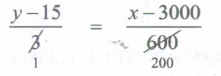
⇒ y-15 = \(\frac{x-300}{200}\)
When time = 15 sec
15-15 = \(\frac{x-300}{200}\)
⇒ \(\frac{x-300}{200}\) = 0
x = 3000 m
(iii) time taken to hit the target.
By the given data
T1(15th sec) D1 (1400 m)
T2(18th sec) D2(800 m)
Using two point form, the linear relationship between time and distance is
\(\frac { T-{ T }_{ 1 } }{ { T }_{ 2 }-{ T }_{ 1 } } =\frac { D-{ D }_{ 1 } }{ { D }_{ 2 }-{ D }_{ 1 } } \)
\(\Rightarrow \quad \frac { T-15 }{ 18-15 } =\frac { D-1400 }{ 800-1400 } \quad \quad \Rightarrow \quad \frac { T-15 }{ 3 } =\frac { D-1400 }{ -600 } \)
\(\Rightarrow \quad T-15=\frac { 1400-D }{ 200 } \quad \Rightarrow \quad T=\frac { 1400-D }{ 200 } +15\)
Putting D = 0 \(\Rightarrow\) \(T=\frac { 1400 }{ 200 } +15=7+15=22\quad sec\)
4.
(i) Find the linear relationship between C and F.
By the given data
x1 (100°C) y1(212°F)
x2(0°C) y2(32°F)
Using two point form, the linear relationship between C and F is
\(\frac { y-{ y }_{ 1 } }{ { y }_{ 2 }-{ y }_{ 1 } } =\frac { x-{ x }_{ 1 } }{ { x }_{ 2 }-{ x }_{ 1 } } \)
\(\frac { y-212 }{ 32-212 } =\frac { x-100 }{ 0-100 } \)
\(\Rightarrow \quad \frac { y-212 }{ -180 } =\frac { x-100 }{ -100 } \)
\(\Rightarrow \quad \frac { y-212 }{ 9 } =\frac { x-100 }{ 5 } =\frac { 5 }{ 9 } (y-212)=x-100\)
\(\Rightarrow \quad x=\frac { 5 }{ 9 } (y-212)+100\quad \Rightarrow \quad x=\frac { 5 }{ 9 } y-\frac { 5 }{ 9 } \times 212+100\)
\(\Rightarrow \quad x=\frac { 5 }{ 9 } y-118+100\quad \Rightarrow x=\frac { 5 }{ 9 } y-18\)
\(\Rightarrow \quad x=\frac { 5 }{ 9 } (y-32) \Rightarrow C=\frac { 5 }{ 9 } (F-32)\quad .....(1)\)
[\(\because \) x represents Celsius and y represents Fahrenheit]
Which is the required relationship between C and F.
(ii) Find the value of C for 98.6°F and
Find C when F = 98.6° F
Substituting F = 98.6° in (1) we get,
C = \(\frac{5}{9}(98.6-32)=\frac{5}{9}(66.6)=\frac{333}{9}=37°\)
(iii) Find the value of F for 38°C.
Substituting C = 38° in (1) we get,
38=\(\frac{5}{9}(F-32)\)
⇒ \(\frac{342}{5}+32\) = F
⇒ F = 100.4°C
5.
Let P(h, k) be the locus of the point and A(4, 0) B(-4, 0) are the given points.
Given PA + PB = 10
\(\sqrt { { (h-4) }^{ 2 }+{ (k-0) }^{ 2 } } +\sqrt { { (h+4) }^{ 2 }+{ k-0) }^{ 2 } } =10\)
\(\sqrt { { (h-4) }^{ 2 }+{ k }^{ 2 } } =10-\sqrt { { (h+4) }^{ 2 }+{ k }^{ 2 } } \)
Squaring both sides we get,
\({ (h-4) }^{ 2 }+{ k }^{ 2 }=100+[({ h }+4)^{ 2 }+{ k }^{ 2 }]-20\sqrt { { (h+4) }^{ 2 }+{ k }^{ 2 } } \)
\(\Rightarrow \ { h }^{ 2 }-8h+16+{ k }^{ 2 }=100+{ h }^{ 2 }+16+8h+{ k }^{ 2 }-20\sqrt { { (h+4) }^{ 2 }+{ k }^{ 2 } } \)
\(\Rightarrow \ { h }^{ 2 }-8h+16+{ k }^{ 2 }-100+{ h }^{ 2 }+16+8h+{ k }^{ 2 }-20\sqrt { { (h+4) }^{ 2 }+{ k }^{ 2 } } \)
\(\Rightarrow -16h-100=-20\sqrt { { (h+4) }^{ 2 }+{ k }^{ 2 } } \)
Dividing by -4, we get
4h + 25 = \(\\ 5\sqrt { ({ h+4) }^{ 2 }+{ k }^{ 2 } } \)
Squaring both sides we get,
\(\Rightarrow\) (4h + 25)2 = 25(h2+ 8h + 16 + k2)
\(\Rightarrow\) 16h2 + 625 + 200h = 25h2+ 400 + 200h + 25k2
\(\Rightarrow\) 9h2 + 25k2 = 225
\(\Rightarrow\) 9h2+ 25k2 = 225
Dividing by 225, we get
\(\Rightarrow \ \frac { { h }^{ 2 } }{ 25 } +\frac { { k }^{ 2 } }{ 9 } =1\)
\(\therefore \) Locus of (h, k) is \(\frac{x^2}{25}+\frac{y^2}{9}=1\)
6.
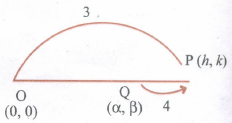
Let P(h, k) be any point on the locus
Let P(\(\alpha \), \(\beta\)) be the point.
Given P divides OQ externally in the ratio 3: 4
\(\therefore \ (h,k)=\left( \frac { 3\alpha -4(0) }{ 3-4 } ,\frac { 3\beta -4(0) }{ 3-4 } \right) \ \left[ \because (z,y)=\left( \frac { { mx }_{ 2 }-{ nx }_{ 1 } }{ m-n } ,\frac { { my }_{ 2 }-{ ny }_{ 1 } }{ m-n } \right) \right] \)
\(\therefore \ (h,k)=\left( \frac { 3\alpha }{ -1 } ,\frac { 3\beta }{ -1 } \right) \)
\(\Rightarrow \ (h,k)=\left( -3\alpha ,-3\beta ) \right) \)
Equating the like co-ordinates both sides we get
\(\Rightarrow h= -3\alpha \Rightarrow k=-3\beta \)
\(\Rightarrow a=\frac { -h }{ 3 } \Rightarrow \beta =\frac { -k }{ 3 } \)
Since Q(\(\alpha \), \(\beta\)) lies on the locus of x2+ y2+ 4x - 3y+ 7 = 0, we get \({ \left( \frac { -h }{ 3 } \right) }^{ 2 }+{ \left( \frac { -k }{ 3 } \right) }^{ 2 }+4{ \left( \frac { -h }{ 3 } \right) }-3{ \left( \frac { -k }{ 3 } \right) }+7=0\)
\(\Rightarrow \frac { { h }^{ 2 } }{ 9 } +\frac { { k }^{ 2 } }{ 9 } -\frac { 4h }{ 3 } +k=7=0\)
Multiplying by 9, throughout we get,
h2+ k2-12h + 9k + 63 = 0
\(\therefore\) Locus of (h,k) is x2+ y2-12x + 9y + 63 = 0
7.
Let R(h, k) be the locus of the mid-point of PQ where, P is (2, -7) and Q is a point on (2x2 + 9y2 = 18)
Given equation is 2x2 + 9y2 = 18
Dividing by 18 we get,
\(\Rightarrow \quad \frac { { x }^{ 2 } }{ 9 } +\frac { { y }^{ 2 } }{ 2 } =1\)
\(\Rightarrow \quad \frac { { x }^{ 2 } }{ { 3 }^{ 2 } } +\frac { { y }^{ 2 } }{ { \left( \sqrt { 2 } \right) }^{ 2 } } =1\)
\(\Rightarrow \quad a=3\quad and\quad b=\sqrt { 2 } \)
Any point on the ellipse is (a cos \(\theta\), b sin \(\theta\))
\(\therefore\) Q is (3 cos \(\theta\), \(\sqrt { 2 } \) sin \(\theta\)
Since R is the mid-point of PQ, we get, (h,k) = \(\left( \frac { 2+3cos\theta }{ 2 } ,\frac { -7+\sqrt { 2 } sin\theta }{ 2 } \right) \)
\(\Rightarrow \quad h=\frac { 2+3\quad cos\quad \theta }{ 2 } \)
\(\Rightarrow \quad 2h=2+3cos\theta \)
\(\Rightarrow \quad 2h-2=3cos\theta \)
\(\Rightarrow \quad \frac { 2h-2 }{ 3 } =cos\quad \theta \)
\(k=\frac { -7+\sqrt { 2 } sin\theta }{ 2 } \)
\(\Rightarrow \quad 2k=-7+\sqrt { 2 } sin\theta \)
\(\Rightarrow \quad 2k+7\quad =\quad \sqrt { 2 } sin\theta \)
\(\Rightarrow \quad \frac { 2k+7 }{ \sqrt { 2 } } =sin\quad \theta \)
Squaring and adding we get,
\({ \left( \frac { 2h-2 }{ 3 } \right) }^{ 2 }+{ \left( \frac { 2k+7 }{ \sqrt { 2 } } \right) }^{ 2 }={ cos }^{ 2 }\theta +{ sin }^{ 2 }\theta \)
\(\Rightarrow \quad \frac { { 4h }^{ 2 }+4-8h }{ 9 } +\frac { { 4k }^{ 2 }+49+28k }{ 2 } =1\quad [\because { cos }^{ 2 }\theta +{ sin }^{ 2 }\theta =1]\)
\(\Rightarrow \quad 2({ 4h }^{ 2 }+4-8h)=9({ 4k }^{ 2 }+49+28k)=18\)
\(\Rightarrow \quad { 8h }^{ 2 }+8-16h+36{ k }^{ 2 }+441+252k-18=0\)
\(\Rightarrow \quad { 8h }^{ 2 }+36{ k }^{ 2 }-16h+252k+431=0\)
\(\therefore\) Locus of (h,k) is
8x2+36y2-16x+252y+431=0
8.
Let P(h, k) be the point on the locus and A(1, -6) B(4, -2) be the given points.
By the given condition, \(\angle APB=90°\)
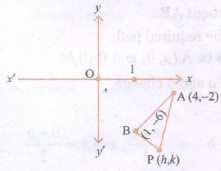
\(\therefore \) \(\Delta\) APB is a right angled triangle
\(\Rightarrow\) AB2 = PA2 + PB2
\(\Rightarrow { (1-4) }^{ 2 }+(-6+{ 2) }^{ 2 }={ (h-1) }^{ 2 }+{ (k+6) }^{ 2 }+{ (h-4) }^{ 2 }+{ (k+2) }^{ 2 }\)
\(\Rightarrow 9+16={ h }^{ 2 }-2h+1+{ k }^{ 2 }+36+12k+{ h }^{ 2 }-8h+16+{ k }^{ 2 }+4k+4\)
\(\Rightarrow { 2h }^{ 2 }+2{ k }^{ 2 }-10h+16k+57-25=0\)
\( \Rightarrow { 2h }^{ 2 }+{ 2k }^{ 2 }-10h+16k+32=0\)
Dividing by 2, we get,
\(\Rightarrow { h }^{ 2 }+{ k }^{ 2 }-5h+8k+16=0\)
\(\therefore\) Locus of (h, k) is
x2 + y2-5x+8y+16 = 0
9.
Let P(h, k) be the point on the locus and A(3, 5) B (1, -1) be the given points.
By the given condition, PA2 + PB2 = 20
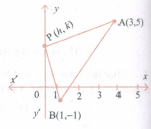
Given PA2 + PB2 = 20
⇒ (h - 3)2 + (k - 5)2 + (h - 1)2+ (k + 1)2 = 20
h2 - 6h + 9 + k2 - 10k + 25 + h2 - 2h + 1 + k2 + 2k + 1 = 20
⇒ 2h2 + 2k2 - 8h - 8k + 36 = 20
⇒ 2h2 + 2k2 - 8h - 8k + 36 - 20 = 0
Dividing by 2 we get,
h2 + k2 - 4h - 4k + 8 = 0
ஃ Locus of (h, k) is x2 + y2- 4x - 4y + 8 = 0
10.
Let (h, k) be the mid-point on the required path.
Let the co-ordinates of A and B be A(a, 0) and B(0, b).
As the rod slides, the values of a and b change.
So a and b are two variables.
Then \(h=\frac { a+0 }{ 2 } ,and\quad k=\frac { 0+b }{ 2 } \)
\(\Rightarrow \ h=\frac { a }{ 2 } and\quad k=\frac { b }{ 2 } \)
\(\Rightarrow\) a = 2h and b = 2k
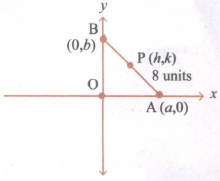
From \(\Delta\)OAB we have
AB2 = OA2 + OB2
\(\Rightarrow\) a2 + b2 = 82 [\(\because\) AB = 8 units]
\(\Rightarrow\) (2h)2 + (2k)2 = 64
\(\Rightarrow\) 4h2 + 4k2 = 64
\(\Rightarrow\) h2 + k2 = 16 [Dividing by 4]
\(\therefore\) Locus of (h, k) is x2 + y2 = 16

11th Standard Syllabus & Materials
11th Standard
TN 11th Tamil பீடு பெற நில் - செய்யுள் - காவடிச்சிந்து Important Questions And Answers Study Material - QB365 Set A
NEW11th Standard
TN 11th Tamil பீடு பெற நில் - உரைநடை - மலை இடப்பெயர்கள் : ஓர் ஆய்வு Important Questions And Answers Study Material - QB365 Set A
NEW11th Standard
TN 11th Tamil மாமழை போற்றுதும் - துணைப்பாடம் - யானை டாக்டர் Important Questions And Answers Study Material - QB365 Set A
NEW11th Standard
TN 11th Tamil மாமழை போற்றுதும் - செய்யுள் - ஐங்குறுநூறு Important Questions And Answers Study Material - QB365 Set A



Tamilnadu Stateboard 11th Standard Subjects
Maths

Commerce

Economics

Biology

Business Maths and Statistics

Accountancy

Computer Science

Physics

Chemistry
Maths
Biology
Economics
Physics
Chemistry

History
Business Maths and Statistics

Computer Science
Accountancy

Computer Applications
History
Computer Technology
Commerce
Computer Applications
Computer Technology

Tamil

English

French
Tamilnadu Stateboard Standards



