
 100% FREE ACCESS
11th Standard Syllabus & Materials
11th Standard
TN 11th Tamil இயற்கை வேளாண்மை,சுற்றுச்சூழல் -செய்யுள் - மனோன்மணீயம் Important Questions And Answers Study Material - QB365 Set A
NEW11th Standard
TN 11th Tamil என்னுயிர் என்பேன் -துணைப்பாடம் - இசைத்தமிழர் இருவர் Important Questions And Answers Study Material - QB365 Set A
NEW11th Standard
TN 11th Tamil மொழி கலை -செய்யுள் - ஒவ்வொரு புல்லையும் Important Questions And Answers Study Material - QB365 Set A
NEW11th Standard
TN 11th Tamil பீடு பெற நில் - இலக்கணம் - பகுபத உறுப்புகள் Important Questions And Answers Study Material - QB365 Set A
NEW11th Standard
TN 11th Tamil பீடு பெற நில் - துணைப்பாடம் - வாடிவாசல் Important Questions And Answers Study Material - QB365 Set A
NEW11th Standard
TN 11th Tamil பீடு பெற நில் - செய்யுள் - குறுந்தொகை Important Questions And Answers Study Material - QB365 Set A

Published on: 13/05/2022
QB365 provides detailed and simple solution for every book back questions in class 11 Maths subject.It will helps to get more idea about question pattern in every book back questions with solution.
latest Book back QuestionsDownload Tamil Nadu 11th Standard Maths question papers, model tests, one-mark questions, important questions, and public exam papers in PDF format. Free study materials and answer keys for TN State Board students.
Questions + Answers key
Take MCQ Maths Test1.
Let ABC be a triangle,\(\overrightarrow{BC}=\overrightarrow{a},\overrightarrow{CA}=\overrightarrow{b}\) and \(\overrightarrow{AB}=\overrightarrow{c}\). Then prove that \(\overrightarrow {a}\times \overrightarrow {b}=\overrightarrow {b}\times \overrightarrow {c}=\overrightarrow {c}\times \overrightarrow {a}.\)
2.
Let \(\overrightarrow { a } ,\overrightarrow { b } \) and \(\overrightarrow { c } \) be unit vectors such that \(\overrightarrow { a } \) is perpendicular to both \(\overrightarrow { b } \) and \(\overrightarrow { c } \) and further the angle between \(\overrightarrow { b } \) and \(\overrightarrow { c } \) is \(\frac { \pi }{ 6 } \). Then \(\overrightarrow { a } =\pm 2\left( \overrightarrow { b } \times \overrightarrow { c } \right) \)
3.
If \(\left| \vec { a } \right| =\left| \vec { b } \right| =\left| \vec { a } +\vec { b } \right| \)=1 then prove that \({ \left| \vec { a } -\vec { b } \right| }=\sqrt { 3 } \)
4.
If \(\vec{a}, \vec{b}\) and \(\vec{c}\) are three vectors such that \(\left| \vec { a } \right| =3.\left| \vec { b } \right| =4\) and \(\left| \vec { c } \right| =\sqrt { 24 } \) sum of any two vectors is orthogonal to the third vector, then find \(\left| \vec { a } +\vec { b } +\vec { c } \right| \).
5.
Let \(\vec{a}=2\hat{i}+\hat{j}-2\hat{k}\) and \(\vec{b}=\hat{i}+\hat{j}\) . Let \(\vec{c}\) be a vector such that \(\vec { a } .\vec { c } =\left| \vec { c } \right| ,\left| \vec { c } -\vec { a } \right| =2\sqrt { 2 } \) and the angle between and is 30o.Then find the value of \(\left| (\vec { a } \times \vec { b } )\times \vec { c } \right| \)
6.
Let A, Band C represent the angles of a \(\triangle\)ABC and a, b, c represent the lengths of the sides opposite to them, then prove that a = b cos C + c cos B (Projection formula)
7.
Let \(\overrightarrow { a } =\hat { i } +\hat { j } +2\hat { k } \) and \(\overrightarrow { b } =\hat { i } +2\hat { j } +\hat { k } \) and \(\overrightarrow { c } \) be a unit vectorin the plane determined by \(\overrightarrow { a } \) and \(\overrightarrow { b } \). If \(\overrightarrow { c } \) is perpendicular to the vector \(\hat { i } +\hat { j } +\hat { k } \) and makes an obtuse angle with \(\overrightarrow { a } \), then prove that \(\overrightarrow { c } =\frac { \hat { j } -\hat { k } }{ \sqrt { 2 } } \)
8.
Let A, Band C represent the angles of a \(\triangle\)ABC and a, band c represent the lengths of the sides opposite to them, then prove that a2 = b2 + c2 - 2bc cos A (Law of cosines)
9.
Prove that the smallar angle between any two diagonals of a cube is cos-1 \(({1\over3})\).
10.
Three vectors \(\overrightarrow{a},\overrightarrow{b}\)and \(\overrightarrow{c}\) are such that \(|\overrightarrow{a}|=2,|\overrightarrow{b}|=3,|\overrightarrow{c}|=4,\) and \(\overrightarrow{a}+\overrightarrow{b}+\overrightarrow{c}=\overrightarrow{0}\) .Find \(4\overrightarrow{a}.\overrightarrow{b}+3\overrightarrow{b}.\overrightarrow{c}+3\overrightarrow{c}.\overrightarrow{a}.\)
1.
Consider \(\overrightarrow {a}+ \overrightarrow {b}+\overrightarrow {c}=\)\(\overrightarrow{BC}+\overrightarrow{CA}+\overrightarrow{AB}=\overrightarrow{BA}+\overrightarrow{AB}=\overrightarrow{0}\)
\(\overrightarrow {a}+ \overrightarrow {b}=-\overrightarrow {c}\)
\(\overrightarrow {a}\times \overrightarrow {b}=\overrightarrow {a}\times (\overrightarrow {a}+\overrightarrow {b})\) \([\because \overrightarrow {a}\times (\overrightarrow {a}+\overrightarrow {b})=\overrightarrow {a}\times \overrightarrow {a}+\overrightarrow {a}\times \overrightarrow {b}=0+\overrightarrow {a}\times \overrightarrow {b}\)\(=0+\overrightarrow {a}\times \overrightarrow {b}=\overrightarrow {a}\times \overrightarrow {b}]\)
\(=\overrightarrow {a}\times (-\overrightarrow {c})+-\overrightarrow {a}\times \overrightarrow {c}\)
\(\overrightarrow {a}\times\overrightarrow {b} =\overrightarrow {c}\times \overrightarrow {a}\) ....(1)
and \(\overrightarrow {b}\times\overrightarrow {c} =\overrightarrow {b}\times (\overrightarrow {b}+\overrightarrow {c})=\overrightarrow {b}\times (\overrightarrow {a})\)
and \(\overrightarrow {b}\times\overrightarrow {c} =-\overrightarrow {b}\times\overrightarrow {a} =\overrightarrow {a}\times \overrightarrow {b}\).....(2)
From (1)and (2), \(\overrightarrow {a}\times\overrightarrow {b} =\overrightarrow {b}\times\overrightarrow {c} =\overrightarrow {c}\times \overrightarrow {a}\)
2.
Given \(\overrightarrow { a } \) is perpendicular to both \(\overrightarrow { b } \) and \(\overrightarrow { c } \)
\(\overrightarrow { a } =\lambda (\overrightarrow { b } \times \overrightarrow { c } )\) for some scalar \(\lambda \)
\(\Rightarrow \quad 1={ |\overrightarrow { a } | }^{ 2 }={ \lambda }^{ 2 }|\overrightarrow { b } \times \overrightarrow { c } |^{ 2 }\quad \Rightarrow 1={ \lambda }^{ 2 }[|{ \overrightarrow { b } | }^{ 2 }{ |\overrightarrow { c } | }^{ 2 }-(\overrightarrow { b } .\overrightarrow { c } )^{ 2 }]\)
\(\Rightarrow 1={ \lambda }^{ 2 }[1(1)-{ |\overrightarrow { b } | }^{ 2 }{ |\overrightarrow { c } | }^{ 2 }-{ cos }^{ 2 }\left( \frac { \pi }{ 6 } \right) ]\quad \Rightarrow 1={ \lambda }^{ 2 }[1-{ cos }^{ 2 }\left( \frac { \pi }{ 6 } \right) ]\)
\(\Rightarrow 1={ \lambda }^{ 2 }[1-{ \left( \frac { \sqrt { 3 } }{ 2 } \right) }^{ 2 }]\ \Rightarrow 1={ \lambda }^{ 2 }[1-\frac { 3 }{ 4 } ]\)
\(\Rightarrow 1={ \lambda }^{ 2 }\left( \frac { 1 }{ 4 } \right) \)
\({ \lambda }^{ 2 }=4\)
\(\lambda =\pm 2\)
\(\therefore \overrightarrow { a } =\pm 2(\overrightarrow { b } \times \overrightarrow { c } )\)
3.
Given \(\left| \vec { a } +\vec { b } \right| =1\)
\({ \left| \vec { a } +\vec { b } \right| }^{ 2 }=1\)
\({ \left| \vec { a } \right| }^{ 2 }+{ \left| \vec { b } \right| }^{ 2 }+2(\vec { a } .\vec { b } )=1\)
1+1+2\({ \left| \vec { a } \right| }{ \left| \vec { b } \right| }\) cos\(\theta\) =1 where \(\theta\) is the angle between \(\vec{a}\)and \(\vec{b}\)
2+2(1)(1)cos\(\theta\) =1
cos\(\theta\) =1-2=-1
cos \(\theta\)=-\(\frac{1}{2}\)
Consider \({ \left| \vec { a } -\vec { b } \right| }^{ 2 }={ \left| \vec { a } \right| }^{ 2 }+{ \left| \vec { b } \right| }^{ 2 }-2(\vec { a } .\vec { b } )=1+1-2\left| \vec { a } \right| \left| \vec { b } \right| cos\theta \)
=2-2(1)(1) \(\left( -\frac { 1 }{ 2 } \right) \)=2+1=3
\(\therefore \left| \vec { a } -\vec { b } \right| =\sqrt { 3 } \)
4.
Given \((\vec { a } +\vec { b } ).\vec { c } =0\Rightarrow \vec { a } .\vec { c } +\vec { b } .\vec { c } =0\)
\((\vec { b } +\vec { c } ).\vec { a } =0\Rightarrow \vec { b } .\vec { a } +\vec { c } .\vec { a } =0\)
\((\vec { c } +\vec { a } ).\vec { b } =0\Rightarrow \vec { c } .\vec { b } +\vec { a } .\vec { b } =0\)
Adding 2\((\vec { a } .\vec { b } +\vec { b } .\vec { c } +\vec { c } .\vec { a } )=0\)
\(\vec { a } .\vec { b } +\vec { b } .\vec { c } +\vec { c } .\vec { a } =0\) --------(1)
\({ \left| \vec { a } +\vec { b } +\vec { c } \right| }^{ 2 }={ \left| \vec { a } \right| }^{ 2 }+{ \left| \vec { b } \right| }^{ 2 }+{ \left| \vec { c } \right| }^{ 2 }+2(\vec { a } .\vec { b } +\vec { b } .\vec { c } +\vec { c } .\vec { a } )\)
=9+16+24+2(0)=49
\(\Rightarrow { \left| \vec { a } +\vec { b } +\vec { c } \right| }=7\)
5.
Given \(\vec{a}=2\hat{i}+\hat{j}-2\hat{k}\)
\(\left| \vec { a } \right| =\sqrt { { 2 }^{ 2 }+{ 1 }^{ 2 }+({ -2) }^{ 2 } } =\sqrt { 4+1+4 } =\sqrt { 9 } \)=3
\(\vec { b } =\hat { i } +\hat { j } \)
\(\left| \vec { b } \right| =\sqrt { { 1 }^{ 2 }+{ 1 }^{ 2 } } =\sqrt { 2 } \)
\(\left| \vec { c } -\vec { a } \right| =2\sqrt { 2 } \)
\({ \left| \vec { c } -\vec { a } \right| }^{ 2 }={ (2\sqrt { 2 } ) }^{ 2 }\)
\(\therefore { \left| \vec { c } \right| }^{ 2 }+{ \left| \vec { a } \right| }^{ 2 }-2(\vec { c } .\vec { a } )=8\)
\({ \left| \vec { c } \right| }^{ 2 }+9-2\left| \vec { c } \right| =8\quad [\therefore \left| \vec { a } \right| =3,\vec { c } .\vec { a } =\left| \vec { c } \right| ]\)
\({ \left| \vec { c } \right| }^{ 2 }+2\left| \vec { c } \right| +1=0\)
\({ [\left| \vec { c } \right| -1] }^{ 2 }=0\)
\({ \left| \vec { c } \right| -1 }=0\) \(\Rightarrow { \left| \vec { c } \right| }=0\)
Also \(\vec { a } \times \vec { b } =\left| \begin{matrix} \hat { i } & \hat { j } & \hat { k } \\ 2 & 1 & -2 \\ 1 & 1 & 0 \end{matrix} \right| \begin{matrix} =\hat { i } (0+2)-\hat { j } (0+2)+\hat { k } (2-1) \\ =2\hat { i } -2\hat { j } +\hat { k } \end{matrix}\)
\(\left| \vec { a } \times \vec { b } \right| =\sqrt { { 2 }^{ 2 }+{ (-2) }^{ 2 }+{ 1 }^{ 2 } } =\sqrt { 4+4+1 } =\sqrt { 9 } =3\)
\(\therefore \left| (\vec { a } \times \vec { b } ).\vec { c } \right| =\left| \vec { a } \times \vec { b } \right| \left| \vec { c } \right| sin30\) [angle between \(\vec{a} \times \vec{b}\) and \(\vec{c}\) is 30o]
=3(1)\(\left( \frac { 1 }{ 2 } \right) =\left( \frac { 3 }{ 2 } \right) \)
6.
\(a^2=|\overrightarrow{a}|^2=|\overrightarrow{BC}|^2=\overrightarrow{BC}.\overrightarrow{BC}\)
\(=-(\overrightarrow{CA}+\overrightarrow{AB}).\overrightarrow{BC}\) \([\because \overrightarrow{BC}=\overrightarrow{BA}+\overrightarrow{CA}=\overrightarrow{BA}-\overrightarrow{CA}=-\overrightarrow{AB}-\overrightarrow{CA}]\)
\(=-\overrightarrow{CA}+.\overrightarrow{BC}-\overrightarrow{AB}.\overrightarrow{BC}=-|\overrightarrow{CA}||\overrightarrow{BC}|\) cos of angle between \(\overrightarrow{CA}\) and \(\overrightarrow{BC}\)\(-|\overrightarrow{AB}||\overrightarrow{BC}|\)cos of angle between \(\overrightarrow{AB}\) and\(\overrightarrow{BC}\)
= - ba cos (180 - C) - ca cos (180 - B)
a2= ab cos C + ac cos B [\(\therefore\) cos (180 - C) = - cos C;
a2= a (b cos C + c cos B) cos (180 - B) = - cos B]
a = b cos C + c cos B
Hence proved.
7.
Since \(\overrightarrow { c } \) is co-planar with \(\overrightarrow { a } \) and \(\overrightarrow { b } \)
Let \(\overrightarrow { c } =x\overrightarrow { a } +y\overrightarrow { b } \) where x, y are sclars.
\(\Rightarrow \overrightarrow { c } =x(\hat { i } +\hat { j } +2\hat { k } )+y(\hat { i } +2\hat { j } +\hat { k } )\)
\(\Rightarrow \overrightarrow { c } =\hat { i } (x+y)+\hat { j } (x+2y)+\hat { k } (2x+y)\)
\(\therefore |\overrightarrow { c } |=1\Rightarrow \sqrt { { (x+y) }^{ 2 }+{ (x+2y) }^{ 2 }+{ (2x+y) }^{ 2 } } =1\) ....(1)
Also, \(\overrightarrow { c } \) is perpendicular to \(\hat { i } +\hat { j } +\hat { k } \)
\(\Rightarrow \overrightarrow { c } .(\hat { i } +\hat { j } +\hat { k } )=0\)
\(\\ \\ \\ \Rightarrow \) (x+y)(1)+(x+2y)1+(2x+y)1 = 0
\(\Rightarrow \) 4x+4y = 0 \(\Rightarrow \) x = -y
Substituting y = -x in (1) we get,
\(\sqrt { 0+{ (-x) }^{ 2 }+{ (x) }^{ 2 } } =1\Rightarrow \sqrt { { 2x }^{ 2 } } =1\)
\(\Rightarrow{ 2x }^{ 2 }=1\Rightarrow { x }^{ 2 }=\frac { 1 }{ 2 } \Rightarrow x=\pm \frac { 1 }{ \sqrt { 2 } } \quad \)
\(\therefore\) when \(x=\frac { 1 }{ \sqrt { 2 } } ,y=-\frac { 1 }{ \sqrt { 2 } } \) and when \(x=-\frac { 1 }{ \sqrt { 2 } } ,y=\frac { 1 }{ \sqrt { 2 } } \)
\(\therefore x=\frac { 1 }{ \sqrt { 2 } } \) and \(y=-\frac { 1 }{ \sqrt { 2 } } \Rightarrow \overrightarrow { c } =-\frac { \hat { j } }{ \sqrt { 2 } } +\frac { \hat { k } }{ \sqrt { 2 } } \)
when \(x=-\frac { 1 }{ \sqrt { 2 } } \) , and \(y=\frac { 1 }{ \sqrt { 2 } } \Rightarrow \overrightarrow { c } =\frac { \hat { j } }{ \sqrt { 2 } } -\frac { \hat { k } }{ \sqrt { 2 } } \)
\(\therefore\) \(\overrightarrow { a } .\overrightarrow { c } =0+\frac { 1 }{ \sqrt { 2 } } -\frac { 2 }{ \sqrt { 2 } } =\frac { -1 }{ \sqrt { 2 } } <0\)
\(\overrightarrow { c } \) makes obtuse angle with \(\overrightarrow { a } \) means.
\(\overrightarrow { c } =\frac { \hat { j } -\hat { k } }{ \sqrt { 2 } } \)
8.
Let \(\overrightarrow{BC}=\overrightarrow{a},\overrightarrow{AC}=\overrightarrow{b},\overrightarrow{BA}=\overrightarrow{c}\)
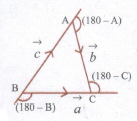
Then \(|\overrightarrow{a}|=a,|\overrightarrow{b}|=b,\) and \(|\overrightarrow{c}|=c\)
Since \(\overrightarrow{BC}=\overrightarrow{BA}+\overrightarrow{AC}\)
We have \(\overrightarrow{a}=\overrightarrow{c}+\overrightarrow{b}\) and angle between \(\overrightarrow{c}\) and \(\overrightarrow{b}\) is (180-A)
\(=|\overrightarrow{a}|^2=|\overrightarrow{c}+\overrightarrow{b}|^2=|\overrightarrow{c}|^2+|\overrightarrow{b}|^2+2|\overrightarrow{c}||\overrightarrow{b}|cos (180-A)\)
\(=c^2+b^2+2cb \ cos (180-A)\)
\(=b^2+c^2-2cb \ cos A\) \([\because cos(180-A)=-cos \ A]\)
9.
Let OABCDEFG be a unit cube.
Keeping O as origin.
Let \(\overrightarrow{OA}=\hat{i},\overrightarrow{OC}=\hat{j}\) and \(\overrightarrow{OG}=\hat{k}\)
Consider the diagonals OE and BG.
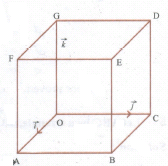
\(\overrightarrow{OE}=\overrightarrow{OB}+\overrightarrow{BE}=\overrightarrow{OA}+\overrightarrow{AB}+\overrightarrow{BE}\)
\(=\overrightarrow{OA}+\overrightarrow{OC}+\overrightarrow{OG}=\hat{i}+\hat{j}+\hat{k}\) \([\because \overrightarrow{AB}= \overrightarrow{OC}, \overrightarrow{BE}= \overrightarrow{OG}]\)
and \(\overrightarrow{GB}=\overrightarrow{GO}+\overrightarrow{OB}=-\hat{k}+\overrightarrow{OA}+\overrightarrow{AB}=\)\(\hat{i}+\hat{j}-\hat{k}\)
Let \(\theta\) be the smaller angle between the diagonals OE and GB, then
cos \(\theta\)=\({\overrightarrow{OE}.\overrightarrow{GB}\over|\overrightarrow{OE}||\overrightarrow{GB}|}=\)\({1(1)+1(1)+1(-1)\over \sqrt{1^2+1^2+1^2}.\sqrt{1^2+1^2+(-1)^2}}={2-1\over \sqrt{3}\sqrt{3}}={1\over3}\)
Thus \(\theta=\)cos-1 \(({1\over3})\)
10.
Given \(|\overrightarrow{a}|=2,|\overrightarrow{b}|=3,|\overrightarrow{c}|=4,\)and \(\overrightarrow{a}+\overrightarrow{b}+\overrightarrow{c}=\overrightarrow{0}\Rightarrow \overrightarrow{a}+\overrightarrow{b}=-\overrightarrow{c}\)
\(\therefore |\overrightarrow{a}+\overrightarrow{b}|^2=|\overrightarrow{c}|^2\)
\(\Rightarrow |\overrightarrow{a}|^2+|\overrightarrow{b}|^2+2(\overrightarrow{a}.\overrightarrow{b})=|\overrightarrow{c}|^2\)
\(\Rightarrow 4+9+2(\overrightarrow{a}.\overrightarrow{b})=16\)
\(\Rightarrow 13+2(\overrightarrow{a}.\overrightarrow{b})=16\)
\(\Rightarrow 2(\overrightarrow{a}.\overrightarrow{b})=16-13=3\)
\(\Rightarrow \overrightarrow{a}.\overrightarrow{b}={3\over2}\)
\(\Rightarrow4( \overrightarrow{a}.\overrightarrow{b})=4\times {3\over2}=6\).....(1)
Also \(\overrightarrow{b}+\overrightarrow{c}=-\overrightarrow{a}\)
\(|\overrightarrow{b}+\overrightarrow{c}|^2=|-\overrightarrow{a}|^2\)
\(|\overrightarrow{b}|^2+|\overrightarrow{c}|^2+2(\overrightarrow{b}.\overrightarrow{c})=|-\overrightarrow{a}|^2\)
\(9+16+2(\overrightarrow{b}.\overrightarrow{c})=4\)
\(25+2(\overrightarrow{b}.\overrightarrow{c})=4\)
\(2(\overrightarrow{b}.\overrightarrow{c})=4-25=-21\)
\((\overrightarrow{b}.\overrightarrow{c})={-21\over 2}\)
\(3(\overrightarrow{b}.\overrightarrow{c})=3({-21\over 2})={-63\over2}\)..(2)
Also, \(\overrightarrow{c}+\overrightarrow{a}=-\overrightarrow{b}\)
\(|\overrightarrow{c}+\overrightarrow{a}|=|-\overrightarrow{b}|\)
\(|\overrightarrow{c}+\overrightarrow{a}|^2=|-\overrightarrow{b}|^2\)
\(|\overrightarrow{c}|^2+|\overrightarrow{a}|^2+2(\overrightarrow{c}.\overrightarrow{a})=|\overrightarrow{b}|^2\)
\(16+4+2(\overrightarrow{c}.\overrightarrow{a})=9\)
\(20+2(\overrightarrow{c}.\overrightarrow{a})=9\)
\(\Rightarrow 2(\overrightarrow{c}.\overrightarrow{a})=9-20=-11\)
\((\overrightarrow{c}.\overrightarrow{a})={-11\over2}\)
\(\therefore 3(\overrightarrow{c}.\overrightarrow{a})=3({-11\over2})={-33\over2}\)....(3)
Adding (1), (2) and (3) we get,
\(4\overrightarrow{a}.\overrightarrow{b}+3\overrightarrow{b}.\overrightarrow{c}+3\overrightarrow{c}.\overrightarrow{a}=\)\(6-{63\over2}-{33\over2}={12-63-33\over 2}={12-96\over2}={-84\over2}=-42\)
\(\therefore 4\overrightarrow{a}.\overrightarrow{b}+3\overrightarrow{b}.\overrightarrow{c}+3\overrightarrow{c}.\overrightarrow{a}=-42\)

11th Standard Syllabus & Materials
11th Standard
TN 11th Tamil பீடு பெற நில் - செய்யுள் - காவடிச்சிந்து Important Questions And Answers Study Material - QB365 Set A
NEW11th Standard
TN 11th Tamil பீடு பெற நில் - உரைநடை - மலை இடப்பெயர்கள் : ஓர் ஆய்வு Important Questions And Answers Study Material - QB365 Set A
NEW11th Standard
TN 11th Tamil மாமழை போற்றுதும் - துணைப்பாடம் - யானை டாக்டர் Important Questions And Answers Study Material - QB365 Set A
NEW11th Standard
TN 11th Tamil மாமழை போற்றுதும் - செய்யுள் - ஐங்குறுநூறு Important Questions And Answers Study Material - QB365 Set A



Tamilnadu Stateboard 11th Standard Subjects
Maths

Commerce

Economics

Biology

Business Maths and Statistics

Accountancy

Computer Science

Physics

Chemistry
Maths
Biology
Economics
Physics
Chemistry

History
Business Maths and Statistics

Computer Science
Accountancy

Computer Applications
History
Computer Technology
Commerce
Computer Applications
Computer Technology

Tamil

English

French
Tamilnadu Stateboard Standards



