
 100% FREE ACCESS
11th Standard Syllabus & Materials
11th Standard
TN 11th Tamil இயற்கை வேளாண்மை,சுற்றுச்சூழல் -செய்யுள் - மனோன்மணீயம் Important Questions And Answers Study Material - QB365 Set A
NEW11th Standard
TN 11th Tamil என்னுயிர் என்பேன் -துணைப்பாடம் - இசைத்தமிழர் இருவர் Important Questions And Answers Study Material - QB365 Set A
NEW11th Standard
TN 11th Tamil மொழி கலை -செய்யுள் - ஒவ்வொரு புல்லையும் Important Questions And Answers Study Material - QB365 Set A
NEW11th Standard
TN 11th Tamil பீடு பெற நில் - இலக்கணம் - பகுபத உறுப்புகள் Important Questions And Answers Study Material - QB365 Set A
NEW11th Standard
TN 11th Tamil பீடு பெற நில் - துணைப்பாடம் - வாடிவாசல் Important Questions And Answers Study Material - QB365 Set A
NEW11th Standard
TN 11th Tamil பீடு பெற நில் - செய்யுள் - குறுந்தொகை Important Questions And Answers Study Material - QB365 Set A

Published on: 30/09/2018
Important 3mark -chapter 3,4
Download Tamil Nadu 11th Standard Physics question papers, model tests, one-mark questions, important questions, and public exam papers in PDF format. Free study materials and answer keys for TN State Board students.
Questions + Answers key
Take MCQ Physics Test1.
A man getting out of a moving bus runs in the same direction for a certain distance. Comment.
2.
Consider a horse attached to the cart which is initially at rest. If the horse starts walking forward, the cart also accelerates in the forward direction. If the horse pulls the cart with force Fh in forward direction, then according to Newton's third law, the cart also pulls the horse by equivalent opposite force Fc = Fh in backward direction. Then total force on 'cart+horse' is zero. Why is it then the 'cart+horse' accelerates and moves forward?
3.
The position vector of a particle is given by \(\vec { r } =3t\hat { i } +5t^{ 2 }\hat { j } +7\hat { k } \). Find the direction in which the particle experiences net force?
4.
Which is conserved in inelastic collision? Total energy (or) Kinetic energy?
5.
A spring which is initially in un-stretched condition, is first stretched by a length x and again by a further length x. The work done in the first case W1 is one third of the work done in second case W2 True or false?
6.
Can we predict the direction of motion of a body from the direction of force on it?
7.
Can the coefficient of friction be more than one?
8.
Under what condition will a car skid on a leveled circular road?
9.
20 J work is required to stretch a spring through 0.1 m. Find the force constant of the spring. If the spring is further stretched through 0.1 m, calculate work done.
10.
A particle of mass m is fixed to one end of a light spring of force constant k and unstretched length I. It is rotated with an angular velocity ω in horizontal circle. What will be the length increase in the spring?
11.
A body of mass 10 kg at rest is subjected to a force of 16N. Find the kinetic energy at the end of 10 s.
12.
A particle moves along X- axis from x = 0 to x = 8 under the influence of a force given by F = 3x2 - 4x + 5. Find the work done in the process.
13.
To simulate car accidents, auto manufacturers study the collisions of moving cars with mounted springs of different spring constants. Consider a typical simulation with a car of mass 1000 kg moving with a speed 18.0 kmh-1 on a smooth road and colliding with a horizontally mounted spring of spring constant 6.25\(\times\)10-3 Nm-1. What is the maximum compression of the spring?
14.
An elevator which can carry a maximum load of 1800 kg (elevator + passengers) is moving up at a constant speed of 2 ms-1. The frictional force opposing the motion is 4000 N. Determine the minimum power delivered by the motor to the elevator in watts as well as in horsepower.
15.
A spring of force constant K is cut into two equal pieces. Calculate force constant of each part.
16.
A ball at rest is dropped from a height of 12 m. It loses 25% of its kinetic energy in striking the ground, find the height to which it bounces. How do you account for the loss in kinetic energy?
17.
A force of 98 N is just required to move a mass of 45 kg on a rough horizontal surface. Find the coefficient of friction and angle of friction?
18.
A block of mass 500 g is at rest on a horizontal table. What steady force is required to give the block a velocity of 200 cms-1 in 4 s?
19.
A spring balance is attached to the ceiling of a lift. When the lift is at rest spring balance reads 49 N of a body hang on it. If the lift moves:
(i) Downward
(ii) upward, with an acceleration of 5 ms-2
(iii) with a constant velocity.
What will be the reading of the balance in each case?
20.
A truck and a car moving with the same K.E. on a straight road. Their engines are simultaneously switched off which one will stop at a lesser distance?
21.
How much work is done by a coolie walking on a horizontal platform with a load on his head? Explain.
22.
A force of 36 dynes is inclined to the horizontal at an angle of 60°. Find the acceleration in a mass of 18 g that moves in a horizontal direction.
23.
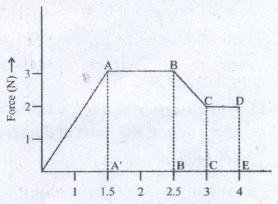
The initial speed of a body of mass 2.0 kg is 5.0 ms-1. A force act for 4s in the direction of motion of the body. The force-time graph is shown in the diagram. Calculate the impulse of the force and the final speed of the body.
24.
After perfectly inelastic collision between two identical particles moving with same speed in different directions, the speed of the particles become half the initial speed. Find the angle between the two before collision.
25.
With an activity prove that coefficient of static friction varies from object to object.
26.
Draw and explain the variations of force of friction vs applied force graphically.
27.
Explain the meaning of law of conservation of linear momentum.
28.
A body of mass 5 kg initially at rest is subjected to a force of 20N: What is the kinetic energy acquired by the body at the end of 10s?
29.
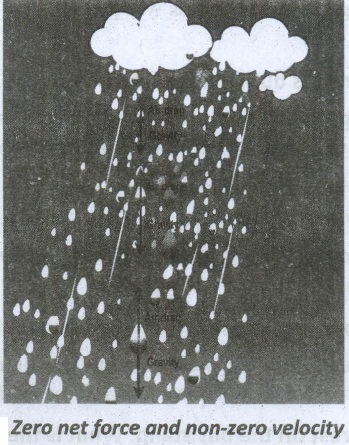
For the following situation, Explain with an example.
30.
A body is displaced 10 \(\hat{j}\) under the force of \(-2\hat{j}+15\hat{j}+6\hat{i}\ N.\) Calculate the work done.
31.
A person of mass 75 kg stands on a weighing scale on a lift. If the lift is descending with a downwards acceleration of 5 ms-2, what would be the reading of the weighing scale?
32.
A constant force acting on a body of mass 7 kg changes its speed from 3.0 ms-1 in 40 s. The direction of the motion of the body remains unchanged. What is the magnitude and direction of the force?
33.
A cyclist starts from rest with moving down a hill with constant acceleration at a distance of 100 m in 30 s.
(i) Find acceleration and
(ii) Find the force acting on it if its mass is 100 kilograms.
34.
What are the steps which have to be followed before applying Newton's laws?
35.
A body of mass 1.5 kg rest an a horizontal plane, and the angle of friction is 45°. Find the least force required to move the body along the plane
36.
Define the following
a) Coefficient of restitution
37.
What is conservative force? State how it is determined from potential energy?
38.
What does the work-kinetic energy theorem imply?
39.
What is mechanical energy? What are its two types?
40.
What is meant by negative work? Give example.
1.
Due to inertia of motion.
2.
This paradox arises due to wrong application of Newton's second and third laws. Before applying Newton's laws, we should decide 'what is the system?'. Once we identify the 'system', then it is possible to identify all the forces acting on the system. We should not consider the force exerted by the system. If there is an unbalanced force acting on the system, then it should have acceleration in the direction of the resultant force. By following these steps we will analyse the horse and cart motion.
If we decide on the cart+horse as a 'system', then we should not consider the force exerted by the horse on the cart or the force exerted by cart on the horse. Both are internal forces acting on each other. According to Newton's third law, total internal force acting on the system is zero and it cannot accelerate the system. The acceleration of the system is caused by some external force. In this case, the force exerted by the road on the system is the external force acting on the system. It is wrong to conclude that the total force acting on the system (cart+horse) is zero without including all the forces acting on the system. The road is pushing the horse and cart forward with acceleration. As there is an external- force acting on the system, Newton's second law has to be applied and not Newton's third law. The following figures illustrates this.
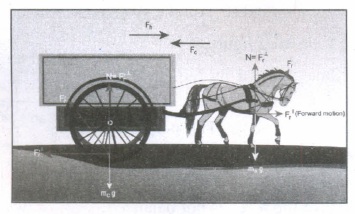
If we consider the horse as the 'system', then there are three forces acting on the horse.
(i) Downward gravitational force (mhg)
(ii) Force exerted by the road (Fr)
(iii) Backward force exerted by the cart (Fc)
It is shown in the following figure.
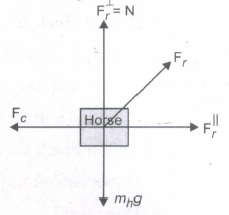
Fr - Force exerted by the road on the horse
Fc - Force exerted by the cart on the horse
F丄r-Perpendicular component of Fr=N
F||r-Parallel component of Fr which is reason for forward movement.
The force exerted by the road can be resolved into parallel and perpendicular components. The perpendicular component balances the downward gravitational force. There is parallel component along the forward direction. It is greater than the backward force (Fc). So there is net force along the forward direction which causes the forward movement of the horse.
If we take the cart as the system, then there are three forces acting on the cart.
(i) Downward gravitational force (mcg)
(ii) Force exerted by the road (Fr)
(iii) Force exerted by the horse (Fh)
It is shown in the figure.
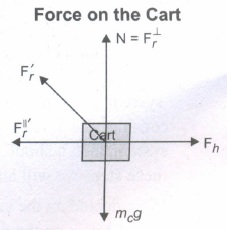
The force exerted by the road (\(\vec { { F }_{ r } } \) ) can be resolved into parallel and perpendicular components. The perpendicular component cancels the downward gravity (mcg). Parallel component acts backwards and the force exerted by the horse (\(\vec { { F }_{ h } } \) ) acts forward. Force (\(\vec { { F }_{ h } } \) ) is greater than the parallel component acting in the opposite direction. So there is an overall unbalanced force in the forward direction which causes the cart to accelerate forward.
If we take the cart+horse as a system, then there are two forces acting on the system.
(i) Downward gravitational force (mh + mc)g
(ii) The force exerted by the road (Fr) on the system.
It is shown in the following figure.
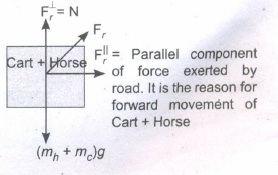
(iii) In this case the force exerted by the road (Fr) on the system (cart+horse) is resolved in to parallel and perpendicular components. The perpendicular component is the normal force which cancels the downward gravitational force (mh + mc)g. The parallel component of the force is not balanced, hence the system (cart+horse) accelerates and moves forward due to this force.
3.
Velocity of the particle,
\(\vec { v } =\frac { d\vec { r } }{ dt } =\frac { d }{ dt } (3t)\hat { i } +\frac { d }{ dt } (5{ t }^{ 2 })\hat { j } +\frac { d }{ dt } (7)\hat { k } \)
\(\frac { d\vec { r } }{ dt } =3\hat { i } +10t\hat { j } \)
Acceleration of the particle
\(\frac { d\vec { r } }{ dt } =\frac { { d }\vec { v } }{ dt } =\frac { { d }^{ 2 }\vec { r } }{ dt^{ 2 } } =10\hat { j } \)
Here, the particle has acceleration only along positive y direction. According to Newton's second law, net force must also act along positive y direction. In addition, the particle has constant velocity in positive x direction and no velocity in z direction. Hence, there are no net force along x or z direction.
4.
Total energy is always conserved.
But K.E. is not conserved
5.
Work done in the first case W1=\(\frac{1}{2}{kx^2}\)
(i.e. P.E. stored)
In second case, work done W2 = Change in P.E.
= P.E(final) - PEinitial
=\(\frac{1}{2}{k(2x)^2}\)-\(\frac{1}{2}{kx^2}\)
=\(\frac{1}{2}{k(4x^2-x^2)}\)
W2=\(\frac{1}{2}{k3x^2}\)
W2=3.W1
∴ W1=\(\frac{1}
{3}\)W2
=True
6.
If an object is thrown vertically upward, the direction of motion is upward, but gravitational force is downward.
7.
Yes, μ > 1, friction is stronger than normal force
8.
In a leveled circular road, skidding mainly depends on the coefficient of static friction \({ \mu }_{ s }\). The coefficient of static friction depends on the nature of the surface which has a maximum limiting value. If the speed of car exceeds this safe speed, then it starts to skid outward but frictional force comes into effect and provides an additional centripetal force to prevent the outward skidding.
\(tan \ \theta> { \mu }_{ s }\)
When the tangent of the angle of banking is greater than the coefficient of friction, skidding occurs.
9.
U=W.D.= \(\frac{1}{2}\)K.x2 = 20J
or K = 4000 N/m
When spring is further stretched through 0.1m, then P.E. will be:
U' = \(\frac{1}{2}\)K(0.2)2 = 80J
W.D.= U'-U = 80-20 = 60J
10.
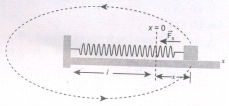
Mass spring = m
Force constant = k
Un-stretched length = l
Angular velocity = ω
Let 'x' be the increase in the length of the spring.
The new length = (l +x) = r
When the spring is rotated in a horizontal circle, Spring force = centripetal force.
kx = mω2 (l + x)
x=\(\frac{mω^2l}{k-mω^2}\)
11.
Mass m = 10 kg
Force F = 16 N
time t = 10 s
\(a=F/m=\frac { 16N }{ 10 \ kg } =1.6 \ ms^{ -2 }\)
We know that, v = u + at = 0 + 1.6 \(\times\) 10 = 16 ms-1
Kinetic energy K.E = \(\frac { 1 }{ 2 } { mv }^{ 2 }=\frac { 1 }{ 2 } \times 10\times 16\times 16=1280\ J\)
12.
Work done in moving a particle from x = 0 to x = 8 will be
\(W=\int _{ 0 }^{ 8 }{ Fdx } =\int _{ 0 }^{ 8 }{ ({ 3x }^{ 2 }-4x+5)dx={ \left[ \frac { { 3x }^{ 2 } }{ 3 } -\frac { { 4x }^{ 2 } }{ 2 } +5x \right] }_{ 0 }^{ 8 } } \)
\(W=\left[ 3\frac { { (8) }^{ 3 } }{ 3 } -4\left( \frac { { 8 }^{ 2 } }{ 2 } \right) +40 \right] \)= [512 - 128 + 40] = 424 J
13.
At maximum compression xm the K.E. of the car is converted entirely into the P.E. of the spring.
\(\therefore\) \(\frac { 1 }{ 2 } k{ x }_{ m }^{ 2 }=\frac { 1 }{ 2 } m{ v }^{ 2 }or{ \ x }_{ m }=2m\)
14.
The downward force on the elevator is :
F = mg + f = 22000 N
\(\therefore\) Power supplied by motor to balance this force is:
P = Fv = 44000 W =\(\frac { 44000 }{ 746 } \)= 59 hp.
15.
Force constant of each half becomes twice the force constant of the original spring.
16.
If ball bounces to height h', then
mgh' = 75% of mgh
\(\therefore\) h' = 0.75 h = 9 m.
17.
F = 48 N, R = 45 \(\times\) 9.8 = 441 N
\(\mu =\frac { F' }{ R } =0.22\)
Angle of friction \(\theta\) = tan -1 \(\mu\)= tan-1 0.22 = 12°24'
18.
Use F = ma
\(a=\frac { v-u }{ t } =\frac { 200-0 }{ 4 } =50\ cm/s^{ 2 }\)
F = 500 \(\times\) 50 = 25,000 dyne.
19.
(i) R = m(g-a)
weight = 49 N
so \(m=\frac { 49 }{ 9.8 } =5\) kg
R = 5(9.8-5)
R = 24N
(ii) R = m(g+a)
R = 5(9.8 + 5)
R = 74 N
(iii) as a = 0 so R = mg = 49N.
20.
By Work-Energy Theorem,
Loss in K.E. = W.D. against the force\(\times\)distance of friction
or K.E. = \(\mu \)mgS
For constant K.E., S\(\propto \frac { 1 }{ m } \)
\(\therefore\) Truck will stop in a lesser distance because of greater mass.
21.
W = 0 as his displacement is along the horizontal direction arid in order to balance the load on his head, he applies a force on it in the upward direction equal to its weight. Thus the angle between force and displacement is zero.
22.
F = 36 dyne at an angle of 60°
\({ F }_{ \underline { x } }=\) F cos 60° = 18 dyne
Fx = max
So \({ a }_{ x }=\frac { { F }_{ x } }{ m } =1\) cm/s2
23.
Given:
Mass = 2.0 kg
Initial speed = 5.0 ms-1
Formula: Impulse of a force ={Area between the force - Time graph and the tiime - axis
={Area of trianlge OA'A + Area of rectangle AA'B'B + Area of trapezium BB'C'C + Area of rectangle CC'ED
= \(\frac { 1 }{ 2 } \)\(\times\)1.5\(\times\)3 + 1\(\times\) 3 + \(\frac { 1 }{ 2 } \) (3+2) (3-2.5) + 2\(\times\)1
= 2.25 + 3 + 1.25 + 2 = 8.50 NS
As impulse = change inmomentum = mΔv
∴ Change in velocity, Δv = \(\frac { impulse }{ m } =\frac { 8.50 }{ 2 } \)= 4.25 ms-1
Final speed of the body Initial speed + Δv = 5.0 + 4.25 = 9.25 ms-1
24.
Linear momentum remains conserved.
Resultant initial momentum \(p=\sqrt{{p}_{1}^{2}+{p}_{2}^{2}+2{p}_{1}{p}_{2}\cos \ \theta}\)
\({\{ 2m\left( {v \over 2} \right) \}}^{2}=\{mv\}^2+2\{ mv\}\{ mv \}\ \cos\theta\)
\(1 = 1 + 1 +2 \times 1 \times 1 \cos\theta\)
\(\cos \theta=-{1\over2}\)
\(\theta=120°\)
25.
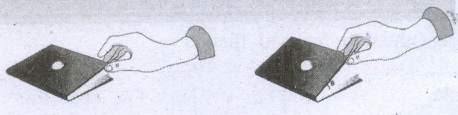
Take a hard bound note book and a coin. Keep the coin on the note book. The note book cover has to be in an inclined position as shown in the figure. Slowly increase the angle of inclination of the cover with respect to rest of the pages. When the angle of inclination reaches the angle of repose, the parallel component of gravitational force(mg sine) to book surface becomes equal to the frictional force and the coin begins to slide down. Measure the angle of inclination and take the tangent of this angle. It gives the coefficient of static friction between the surface of the cover and coin. The same can be repeated with other objects such as an eraser in order to observe that the coefficient of static friction differs from case to case.
26.
The variation of both static and kinetic frictional forces with external applied force is graphically shown in the figure.
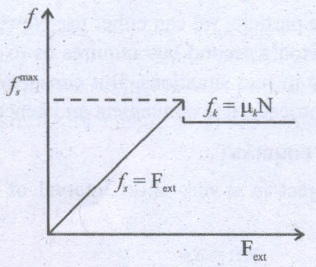
Variation of static and kinetic frictional forces with external applied force
The Figure shows that static friction increases linearly with external applied force till it reaches the maximum. If the object begins to move then the kinetic friction is slightly lesser than the maximum static friction. Note that the kinetic friction is constant and it is independent of applied force.
27.
(i) The Law of conservation of linear momentum is a vector law. It implies that both the magnitude and direction of total linear momentum are constant. In some cases, this total momentum can also be zero.
(ii) To analyse the motion of a particle, we can either use Newton's second law or the law of conservation of linear momentum. Newton's second law requires us to specify the forces involved in the process. This is difficult to specify in real situations. But conservation of linear momentum does not require any force involved in the process. It is convenient and hence important.
28.
\(a={F \over m}={20 \over 5}={4ms}^{-2}\)
v=u + a t = 0 + 4\(\times\)10 = 40 ms-1
\(AE={1\over2}\times5\times{(40)}^{2}=4000\) Joule
29.
When a raindrop gets detached from the cloud it experiences both downward gravitational force and upward air drag force. As it descends towards the Earth, the upward after drag force increases and after a certain time, the upward air drag force cancels the downward gravity. From then on the raindrop moves at constant velocity till it touches the surface of the Earth.
30.
\(w=\bar{F}.\bar{a}\)
\(=(-2\hat{i}+15\hat{j}+6\hat{k})-10\hat{j}\)
= 0 + 15\(\times\)10 + 0
= 150 Joule
31.
Mass of the person m = 75 kg
Descending acceleration a = 5 ms-2
Acceleration due to gravity, g = 9.8 ms-2
Apparent weight of the person,
R = m (g - a)
= 75\(\times\)(9.8 - 5)
= 75 x (4.8)
R = 360 N
Reading of the weighing scale = \(\frac { R }{ g } =\frac { 360 }{ 9.8 } =36.73\)
32.
Mass of a body (m) = 7 kg
Initial velocity (u) = 3.0 ms-1
Final velocity (v) = 4.5 ms-1
Time (t) = 40s
Now, According to newton's second law of
motion,
Force F=ma
=m(v-u)/ t
= 7.0\(\times\)(4.5 - 3.0) / 40
= \(7.0\times \frac { (1.5) }{ 40 } \)
F = 0.262 N
The Force is along the direction of motion of a body
33.
Displacement (s) = 100 m
Initial velocity (u) = O.
Time (t) = 30 s
Mass (m) = 100 kg
Now,
s F< u
(i) The acceleration is,
\(s=ut+\frac { 1 }{ 2 } { at }^{ 2 }\)
\(100=(0\times 30)+\frac { 1 }{ 2 } a\times ({ 30 }^{ 2 })\)
\(100=0+\frac { 1 }{ 2 } a\times 900\)
100 = 450 a
a = 0.22ms-2
(ii) The Force acting on the cycle
F = ma = 100\(\times\) 0.223
F = 22.3N
34.
(i) Choose a suitable inertial coordinate system to analyse the problem. For most of the cases we can take Earth as an inertial coordinate system.
(ii) Identify the system to which Newton's laws need to be applied. The system can be a single object or more than one object.
(iii) Draw the free body diagram
(iv) Once the forces acting on the system are identified, and the free body diagram is drawn, apply Newton's second law. In the left hand side of the equation, write the forces acting on the system in vector notation and equate it to the right hand side of equation which is the product of mass and acceleration. Here, acceleration should also be in vector notation.
(v) If acceleration is given, the force can be calculated. If the force is given, acceleration can be calculated.
35.
The least force required to move the body on the horizontal plane is equal to force of friction
F = mg tan \(\theta\)
= 1.5\(\times\)9 .8\(\times\)tan 450
= 1.5\(\times\)9. 8 x 1 [\(\because\) g \(\longrightarrow \) acceleration due to gravity is 9.8 ms-2]
F = 14.7 N
36.
(a) Coefficient of restitution
It is defined as the ratio of velocity of separation (relative velocity) after collision to the velocity of approach (relative velocity) before collision.
\(e=\frac{v_2-v_1}{u_1-u_2}\)
37.
(i) A force is said to be a conservative force if the work done by or against the force in moving the body depends only on the initial and final positions of the body and not on the nature of the path followed between the initial and final positions.
(ii) Consider an object at point A on the earth. It can be taken to another point B at a height h above the surface of the Earth by three paths as shown in Figure.
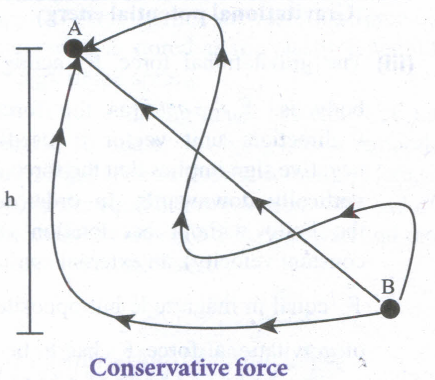
(iii) Whatever may be the path, the work done against the gravitational force is the same as long as the initial and final positions are the same.
(iv) This is the reason why gravitational force is a conservative force.
(v) Conservative force is equal to the negative gradient of the potential energy. In one dimensional case, \(F_x=-\frac{dU}{dx}\)
38.
It implies the following.
(i) If the work done by the force on the body is positive then its kinetic energy increases.
(ii) If the work done by the force on the-body is negative then its kinetic energy decreases.
(iii) If there is no work done by the force on the body then there is no change in its, kinetic energy, which means that the body has moved at constant speed provided its mass remains constant.
39.
(i) The energy produced by mechanical means is called mechanical energy.
(ii) It is classified into 2 types : (1) Kinetic energy (2) Potential energy.
(iii) The energy possessed by a body due to its motion is called kinetic energy. The energy possessed by the body by virtue of its position is called potential energy. SI unit of energy: N m (or) joule (J).
40.
(i) If a force acting on the body in the opposite direction of displacement, the work done is negative.
(ii) For negative work (90° < θ <180°)
i.e. - 1

11th Standard Syllabus & Materials
11th Standard
TN 11th Tamil பீடு பெற நில் - செய்யுள் - காவடிச்சிந்து Important Questions And Answers Study Material - QB365 Set A
NEW11th Standard
TN 11th Tamil பீடு பெற நில் - உரைநடை - மலை இடப்பெயர்கள் : ஓர் ஆய்வு Important Questions And Answers Study Material - QB365 Set A
NEW11th Standard
TN 11th Tamil மாமழை போற்றுதும் - துணைப்பாடம் - யானை டாக்டர் Important Questions And Answers Study Material - QB365 Set A
NEW11th Standard
TN 11th Tamil மாமழை போற்றுதும் - செய்யுள் - ஐங்குறுநூறு Important Questions And Answers Study Material - QB365 Set A



Tamilnadu Stateboard 11th Standard Subjects

Maths

Commerce

Economics

Biology

Business Maths and Statistics

Accountancy

Computer Science
Physics

Chemistry
Maths
Biology
Economics
Physics
Chemistry

History
Business Maths and Statistics

Computer Science
Accountancy

Computer Applications
History
Computer Technology
Commerce
Computer Applications
Computer Technology

Tamil

English

French
Tamilnadu Stateboard Standards

