
 100% FREE ACCESS
11th Standard Syllabus & Materials
11th Standard
TN 11th Tamil இயற்கை வேளாண்மை,சுற்றுச்சூழல் -செய்யுள் - மனோன்மணீயம் Important Questions And Answers Study Material - QB365 Set A
NEW11th Standard
TN 11th Tamil என்னுயிர் என்பேன் -துணைப்பாடம் - இசைத்தமிழர் இருவர் Important Questions And Answers Study Material - QB365 Set A
NEW11th Standard
TN 11th Tamil மொழி கலை -செய்யுள் - ஒவ்வொரு புல்லையும் Important Questions And Answers Study Material - QB365 Set A
NEW11th Standard
TN 11th Tamil பீடு பெற நில் - இலக்கணம் - பகுபத உறுப்புகள் Important Questions And Answers Study Material - QB365 Set A
NEW11th Standard
TN 11th Tamil பீடு பெற நில் - துணைப்பாடம் - வாடிவாசல் Important Questions And Answers Study Material - QB365 Set A
NEW11th Standard
TN 11th Tamil பீடு பெற நில் - செய்யுள் - குறுந்தொகை Important Questions And Answers Study Material - QB365 Set A

Published on: 18/02/2019
11th Public Model Exam 2019
Download Tamil Nadu 11th Standard Physics question papers, model tests, one-mark questions, important questions, and public exam papers in PDF format. Free study materials and answer keys for TN State Board students.
Questions + Answers key
Take MCQ Physics Test1.
What is time period of a pendulum hanged in a satellite? (T is time period on earth)
zero
T
infinite
\(\frac { T }{ \sqrt { 6 } } \)
2.
Amount of energy required to change liquid to gas and vice versa without any change in temperature is termed as __________________.
Latent Heat and Fusion
Latent Heat of Yaporis ation
Heat capacity
Specific heat capacity
3.
An air column in a pipe which is closed at one end, will be in resonance with the vibrating body of frequency 83Hz. Then the length of the air column is
1.5 m
0.5 m
1.0 m
2.0 m
4.
The length of a second’s pendulum on the surface of the Earth is 0.9 m. The length of the same pendulum on surface of planet X such that the acceleration of the planet X is n times greater than the Earth is
0.9n
\(\frac{0.9}{n}\)m
0.9n2m
\(\frac{0.9}{n^2}\)
5.
An ideal gas is maintained at constant pressure. If the temperature of an ideal gas increases from 100K to 1000K then the rms speed of the gas molecules
increases by 5 times
increases by 10 times
remains same
increases by 7 times
6.
A hot cup of coffee is kept on the table. After some time it attains a thermal equilibrium with the surroundings. By considering the air molecules in the room as a thermodynamic system, which of the following is true
ΔU > 0, Q = 0
ΔU > 0, W < 0
ΔU > 0, Q > 0
ΔU = 0, Q > 0
7.
For a given material, the rigidity modulus is \(\left( \frac { 1 }{ 3 } \right) \)rd of Young’s modulus. Its Poisson’s ratio is
0
0.25
0.3
0.5
8.
The magnitude of the Sun’s gravitational field as experienced by Earth is
same over the year
decreases in the month of January and increases in the month of July
decreases in the month of July and increases in the month of January
increases during day time and decreases during night time
9.
A butterfly and stone (mass of later is greater than earlier) is moving with same velocity. Momentum of the stone is____________ than the momentum of butterfly.
equal
greater
lesser
lesser (or) equal to
10.
Analogue of mass in rotational motion is ___________.
M.I.
Angular momentum
Gyration
Torque
11.
A round object of mass M and radius R rolls down without slipping along an inclined plane. The frictional force,
dissipates kinetic energy as heat
decreases the rotational motion
decreases the rotational and translational motion
converts translational energy into rotational energy
12.
If the potential energy of the particle is \(\alpha -\frac { \beta }{ 2 } { x }^{ 2 }\), then force experienced by the particle is
F = \(\frac { \beta }{ 2 } { x }^{ 2 }\)
F = βx
F = -βx
F = -\(\frac { \beta }{ 2 } { x }^{ 2 }\)
13.
Force acting on the particle moving with constant speed is
always zero
need not be zero
always non zero
cannot be concluded
14.
15.
If the length and time period of an oscillating pendulum have errors of 1% and 3% respectively then the error in measurement of acceleration due to gravity is
4%
5%
6%
7%
16.
Find the expression of the orbital speed of satellite revolving around the earth.
17.
At what temperature the rms speed of oxygen atom equal to rms speed of helium gas atom at 10°C?
Atomic mass of helium = 4
Atomic mass of oxygen = 32
18.
Two students want to increase the temperature of a gas without adding heat to it. Is it possible to increase the temperature of a gas without adding heat to it?
19.
What is meant by periodic and nonperiodic motion? Give any two examples, for each motion.
20.
Consider a particle undergoing simple harmonic motion. The velocity of the particle at position x1 is v1 and velocity of the particle at position x2 is v2. Show that the ratio of time period and amplitude is
\(\frac { T }{ A } =2\pi \sqrt { \frac { { x }_{ 2 }^{ 2 }-{ x }_{ 1 }^{ 2 } }{ { { v }_{ 1 }^{ 2 }x }_{ 2 }^{ 2 }-{ { v }_{ 2 }^{ 2 }x }_{ 1 }^{ 2 } } } \)
21.
In a petrol engine, (internal combustion engine) air at atmospheric pressure and temperature of 20°C is compressed in the cylinder by the piston to 1/8 of its original volume. Calculate the temperature of the compressed air. (For air \(\gamma \) = 1.4)
22.
Explain the variation of g with lattitude.
23.
Which of the two kilowatt hour or electron volt is a bigger unit of energy and by what factor?
24.
Three masses 3 kg, 4 kg and 5 kg are located at the corners of an equilateral triangle of side 1 m. Locate the center of mass of the system.
25.
The vernier scale of a travelling microscope has 50 divisions which coincide with 49 main scale divisions. If each main scale division is 0.5 mm. Calculate the minimum inaccuracy in the measurement of distance.
26.
An object of mass 10 kg moving with a speed of 15 ms-1 hits the wall and comes to rest within
(a) 0.03 second
(b) 10 second.
Calculate the impulse and average force acting on the object in both the cases.
27.
A particle is projected at an angle of θ with respect to the horizontal direction. Match the following for the above motion.
(a) vx - decreases and increases
(b) vy - remains constant
(c) Acceleration - varies
(d) Position vector - remains downward
28.
Explain various types of friction. Suggest a few methods to reduce friction.
29.
What is Echo?
30.
Two vibrating tuning forks produce waves whose equation is given by y1 = 5 sin(240\(\pi\)t) and y2 = 4 sin(244πt). Compute the number of beats per second.
31.
What do you mean by capillarity or capillary action?
32.
A small particle of mass m is projected with an initial velocity v at an angle \(\theta\) with x-axis in X-Y plane as shown in Figure.
Find the angular momentum of the particle.
33.
A person initially at rest starts to walk 2 m towards north, then 1 m towards east, then 5 m towards south and then 3 m towards west. What is the position vector of the person at the end of the trip?
34.
Check the correctness of the equation\(\frac { 1 }{ 2 } \)mv2 = mgh using dimensional analysis method.
35.
If energy is neither created nor destroyed, what happens to the so much energy spent against friction?
36.
In an ocean surveillance system of ship fitted with a (RADAR), the time delay between generation of a radio waves reflected from an enemy ship is observed to be 5.6s. Calculate the distance of the enemy ship from the surveillance ship.
37.
Why it is not possible to push a car from inside?
38.
From a certain apparatus, the diffusion rate of hydrogen has an average value of 28.7 cm3/s, The diffusion of another gas under the same condition is measured to have an average rate of 7.2 cm3/s. Identify the gas.
39.
Explain the second law of thermodynamics in terms of entropy.
40.
Derive an expression for the elastic energy stored per unit volume of a wire.
41.
Derive the relation between rotational KE and angular momentum.
42.
Two bodies A and B are moving with velocities VA and VB making an 'θ' with each other. Determine the relative velocity of A with respect to B. What will be the relative velocity.
(i) When 2 bodies are moving in the same direction.
(ii) When 2 bodies are moving in the opposite direction.
(iii) When 2 bodies are moving at right angle to each other.
43.
Derive an expression for the gravitational potential energy of a body of mass 'm' raised to a height 'h' above the earth's surface.
1.
(c)
infinite
2.
(b)
Latent Heat of Yaporis ation
3.
\(l=\lambda \mathrm{f}=8.3 \mathrm{~Hz} \)
\(v=332 \mathrm{~m} / \mathrm{s} \quad \lambda=4 l \)
\(\lambda=\frac{v}{f}=\frac{332}{83}=4 \mathrm{~m} \)
\(l=\frac{\lambda}{4}=\frac{4 l m}{4}=1.0 \mathrm{~m} \)
4.
\(l =0.9 \)
\(\mathrm{~T} =2 \pi \frac{l}{g} \)
\(T^{\prime} =2 \pi \frac{l_{X}}{g_{X}} \)
\(\mathrm{~g} \mathrm{x} =\mathrm{ng} \)
\(\therefore \mathrm{x} =0.9 \mathrm{n} \)
5.
\(v_{m s}=1.73 \sqrt{\frac{k T}{m}}\)
\(\text { AT Increased by } 10 \text { times }\)
\(v_{\mathrm{ms}} \propto \Delta T\)
\(\text { RMS speed increases by } 10 \text { times. }\)
6.
During the thermal equilibrium with surroundings internal energy is increased and heat energy will be increased.
\(\Delta U>0 Q>0\)
7.
\(\text { Rigidity modulus }=\frac{1}{3} \times \text { Young's modulus }\)
\(\text { Poisson ratio }=\frac{\text { lateral strain }}{\text { longitudinal strain }}\)
8.
(c)
decreases in the month of July and increases in the month of January
9.
(b)
greater
10.
(a)
M.I.
11.
(d)
converts translational energy into rotational energy
12.
\(\text {Potential energy } P . E=\alpha-\frac{\beta}{2} x^{2}\)
P.E = Work = Fx
\(P=\alpha-\frac{\beta}{2} x^{2}\)
\(\text {Force }=\frac{d p}{d x}=\frac{d}{d x}\left(\alpha-\frac{\beta}{2} x^{2}\right)\)
\(=0-\frac{\beta}{2} \times 2 x =-\beta x \)
13.
(b)
need not be zero
14.
(b)
15.
\(T =2 \pi \sqrt{\frac{l}{g}} \)
\(g =4 \pi^{2} l / T^{2} \)
\(\frac{d g}{g} =\frac{d l}{l}-\frac{2 d T}{T} \)
\(\frac{d g}{g} \% =\left(\frac{d l}{l}\right) \%-2\left(\frac{d T}{T}\right) \% \)
\(=1 \%-2 \times(-3 \%) \)
\(=1+6=7 \% \)
16.
A satellite of mass M to move in a circular orbit, centripetal force must be acting on the satellite. This centripetal force is provided by the Earth's gravitational force.
\(\frac { { mv }^{ 2 } }{ \left( { R }_{ E }+h \right) } =\frac { { GMM }_{ E } }{ { \left( { R }_{ e }+h \right) }^{ 2 } } \)
\({ v }^{ 2 }=\frac { { GM }_{ E } }{ \left( { R }_{ E }+h \right) } \)
\(v=\sqrt { \frac { { GM }_{ E } }{ \left( { R }_{ E }+h \right) } } \)
As h increases, the speed of the satellite decreases.
17.
Here,
\({ V }_{ rms }=\left[ \frac { 3PV }{ M } \right] ^{ \frac { 1 }{ 2 } }=\left[ \frac { 3RT }{ M } \right] ^{ \frac { 1 }{ 2 } }\)
Let rms speed of oxygen is (V rms)1 and of helium is (Vrms)2 is equal at temperature T1 and T2 respectively. \(\frac { { \left( { V }_{ rms } \right) }_{ 1 } }{ { \left( { V }_{ rms } \right) }_{ 2 } } =\sqrt { \frac { { M }_{ 2 }{ T }_{ 1 } }{ { M }_{ 1 }{ T }_{ 2 } } } \)
Atomic mass of Helium M2 = 4
Atomic mass of Oxygen M1 = 32
Temperature of helium -10oC = 273 + (-10oC)
= 263K
\(\left[ \frac { 4{ T }_{ 1 } }{ 32\times 263 } \right] =1\)
\({ T }_{ 1 }=\frac { 32\times 263 }{ 4 } =\frac { 8416 }{ 4 } =2104K\)
\(\therefore\)T1 = 2104 K
18.
Yes, during adiabatic compression the temperature
of a gas increases while no heat is given to it.
In adiabatic compression, dQ = 0
\(\therefore\) From first law of thermodynamics
dU = dQ - dW
dU = -dW
dU =- dW
In compression work is done on the gas i.e, work done is negative. Therefore,
dU = positive
Hence, internal energy of the gas increases due to which its temperature increases.
19.
Periodic motion is any motion which repeats itself in a fixed time internal.
Example:
Hands in pendulum clock, swing of a cradle, the revolution of the Earth around the Sun, waxing and waning of Moon, etc.
Non periodic motion is any motion which does not repeat itself after a regular interval of time.
Example: Occurrence of Earth quake, eruption of volcano, etc.
20.
Using equation
v = \(\omega \sqrt { { A }^{ 2 }-{ x }^{ 2 } } \Rightarrow { v }^{ 2 }={ \omega }^{ 2 }\left( { A }^{ 2 }-{ x }^{ 2 } \right) \)
Therefore, at position x1,
\({ v }_{ 1 }^{ 2 }={ \omega }^{ 2 }\left( { A }^{ 2 }-{ x }_{ 1 }^{ 2 } \right) \) .................(1)
Similarly, at position x2,
\({ v }_{ 2 }^{ 2 }={ \omega }^{ 2 }\left( { A }^{ 2 }-{ x }_{ 2 }^{ 2 } \right) \) ...................(2)
Subtrating (2) from (1), we get
\({ v }_{ 1 }^{ 2 }-{ v }_{ 2 }^{ 2 }={ \omega }^{ 2 }\left( { A }^{ 2 }-{ x_1 }^{ 2 } \right) -{ \omega }^{ 2 }\left( { A }^{ 2 }-{ x }_{ 2 }^{ 2 } \right) \)
\(= { \omega }^{ 2 }\left( { x }_{ 2 }^{ 2 }-{ x }_{ 1 }^{ 2 } \right) \)
\({ \omega }=\sqrt { \frac { { v }_{ 1 }^{ 2 }-{ v }_{ 2 }^{ 2 } }{ { x }_{ 2 }^{ 2 }-{ x }_{ 1 }^{ 2 } } } \Rightarrow T=2\pi \sqrt { \frac { { x }_{ 2 }^{ 2 }-{ x }_{ 1 }^{ 2 } }{ { { v }_{ 1 }^{ 2 } }-{ { v }_{ 2 }^{ 2 } } } } \) ....................(3)
Dividing (1) and (2), we get
\(\frac { { v }_{ 1 }^{ 2 } }{ { v }_{ 2 }^{ 2 } } =\frac { { \omega }^{ 2 }\left( { A }^{ 2 }-{ x }_{ 1 }^{ 2 } \right) }{ { \omega }^{ 2 }\left( { A }^{ 2 }-{ x }_{ 2 }^{ 2 } \right) } \Rightarrow A=\sqrt { \frac { { { v }_{ 1 }^{ 2 }x }_{ 2 }^{ 2 }-{ v }_{ 2 }^{ 2 }{ x }_{ 1 }^{ 2 } }{ { { v }_{ 1 }^{ 2 } }-{ { v }_{ 2 }^{ 2 } } } } \) .................(4)
Dividing equation (3) and equation (4), we have
\(\frac { T }{ A } =2\pi \sqrt { \frac { { x }_{ 2 }^{ 2 }-{ x }_{ 1 }^{ 2 } }{ { { v }_{ 1 }^{ 2 }x }_{ 2 }^{ 2 }-{ { v }_{ 2 }^{ 2 }x }_{ 1 }^{ 2 } } } \)
21.
P1 = 1 atmospheric Pressure
V1 = V
V2 = V/8
T1 = 32 + 273
= 305
T2 = ?
\(\gamma =1.4
\)
\(T_{2} V_{2}^{\gamma-1} =T_{1} V_{1}^{\gamma-1}
\)
\(\frac{T_{1}}{T_{2}} =\left(\frac{V_{2}}{V_{1}}\right)^{\gamma-1}
\)
\(\frac{T_{1}}{T_{2}} =\left(\frac{V / 8}{V}\right)^{1.4-1}
\)
\(=\left(\frac{1}{8}\right)^{0.4} \)
\(\frac{305}{T_{2}} =\frac{1}{8^{0.4}}\)
\(\therefore T_{2} =305 \times 8^{0.4}
\)
\(=400^{\circ} \mathrm{C}\)
Temperature of the compressed air
\(T \cong 400^{\circ} \mathrm{C}\)
22.
Whenever we analyze the motion of objects in rotating frames we must take into account the centrifugal force. Even though we treat the Earth as an inertial frame, it is not exactly correct because the Earth spins about its own axis. So when an object is on the surface of the Earth, it experiences a centrifugal force that depends on the latitude of the object on Earth. If the Earth were not spinning, the force on the object would have been mg. However, the object experiences an additional centrifugal force due to spinning of the Earth.
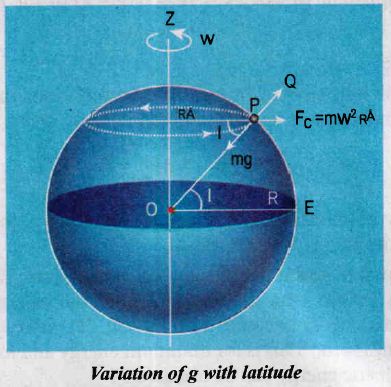
This centrifugal force is given by mω2R'.
R' = R cos λ ....(1)
where λ is the latitude. The component of centrifugal acceleration experienced by the object in the direction opposite to g is
ac = ω2R' cos λ = ω2R cos2 λ
since R' = R cos λ
Therefore,
g' = g -ω2R cos2 λ ...(2)
From the expression (2), we can infer that at equator, λ = 0; g' = g - ω2R. The acceleration due to gravity is minimum. At poles λ = 90; g' = g, it is maximum. At the equator, g' is minimum.
23.
kWh is a bigger unit of energy.
\(\frac { 1kwh }{ 1eV } =\frac { 3.6\times { 10 }^{ 6 }J }{ 1.6\times { 10 }^{ -19 }J } =2.25\times10^{25}\)
24.
(x, y) = (0.54 m, 0.36 m)
25.
Minimum inaccuracy = Vernier constant
= 1 MSD -1 VS.D
=1 MSD-\(\frac { 49 }{ 50 } \) MSD
= \(\frac { 1 }{ 50 } \)(0.5 mm)= 0.01 mm
26.
Initial momentum of the object Pi = 10 \(\times\)15 = 150 kgm s-1
Final momentum of the object pf = 0
Δp = 150 - 0 = 150 kg ms-1
(a) Impulse J = Δp = 150 N s and Average force \({ F }_{ avg }=\frac { \triangle p }{ \triangle t } =\frac { 150 }{ 0.03 } \)= 5000N
b) Impulse J = Δp = 150 N s and Average force Favg =\(\frac { 150 }{ 10 } \)= 15N
27.
(a) vx - remains constant
(b) vy - decreases and increases
(c) a - remains downward
(d) r - varies
28.
Static friction: The opposing force that comes into play when one body tends to move over the surface of another, but the actual motion has yet not started is called static friction.
Limiting friction: If the applied force is increased the force of static friction also increases. If the applied force exceeds a certain (maximum) value, the body starts moving. This maximum value of static friction up to which body does not move is called limiting friction.
Kinetic or dynamic friction: If the applied force is increased further and sets the body in motion, the friction opposing the motion is called kinetic friction.
We can reduce friction
(1) By polishing.
(2) By lubrication.
(3) By proper selection of material.
(4) By streamlining the shape of the body.
(5) By using ball bearing.
29.
An echo is a repetition of sound produced by the reflection of sound waves from a wall, mountain or other obstructing surfaces.
30.
Given y1 = 5 sin(240\(\pi\)t) and y2 = 4 sin(244\(\pi\)t)
Comparing with y = A sin(2\(\pi\) f1t), we get
2\(\pi\)f1 = 240π \(\Rightarrow\) f1 = 120Hz
2\(\pi\)f2 = 244π \(\Rightarrow\) f2 = 122Hz
The number of beats produced is | f1 − f2| = |120 − 122| = |− 2|=2 beats per sec
31.
The rise or fall of a liquid in a narrow tube is called capillarity or capillary action.
32.
Let the particle of mass m cross a horizontal distance x in time t.
Angular momentum \(\overrightarrow{L}=\int{\overrightarrow{\tau}}{dt}\)
But \(\overrightarrow{\tau}=\overrightarrow{r}\times \overrightarrow{F}\)
\(\overrightarrow{r}=x\hat { i } +y\hat { j} \) and \(\hat { F }=-mg \hat { j } \)
\(\therefore \overrightarrow { \tau }=(x\hat { i }+y\hat { j } ) \times (-mg \hat { j } )\)
\(\overrightarrow { \tau } =-mgx(\hat { i } \times \hat { j } )=-mgx\hat { k } \)
\(\overrightarrow { L } = -mg \int{(xdt)}\hat {k} =-gv\ cos\theta (\int t dt)\hat { k } \)
Let initial time t = 0 and final time t = tf
\(\overrightarrow {L}=-mg \cos \theta \left( ^{ t }\int _{ 0 }^{ f }{ tdt } \right) \hat k = -\frac{1}{2}mgv\ cos \theta\ t^{2}_{f} \hat{k}\)
Negative sign indicates, \(\overrightarrow {L}\) point inwards.
33.
.png)
As shown in the Figure, the positive x-axis is taken as east direction, positive y-direction is taken as north. After the trip, the person reaches the point P whose position vector given by
\(\vec r=-2\hat i-3\hat j\)
The displacement direction is south west.
34.
Dimension formula for
\(\frac { 1 }{ 2 } \)mv2 = [M][LT-1]2 = [ML2T-2]
Dimension formula for
mgh = [M][LT-2][L] = [ML2T-2]
[ML2T-2] = [ML2T-2]
Both sides are dimensionally the same, hence the equations \(\frac { 1 }{ 2 } \)mv2 = mgh is dimensionally correct
35.
The energy is dissipated in the form of heat. The heat energy so produced is not available for work.
36.
Time delay T = 5.6s
\(t={{T}\over{2}}={{5.6}\over{2}}=2.8\)
Speed of radio waves = speed of light (v) 3\(\times\)108 m/s
Distance from the surveillance ship to enemy ship D = v \(\times\) t
= 3\(\times\)108\(\times\)2.8
= 8.4\(\times\)108m
Distance (D) = 8.4\(\times\)108 km.
37.
(i) According to Newton's third law when one body exerts a force on a second body, the second body simultaneously exerts a force equal in magnitude and opposite in direction on the first body.
(ii) When you push a car from inside, the reaction force of your pushing is balanced out by your body moving backward and eventually the seat behind you pushes against to bring things to static equilibrium.
38.
Using Graham's law of diffusion
\(\frac { { R }_{ 1 } }{ { R }_{ 2 } } =\sqrt { \frac { { M }_{ 2 } }{ { M }_{ 1 } } } \)
Squaring both side, we get.
\({ \left( \frac { { R }_{ 1 } }{ { R }_{ 2 } } \right) }^{ 2 }={ \left( \sqrt { \frac { { M }_{ 2 } }{ { M }_{ 1 } } } \right) }^{ 2 }\)
\({ \left( \frac { { R }_{ 1 } }{ { R }_{ 2 } } \right) }^{ 2 }=\frac { { M }_{ 2 } }{ { M }_{ 1 } } \)
\({ M }_{ 2 }={ M }_{ 1 }{ \left( \frac { { R }_{ 1 } }{ { R }_{ 2 } } \right) }^{ 2 }\)
\(={ \left( \frac { { 28.7 } }{ { 7.2 } } \right) }^{ 2 }\)
\(=\frac { 823.69 }{ 51.84 } =15.88\)
=16
The gas is identified as oxygen.
39.
Entropy and second law of thermodynamics:
(i) We have seen in the equation that the quantity \(\cfrac { { O }_{ H } }{ { T }_{ H } } \) is equal to \(\cfrac { { O }_{ H } }{ { T }_{ H } } \) The quantity\(\cfrac { Q }{ T } \) is called entropy. It is a very important thermodynamic property of a system.
(ii) It is also a state variable. \(\cfrac { { O }_{ H } }{ { T }_{ H } } \) is the entropy received by the Carnot engine from hot reservoir and \(\cfrac { { Q }_{ L } }{ { T }_{ L } } \) is entropy given out by the Camot engine to the cold reservoir. For reversible engines (Chamot Engine) both entropies should be same, so that the change in entropy of the Camot engine in one cycle is zero.
(iii) This is proved in equation (8.66). But for all practical engines like diesel and petrol engines which are not reversible engines, they satisfy the relation\(\cfrac { { Q }_{ L } }{ { T }_{ L } } >\cfrac { { Q }_{ H } }{ T_{ H } } \) fact we, can reformulate the second law of thermodynamics as follows
(iv) "For all the processes that occur in nature (irreversible process), the entropy always increases. For reversible process entropy will not change". Entropy determines the direction in which natural process should occur.
(v) Because entropy increases when heat flows from hot object to cold object. If heat were to. flow from a cold to a hot object, entropy will decrease leading to violation of second law thermodynamics
(vi) Entropy is also called 'measure of disorder'. All natural process occur such that the disorder should always increases.
(vii) Consider a bottle with a gas inside. When the gas molecules are inside the bottle it has less disorder. Once it spreads into the entire room it leads to more disorder.
(viii) In other words when the gas is inside the bottle the entropy is less and once the gas spreads into entire room, the entropy increases.
(ix) From the second law of thermodynamics, entropy always increases. If the air molecules go back in to the bottle, the entropy should decrease, which is not allowed by the second law of thermodynamics.
(x) The same explanation applies to a drop of ink diffusing into water. Once the drop of ink spreads, its entropy is increased. The diffused ink can never become a drop again. So the natural processes occur in such a way that entropy should increase for all irreversible proc
40.
When a body is stretched, work is done against the restoring force (internal force). This work done is stored in the body in the form of elastic energy. Consider a wire whose un-stretch length is L and area of cross section is A. Let a force produce an extension I and further assume that the elastic limit of the wire has not been exceeded and there is no loss in energy. Then, the work done by the force F is equal to the energy gained by the wire.
The work done in stretching the wire by dl, dW = Fdl
The total work done in stretching the wire from 0 to l is
\(W=\int^{l}_{o}F dl\) --- (1)
From Young's modulus of elasticity,
\(\mathrm{Y}=\frac{F}{A} \times \frac{L}{l} \Rightarrow \frac{Y A l}{L}\) ......(2)
Substituting equation (2) in equation (1), we get
\(\mathrm{W}=\int_{0}^{1} \frac{Y A l}{L} d l\)
Since, l is the dummy variable in the integration, we can change l to l' (not in limits), therefore
\(\mathrm{W}=\int_{0}^{l} \frac{Y A l^{\prime}}{L} d l^{\prime} =\frac{Y A}{L}\left(\frac{l^{\prime 2}}{2}\right)_{0}^{i}=\frac{Y A}{I} \frac{l^{2}}{2}=\frac{1}{2}\left(\frac{Y A l}{L}\right) l=\frac{1}{2} F l \)
\(W =\frac{1}{2} F l=\text { Elastic potential energy }\)
Energy per unit volume is called energy density,
\(u =\frac{\text { Elastic potential energy }}{\text { Volume }}=\frac{\frac{1}{2} F l}{A L}
\)
\(\frac{1}{2} \frac{F}{A} \frac{l}{L} =\frac{1}{2}(\text { Stress } \times \text { Strain })\) ......(3)
41.
Let a rigid body of moment of inertia I rotate with angular velocity ധ
The angular momentum of a rigid body is, L= Iധ
The rotational kinetic energy of the rigid body is, KE =\(\frac{1}{2}\)Iധ2
By multiplying the numerator and denominator of the above equation with I, we get a relation between L and KE as,
\(KE=\frac { 1 }{ 2 } \frac { { I }^{ 2 }{ \omega }^{ 2 } }{ I } =\frac { 1 }{ 2 } \frac { { \left( I\omega \right) }^{ 2 } }{ I } \)
\(KE=\frac { { L }^{ 2 } }{ 2I } \)
42.
Consider the velocities \(\overrightarrow { { V }_{ A } } \) and \(\overrightarrow { { V }_{ B } } \) at an angle \(\theta \) between their directions.
The relative velocity of A with respect to B,
\(\overrightarrow { { V }_{ AB } } =-\overrightarrow { { V }_{ B } } -\overrightarrow { { V }_{ A } } \)
Then, the magnitude and direction of \(\overrightarrow { { V }_{ AB } } \) is given by VAB= \({ v }_{ aB }=\sqrt { { v }_{ A }^{ 2 }+{ v }_{ B }^{ 2 }-2{ v }_{ A }{ v }_{ B }cos\theta } \) and tan \(\beta =\frac { { v }_{ B }sin\theta }{ { v }_{ B }-{ v }_{ A }cos\theta } \) (Here \(\beta\) is angle between \(\overrightarrow { { V }_{ AB } } and\quad \overrightarrow { { V }_{ B } } \) )
(i) When \(\theta\) = 0, the bodies move along parallel straight lines in the same direction, We have vAB = (vA - vB) in the direction of \(\overrightarrow { { V }_{ A } } \) . Obviously vBA= (VB+ vA) in the direction of \(\overrightarrow { { V }_{ B } } \).
(ii) When \(\theta\) = 180°, the bodies move along parallel straight lines in opposite directions, We have vAB= (vA + VB) in the direction of \(\overrightarrow { { V }_{ A } } \) .Similarly vBA= (VB+ vA) in the direction of \(\overrightarrow { { V }_{ B } } \).
(iii) If the two bodies are moving at right angles to each other, then \(\theta\) =90°. The magnitude of the relative velocity of A with respect to \(B={ v }_{ BA }=\sqrt { { v }_{ A }^{ 2 }+{ v }_{ B }^{ 2 } } \).
43.
The gravitational potential energy (U) at some height his, equal to the amount of work required to take the object from the ground to that height h.
\(U=\int{\bar{F}_a.d\bar{r}}=\int_{0}^{h}|\bar{F}_a||d\bar{r}|\cos\ \theta\)
Since the displacement and the applied force are in the same upward direction, the angle between them, \(\theta = 0°.\)Hence, cos°=1 and \(|\bar{F}_a|=mg\) and \(|d\bar{r}|=dr.\)
\(U=mg\int_{0}^{4}dr\Rightarrow mg {[r]}_{0}^{h} =mgh\)

11th Standard Syllabus & Materials
11th Standard
TN 11th Tamil பீடு பெற நில் - செய்யுள் - காவடிச்சிந்து Important Questions And Answers Study Material - QB365 Set A
NEW11th Standard
TN 11th Tamil பீடு பெற நில் - உரைநடை - மலை இடப்பெயர்கள் : ஓர் ஆய்வு Important Questions And Answers Study Material - QB365 Set A
NEW11th Standard
TN 11th Tamil மாமழை போற்றுதும் - துணைப்பாடம் - யானை டாக்டர் Important Questions And Answers Study Material - QB365 Set A
NEW11th Standard
TN 11th Tamil மாமழை போற்றுதும் - செய்யுள் - ஐங்குறுநூறு Important Questions And Answers Study Material - QB365 Set A



Tamilnadu Stateboard 11th Standard Subjects

Maths

Commerce

Economics

Biology

Business Maths and Statistics

Accountancy

Computer Science
Physics

Chemistry
Maths
Biology
Economics
Physics
Chemistry

History
Business Maths and Statistics

Computer Science
Accountancy

Computer Applications
History
Computer Technology
Commerce
Computer Applications
Computer Technology

Tamil

English

French
Tamilnadu Stateboard Standards

