
 100% FREE ACCESS
11th Standard Syllabus & Materials
11th Standard
TN 11th Tamil இயற்கை வேளாண்மை,சுற்றுச்சூழல் -செய்யுள் - மனோன்மணீயம் Important Questions And Answers Study Material - QB365 Set A
NEW11th Standard
TN 11th Tamil என்னுயிர் என்பேன் -துணைப்பாடம் - இசைத்தமிழர் இருவர் Important Questions And Answers Study Material - QB365 Set A
NEW11th Standard
TN 11th Tamil மொழி கலை -செய்யுள் - ஒவ்வொரு புல்லையும் Important Questions And Answers Study Material - QB365 Set A
NEW11th Standard
TN 11th Tamil பீடு பெற நில் - இலக்கணம் - பகுபத உறுப்புகள் Important Questions And Answers Study Material - QB365 Set A
NEW11th Standard
TN 11th Tamil பீடு பெற நில் - துணைப்பாடம் - வாடிவாசல் Important Questions And Answers Study Material - QB365 Set A
NEW11th Standard
TN 11th Tamil பீடு பெற நில் - செய்யுள் - குறுந்தொகை Important Questions And Answers Study Material - QB365 Set A

Published on: 30/09/2018
Important 3mark -chapter 1,2,3
Download Tamil Nadu 11th Standard Physics question papers, model tests, one-mark questions, important questions, and public exam papers in PDF format. Free study materials and answer keys for TN State Board students.
Questions + Answers key
Take MCQ Physics Test1.
Can we add a velocity vector to a displacement vector?
2.
Is pressure a vector? Give reason.
3.
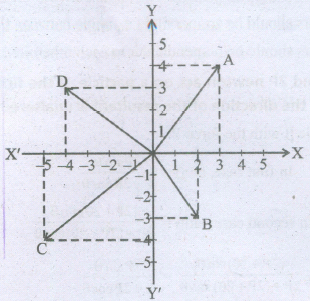
Write vectors shown graphically:
\(\vec{A}=3\hat{i}+4\hat{j};\vec{B}=2\hat{i}-3\hat{j};\vec{C}=-5\hat{i}-4\hat{j};\vec{D}=-4\hat{i}+3\hat{j}\)
4.
Two forces equal to P and 2P newton act on a particle. If the first be doubled and the second be increased by 20 newtons, the direction of the resultant is unaltered. Find the value of P.
5.
Under what condition the sum and difference of two vectors will be equal in magnitude?
6.
Two vectors \(\vec{A}=\hat{i}+2\hat{j}+2\hat{k}\) and \(\vec{B}=\hat{i}+3\hat{j}+6\hat{k}\) Find their dot products.
7.
Shown that the resultant of two vectors \(\vec{A}\) and \(\vec{B}\) always lies between A + B and A - B.
8.
Define non-uniform motion.
9.
Define uniform motion.
10.
Define degree.
11.
Two equal forces are acting at a point with an angle of 60° between them. If the resultant force is equal to 20\(\sqrt{3}\) N, find the magnitude of each force.
12.
A force is inclined at 60° to the horizontal. If the horizontal component of force is 40 kg wt, calculate the vertical component.
13.
Given \(\vec{a}=3\hat{i}+2\hat{j}-\hat{k}\) and \(\vec{b}=\hat{i}+\hat{j}-3\hat{k}\) Determine \(\vec{a}-\vec{b}\)
14.
Given \(\vec{a}=3\hat{i}+2\hat{j}-\hat{k}\) and \(\vec{b}=\hat{i}+\hat{j}-3\hat{k}\) Determine \(\vec{a}+\vec{b}\)
15.
Can we use the equations of kinematics to find the height attained by a body projected upward with any velocity.
16.
Define trajectory.
17.
Define free fall.
18.
Distinguish between uniformly accelerated and non-uniformly accelerated motion.
19.
Define relative velocity.
20.
Explain the physical significance of momentum with example.
21.
Distinguish between average velocity and average speed.
22.
Write note on function with example.
23.
What is position vector? Explain.
24.
Using components method, subtract the following vectors.
\(\overrightarrow { A } ={ A }_{ x }\hat { i } +{ A }_{ y }\hat { j } +{ A }_{ z }\hat { k } \)
\(\overrightarrow { B } ={ B }_{ x }\hat { i } +{ B }_{ y }\hat { j } +{ B }_{ z }\hat { k } \)
25.
When the sum of two vectors is maximum?
26.
Does a scalar quantity depends upon the frame of reference chosen.
27.
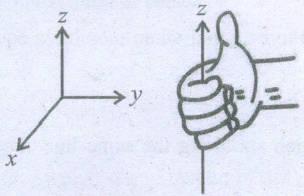
Draw the diagram for Right handed co-ordinate system and explain the same.
28.
Define kinematics.
29.
(i) Name the quantity which remains unchanged during the flight of an oblique projectile.
(ii) If the velocity of projectile is 10 ms-1 at what angle to the horizontal should be projected as that it covers maximum horizontal distance?
30.
Define centripetal acceleration.
31.
Define angular acceleration
32.
Write the condition for the maximum horizontal range.
33.
Define Time of flight (Tf) of a projectile and derive?
34.
Find the speed of the projectile when it hits the ground?
35.
Write the combined effect of two velocities of a projectile.
36.
How can you find velocity from 'a - t' graph?
37.
Define average acceleration.
38.
What is retardation?
39.
Define relative velocity.
40.
Define momentum.
41.
What is calculus?
42.
Explain the concept of a function.
43.
Distinguish between distance and displacement.
44.
What is position vector? Show the position vector for particle in three dimensional motion. Write an expression for this position vector.
45.
Give some examples of physical quantities which can be expressed as the vector product of two vectors.
46.
What is meant by resolution of vector?
47.
State the vector product of two vectors is not commutative but anti commutative.
48.
Find the magnitude of vector 3\(\hat { i } -2\hat { j } +\sqrt { 3 } \hat { k } \) ?
49.
Define the term modulus or magnitude of vector.
50.
What is meant by frame of reference?
51.
What is Kinematics?
52.
State the assumptions made in the study of projectile motion.
1.
No, only vectors representing physical quantities, of same nature can be added together.
2.
No, pressure is always taken to be normal to the plane of the area on which it is acting. As this direction is unique, it does need any specification. So pressure is not a vector.
3.
4.
Let the resultant make angle \(\beta\) with the force P.
In first case, \(\tan\beta=\frac{2P\sin\theta}{P+2P\cos\theta}\)
In second case, \(\tan\beta=\frac{(2P+20)\sin\theta}{2P+(2P+20)\cos\theta}\)
Hence \(\frac{(2P+20)\sin\theta}{2P+(2P+20)\cos\theta}=\frac{2P\sin\theta}{P+2P\cos\theta}\)
or \(\frac{2P\sin\theta}{P+2P\cos\theta}=\frac{20\sin\theta}{P+20\cos\theta}\)
From the above equation, 2P = 20 (or) P = 10 N.
5.
\(\left| \vec { A } +\vec { B } \right| =\left| \vec { A } -\vec { B } \right| \)
Squaring both sides \(A^2+B^2+2\vec{A}.\vec{B}=A^2-2\vec{A}.\vec{B}+B^2\)
\(4\vec{A}.\vec{B}=0\) (or) \(\vec{A}.\vec{B}=0 i.e, \vec{A}\bot\vec{B}\)
Thus, when the two vectors are equal in magnitude and perpendicular to each other, then he sum and difference of two vectors will be equal in magnitude.
6.
Given: \(\vec{A}=\hat{i}+2\hat{j}+2\hat{k}\) \(\vec{B}=\hat{i}+3\hat{j}+6\hat{k}\)
Dot product: A = \(\sqrt{(1)^2+(2)^2+(2)^2}\) = 3
B = \(\sqrt{(1)^2+(3)^2+(6)^2}\) = \(\sqrt{46}\)
\(\vec{A}.\vec{B}=(\hat{i}+2\hat{j}+2\hat{k}).(\hat{i}+3\hat{j}+6\hat{k})\)
= 1\(\times\)1 + 2\(\times\)3 + 2\(\times\) 6 = 19.
7.
Let e be the angle between \(\vec{A}\) and \(\vec{B}\). Thus the resultant of \(\vec{A}\) and \(\vec{B}\) is given by
\(\vec{R}=\sqrt{A^2+B^2+2AB\cos\theta}\)
or R2 = A2 + B2 + 2AB cos\(\theta\)
Now greatest value of cos\(\theta\) is + 1.
Greatest value of R2 is (A2 + B2 + 2AB) or (A + B)2 i.e., the greatest value of R is (A + B).
The least value of cos\(\theta\) is -1.
So the least value of R2 is (A2 + B2 - 2AB) or (A - B)2 i.e., the least value of R is (A - B).
8.
If the velocity changes in both speed and direction during the circular motion, we get non uniform circular motion.
9.
When a point object covers equal distances on the circumference of the circle in equal intervals of time.
10.
Degree is the unit of measurement which is used to determine the size of an angle.
11.
Given: Angle between the forces, \(\theta =60^o\); Resultant R = 20\(\sqrt{3}\)N; P = Q = P (say) = ?
Resultant R = \(\sqrt{P^2+Q^2+2PQ\cos\theta}\)
= \(\sqrt{P^2+P^2+2P.p\cos\theta}\)
= \(\sqrt{2P^2+2P^2+\frac{1}{2}}=P\sqrt{3}\)
But the resultant force is = 20\(\sqrt{3}\)
20 \(\sqrt{3}\) = p \(\sqrt{3}\)
P = 20 N.
12.
Let the force be, \(\vec{F}\) . Let angle of inclination be \(\theta\).
\(\therefore\) Horizontal component FH = F cos \(\theta\)
Vertical component Fv = F sin \(\theta\)
Given: FH = 40 kg. wt.
Angle \(\theta\) = 60°
FH = F cos 60° = 40 kg wt
F = \(\frac{40}{60^o}=\frac{40}{\frac{1}{2}}\) = 80 kg wt
Vertical component Fv = F sin \(\theta\)
= 80 sin 60o = 80\(\times\)\(\frac{\sqrt{3}}{2}=40\sqrt{3}\)
= 40\(\times\)1.732 = 69.28 kg wt.
Vertical component of the force = 69.28 kg wt.
13.
Given \(\vec{a}=3\hat{i}+2\hat{j}-\hat{k}\), \(\vec{b}=\hat{i}+\hat{j}-3\hat{k}\)
\(\vec{a}-\vec{b}=(3\hat{i}+2\hat{j}-\hat{k})-(\hat{i}+\hat{j}+3\hat{k})\)
\(= 3\hat{i}+2\hat{j}-\hat{k}-\hat{i}-\hat{j}-3\hat{k}\)
\(= 2\hat{i}+\hat{j}-4\hat{k}\)
14.
Given : \(\vec{a}=3\hat{i}+2\hat{j}-\hat{k}\), \(\vec{b}=\hat{i}+\hat{j}-3\hat{k}\)
\(\vec{a}+\vec{b}=(3\hat{i}+2\hat{j}-\hat{k})+(\hat{i}+\hat{j}+3\hat{k})\)
\(= 3\hat{i}+2\hat{j}-\hat{k}+\hat{i}+\hat{j}+3\hat{k}\)
\(= 4\hat{i}+3\hat{j}+2\hat{k}\)
15.
No, because equations of motions are applicable as long as the acceleration is uniform.
16.
The path followed by the particle is called its trajectory.
17.
The motion of a body falling towards the Earth from a small altitude (h « R), purely under the force of gravity is called free fall.
18.
In accelerated motion, if the change in velocity of an object per unit time is same (constant) then the object is said to be moving with uniformly accelerated motion.
On the other hand, if the change in velocity per unit time is different at different times, then the object is said to be moving with non-uniform accelerated motion.
19.
When two objects A and B are moving with different velocities, then the velocity of one object A with respect to another object B is called relative velocity of object A with respect to B.
20.
Consider a butterfly and a stone, both moving towards you with the same velocity 5 ms-1. If both hit your body, the effects will not be the same. The effects not only depend upon the velocity but also on the mass. The stone has greater mass compared to the butterfly. The momentum of the stone is thus greater than the momentum of the butterfly.
21.
Average velocity: The average velocity is defined as ratio of the displacement vector to the corresponding time interval.
\(\vec{v_{avg}}=\frac{\Delta\vec{r}}{\Delta t}\)
It is a vector quantity. The direction of average velocity is in the direction of the displacement vector (AY).
Average speed: The average speed is defined as the ratio of total path length travelled by the particle in a time interval.
Average speed = Total path length / total time
It is a scalar quantity. Doesn't possess direction.
22.
Any physical quantity is represented by a "function" in mathematics. Take the example of temperature T. We know that the temperature of the surroundings is changing throughout the day. It increases till noon and decreases in the evening. At any time "t" the temperature T has a unique value. Mathematically this variation can be represented by the notation 'T (t)' and it should be called "temperature as a function of time". It implies that if the value of 't' is given, then the function "T (t)" will give the value of the temperature at that time 't'.
Eg: Consider a function f(x) = x2 Sometimes it is also represented as y = x2. Here y is called the dependent .variable and x is called independent variable. It means as x changes, y also changes. Once a physical quantity is represented by a function, one can study the variation of the function over time or over the independent variable on which the quantity depends.
23.
A vector which denotes the position of a particle at any instant of time, with respect to origin of coordinate system.
The position vector \(\vec{r}\) of the particle at a point P is given by \(\vec{r}=x\vec{i}+y\vec{j}+z\vec{k}\)
24.
Similarly the subtraction of two vectors is equivalent to subtracting the corresponding x, y and z components:
\(\vec{A}-\vec{B}=(A_x-B_{x})\hat{i}+(A_y-B_y)\hat{j}+(A_z-B_z)\hat{k}\)
25.
Two vectors have same direction.
26.
No.
27.
If the x, y and z-axes are drawn in anticlockwise direction then the coordinate system is called as "right handed Cartesian coordinate system".
28.
The branch of mechanics which deals with the motion of objects without taking force into account. The Greek word "kinema" means "motion".
29.
(i) Horizontal component of velocity.
(ii) At an angle of 45° to the horizontal.
30.
(i) In uniform circular motion, speed remains constant but velocity changes continuously due to change in its direction.
(ii) Even though the velocity is tangential at every point in the circle, the acceleration is acting towards the center of the circle. This is called centripetal acceleration. It always points towards the center of the circle.
31.
The rate of change of angular velocity is called angular acceleration.
\(\overrightarrow { a } =\frac { d\overrightarrow { \omega } }{ dt } \)
32.
(i) For a given initial speed u, the maximum possible range is reached when sin 28 is maximum, sin 2 \(\theta\) = 1. This implies 2\(\theta\) = \(\pi\)/2.
R = \(\frac { { u }^{ 2 }sin\ 2\theta }{ g } \ or\ \theta =\frac { \pi }{ 4 } \)
(ii) This means that if the particle is projected at 45 degrees with respect to horizontal, it attains maximum range, given by
\({ R }_{ max }=\frac { { u }^{ 2 } }{ g } \)
33.
Time of flight (Tf) The total time taken by the projectile from the point of projection till it hits the horizontal plane is called time of flight.
34.
(i) When the projectile hits the ground after initially thrown horizontally from the top of tower of height h, the time of flight is
\(t=\sqrt { \frac { 2h }{ g } } \)
(ii) The horizontal component velocity of the projectile remains the same i.e Vx = u.
(iii) The vertical component velocity of the projectile at time T is
\({ v }_{ y }=gt=g\sqrt { \frac { 2h }{ g } } =\sqrt { 2gh } \quad \)
(iv) The speed of the particle when it reaches the ground is
\(v=\sqrt { { u }^{ 2 }+2gh } \)
35.
(i) A uniform velocity in the horizontal direction, which will not change provided there is no air resistance.
(ii) A uniformly changing velocity (i.e., increasing or decreasing) in the vertical direction.
36.
(i) The velocity can be found from the area under the acceleration-time graph.
\(v=\int _{ { t }_{ 1 } }^{ { t }_{ 2 } }{ adt } \quad \)
(ii) From \(\frac { dv }{ dt } =a,\) we have dv = adt; hence for an initial time t1 and final time t2.
37.
(i) If an object changes its velocity from \(\overrightarrow { { v }_{ 1 } } to\ \overrightarrow { { v }_{ 2 } } \) in a time interval \(\Delta t={ t }_{ 2 }-{ t }_{ 1 },\) then the average acceleration is defined as the ratio of change in velocity over the time interval \(\Delta t={ t }_{ 2 }-{ t }_{ 1 }\)
\(\overrightarrow { { a }_{ avg } } =\frac { \overrightarrow { { v }_{ 2 } } -\overrightarrow { { v }_{ 1 } } }{ \overrightarrow { { t }_{ 2 } } -\overrightarrow { { t }_{ 1 } } } =\frac { \Delta \overrightarrow { v } }{ \Delta t } \)
(ii) Average acceleration is a vector quantity in the same direction as the vector \(\Delta v\).
38.
If the velocity is decreasing with respect to time then the acceleration is called retardation or deceleration (or) negative acceleration.
39.
When two objects A and B are moving with different velocities, then the velocity of one object A with respect to another object B is called relative velocity of object A with respect to B.
40.
(i) The linear momentum or simply momentum of a particle is defined as product of mass with velocity. It is denoted as '\(\overrightarrow { p } \)'. Momentum is also a vector quantity.
\(\overrightarrow { p } =m\overrightarrow { v } \)
(ii) The direction of momentum is also in the direction of velocity, and the magnitude of momentum is equal to product of mass and speed of the particle.
41.
Calculus is the branch of mathematics used to analyse the change of any quantity.
42.
(i) Any physical quantity is represented by a "function" in mathematics. For example:- temperature T. We know that the temperature varies with time.
(ii) Mathematically this variation can be represented by the notation 'T (t)' and it should be called "temperature as a function of time".
(iii) It implies that if the value of 't' is given, then the function "T (t)" will give the value of the temperature at that time 't'.
43.
(i) The Distance travelled by an object in motion in a given time is never negative or zero, it is always positive.
(ii) The displacement of an object, in a given time can be positive, zero or negative.
(iii) The displacement of an object can be equal or less than the distance travelled but never greater than distance travelled.
(iv) The distance covered by an object between two positions can have many values, but the displacement between them has only one value (in magnitude).
44.
(i) It is a vector which denotes the position of a particle at any instant of time, with respect to some reference frame or coordinate system.
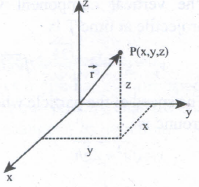
(ii) The position vector \(\overrightarrow { r } \)of the particle at a point P is given by \(\overrightarrow { r } =x\overrightarrow { i } +y\overrightarrow { j } +z\overrightarrow { k } \) where x, y and z are components of \(\overrightarrow { r } \).
45.
(i) Torque \(\overrightarrow { t } =\overrightarrow { r } \times \overrightarrow { F } \). where F is Force and \(\overrightarrow { r } \) is position vector of a particle
(ii) Angular momentum \(\overrightarrow { L } =\overrightarrow { r } \times \overrightarrow { p }\ where\ \overrightarrow { p } \) is the linear momentum
(iii) Linear Velocity \(\overrightarrow { v } =\overrightarrow { \omega } \times \overrightarrow { r } \) where \(\overrightarrow { \omega } \) is angular velocity.
46.
It is the process of splitting a vector into two or more vectors in such a way that their combined effect is same as that of the given vector.
47.
i) The vector product of two vectors is not commutative, i.e., \(\overrightarrow { A } \times \overrightarrow { B } \neq \overrightarrow { B } \times \overrightarrow { A } \) But., \(\overrightarrow { A } \times \overrightarrow { B } =-[\overrightarrow { B } \times \overrightarrow { A } ]\)
(ii) Here it is worthwhile to note that \(|\overrightarrow { A } \times \overrightarrow { B } |=[\overrightarrow { B } \times \overrightarrow { A } ]\)= AB sin \(\theta\) i.e., in the case of the product vectors \(\overrightarrow { A } \) \(\times\)\(\overrightarrow { B } \) and \(\overrightarrow { B } \) \(\times\) \(\overrightarrow { A } \) , the magnitudes are equal but directions are opposite to each other.
48.
\(|3\hat { i } -2\hat { j } +\sqrt { 3 } \hat { k } |=\sqrt { { 3 }^{ 2 }+{ 2 }^{ 2 }+{ \sqrt { 3 } }^{ 2 } } \)
\(\sqrt { 9+4+3 } =\sqrt { 16 } =4\)
49.
The length of a vector is called magnitude of the vector. It is always a positive quantity. The magnitude or norm is denoted by \(\left| \overrightarrow { A } \right| \) .
50.
A coordinate system and the position of an object is described relative to it, then such a coordinate system is called frame of reference.
51.
Kinematics is the branch of mechanics which deals with the motion of objects without taking force into account. The Greek word "kinema" means "motion".
52.
(i) Air resistance is neglected.
(ii) The effect due to rotation of Earth and curvature of Earth is negligible.
(iii) The acceleration due to gravity is constant in magnitude and direction at all points of the motion of the projectile.

11th Standard Syllabus & Materials
11th Standard
TN 11th Tamil பீடு பெற நில் - செய்யுள் - காவடிச்சிந்து Important Questions And Answers Study Material - QB365 Set A
NEW11th Standard
TN 11th Tamil பீடு பெற நில் - உரைநடை - மலை இடப்பெயர்கள் : ஓர் ஆய்வு Important Questions And Answers Study Material - QB365 Set A
NEW11th Standard
TN 11th Tamil மாமழை போற்றுதும் - துணைப்பாடம் - யானை டாக்டர் Important Questions And Answers Study Material - QB365 Set A
NEW11th Standard
TN 11th Tamil மாமழை போற்றுதும் - செய்யுள் - ஐங்குறுநூறு Important Questions And Answers Study Material - QB365 Set A



Tamilnadu Stateboard 11th Standard Subjects

Maths

Commerce

Economics

Biology

Business Maths and Statistics

Accountancy

Computer Science
Physics

Chemistry
Maths
Biology
Economics
Physics
Chemistry

History
Business Maths and Statistics

Computer Science
Accountancy

Computer Applications
History
Computer Technology
Commerce
Computer Applications
Computer Technology

Tamil

English

French
Tamilnadu Stateboard Standards

