
 100% FREE ACCESS
11th Standard Syllabus & Materials
11th Standard
TN 11th Tamil இயற்கை வேளாண்மை,சுற்றுச்சூழல் -செய்யுள் - மனோன்மணீயம் Important Questions And Answers Study Material - QB365 Set A
NEW11th Standard
TN 11th Tamil என்னுயிர் என்பேன் -துணைப்பாடம் - இசைத்தமிழர் இருவர் Important Questions And Answers Study Material - QB365 Set A
NEW11th Standard
TN 11th Tamil மொழி கலை -செய்யுள் - ஒவ்வொரு புல்லையும் Important Questions And Answers Study Material - QB365 Set A
NEW11th Standard
TN 11th Tamil பீடு பெற நில் - இலக்கணம் - பகுபத உறுப்புகள் Important Questions And Answers Study Material - QB365 Set A
NEW11th Standard
TN 11th Tamil பீடு பெற நில் - துணைப்பாடம் - வாடிவாசல் Important Questions And Answers Study Material - QB365 Set A
NEW11th Standard
TN 11th Tamil பீடு பெற நில் - செய்யுள் - குறுந்தொகை Important Questions And Answers Study Material - QB365 Set A

Published on: 30/09/2018
Important 5mark -chapter 1,2,3
Download Tamil Nadu 11th Standard Physics question papers, model tests, one-mark questions, important questions, and public exam papers in PDF format. Free study materials and answer keys for TN State Board students.
Questions + Answers key
Take MCQ Physics Test1.
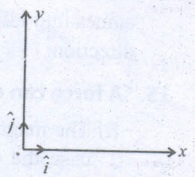
Draw the resultant direction of the two unit vectors \(\hat i\) and \(\hat j\). Use a 2-dimensional Cartesian co-ordinate system. is \(\hat i+\hat j\) a unit vector?
2.
In the section 3.7.3 (Banking of road) we have not included the friction exerted by the road on the car. Suppose the coefficient of static friction between the car tyre and the surface of the road is, calculate the minimum speed with which the car can take safe turn? When the car takes turn in the banked road, the following three forces act on the car.
(1) The gravitational force mg acting downwards.
(2) The normal force N acting perpendicular to the surface of the road.
(3) The static frictional force f acting on the car along the surface.
3.
A three storey building of height 100m is located on Earth and a similar building is also located on Moon. If two people jump from the top of these buildings on Earth and Moon simultaneously, when will they reach the ground and at what speed? (g = 10m s-2)
4.
Derive the relation between Tangential acceleration and angular acceleration.
5.
Shows that the path of horizontal projectile is a parabola and derive an expression for
(i) Time of flight
(ii) Horizontal range
(iii) resultant relative and any instant
(iv) speed of the projectile when it hits the ground?
6.
Explain the concept of relative velocity in one and two dimensional motion.
7.
Explain the types of motion with example.
8.
Explain the principle of homogeniety of dimensions. What are its uses? Give example
9.
The frequency of vibration of a string depends of on,
(i) tension in the string
(ii) mass per unit length of string
(iii) vibrating length of the string
Establish dimensionally the relation for frequency.
10.
One mole of an ideal gas at STP occupies 22.4 L. What is the ratio of molar volume to atomic volume of a mole of hydrogen? Why is the ratio so large? Take radius of hydrogen molecule to be 1oA.
11.
Two resistors of resistances R1= 150 ± 2 Ohm and R2 = 220 ± 6 Ohm are connected in parallel combination. Calculate the equivalent resistance.
Hint:\(\frac{1}{R'}=\frac{1}{R_1}+\frac{1}{R_2}\)
12.
A planet moves around the sun in nearly circular orbit. Its period of revolution 'T' depends upon.
(i) radius 'r' of orbit
(ii) mass 'm' of the sun and
(iii) The gravitational constant G Show dimensionally that T2 \(\propto\)r3.
13.
Check the dimensional consistency of the following equations.
(i) de-Broglie wavelength, \(\lambda ={h\over mv}\)
(ii) Escape velocity, v = \({\sqrt{2GM\over R}}\)
14.
The value Gin CGS system is 6.67\(\times\)10-8 dyne cm2 g-2. Calculate the value in SI units.
15.
On a certain day, rain was falling vertically with a speed of 35 ms-1. A wind started biowing after sometime with a speed of 12 ms-1 in east to west direction. In which direction should boy waiting at a bus stop hold his umbrella?
16.
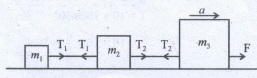
As shown In the diagram, three blocks connected together lie on a horizontal frictionless table and pulled to the right with a force F = 50N. If m1 = 5 kg, m2 = 10 kg and m3 = 15 kg. Find the tensions T1 and T2.
17.
A ball is thrown upward with an initial velocity of 100ms-1. After how much time will it return? Draw velocity-time graph for the ball and find from the graph.
(i) the maximum height attained by the ball
(ii) the height of the ball after 15 s. Take g= 10 ms-2.
18.
A van is moving along x-axis. As shown in the figure, it moves from 0 to P in 18s and returns from P to Q in 6s. What are the average velocity and average speed of the van in going from
(i) from O to P
(ii) from O to P and back to Q?
19.
Explain the propagation of errors in subtraction, quotient and power of a quantity.
20.
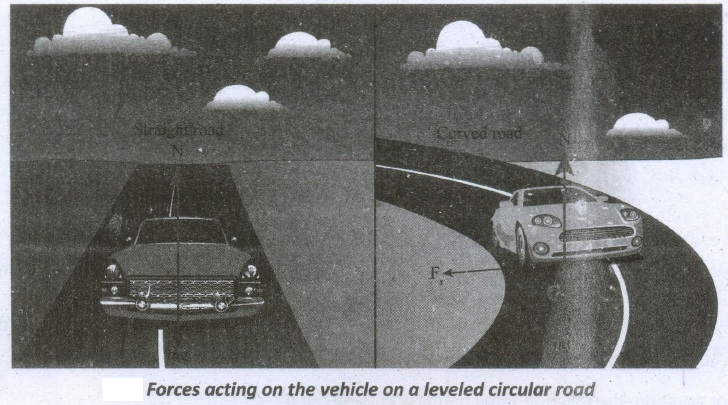
Briefly explain how is a vehicle able to go round a level curved track. Determine the maximum speed with which the vehicle can negotiate this curved track safely.
21.
A projectile is fired horizontally with a velocity u. Show that its trajectory is a parabola. Also obtain the expression for
(i) Time of flight.
(ii) Horizontal range.
22.
Define and illustrate the following terms.
(i) Equal vectors
(il) Parallel vectors
(iii) Anti-parallel vectors
(iv) Unit vector.
23.
Two masses m1 and m2 m1 > m2 or in contact with each other on a smooth horizontal surface. Calculate the magnitude of contact force between them.
24.
Derive an expression for the acceleration of the body sliding down a frictionless surface.
25.
Briefly explain the different types of errors and their causes with an example. How can these error be minimised?
26.
How will you determine the distance of moon from earth using parallax method?
27.
Briefly explain how is a horse able to pull a cart.
28.
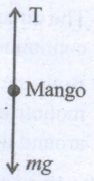
Using Newton's laws calculate the tension acting on the mango (mass m = 400g) hanging from a tree.
29.
Explain the resolution of vectors in three dimensional co-ordinates.
30.
What happens to the object at rest if
(i) fs = 0
(ii) fs = Fext
(iii) fs = max.
31.
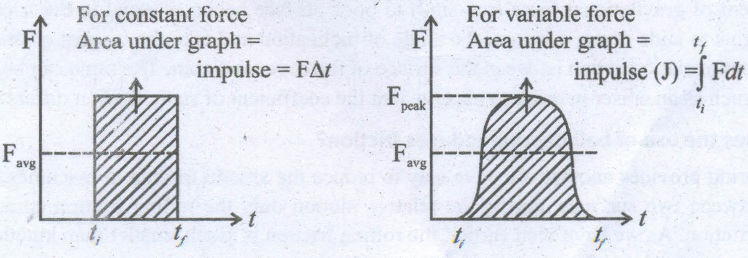
Show how impulse force can be measured graphically.
32.
Prove Impulse - Momentum equation.
33.
Describe Galileo's experiments concerning motion of objects on inclined planes?
34.
The position of a particle is given by r = 2.00t \(\hat { i } -1.00{ t }^{ 2 }\hat { j } +3.00\hat { k } \) where t is in seconds and the coefficients have the proper units for r to be in metres. Find the velocity and acceleration of a particle then what is the magnitude and direction of velocity of the particle at t = 2 s?
35.
A person travels along a straight road for the first half distance 4 m with a velocity 1 ms-1 and the second half distance 3 m with a velocity 0.7 ms-1 What is the mean velocity of the person.
36.
Calculate the vector which has to be added to the resultant of \(\overrightarrow { A } =2\overrightarrow { i } -3\overrightarrow { j } -4\overrightarrow { k } \) and \(\overrightarrow { B } =6\hat { i } -4\hat { j } -4\hat { k } \) gives unit vector along x - direction.
37.
A car moving uniform motion with speed 120 kmh-2 is brought to a stop within a distance of 200 m. How long does it take for the car to stop?
38.
Give some examples for centripetal force.
39.
Write to causes of errors in measurement.
40.
41.
Calculate the centripetal acceleration of Moon towards the Earth.
42.
Describe the method of measuring angle of repose.
43.
44.
Convert 76 cm of mercury pressure into Nm-2 using the method of dimensions.
45.
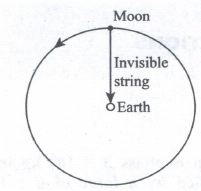
Imagine that the gravitational force between Earth and Moon is provided by an invisible string that exists between the Moon and Earth. What is the tension that exists in this invisible string due to Earth's centripetal force? (Mass of the Moon = 7.34\(\times\)1022 kg, Distance between Moon and Earth = 3.84 \(\times\) 108m).
46.
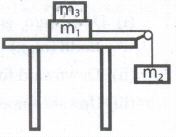
Two masses m1 and m2 are connected with a string passing over a frictionless pulley fixed at the corner of the table as shown in the figure. The coefficient of static friction of mass m1 with the table is μs, Calculate the minimum mass m3 that may be placed on m1 to prevent it from sliding. Check if m1= 15 kg, m2 = 10 kg, m3 = 25 and μs = 0.2.
47.
An object at an angle such that the horizontal range is 4 times of the maximum height. What is the angle of projection of the object?
48.
A particle has its position moved from \(\overset { \rightarrow }{ { r }_{ 1 } } =3\hat { i } +4\hat { j } \) to \(\overset { \rightarrow }{ { r }_{ 2 } } =\hat { i } +2\hat { j } \) Calculate the displacement vector (\(\Delta \)\(\overrightarrow { r } \)) and draw the \(\overrightarrow { { r }_{ 1 } } \), \(\overrightarrow { { r }_{ 2 } } \) and \(\Delta \overrightarrow { r } \) vector in a two dimensional cartesian coordinate system.
49.
The measurement value of length of a simple pendulum is 20cm known with 2mm accuracy. The time for 50 oscillations was measured to be 40 s within is resolution. Calculate the percentage accuracy in the determination of acceleration due to gravity 'g' from the above measurement.
50.
Write short notes on the following.
(a) Unit
51.
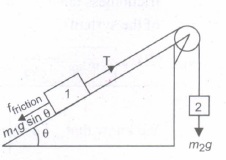
A block 1 of mass m1, constrained to move along a plane. inclined at angle e to the horizontal, is connected via a massless inextensible string that passes over. a massless pulley, to a second block 2 of mass m2. Assume the coefficient of static friction between the block and the inclined plane is and μs the coefficient of kinetic friction is μs.
What is the relation between the masses of block 1 and block 2 such that the system just starts to slip?
52.
Two bodies of masses 7 kg and 5 kg are connected by a light string passing over a smooth pulley at the edge of the table as shown in the figure. The coefficient of static friction between the surfaces (body and table) is 0.9. Will the mass m1 = 7 kg on the surface move? If not what value of m2 should be used so that mass 7 kg begins to slide on the table?
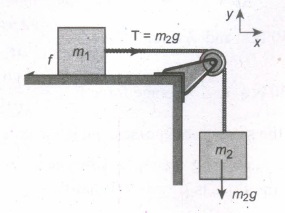
53.
Consider the function Y = x2. Calculate the derivative \(\frac{dy}{dx}\) using the concept of limit. at the point x = 2.
54.
Identify the internal and external forces acting on the following systems.
(a) Earth alone as a system
(b) Earth and Sun as a system
(c) Our body as a system while walking
(d) Our body + Earth as a system
55.
Arrive at Einstein's mass-energy relation by dimensional method (E = mc2).
56.
In a series of successive measurements in an experiment, the readings of the period of oscillation of a simple pendulum were found to be 2.63s, 2.56s, 2.42s, 2.71s, and 2.80s.
Calculate
(i) the mean value of the period of oscillation
(ii) the absolute error in each measurement
(iii) the mean absolute error
(iv) the relative error
(v) the percentage error.
(vi) Express the result in proper form.
57.
A foot-ball player hits the ball with speed 20 ms-1 with angle 30° with respect to horizontal direction as shown in the figure. The goal post is at distance of 40 m from him. Find out whether ball reaches the goal post.
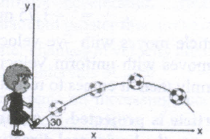
58.
Assuming that the frequency \(\gamma\) of a vibrating string may depend upon
(i) applied force (F)
(ii) length (I)
(ill) mass per unit length (m), prove that \(\gamma\alpha{{1}\over{l}}\sqrt{{{F}\over{m}}}\) using dimensional analysis.
59.
In a submarine equipped with sonar, the time delay between the generation of a pulse and its echo after reflection from an enemy submarine is observed to be 80 sec. If the speed of sound in water is 1460 ms-1. What is the distance of enemy submarine?
1.
By using the triangular law of addition \(\hat i+\hat j\) as shown in the following figure,
.png)
The definition of unit vector is \(\hat A.\hat A=1\)
But here,\((i+j).(i+j)=\hat i.\hat i+\hat i.\hat j+\hat j.\hat i+\hat j.\hat j=1+0+0+1=2\)
So, \(\hat i+\hat j\) is not a unit vector.
To make any vector to a unit vector, must divide the vector by its magnitude, \(\hat A=\frac{\vec A}{|\vec A|}\).
The magnitude of the vector \(\hat i+\hat j=\sqrt 2.\)
Hence, thee unit vector is \(\frac{\hat i+\hat j}{\sqrt 2}.\)
2.
The following figure shows the forces acting on the horizontal and vertical direction.
When the car takes turn with the speed v, the centripetal force is exerted by horizontal component of normal force and static frictional force. It is given by
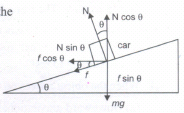
N sinθ+f cosθ=\(\frac { mv^{ 2 } }{ r } \) ......(1)
In the vertical direction, there is no acceleration. It implies that the vertical component of normal force is balanced by downward gravitational force and downward vertical component of frictional force. This can be expressed as
N cosθ=mg+f sinθ
or N cosθ-f sinθ=mg
Diving the equation (1) by equation (2), we get
\(\frac { Nsin\theta +fcos\theta }{ Ncos\theta -fsin\theta } =\frac { { v }^{ 2 } }{ rg } \)
To calculate the maximum speed for the safe turn, we can use the maximum static friction is given by. By substituting this relation in equation (3), we get
\(\frac { Nsin\theta +{ \mu }_{ s }Ncos\theta }{ Ncos\theta -{ \mu }_{ s }Nsin\theta } =\frac { { v }_{ max }^{ 2 } }{ rg } \)
By taking outside the bracket in L.H. S of equation
\(\frac { Ncos\left\{ \left( \frac { Nsin\theta }{ Ncos\theta } \right) +{ \mu }_{ s } \right\} }{ Ncos\theta \left( 1-{ \mu }_{ s }\frac { Nsin\theta }{ Ncos\theta } \right) } =\frac { { v }_{ max }^{ 2 } }{ rg } \)
\(\frac { (tan\theta +{ \mu }_{ s }) }{ 1-{ \mu }_{ s }tan\theta } =\frac { { v }_{ max }^{ 2 } }{ rg } \)
The Maximum speed for safe turn is given. by
vmax=\(\sqrt { rg\frac { (tan\theta +{ \mu }_{ s }) }{ (1-{ \mu }_{ s }tan\theta ) } } \)
Suppose we neglect the effect of friction (μs = 0), then safe speed
vsafe=\(\sqrt { rgtan\theta } \)
Note that the maximum speed with which the car takes safe turn is increased by friction (equation (4)). Suppose the car turns with speed v < -safe then the stati~ friction acts up in the slope to prevent from inward skidding.
If the car turns with the speed little greater than, then the static friction acts down the slope to prevent outward skidding. But if the car turns with the speed greater than then static friction cannot prevent from outward skidding.
3.
.png)
For both persons, the Kinematic equations are the same, with u=0,ac =g and amoon =\(g\over 6\)
ae = g and am =\(g\over 6\)
For a person on earth, Vearth = \(\sqrt{2gh}=\sqrt{2\times 10\times 100}\)
Hence, Vearth =\(\sqrt{2000} ms^{-1}\) gives the velocity at the ground, on earth.
Similarly, for a person on the moon,
Vearth =\(\sqrt{2gh\over6}={\sqrt{2000}\over \sqrt{6}}ms^{-1}\)
The person on earth reaches ground with greater velocity than the person on the moon.
4.
Consider an object moving along a circle of radius r. In a time ∆t, the object travels in an arc distance ∆s as shown in figure. The corresponding angle subtended is ∆\(\theta\)
The ∆s can be written in terms of ∆\(\theta\)
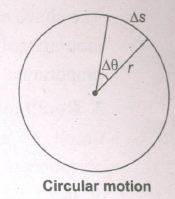
∆s = r∆\(\theta\) ...............(i)
In a time ∆t, we have
\(\frac { \Delta s }{ \Delta t } =t\frac { \Delta \theta }{ \Delta t } \) .......(ii)
In the limit Δt⟶0 the above equation becomes
\(\frac { ds }{ dt } =r\omega \) ........(iii)
Here\(\frac { ds }{ dt } \) is linear speed (v) which is tangential to the circle and \(\omega \) is angular speed. So equation (iii) becomes
vr = rω ........(iv)
which gives the relation between linear speed and angular speed
Eq (iv) is true only for circular motion. In general the relation between linear and angular velocity is given by
\(\vec { v } =\vec { \omega } \times \vec { r } \)...........(v)
For circular motion eq. (v) reduces to eq. (iv) since \(\vec { \omega } \) and \(\vec { r } \) are perpendicular to each other Differentiating the eq. (iv) with respect to time, we get (since r is constant)
\(\frac { dv }{ dt } =\frac { rd\omega }{ dt } =r\alpha \)
Here\(\frac { dv }{ dt } \) is the tangential acceleration and is denoted as at = \(\frac { d\omega }{ dt } \) is the angular acceleration Then eq.(v) becomes
at = r∝ ......(vii)
5.
Consider a projectile, say a ball, thrown horizontally with an initial velocity \(\vec{u}\) from the top of a tower of height h.
As the ball moves, it covers a horizontal distance due to its uniform horizontal velocity u, and a vertical downward distance because of constant acceleration due to gravity g. Thus, under the combined effect the ball moves along the path OPA. The motion is in a 2-dimensional plane. Let the ball take-time t to reach the ground at point A, Then the horizontal distance travelled by the ball is x(t) = x, and the vertical distance travelled is y(t) =y.
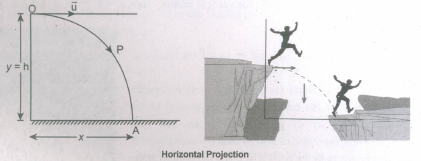
We can apply the kinematic equations along the x direction and y direction separately. Since this is two-dimensional motion, the velocity will have both horizontal component Ux and vertical component uy.
Motion along horizontal direction: The particle has zero acceleration along x direction. So, the initial velocity Ux remains constant throughout the motion.
The distance traveled by the projectile at a time t is given by the equation x = ux t+\(1\over 2\) at 2.
Since a = 0 along x direction, we have
x = uxt ................(i)
Motion along downward direction: Here u y = 0 (initial velocity has no downward component), a = g (we choose the +ve y-axis in downward direction), and distance y at time t.
\(\therefore\) y=\(u_xt+{1\over2}at^2,\) we get
\(y={1\over 2}at^2\) ..............(ii)
Substituting the value of t from equation (i) in equation (ii) we have
\(y={1\over 2}g{x^2\over u^2_x}=({g\over 2u^2_x})x^2\)
y = Kx2
where K = \(g\over 2u^2_x\) is constant.
Equation (iii) is the equation of a parabola. Thus, the path followed by the projectile is a parabola.
1. Time of Flight: The time taken for the projectile to complete its trajectory or time taken by the projectile to hit the ground is called time of flight. Consider the example of a tower and projectile. Let h be the height .of a tower. Let T be the time taken by the projectile to hit the ground, after being thrown horizontally from the tower.
We know that Sy = uyt +\(1\over2\) at2 for vertical motion. Here Sy = h, t = T, uy = 0 (i.e., no initial vertical velocity). Then
\(h={1\over2}gt^2 \ or \ T=\sqrt{2h\over g}\)
Thus, the time of flight for projectile motion depends on the height of the tower, but is independent of the horizontal. velocity of projection. If one ball falls vertically and another ball is projected horizontally with some velocity, both the balls will reach the bottom at the same time.
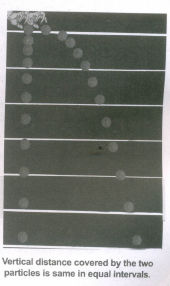
2. Horizontal range: The horizontal distance covered by the projectile from the foot of the tower to the point where the projectile hits the ground is called horizontal range.
For horizontal motion, we have
\(s_x=u_xt+{1\over2}at^2\)
Here, Sx = R (range), Ux = u, a = 0 (no horizontal acceleration) T is time of flight. Then horizontal range = uT.
Since the time of flight T =\(\sqrt{2h\over g}\) ,we substitute this and we get the horizontal range of the particle as R = u\(\sqrt{2h\over g}\)
The above equation implies that the range R is directly proportional to the initial velocity u and inversely proportional to acceleration due to gravity g.
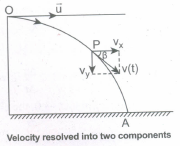
3. Resultant Velocity (Velocity of projectile at any time): At any instant t, the projectile has velocity components along both x-axis and y-axis. The resultant of these two components gives the velocity of the projectile at that instant t
The velocity component at any t along horizontal (x-axis) is vx= ux+axt.
Since, Ux = u, ax = 0 , we get
vx= u
The component of velocity along vertical direction (y-axis) isvy = uy + ay t
Since, uy = 0, ay = g, we get
vy = gt
Hence the velocity of the particle at any instant is
\(\vec{v}=u\hat{i}+gt\hat{j}\)
The speed of the particle at any instant t is given by
\(v=\sqrt{v^2_x+v^2_y}\)
\(\therefore v=\sqrt{u^2+g^2t^2}\)
4. Speed of the projectile when it hits the ground: When the projectile hits the ground after initially thrown horizontally from the top of tower of height h, the time of flight is
\(t=\sqrt{2h\over g}\)
The horizontal component velocity of the projectile remains the same i.e Vx = u.
The vertical component velocity of the projectile at time T is
\(v=gT=g\sqrt{2h\over g}=\sqrt{2gh}\)
The speed of the particle when it reaches the ground is
\(v=\sqrt{u^2+2gh}\)
6.
When two objects A and B are moving with different velocities, then the velocity of one object A with respect to another object B is called relative velocity of object A with respect to B.
Case 1
Consider two objects A and B moving with uniform velocities VA and VB as shown, along straight tracks in the same direction \(\vec { { V }_{ A } } \) ,\(\vec { { V }_{ B } } \) with respect to ground.
The relative velocity of object A with respect to object B is \(\vec { { V }_{ AB } } =\vec { { V }_{ A } } -\vec { { V }_{ B } } \)
The relative velocity of object B with respect to object A is \(\vec { { V }_{ BS } } =\vec { { V }_{ B } } -\vec { { V }_{ A } } \)
Thus, if two objects are moving in the same direction, the magnitude of relative velocity of one object with respect to another is equal to the difference in magnitude of two velocities.
Case 2
Consider two objects A and B moving with uniform velocities VA and VB along the same straight tracks but opposite in direction.
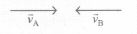
The relative velocity of an object A with respect to object B is
. \(\vec { { V }_{ AB } } =\vec { { V }_{ A } } -(-\vec { { V }_{ B } } )=\vec { { V }_{ A } } +\vec { { V }_{ B } } \)
The relative velocity of an object B with respect to object A is
\(\vec { { V }_{ AB } } =-\vec { { V }_{ A } } -\vec { { V }_{ A } } =-(\vec { { V }_{ A } } +\vec { { V }_{ B } } )\)
Thus, if two objects are moving in opposite directions, the magnitude of relative velocity of one object with respect to other is equal to the sum of magnitude of their velocities.
Case 3
Consider the velocities \(\vec { { V }_{ B } } \) and \(\vec { { V }_{ A } } \) at an angle θ between their directions.
The relative velocity of A with respect to B, \(\vec { { V }_{ AB } } =\vec { { V }_{ A } } -\vec { { V }_{ B } } \)
Then, the magnitude and direction of is given by \({ V }_{ AB }=\sqrt { { v } _{ A }^{ 2 }+ { v } _{ B }^{ 2 }-2{ v }_{ A }{ v }_{ B }cos\theta } \)
and tan\(\beta =\frac { { v }_{ B } \ sin\theta }{ { v }_{ A }-{ v }_{ B } \ cos\theta } \) (Here β is angle between\(\vec { { V }_{ AB } } \) and \(\vec { { V }_{ B } } \))
(i) When \(\theta \) = 0o, the bodies move along parallel straight lines in the same direction,
We have vAB=(vA - vB) in the direction of \(\vec { { V }_{ A } } \) .Obviously \({ V }_{ BA }=({ V }_{ B }+{ V }_{ A })\) in the direction of \(\vec { { V }_{B } } \)
(ii) When\(\theta \) =180o, the bodies move along parallel straight lines in opposite directions,
We have \({ V }_{ AB }=({ V }_{ A}+{ V }_{B })\)in the direction of \(\vec { { V }_{ A } } \)
Similarly, \({ V }_{ BA }=({ V }_{ B}-{ V }_{A })\)in the direction of \(\vec { { V }_{ B } } \)
(iii) If the two bodies are moving at right angles to each other, then \(\theta \)= 90o.The magnitude of the relative velocity of A with respect to B = \({ V }_{ AB }=\sqrt { { v }_{ A }^{ 2 }+{ v }_{ B }^{ 2 } } \)
(iv) Consider a person moving horizontally with velocity \(\vec { { V }_{ M } } \). Let rain fall vertically with velocity \(\vec { { V }_{ R } } \). An umbrella is held to avoid the rain. Then the relative velocity of the rain with respect to the person is,
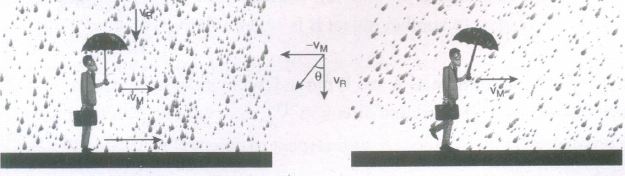
which has magnitude
\(\vec { { V }_{ RM } } =\vec { { V }_{ R } } -\vec { { V }_{ M } } \)
which has magnitude
\(\mathrm{v}_{\mathrm{RM}}=\sqrt{v_{R}^{2}+v_{M}^{2}}\)
and direction \(\theta ={ tan }^{ -1 }\left( \frac { { V }_{ M } }{ { V }_{ R } } \right) \)with the vertical.
In order to save himself from the rain, he should hold an umbrella at an angle θ with the vertical.
7.
(a) Linear motion: An object is said to be in linear motion if it moves in a straight line.
Examples:
1. An athlete running on a straight track
2. AA particle falling vertically downwards to the Earth
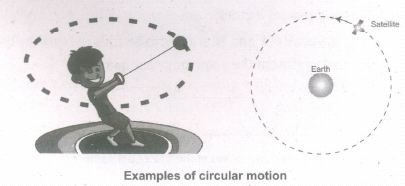
(b) Circular motion: Circular motion is defined as a motion described by an object traversing a circular path.
Examples:
1. The whirling motion of a stone attached to a string.
2. The motion of a satellite around the Earth.
These two circular motions are shown in figure.
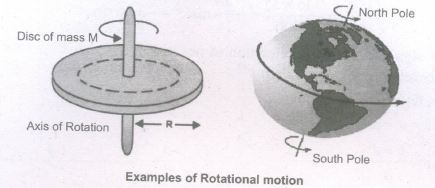
(c) Rotational motion: If any object moves in a rotational motion about an axis, the motion is called 'rotation'. During rotation every point in the object transverses a circular path about an axis, (except the points located on the axis).
Examples:
1. Rotation of a disc about an axis through its center
2. Spinning of the Earth about its own axis.
These two rotational motions are shown in figure.
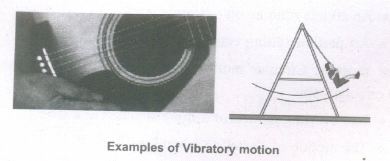
(d) Vibratory motion: If an object or particle executes a to-and-fro motion about a fixed point, it is said to be in vibratory motion. This is sometimes also called oscillatory motion.
Examples:
1.Vibration of a string on a guitar
2. Movement of a swing
These motions are shown in figure
Other types of motion like elliptical motion and helical motion are also possible.
8.
The principle of homogeneity of dimensions states that the dimensions of all the terms in a physical expression should be the same. For example, in the physical expression v2= u2 + 2as, the dimensions of v2, u2 and 2 as are the same and equal to [L2T-2].
This method is used to
(i) Convert a physical quantity from one system of units to another.
(ii) Check the dimensional correctness of a given physical equation.
(iii) Establish relations among various physical quantities.
(i) To convert a physical quantity from one system of units to another: This is based on the fact that the product of the numerical values (n) and its corresponding unit (u) is a constant. i.e, n1[u1] = constant (or) n, n1[u1 ] = n2[u2].
Consider a physical quantity which has dimension 'a' in mass, 'b' in length and 'c' in time.
If the fundamental units in one system are M1, L1 and T1 and the other system are M2, L2, and T2 respectively, then we can write, n1 [M1a L1b T1c] = n2 [ M 2a L2b T2c]
We have thus converted the numerical value of physical quantity from one system of units into the other system.
Example: Convert 76 cm of mercury pressure into Nm-2 using the method of dimensions.
Solution: In cgs system 76 cm of mercury pressure =76\(\times\)13.6\(\times\)980 dyne cm-2
The dimensional formula of pressure P is [ML-1T-2]
\(P_{1}\left[M_{1}^{a} L_{1}^{b} T_{1}^{c}\right]=P_{2}\left[M_{2}^{a} L_{2}^{b} T_{2}^{c}\right]\)
We have
\(P_{2} =\left[\frac{\mathrm{M}_{1}}{\mathrm{M}_{2}}\right]^{a}\left[\frac{\mathrm{L}_{1}}{\mathrm{~L}_{2}}\right]^{b}\left[\frac{\mathrm{T}_{1}}{\mathrm{~T}_{2}}\right]^{c} \)
\(M_{1} =1 \mathrm{~g}, \mathrm{M}_{2}=1 \mathrm{~kg}\)
\(L_{1}=1 \mathrm{~cm}, \mathrm{~L}_{2}=1 \mathrm{~m}
\)
\(T_{1}=1 \mathrm{~s}, T_{2}=1 \mathrm{~s}\)
So a=1, b=1 and c=-2
Then
\(P_{2} =76 \times 13.6 \times 980\left[\frac{\mathrm{g}}{1 \mathrm{~kg}}\right]^{1}\left[\frac{\mathrm{cm}}{1 \mathrm{~m}}\right]^{-1}\left[\frac{1 \mathrm{~s}}{1 \mathrm{~s}}\right]^{-2} \)
\(=76 \times 13.6 \times 980\left[\frac{10^{-3} \mathrm{~kg}}{1 \mathrm{~kg}}\right]^{1}\left[\frac{10^{-2} \mathrm{~m}}{1 \mathrm{~m}}\right]^{-1}\left[\frac{1 \mathrm{~s}}{1 \mathrm{~s}}\right]^{-2} \)
\(=76 \times 13.6 \times 980 \times\left[10^{-3}\right] \times 10^{2} \)
\(P_{2} =1.01 \times 10^{5} \mathrm{Nm}^{-2}\)
(ii) To check the dimensional correctness of a given physical equation:
Example: The equation \(1\over 2\) mv2 = mgh can be checked by using this method as follows.
Solution: Dimensional formula for
\(\boxed{{1\over 2}mv^2=[M][LT^{-1}]^2=[ML^2T^{-2}]}\)
Dimensional formula for
\(\boxed {mgh=[M][LT^{-2}][L]=[ML^{2}T^{-2}] \\ [ML^{2}T^{2}]=[ML^{2}T^{-2}]}\)
Both sides are dimensionally the same, hence the equations\(1\over 2\) mv2 = mgh is dimensionally correct.
(iii) To establish the relation among various physical quantities:
If the physical quantity Q depends upon the quantities Q1, Q2 and Q3 ie. Q is proportional to Q1, Q2 and Q3.
Then,
\(Q \alpha Q_{1}^{a} Q_{2}^{b} Q_{3}^{c}
\)
\(Q=k Q_{1}^{a} Q_{2}^{b} Q_{3}^{c}\)
where k is a dimensionless constant. When the dimensional formula of Q1, Q2 and Q3 are substituted, then according to the principle of homogeneity, the powers of M, L, T are made equal on both sides of the equation. From this, we get the values of a, b, c.
Example:
Obtain an expression for the time period T of a simple pendulum. The time period T depend upon (i) mass 'm' of the bob (ii) length 'l' of the pendulum and (iii) acceleration due to gravity g at the place where the pendulum is suspended. (Constant k=2π ) i.e
Solution:
\(\boxed{T \alpha m^a l^b g^c \\ T=k.m^al^bg^c}\)
Here k is the dimensionless constant. Rewriting the above equation with dimensions.
\(\boxed{[T^1]=[M^a][L^b][LT^{-2}]^c\\ [M^oL^oT^1]=[M^aL^{b+c}T^{-2c}]}\)
Comparing the powers of M, L and T on both sides, a = 0, b + C = 0, -2c = 1
Solving for a, b and c a = 0, b = 1/2, and c = -1/2
From the above equation
T = k. mo l1/2 g-1/2
T=\(k{1\over g}^{1\over 2}=k\sqrt{1\over g}\)
Experimentally k = 2\(\pi\) , hence \(T=2\pi \sqrt{l\over g}\)
9.
n\(\propto\) IaTbmc, [I] = [MoL1To]
[T] = [M1L1T-2] (force)
[M] = [M1L-1To]
[Mo LoT-1] = [MoL1To]a [M1L1T-2]b [MoL-1To]C
b + c = 0
a + b - c = 0
-2b = -1 \(\Rightarrow\) b = \(1\over2\)
c =\(-{1\over2}a=1\)
n\(\propto\) \({1\over l}{\sqrt{T\over m}}\)
10.
Ao= 10-10 m
Atomic volume of 1 mole of hydrogen
= Avagadro's number\(\times\)volume of hydrogen molecule
= 6.023\(\times\)1023 \(\times\)\(4\over 3\) \(\times\) \(\pi\) x (10-10 m)3
= 25.2\(\times\)10-7 m3
Molar volume = 22.4 L = 22.4\(\times\)10-3 m3
\(Molar \ volume \over Atomic\ volume\)= 0.89x10⁴\(\approx \)104
This ratio is large because actual size of gas molecule is negligible in comparison to the inter molecular separation.
11.
The equivalent resistance of a parallel combination
\(R'=\frac{R_1R_2}{R_1+R_2}=\frac{150\times220}{150+220}=\frac{33000}{370}=89.1\ Ohm\)
We know that, \(\frac{1}{R'}=\frac{1}{R_1}+\frac{1}{R_2}\)
\(\frac { \triangle { R }^{ ' } }{ \left( { R }^{ ' } \right) ^{ 2 } } =\frac { \triangle { R }_{ 1 } }{ { R }_{ 1 }^{ 2 } } +\frac { \triangle { R }_{ 2 } }{ { R }_{ 2 }^{ 2 } } \)
\(\triangle { R }^{ ' }=\left( { R }^{ ' } \right) ^{ 2 }\frac { \triangle { R }_{ 1 } }{ { R }_{ 1 }^{ 2 } } +\left( { R }^{ ' } \right) ^{ 2 }\frac { \triangle { R }_{ 2 } }{ { R }_{ 2 }^{ 2 } } =\left( \frac { { R }^{ ' } }{ { R }_{ 1 } } \right) ^{ 2 }\triangle { R }_{ 1 }+\left( \frac { { R }^{ ' } }{ { R }_{ 2 } } \right) ^{ 2 }\triangle { R }_{ 2 }\)
Substituting the value,
\(\triangle { R }^{ ' }=\left[ \frac { 89.1 }{ 150 } \right] ^{ 2 }\times 2+\left[ \frac { 89.1 }{ 220 } \right] ^{ 2 }\times 6=0.070+0.098=0.168\)
R' = 89.1 ± 0.168 Ohm.
12.
Let T = KraMbGc ..... (1)
Where K = a dimensionless constant
dimensions of the various quantities are [T] = T, [r] = L, [M] = M
[G] \(={Fr^2\over m_1m_2}={MLT^{-2}.L\over MM}=M^{-1}L^3T^{-2}\)
Substituting these dimensions in equation (1) we get,
[T] = [L]a [M]b [M-1 L3 T-2]c
MOLoTI=Mb-c=Mb-cLa+3cT-2c
Equating the dimensions of M, L and T, we get b - c = 0, a + 3c = 0, - 2c = 1
on solving a=\(3\over2\) b=\(-{1\over2}\) c=\(-{1\over2}\) T=Kr3/2M-1/2 G-l/2 or T2=\({K^2R^3\over MG} \Rightarrow \therefore T^2 \propto r^3\)
13.
(i) Given \(\lambda ={h\over mv}\)
As wavelength is a distance,
LHS = \(\therefore [\lambda]=L\)
Also, RHS =\([{h\over mv}] ={Planck's \ constant \over mass \times velocity}={ML^2T^{-1}\over MLT^{-1}}=L\)
\(\therefore\) Dimensions of LHS = Dimensions of RHS.
Hence the given equation is dimensionally consistent.
(ii) Given v = \(\sqrt{2GM\over R}\)
LHS = [V] = LT-1
\(RHS=[{2GM\over R}]^{1\over2}=[{M^{1\over2}L^3T^{-2}.M \over L}]^{1\over 2}=[L^2T^{-2}]{1\over2}=LT^{-1}\)
\(\therefore\) Dimensions of LHS = Dimensions of RHS.
Hence the given equation is dimensionally correct.
14.
As F \(=G{m_1m_2\over r^2}\)
\(G={F.r^2\over m_1m_2}\)
\([G]={{MLT}^{-2}.L^2\over MM}={M}^{-1}L^3{T}^{-2}\)
\(\therefore\) a = -1, b ~ 3, c = -2
| CGS units | SI units |
|---|---|
| n1 = 6.67\(\times\) 10-8 | n2 =?, |
| m1=1g | m2 = 1 kg=1000 g |
| L1 = 1cm | L2 = 1 cm = 100cm |
| T1=1s | T2=1s |
\(\therefore\) \(n_2=n_1{\left[ {M_1 \over M_2} \right]}^{a}{\left[ {L_1 \over L_2} \right]}^{b}{\left[ {T_1 \over T_2} \right]}^{c}\)
\(=6.67\times{10}^{-8}{\left[ {{1\over 1000}} \right]}^{-1}{\left[ {{1\over 100}} \right]}^{3}\left[ {1\over 1} \right]^{-2}=6.67\times{10}^{}-11\)
Hence in SI units, G = 6.67\(\times\)10-11Nm2 kg-2
15.
In the figure, Velocity of rain, \(\vec V_R=\vec OA=3.5ms^{-1}\)(vertically downwards)
Velocity of wind, \(\vec V_w=\vec OB=12 ms^{-1}\)east to west
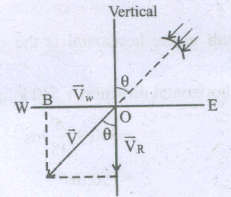
The magnitude of the resultant velocity is
\(V=\sqrt{V_R^2+V_W^2}=\sqrt{35^2+12^2}=37\ ms^{-1}\)
Let the resultant velocity \(\vec v=(\vec {OC})\) make an angle θ with the vertical, then
\(tan\theta=\frac{AC}{OA}=\frac{V_W}{V_R}=\frac{12}{35}=0.343\)
\(\therefore\theta=tan^{-1}(0.343)\simeq19^0\)
Hence the boy should hold umbrella bending it towards east making an angle of about 190 with the vertical.
16.
Given:
F = 50N
m1 = 5 kg
m2 = 10 kg
m3 = 15 kg
All the blocks move with common acceleration a under the force F = 50N
∴ F = (m1 + m2 + m3)a
or a = \(\frac { F }{ { m }_{ 1 }+{ m }_{ 2 }+{ m }_{ 3 } } =\frac { 50 }{ 5+10+15 } =\frac { 5 }{ 3 } \) ms-2
To determine T1 Refer to the free-body diagram for m1 shown in the diagram. Clearly, the tension T1 produces acceleration a in mass m1.
∴ T1 = m1a = \(5\times \frac { 5 }{ 3 } =\frac { 25 }{ 3 } \) = 8.33 N
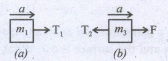
To determine T2 Refer to the free-body diagram for m3 shown in the diagram (b). Force F acts towards right and tension T2 acts towards left.
∴ F - T2 = m3 a (or) 50 - T2 = 15 x \(\frac { 5 }{ 3 } \) or T2 =25N
17.
Given:
u = 100 ms-1, g = -10 ms-2
At highest point,v = 0
As v = u + gt
∴ 0 = 100 - 10\(\times\)t
∴ Time taken to reach highest point,
\(t=\frac{100}{10}\) =10 s
The ball will return to the ground at t = 20 s
Velocities of the ball at different instants at time will be as follows:
At t = 0, v = 100 -10\(\times\)0 = 100 ms-1
At t = 5 s, v = 100 -10\(\times\)5 = 50 ms-1
At t = 10 s, v = 100 - 10\(\times\)10 = 0
At t = 15 s,v = 100 -10\(\times\)15 = - 50 ms-1
At t = 20 s, v = 100 - 10\(\times\)20 = - 100 ms-1
The velocity-time graph will be as shown in the figure.
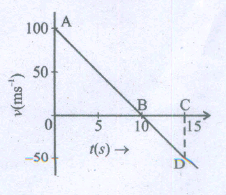
(i) Maximum height attained by the ball
= Area of \(\Delta\)OAB
=\(\frac{1}{2}\)\(\times\)10s\(\times\)100ms-1= 500m
(ii) Height attained after 15 s
= Area of \(\Delta\)AOB + Area of \(\Delta\)BCD
= 500 + \(\frac{1}{2}\)(15-10) \(\times\)(-50) = 500 -125 = 375m
18.

(i) Formula: From O to P \(Average\ velocity=\frac{Displacement}{Time\ interval}\)
\(=\frac{+360m}{18s}=+20\ ms^-1\)
\(Average\ speed=\frac{Path\ length}{Time\ interval}=\frac{360m}{18s}=20ms^{-1}\)
(ii) From O to P and back to Q.
\(Average\ velocity=\frac{Displacement}{Time\ interval}\)
\(=\frac{OQ}{18+6}=\frac{+240m}{24s}=10ms^{-1}\)
\(Average\ speed=\frac{Path\ length}{Time\ interval}\)
\(=\frac{OP+OQ}{18+6}=\frac{(360+120)}{24s}=20ms^{-1}\)
19.
(i) Error in the difference of two quantities:
Let \(\triangle\)A and \(\triangle\)B be the absolute errors in the two quantities, A and B, respectively. Then,
Measured value of A = A \(\pm \triangle\)A
Measured value of B = B \(\pm \triangle\)B
Consider the difference, Z =A - B
The error \(\triangle\)Z in Z is then given by
\(Z\pm\triangle Z=(A\pm\triangle A)-(B\pm\triangle B)\)
\(=(A-B)\pm(\triangle A+\triangle B)\)
\(=Z\pm(\triangle A + \triangle B)\)
(or) \(\triangle Z=\triangle A+\triangle B\)
(ii) Error in the division or quotient of two quantities: Let \(\triangle\)A and \(\triangle\)B be the absolute errors in the two quantities A and B respectively.
Consider the quotient, Z = \(A\over B\)
The error \(\triangle\)Z in Z is given by \(Z\pm\triangle Z={A\pm\triangle A\over B\pm\triangle B}={A{(1\pm{\triangle A \over A})\over B{(\pm {\triangle B\over B})}}}={A\over B}(1\pm{\triangle A\over A})(1\pm{\triangle B\over B})^{-1}\)
\(or Z\pm \triangle Z=Z(1\pm {\triangle A\over A})(1\mp{\triangle B\over B}) \) [using (1 +x)n=1+ nx, when x «1]
Dividing both sides by Z, we get, \(1\pm{\triangle Z\over Z}=(1\pm{\triangle A\over A})(1\mp{\triangle B\over B})=1\pm {\triangle A\over A}\mp {\triangle B\over B}\pm{\triangle A\over A}{\triangle B\over B}\)
As the terms \(\triangle\)A / A and \(\triangle\)B/B are small, their product term can be neglected,
The maximum fractional error in Z is given by \({\triangle Z \over Z}=({\triangle A \over A}+{\triangle B\over B})\)
(iii) Error in the power of a quantity: Consider the nth power of A, Z = An The error\(\triangle\) Zin Z is given by
Z\(\pm \triangle\)Z=(A\(\pm \triangle\)A)n=An =\(=(1\pm{\triangle A\over A})^n=Z(1\pm n{\triangle A\over A})\)
We get [(1+x)n + nx, when x« 1] neglecting remaining terms, Dividing both sides by Z
\(1\pm{\triangle Z \over Z}=1\pm n{\triangle A \over A}or{\triangle Z \over Z}=n{\triangle A \over A}\)
20.
When a vehicle travels in a curved path, there must be a centripetal force acting on it. This centripetal force is provided by the frictional force between tyre and surface of the road. Consider a vehicle of mass 'm' moving at a speed 'v' in the circular track of radius 'r'. There are three forces acting on the vehicle when it moves as shown in the figure.
(i) Gravitational force (mg) acting downwards
(ii) Normal force (mg) acting upwards
(iii) Frictional force (Fs) acting horizontally inwards along the road
Suppose the road is horizontal then the normal force and gravitational force are exactly equal and opposite. The centripetal force is provided by the force of static friction Fs between the tyre and surface of the road which acts towards the center of the circular track,
\(\frac { m{ v }^{ 2 } }{ r } ={ F }_{ s }\)
As we have already seen in the previous section, the static friction can increase from zero to a maximum value
Fs ≤ μsmg
There are two conditions possible namely without skidding and skidding.
For without skidding \(\frac { m{ v }^{ 2 } }{ r } \le { \mu }_{ s }mg\), or \({ \mu }_{ s }\ge \frac { { v }^{ 2 } }{ rg } \) or \(\sqrt { { \mu }_{ s }rg } \ge v\)
The static friction would be able to provide necessary-centripetal force to bend the car on the road.
21.
Consider a projectile, say a ball, thrown horizontally with an initial velocity \(\vec u\) from the top of a tower of height h in the figure (graphical representation of horizontal projection).
Motion along horizontal direction: The particle has zero acceleration along x direction. So, the initial velocity u, remains constant throughout the motion. The distance traveled by the projectile at a time t is given by the equation \(x={ u }_{ x }t+\frac { 1 }{ 2 } a{ t }^{ 2 }\). Since a = 0 along r direction, we have
x = uxt.................(1)
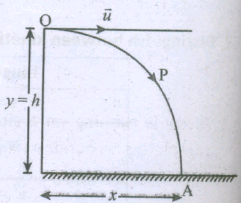
Motion along downward direction: Here uy = 0 (initial velocity has no downward component), a = g (we choose the positive y-axis in downward direction), and distance y at time t.
∴ From the equation,\(y={ u }_{ y }t+\frac { 1 }{ 2 } a{ t }^{ 2 }\)
\(y=\frac{1}{2}gt^2\)..............(2)
Substituting the value oft from equation (1) in equation (2) we have
\(y=\frac { 1 }{ 2 } g\frac { { x }^{ 2 } }{ { u }_{ x }^{ 2 } } =\left( \frac { g }{ { 2u }_{ x }^{ 2 } } \right) { x }^{ 2 }\)
y = Kx2................(3)
where \(K=\frac { g }{ { 2u }_{ x }^{ 2 } } \) is constant
Equation (3) is the equation of a parabola. Thus, the path followed by the projectile is a parabola.
(i) Time of Flight: The time taken for the projectile to complete its trajectory or time taken by the projectile to hit the ground is called time of flight.
Consider the example of a tower and projectile. Let h be the height of a tower. Let T be the time taken by the projectile to hit the ground, after being thrown horizontally from the tower.
We know that \(s_y={ u }_{ y }t+\frac { 1 }{ 2 } a{ t }^{ 2 }\) for vertical motion. Here Sy = h, t = T, uy = 0 (i.e., no initial vertical velocity).
Then \(h=\frac { 1 }{ 2 } g{ T }^{ 2 }\left( or \right) T=\sqrt { \frac { 2h }{ g } } \)
(ii) Horizontal range: The horizontal distance covered by the projectile from the foot of the tower to the point where the projectile hits the ground is called horizontal range. For horizontal motion, we have
\(s_x={ u }_{ x }t+\frac { 1 }{ 2 } a{ t }^{ 2 }\)
Here, s = R (range), ux= u, a = 0 (no horizontal acceleration) T is time of flight. Then horizontal range = uT.
Since the time of flight \(T=\sqrt\frac{2h}{2},\) we substitute this and we get the horizontal range of the particle as \(R=u\sqrt\frac{2h}{2}.\)
22.
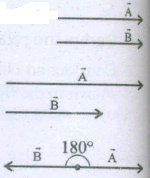
(i) Two vectors\(\vec A\) and \(\vec B\) are said to be equal when they have equal magnitude and same direction.
(ii) If two vectors \(\vec A\) and \(\vec B\) act in the same direction along the same line or on parallel lines, such that the angle between them is 0°.
(iii) Two vectors are said to be anti-parallel when they are in opposite directions.
(iv) A vector divided by its magnitude is a unit vector. It has a magnitude equal to unit or one. \(\hat A=\frac{\vec A}{A}\).
23.
Consider two blocks of masses m1 and m2 (m1 > m2) kept in contact with each other on a smooth, horizontal frictionless surface as shown in the figure.
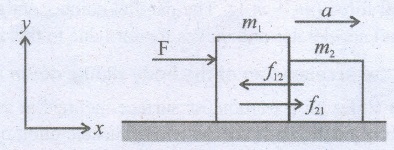
By the application of a horizontal force F, both the blocks are set into motion with acceleration 'a' simultaneously in the direction ofthe force F.
To find the acceleration \(\vec { a } \), Newton's second law has to be applied to the system (combined mass m = m1 + m2)
\(\vec { F } =m\vec { a } \)
If we choose the motion of the two masses along the positive x direction
\(F\hat { i } =ma\hat { i } \)
By comparing components on both sides of the above equation
F = ma where m = m1 + m2
The acceleration of the system is given by
∴ a = \(\frac { F }{ { m }_{ 1 }+{ m }_{ 2 } } \) ..............(1)
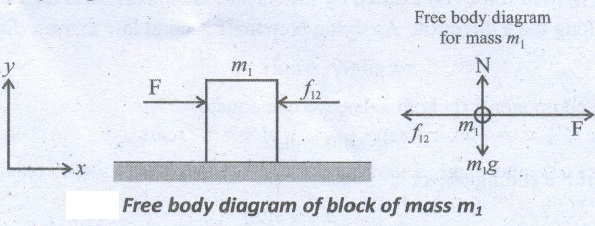
The force exerted by the block m1 on m2 due to its motion is called force of contact (\(\vec { f_{ 21 } } \)). According to Newton's third law, the block m2 will exert an equivalent opposite reaction force (\(\vec { f_{ 12 } } \)) on block m1..Figure shows the free body diagram of block m1.
Figure shows the free body diagram of block m1
∴ \(F\hat { i } ={ \vec { f } }_{ 12 }\hat { i } ={ m }_{ 1 }a\hat { i } \)
By comparing the components on both sides. of the above equation, we get
F-f12 = m1a
f12 = F-m1a .....(2)
Substituting the value of accelera~ion from equation (1) in (2) we get
f12= \(F-{ m }_{ 1 }\left( \frac { F }{ { m }_{ 1 }+{ m }_{ 2 } } \right) \)
f12=\(f\left[ 1-\frac { { m }_{ 1 } }{ { m }_{ 1 }+{ m }_{ 2 } } \right] \)
f12=\(\frac { F{ m }_{ 2 } }{ { m }_{ 1 }+{ m }_{ 2 } } \) ....(3)
Equation (3) shows that the magnitude of contact force depends on mass m: which provides the reaction force. Note that this force is acting along the negative x direction.
In vector notation, the reaction force on mass m1 is given by \(\vec { { fi }_{ 12 } } =\frac { F{ m }_{ 2 } }{ { m }_{ 1 }+{ m }_{ 2 } } \)
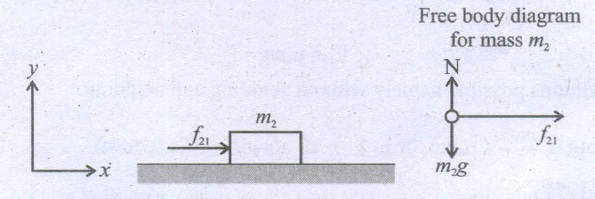
For mass m2 there is only one force acting on it in the x direction and it is denoted by f21 This force is exerted by mass m1. The free body diagram for mass m2 is shown in the figure.
Applying Newton's second law for mass m2
\(f_{ 21 }\hat { i } ={ m }_{ 2 }a\hat { i } \)
By comparing the components on, both sides of the above equation
f21 = m2a .....(4)
Substituting for acceleration from equation (1) in equation (4), we get \({ f }_{ 21 }=\frac { F{ m }_{ 2 } }{ { m }_{ 1 }+{ m }_{ 2 } } \)
In this case the magnitude of the contact force is \({ f }_{ 21 }=\frac { F{ m }_{ 2 } }{ { m }_{ 1 }+{ m }_{ 2 } } \).
Free body diagram of block of mass m2
24.
When an object of mass m slides on a frictionless surface inclined at an angle e as shown in the figure, the forces acting on it decides the
(a) acceleration of the object
(b) speed of the object when it reaches the bottom.
The force acting on the object is
(i) Downward gravitational force (mg)
(ii) Normal force perpendicular to inclined surface (N)
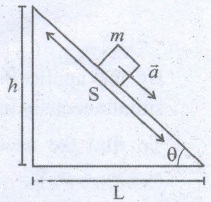
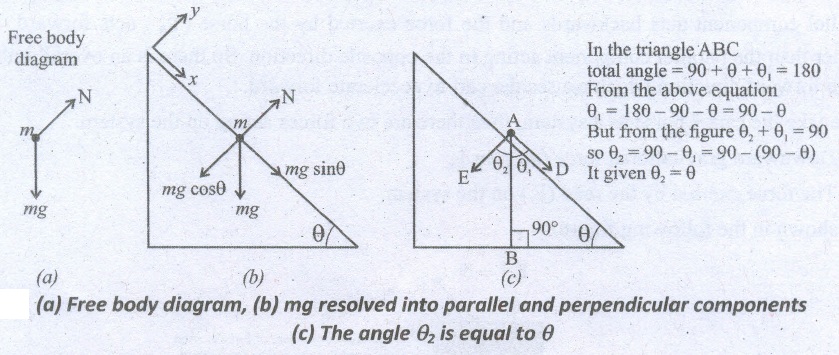
To draw the free body diagram, the block is assumed to be a point mass [in figure (a)]. Since the motion is on the inclined surface, we have to choose the coordinate system parallel to the inclined surface as shown
in the figure (b).
The gravitational force mg is resolved in to parallel component mg sine along the inclined plane and perpendicular component mg coss perpendicular to the inclined surface [figure (b)].
Note that the angle made by the gravitational force (mg) with the perpendicular to the surface is equal to the angle of inclination e' as shown in figure (c).
There is no motion (acceleration) along the y axis. Applying Newton's second law in the y direction
\(-mg\ cos\theta \hat { j } +N\hat { j } \) =0 (No acceleration)
By comparing the components on both sides, N-mg cos ፀ=0
N=mg cosፀ
The magnitude ~fnormal force (N) exerted by the surface is equivalent to mg cosፀ, Tlie object slides (with an acceleration) along the x direction. Applying Newton's second law in the x direction.
\(mg\ sin\theta\ \hat { i } =ma\hat { i } \)
By comparing the components on both sides, we can equate
mg sinፀ = ma
The acceleration of the sliding object is
a = g sinፀ
Note that the acceleration depends on the angle of inclination ፀ.
25.
The uncertainty in a measurement is called an error. The three possible errors are
(i) Systematic error
(ii) Random error and
(iii )Gross error
(i) Systematic Errors: Systematic errors are reproducible inaccuracies that are consistently in the same direction. These occur often due to a problem that persists throughout the experiment. Systematic errors can be classified as follows,
Instrumental errors: When an instrument is not calibrated properly at the time of manufacture, instrumental errors may arise. If a measurement is made with a meter scale whose end is worn out, the result obtained will have errors. These errors can be corrected by choosing the instrument carefully.
Imperfections in experimental technique or procedure: These errors arise due to the limitations iri the experimental arrangement. As an example, while performing experiments with a calorimeter, if there is no proper insulation, there will be radiation losses. This results in errors and to overcome these, necessary correction has to be applied.
Personal errors: These errors are due to, individuals performing the experiment, may be due to incorrect initial setting up of the experiment or carelessness of the individual making the observation due to improper precautions. Errors due to external causes: The change in the external conditions during an experiment can cause error in measurement. For example, changes in temperature, humidity, or pressure during measurements may affect-the result of the measurement.
Least count error: Least count is the smallest value that can be measured by the measuring instrument, and the error due to this measurement is least count error. The instrument's resolution hence is the cause of this error. Least count error can be reduced by using a high precision instrument for the measurement.
(ii) Random errors: Random errors may arise due to random and unpredictable variations in experimental conditions like pressure, temperature, voltage supply etc. Errors may also be due to personal errors by the observer who performs the experiment. Random errors are sometimes called "chance error". When different readings are obtained by a person every time he repeats the experiment, personal error occurs. For example, consider the case of the thickness of a wire measured using a screw .gauge. The readings taken may be different for different trials. In this case, a large number of measurements are made and then the arithmetic mean is taken.
If n number of trial readings are taken in an experiment, and the readings are a1,a2,a3,..... an. The arithmetic mean is
\(a_m={a_1+a_2+a_3+...a_n\over n}(or)a_m={1\over n}\sum _{ i=1 }^{ i=n }{ { a }_{ i } } \)
Usually this arithmetic mean is taken as the best way to minimize the error.
(iii) Gross Error: The error caused clue to the shear carelessness of an observer is called gross error.
for example
(a) Reading an instrument without setting it properly.
(b) Taking observations in a wrong manner without bothering about the sources of errors and the precautions.
(c) Recording wrong observations.
(d) Using wrong values of the observations in calculations.
These errors can. be minimized only when an observer is careful and mentally alert.
| Type of error | Example | How to minimize it |
| Random error | Suppose you measure the mass of a ring three times using the same balance and get slightly different values. 15.46g,15.42g, 15.44g. | Take more data. Random errors can be evaluated through statistical analysis and can be reduced by averaging over a large number of observations. |
| Systematic error | Suppose the cloth tape measure that you use to measure the length of an object has been stretched out from years of use. (As a result all of the length measurements are not correct). | Systematic errors are difficult to detect and cannot be analysed statistically, because all of the data is in the same direction. (Either too high or too low) |
26.
C is the centre of the Earth A and B are two diametrically opposite places on the surface of the Earth. From A and B, the parallaxes \(\theta _1\) and \(\theta _2\) respectively of Moon M with respect to some distant star are determined with the help of an astronomical telescope.
Thus, the total parallax of the Moon subtended on Earth \(\angle\)AMB = \(\theta _1\)+ \(\theta _2\) =\(\theta \)
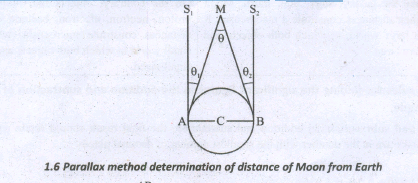
If \(\theta\) is measured in radians, then\(\theta ={AB\over MC};AM\approx MC\)
\(\theta ={AB\over MC} or M.C={AB\over\theta}\)
Knowing the values of AB and \(\theta\) , we can calculate the distance MC of Moon from the Earth.
27.
Consider the horse as the 'system', then there are three forces acting on the horse
(i) Downward gravitational force (mhg)
(ii) Force exerted by the road (Fr)
(iii) Backward force exerted by the cart (Fc)
It is shown in the following figure.
Fr - Force exerted by the road on the horse
Fc - force exerted by the cart on the horse
Fr丄 - Perpendicular component of Fr = N
Fr||-Parallel component of F, which is reason for forward movement.
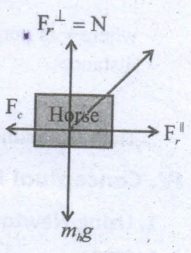
The force exerted by .the road can be resolved into parallel and perpendicular components, The perpendicular component balances the downward gravitational force. There is parallel component along the forward direction. It is greater than the backward force (Fc). So there is net force along the forward direction which causes the forward movement of the horse.
If we take the cart as the system, then there are three forces acting on the cart.
(i) Downward gravitational force (mcg)
(ii) Force exerted by the road (Fr')
(iii) Force exerted by the horse (Fh)
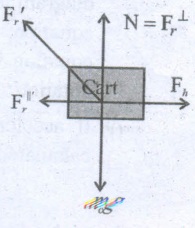
It is shown in the figure
The force exerted by the road (\(\vec { { F }_{ r } } \)) can be resolved into parallel and perpendicular components. The perpendicular component cancels the downward gravity (mcg)
Parallel component acts backwards and the force exerted by the horse (\(\vec { { F }_{ h } } \)) acts forward. Force (\(\vec { { F }_{ h } } \)) is greater than the parallel component acting in the opposite direction. So there is an overall unbalanced force in the forward direction which causes the cart to accelerate forward.
If we take the cart + horse as a system, then there are two forces acting on the system.
(i) Downward gravitational force (mh + mc)g
(ii) The force exerted by the road (Fr) on the system.
It is shown in the following figure.
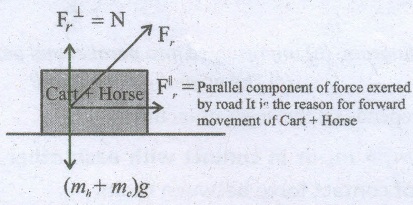
(iii) In this case the force exerted by the road (Fr) on the system (cart + horse) is resolved in to parallel and perpendicular components. The perpendicular component is the normal force which cancels the downward gravitational force (mh +mc)g. The parallel component of the force is not balanced, hence the system (cart + horse) accelerates and moves forward due to this force.
28.
(i) Choose a suitable inertial coordinate system to analyse the problem. For most of the cases we can take Earth as an inertial coordinate system.
(ii) Identify the system to which Newton's laws need to be applied. The system can be a single object or more than one object.
(iii) Draw the free body diagram.
(iv) Once the forces acting on the system are identified, and the free body diagram is drawn, apply Newton's second law. In the left hand side of the equation, write the forces acting on the .system in vector notation and equate it to the right hand side of equation which is the product of mass .and acceleration. Here, acceleration should also be in vector notation.
(v) If acceleration is given, the force can be calculated. If the force is given, acceleration can be calculated.
By following the above steps: We fix the inertial coordinate system on the. ground as shown in the figure.
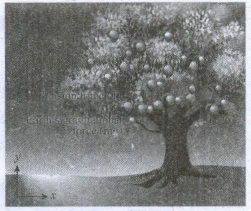
The forces acting on the mango are
(i) Gravitational force exerted by the Earth on the mango acting downward along negative y-axis.
(ii) Tension (in the cord attached to the mango) acts upward along positive y-axis.
The free body diagram for the mango is shown in the figure.
\(\vec { { F }_{ g } } =mg(-\hat { j } )=-mg\hat { j } \)
Here, mg is the magnitude of the gravitational force and \((-\hat { j } )\) represents the unit vector in negative y direction.
\(\vec { T } =T\hat { j } \)

Here T is the magnitude of the tension force and \((-\hat { j } )\) represents the unit vector in positive y direction.
\({ \vec { F } }_{ net }={ \vec { F } }_{ s }+{ \vec { T } }_{ g }=-mg\hat { j } +T\hat { j } =(T-mg)\hat { j } \)
From Newton's second law \({ \vec { F } }_{ net }=m\vec { a } \)
Since the mango is at rest with respect to us (inertial coordinate system) the acceleration is zero (\(\vec { a } =0\))
So \({ \vec { F } }_{ net }=m\vec { a } =0\)
\((T-mg)\hat { j } =0\)
By comparing the components on both sides of the above equation, we get T - mg = 0
So the tension force acting on the mango is given by T - mg
Mass of the mango m = 400g and g = 9.8 ms-2 Tension acting on the mango is T = 0.4\(\times\)9.8 = 3.92 N.
29.
In the Cartesian coordinate system any vector \(\vec A\) can be resolved into three components along x, y and z directions. This is shown in the figure (b) (Components of a vector in 2 dimensions and 3 dimensions).
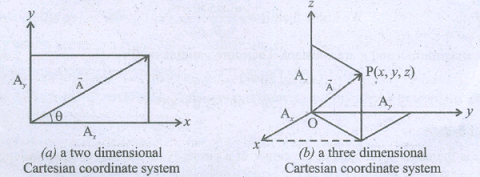
Consider a 3-dimensional coordinate system. With respect to this a vector can be written in component form as
\(\vec { A } ={ A }_{ x }\hat { i } +{ A }_{ y }\hat { j } +A_{ z }\hat { k } \)
\(A=\sqrt { { A }_{ x }^{ 2 }+{ A }_{ y }^{ 2 }+{ A }_{ z }^{ 2 } } \)
30.
(i) If the object is at rest and no external force is applied on the object, the static friction acting on the object is zero (fs = 0).
(ii) If the object is at rest, and there is an external force applied parallel to the surface, then the force of static friction acting on the object is exactly equal to the external force applied on the object (fs = Fext). But still the static friction Is is less than μsN.
(iii) When object begins to slide, the static friction (fs) acting on the object attains maximum.
31.
32.
If a force (F) acts on the object in a very short interval of time (M), from Newton's second law in magnitude form
Fdt = dp
Integrating over time from an initial time ti to a final time tf, we get
\(\int _{ i }^{ f }{ dp } =\int _{ { t }_{ i } }^{ { t }_{ f } }{ Fdt } \)
pf-pi = \(\int _{ { t }_{ i } }^{ { t }_{ f } }{ Fdt } \)
pi = initial momentum of the object at time ti
Pt = final momentum of the object at time tf.
pf - pi = Δp change in momentum of the object during the time interval
tf - ti = Δt
The integral \(\int _{ { t }_{ i } }^{ { t }_{ f } }{ Fdt } \)=J is called the impulse and it is equal to change in momentum of the object.
If the force is constant over the time interval, then
\(\int _{ { t }_{ i } }^{ { t }_{ f } }{ F } dt=\int _{ i }^{ f }{ dp } \) = F(tf - ti) = FΔt
FΔt = Δp
33.
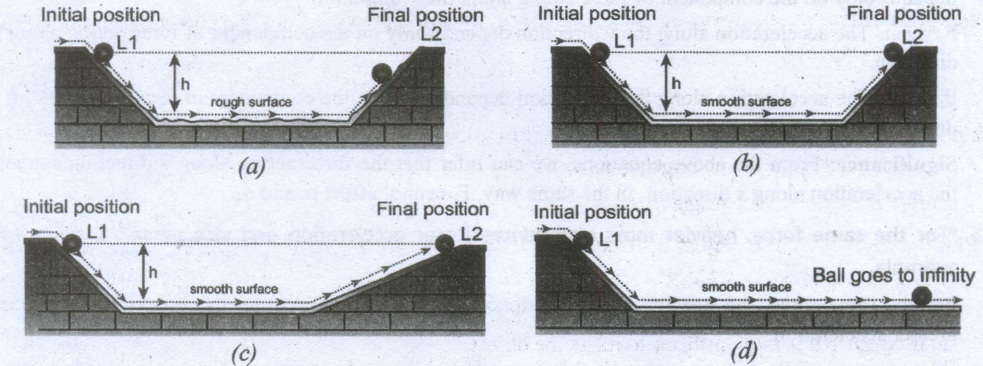
Galileo's experiment with. the second plane (a) at same inclination angle Cisthe first (b) with increased smoothness (c) with reduced angle of inclination (d) with zero angle of inclination
When a ball rolls from the top of an inclined plane to its bottom, after reaching the ground it moves some distance and continues to move on to another inclined plane of same angle of inclination as shown in the Figure (a). By increasing the smoothness of both the inclined planes, the ball reach almost the same height (h) from where it was released (L1) in the second plane (L2) [figure (b)]. The motion of the ball is then observed by varying the angle of inclination of the second plane keeping the same smoothness. If the angle of inclination is reduced, the ball travels longer distance in the second plane to reach the same height [figure (c)). When the angle of inclination is made zero, the ball moves forever in the horizontal direction [figure (d)]. If the Aristotelian idea were true, the ball would not have moved in the second plane even if its smoothness is made maximum since no force acted on it in the horizontal direction.
34.
Given position of the particle is
\(r=2.00t\ \hat{t}-1.00t^2\hat{j}+3.00\hat{k}\)
Velocity: The rate of change of acceleration is called velocity
velocity v = \({{dr}\over{dt}}={d\over dt}(2.00t \ \hat{t}-1.00t^2\hat{j}+3.00\hat{k})\)
\(=\left[ 2.00\hat{i}-2.00t\ \hat{j}+0 \right]{ms}^{-1}\)
\(v=\left[ 2.00 \hat{i}-2.00t\ \hat {j}\right]{ms}^{-1}\)
Acceleration: The rate of change of position of the particle is called acceleration.
Acceleration \(a={dv \over dt}={d \over dt}(2.00\hat{i}-2.00t\hat{j})\)
\(=0-2.00\hat{j}\)
\(=-2.00\hat{j}\ {ms}^{-1}\)
At timet t = 2s:
velocity \(=\left[ 2.00\hat{i}-2.00\hat{j} \right]{ms}^{-1}.\)
\(=\left[ 2.00\hat{i}-2.00\times2\hat{j} \right]\)
\(=\left[ 2.00\hat{i}-4.00\hat{j} \right]\)
Magnitude and direction of the particles.
\(v=\sqrt{{(2)}^{2}+{(-4)}^{2}}=\sqrt{4+16}\)
\(=\sqrt{20}=4.47{ms}^{-1}\)
If \(\theta\) is the angle which v makes with x-axis, then.
\(\tan\ \theta={{v_y}\over{v_x}}={-4 \over 2}=-2=\tan\ 63.5°\)
\(\theta=63.5°\) below the x-axis.
35.
Time taken by person to travel 4 m
\({ t }_{ 1 }=\frac { \left( \frac { d }{ 2 } \right) }{ { v }_{ 1 } } =\frac { d }{ 2{ v }_{ 1 } } \)
\(=\frac { 4 }{ 2\times 1 } =\frac { 4 }{ 2 } =2\quad sec\)
Time taken by person to travel 3 m,
\({ t }_{ 2 }=\frac { \left( \frac { d }{ 2 } \right) }{ { v }_{ 2 } } =\frac { d }{ 2{ v }_{ 2 } } \)
\(=\frac { 4 }{ 2\times 1 } =\frac { 4 }{ 2 } =2\quad sec\)
Time taken by person to travel 3 m,
\({ t }_{ 2 }=\frac { \left( \frac { d }{ 2 } \right) }{ { v }_{ 2 } } =\frac { d }{ 2{ v }_{ 2 } } \)
\(=\frac { 3 }{ 2\times 0.7 } =\frac { 3 }{ 1.4 } =2.14\)
\(\because\) Total time = t1 + t2
= 2 + 2.14
= 4.14 sec.
Mean (or) average velocity,
\(\frac { d }{ { t }_{ 1 }+{ t }_{ 2 } } =\frac { 2{ v }_{ 1 }{ v }_{ 2 } }{ ({ v }_{ 1 }+{ v }_{ 2 }) } \)
\(=\frac { 2\times (1\times 0.7) }{ (1+0.7) } =\frac { 1.4 }{ 1.7 } \)
= 0.82 ms-1
36.
\(\overrightarrow { A } =2\hat { i } -3\hat { j } -4\hat { k } \)
\(\overrightarrow { B } =6\hat { i } -4\hat { j } -4\hat { k } \)
Sum of the two vectors \(\overrightarrow { A } \ and\ \overrightarrow { B } \) gives,
\(\overrightarrow { A } +\overrightarrow { B } =(2\hat { i } -3\hat { j } -4\hat { k } )+(6\hat { i } -4\hat { j } -4\hat { k } )\)
\(=2(8\hat { i } -\hat { j } -0)\)
\(=8\hat { i } -\hat { j } \)
Required vector,
\(=\hat { i } -(8\hat { i } -\hat { j } )\)
\(=\hat { i } -8\hat { i } +\hat { j } \)
\(=-7\hat { i } +\hat { j } \)
37.
Speed u = 120 km/h = 120\(\times\)\(\frac { 5 }{ 18 } \)
u = 33 m/s
Final velocity v =0, distances = 200 m
We know,
v2=u2 +2as
02=(33)2+2a \(\times\) (200)
a = (-33)2/(2\(\times\)200)
\(a=\frac { 1089 }{ 400 } =2.722\quad { ms }^{ -2 }\)
As
v = u + at
0 = 33+(2.72)t
\(t=\frac { 33 }{ 2.72 } \)
t=12.13s
38.
(i) In the case of whirling motion of a stone tied to a string, the centripetal force on the particle is provided by the tensional force on the string. In circular motion in an amusement park, the centripetal force is provided by.the tension in the iron ropes.
(ii) In motion of satellites around the Earth, the centripetal force is given by Earth's gravitational force on the satellites. Newton's second law for satellite motion is F = Earth's gravitational force = \(\frac { { mv }^{ 2 } }{ r } \)
Where r- a distance of the planet from the center of the Earth
.png)
(iii) When a car is moving on a circular track the centripetal force is given by the frictional force between the road and the tires Newton second law for this case is
.png)
Frictional force = \(\frac { { mv }^{ 2 } }{ r } \)
m-mass of the car
v-speed of the car
r-radius of curvature of track.
Even when the car moves on a curved track, the car experiences the centripetal force which is provided by a frictional force between the surface and the tire of the car.
(iv) When the planets orbit around the Sun, they experience the centripetal force towards the center of the Sun. Here the gravitational force of the Sun acts as a centripetal force on the planets.
Newton's second law for this motion Gravitational force of Sun on the planet = \(\frac { { mv }^{ 2 } }{ r } \)
39.
| (i) | Least count error | Associated with the poor resolution of the instrument |
| (ii) | Instrumental errors | Associated with the faulty calibration or change in conditions |
| (iii) | Random errors | Getting difficult results for the same measurement done repeatedly |
| (iv) | Personal errors | Associated with the individual performing the experiments ie. Improper precautions, incorrect initial set up of experiment |
| (v) | Systematic errors | Which tends to be in the same direction |
40.
41.
(i) The centripetal acceleration is given by \(a=\frac { { v }^{ 2 } }{ r } \) This expression explicitly depends on Moon's speed which is non trivial. We can work with the formula
ω2Rm = am
(ii) am is centripetal acceleration of the Moon due to Earth's gravity.
ω is angular velocity
(iii) Rm the distance between Earth and the Moon, which is 60 times the radius of the Earth.
Rm = 60R = 60 \(\times\)6.4 \(\times\)106 = 384 \(\times\)106 m
(iv) As we know the angular velocity ω = \(\frac { 2\pi }{ T } \)and
T = 27.3 days = 27.3 \(\times\) 24 \(\times\) 60 \(\times\) 60 second
= 2.358 \(\times\) 106 sec
(v) By substituting these values in the formula for acceleration
am = \(\frac { (4\pi ^{ 2 })(384\times { 10 }^{ 6 }) }{ (2.358\times { 10 }^{ 6 }) } \) = 0.00272 ms-2
= 2.72 x 10⁻³ms-2
The centripetal acceleration of Moon towards the Earth is 0.00272 m s-2
42.
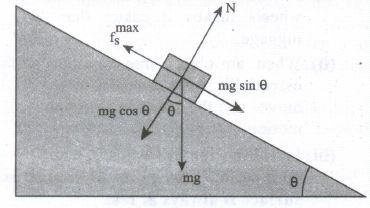
Consider an inclined plane on which an object is placed as shown in the figure, Let the angle which this plane makes with the horizontal be ፀ. For small angle of ፀ, the object may not slide down. As ፀ is increased, for a particular value of ፀ, the object begins to slide down. This value is called angle of repose. Hence, the angle of repose is the angle of the inclined plane with the horizontal such that an object placed on it begins to slide.
43.
44.
In cgs system 76 cm of mercury pressure = 76\(\times\)13.6\(\times\)980 dyne cm-2
The dimensional formula of pressure P is [ML-1T-2]; so P1 [M1a L1b T1c ]= P2[M2a L2bT2c]
We have P2 = P1 \([{M_1\over M_2}]^a[{L_1\over 2}]^b[{T_1\over T_2} ]^c\)
M1 = 1g, M2 =1kg
L1 = 1 cm, L2 = 1m
T1 = 1 s, T2 = 1s
So, a = 1, b = -1, and c =-2
Then, P1 = 76\(\times\)13.6\(\times\)980
\([{1g\over 1kg}]^1[{1cm\over 1m}]^{-1}[{1s\over 1s}]^{-1}=76\times13.6\times980[{10^{-3}kg\over 1kg}]^1[{10^{-2}m\over1m}]^{-1}[{1s\over 1s}]^{-2}\)
= 76\(\times\)13.6\(\times\)980\(\times\)[10-3]\(\times\)102
P2 = 1.01\(\times\)105 Nm-2
45.
Radius (r) of moon orbit from the centre of earth
\(r =(384,000 \mathrm{~km}) \times \frac{1000 \mathrm{~m}}{1 \mathrm{~km}} \)
= 384,000,000 m
Time Period (T) = (27 days ) \(\times \frac{24 \text { hours }}{1 \text { day }} \times \frac{60 \mathrm{~min}}{1 \mathrm{hr}} \times \frac{60 \mathrm{sec}}{1 \mathrm{~min}}\)
= 2,332,800 sec
\(velocity (v)=\frac{\text { circumference }}{\text { Time period }}=\frac{2 \pi \mathrm{r}}{\mathrm{T}}\)
\(=\frac{2 \pi \times 384,000,000 m}{2,332,800 \mathrm{~s}}=329 \pi \mathrm{m} / \mathrm{s}\)
Centripetal acceleration \(\left(a_{\perp}\right)=\frac{v^{2}}{r}=\frac{(329 \pi \mathrm{m} / \mathrm{s})^{2}}{384,000,000 \mathrm{~m}}\)
\(a_{\perp}=2.78 \times 10^{-3} \mathrm{~m} / \mathrm{s}^{2}\)
Tension due to Centripetal force
\(F_{c} =T=m a_{\perp}=7.34 \times 10^{22} \mathrm{~kg} \times 2.78 \times 10^{-3} \mathrm{~m} / \mathrm{s}^{2} \)
\(\mathrm{~T} =2.04052 \times 10^{20} N\)
46.
For the system to be in equilibrium for block of mass M1 frictionless Tension in the string T
T = μs (M3 + M1)g
For the equilibrium of block of mass M2
T = M2g .....(2)
(1) = (2)
μs (M3 + M1)g = M2g
M3 =\(\frac { { m }_{ 2 } }{ { \mu }_{ 2 } } -{ m }_{ 1 }\)
47.
Max.height = \(\frac { { u }^{ 2 }{ sin }^{ 2 }\theta }{ 2g } \)
\(Range \ R=\frac { { u }^{ 2 }{ sin 2 }\theta }{ 2g } \)
Here, R = 4 x Max.height
\(\therefore \frac { { u }^{ 2 }{ sin 2 }\theta }{ g } =\frac { {4\times u }^{ 2 }{ sin }^{ 2 }\theta }{ 2g } \)
\(sin2\theta =2{ sin }^{ 2 }\theta \)
\(2sin\theta cos\theta =2{ sin }^{ 2 }\theta \)
\(\therefore \ cos\theta = sin \theta\)
\(\therefore \theta =45°\)
48.
\(\vec { { r }_{ 1 } } =3\hat { i } +4\hat { j } \)
\(\vec { { r }_{ 2 } } =\hat { i } +2\hat { j } \)
\(\Delta \overrightarrow { r } =\overrightarrow { { r }_{ 2 } } -\overrightarrow { { r }_{ 1 } } \)
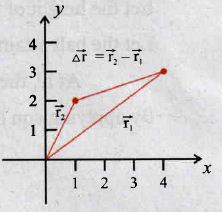
\(=(\hat { i } +2\hat { j } )-(3\hat { i } +4\hat { j } )\)
\(\Delta \overrightarrow { r } =-2\hat { i } +\hat { j } \)
49.
Length of a simple pendulum \(l=20 \mathrm{~cm}=20 \times 10^{-2} \mathrm{~m}\)
\(\text {Accuracy }=2 \mathrm{~mm}=2 \times 10^{-3} \mathrm{~m}\)
Time for one oscillation \(=\frac{40}{50}=0.88\)
\(T =2 \pi \sqrt{\frac{l}{g}} ; T^{2}=4 \pi^{2}\left(\frac{l}{g}\right) \)
\(g =\frac{4 \pi^{2} l}{T^{2}}\)
\(\frac{\Delta g}{g} \times 100 ==\frac{\Delta l}{l} \times 100+2 \frac{\Delta T}{T} \times 100
\)
\(l =20 \mathrm{~cm} \Delta l=2 \mathrm{~mm}=0.2 \mathrm{~cm} \Delta T=1 \mathrm{~s}
\)
\(\frac{\Delta g}{g} =\frac{\Delta l}{l}+2 \frac{\Delta T}{T}
\)
\(=\frac{0.2}{20}+2 \times \frac{1}{40} \)
= 0.01 + 0.05 = 0.06
\(\therefore\) Percentage accuracy in the determination of g=0.06 x 100=6 %
50.
(a) Unit: An arbitrarily chosen standard of measurement of a quantity, which is accepted internationally is called unit of the quantity.
51.
For all parts of this problem, it will be convenient to use different coordinate systems for the two different blocks. For block 1, take the positive x -direction to be up the incline, parallel to the plane, and the positive y -direction to be perpendicular to the plane, directed with a positive upward component. Take the positive direction of the position of block 2 to be downward.
The normal component N of the contact force between block 1 and the ramp will be
N=m1g cosθ
The net x-component of the force on block 1 is then
F1x =T-ffriction - m1g sinθ
where T is the tension in the string.
For the just-slipping condition, the frictional force has magnitude
ffriction = μsN = μsg cosθ
The tension in the string is the gravitational force of the suspended mass,
T=m2g
For the just-slipping condition, the net force on block 1 must be zero. Equations (2), (3) and . (4) gives
0 = m2g-μsm1g cosθ-m1gsinθ
m2=m1(μs cosθ+sinθ)
52.
As shown in the figure, there are four forces acting on the mass m1
(a) Downward gravitational force along the negative y-axis (m1g)
(b) Upward normal force along the positive y-axis (N)
(c) Tension force due to mass m2 along the positive x axis
(d) Frictional force along the negative x-axis
Since the mass m1 has no vertical motion, m1g = N
Free body diagram for mass m1
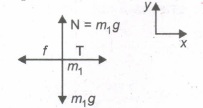
To determine whether the mass m1 moves on the surface, calculate the maximum static friction exerted by the table on the mass m1 If the tension on the mass m1 is equal to or greater than this maximum static friction, the object will move.
fsmax = μsN = μsm1g
fsmax = 0.9\(\times\)7\(\times\)9.8 =61.74 N
The tension T = m2g= 5\(\times\)9.8 = 49 N
T < fsmax
The tension acting on the mass mi is less than the maximum static friction. So the mass m1 will not move.
To move the mass m1, T > fsmax where T = m2g
m2 = \(\frac { { \mu }_{ s }{ m }_{ 1 }g }{ g } \)=μsm1
m2 = 0.9\(\times\)7 = 6.3 kg
If the mass m2 is 6.3 kg then the mass m1 will begin to slide. Note that if there is no friction on the surface, the mass m1 will move for m2 even for just 1 kg.
The values of coefficient of static friction for pairs of materials are presented in Table 3.1. Note that the ice and ice pair have very low coefficient of static friction. This means a block of ice can move easily over another block of ice.
53.
Let us take two points given by
x1= 2 and x2 = 3, then y1 = 4 and y2 = 9
Here \(\Delta x\) = 1 and \(\Delta y\) = 5.
Then \(\frac{\Delta y}{\Delta x}=\frac{9-4}{3-2}=5\)
If we take x1= 2 and x2 = 2.5, then y1= 4 and y2 = (2.5)2 = 6.25
Here \(\Delta x=0.5=\frac{1}{2}\) and \(\Delta y\) = 2.25
Then \(\frac{\Delta y}{\Delta x}=\frac{6.25-4}{0.5}=4.5\)
If we take x1= 2 and x2 = 2.25, then y1= 4 and y2 = 5.0625.
Here \(\Delta x=0.25=\frac{1}{4},\Delta y=1.0625\)
\(\frac{\Delta y}{\Delta x}=\frac{5.0625-4}{0.25}=\frac{(5.0625-4)}{\frac{1}{4}}\) = 4(5.0625 - 4) = 4.25
If we take x1= 2 and x2 = 2.1, then y1= 4 and y2 = 4.41.
Here \(\Delta x=0.1=\frac{1}{10}\)
and \(\frac{\Delta y}{\Delta x} = \frac{(4.41-4)}{\frac{1}{10}}\) = 10(4.41 - 4) = 4.1
These results are tabulated as shown below:
| x1 | x2 | \(\Delta x\) | y1 | y2 | \(\frac{\Delta y}{\Delta x}\) |
| 2 | 2.25 | 0.25 | 4 | 50625 | 4.25 |
| 2 | 2.1 | 0.1 | 4 | 4.41 | 4.1 |
| 2 | 2.01 | 0.01 | 4 | 4.0401 | 4.01 |
| 2 | 2.001 | 0.001 | 4 | 4.004001 | 4.001 |
| 2 | 2.0001 | 0.0001 | 4 | 4.00040001 | 4.0001 |
From the above table, the following inferences can be made.
(i) As \(\Delta x\) tends to zero, \(\frac{\Delta y}{\Delta x}\) approaches the limit given by the number 4.
(ii) At a point x = 2, the derivative \(\frac{dy}{dx}=4\)
(iii) It should also be mentioned here that \(\Delta x\rightarrow 0\) does not mean that \(\Delta x =0\)
This is because, if we substitute \(\Delta x=0,\frac{\Delta y}{\Delta x}\) because indeterminate.
In general, we can obtain the derivative of the function y = x2, as follows:
\(\frac{\Delta y}{\Delta x}=\frac{(x+\Delta x)^2-x^2}{\Delta x}=\frac{x^2+2x\Delta x+\Delta x^2-x^2}{\Delta x}=\frac{2x\Delta x+\Delta x^2}{\Delta x}=2x+\Delta x\)
\(\frac { dy }{ dx } =\lim _{ \Delta x\rightarrow 0 }{ 2x+\Delta x=2x } \)
54.
(a) Earth alone as a system: Earth orbits the Sun due to gravitational attraction of the Sun. If we consider Earth as a system, then Sun's gravitational force is an external force. If we take the Moon into account, it also exerts an external force on Earth.
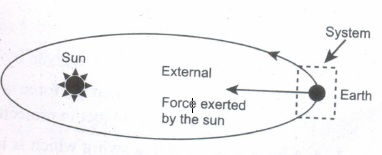
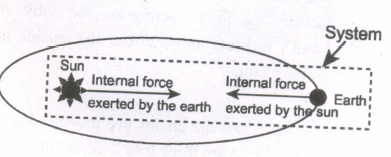
(b) (Earth + Sun) as a system: In this case, there are two internal forces which form an action and reaction pair-the gravitational force exerted by the Sun on Earth and gravitational force exerted by the Earth on the Sun.
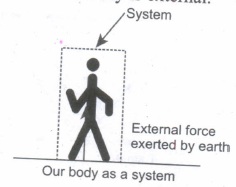
(c) Our body as a system: While walking, we exert a force on the Earth and Earth exerts an equal and opposite force on our body. If our body alone is considered as a system, then the force exerted by the earth on our body is external.
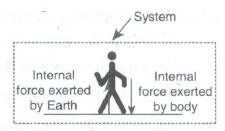
(d) (Our body + Earth) as a system: In this case, there are two internal forces present in the system. One is the force exerted by our body on the Earth and the other is the equal and opposite force exerted by the Earth on our body.
55.
Let us assume that the Energy E depends on mass m and velocity of light c.
\(E\alpha m^ac^b\)
\(E=km^ac^b\) where K a constant
Dimensions of E = [ML2T-2]
Dimensions of m = [M]
Dimensions ofc = [LT-1]
Substituting the values in the above equation
[ML2T-2] = K[M]a [LT-1]b
By equating the dimensions
a = 1
b = 2
-b = -2
E = k.mc2
The value of constant k = 1
E = mc2. This is Einstein's mass energy relation.
56.
t1 = 2.63s, t2 = 2.56s,
t3 = 2.42s, t4 = 2.71s, t5 = 2.80s
(i) Tm =\({t_1+t_2+t_3+t_4+t_5\over 5}={2.63+2.56+2.42+2.71+2.80\over 5}\)
Tm = 2.62s (Rounded off to 2nd decimal place)
(ii) Absolute error
\(\triangle\)T = Tm - t
\(\triangle\)TI = 2.62 - 2.63 = +0.01s
\(\triangle\)T2 = 2.62 - 2.56 = +0.06s
\(\triangle\)T3 = 2.62 - 2.42 = +0.20s
\(\triangle\)T4 = 2.62 - 2.71 = +0.09s
\(\triangle\)T5 = 2.62 - 2.80 = +0.18s
(iii) Mean absolute error = \({\sum |\triangle T_1|\over n}\)
\(\triangle\)Tm = \({0.01+0.06+0.20+0.09+0.18\over 5}\)
\(\triangle\)Tm=\({0.54\over 5}=0.108s=0.11s\) (Rounded off to 2nd decimal place)
(iv) Relative error: ST =\({\triangle T_m\over T_m}={0.11\over 2.62}=0.0419\)
ST = 0.04
(v) Percentage error in T = 0.04\(\times\)100% = 4%
(vi) Time period of simple pendulum = T = (2.62 ± 4%)s
57.
u = 20 ms-1.
\(\theta\) = 30°
Distance of goal Post = 40 m
Range = \(\frac { { u }^{ 2 }sin2\theta }{ g } \)
\(=\frac {400\times \sqrt{3}}{9.8 \times2}=35.35m\)
The ball will not reach the goal post.
58.
Frequency of a vibrating body \(\gamma \alpha \frac{1}{l} \sqrt{\frac{F}{M}}\)
\( a\text { Dimension of frequency } =\mathrm{M}^{0} \mathrm{~L}^{0} \mathrm{~T}^{-1} \)
\(\text {Dimension of length } =\mathrm{L}=\mathrm{M}^{0} \mathrm{LT}^{0} \)
\(\text {Dimension of Force } =\mathrm{MLT}^{-2} \)
\(\text {Dimension of Mass } =\mathrm{M}^{1} \mathrm{~L}^{0} \mathrm{~T}^{0} \)
\(\text {Frequency } \gamma =x \)
\(\gamma =\mathrm{K}\left[\mathrm{F}^{x}\right][\mathrm{M}]^{y}[\mathrm{~L}]^{z}\)
Using dimensions we get
\(\mathrm{M}^{0} \mathrm{~L}^{0} \mathrm{~T}^{-1}=\left[\mathrm{MLT}^{-2}\right]^{x}[\mathrm{M}]^{y}[\mathrm{~L}]^{z} \)
\(\mathrm{M}^{0} \mathrm{~L}^{0} \mathrm{~T}^{-1}=\mathrm{M}^{x+y} \mathrm{~L}^{x+z} \mathrm{~T}^{-2 x}\)
Comparing the powers we get
x + y = 0 z = -x = \(\frac{1}{2} \)
x + z = 0 y = -x = \(\frac{-1}{2} \)
-2 x = -1
\(\therefore x =\frac{-1}{-2}=\frac{1}{2} \)
\(\therefore \gamma =1 \times[\mathrm{F}]^{1 / 2}[\mathrm{M}]^{-1 / 2}[\mathrm{~L}]^{-1 / 2} \)
\(\gamma =\frac{1}{l} \sqrt{\frac{F}{m}}\)
59.
The speed of sound in water v = 1460 ms-1
Time taken t = 80 s
\(=\frac{2 d}{t} \)
2d = u x t
= 1460 x 80
2d =11680 m
\(\therefore \text { Distance of enemy submarine } d =\frac{11680}{2} \)
= 58.40 km

11th Standard Syllabus & Materials
11th Standard
TN 11th Tamil பீடு பெற நில் - செய்யுள் - காவடிச்சிந்து Important Questions And Answers Study Material - QB365 Set A
NEW11th Standard
TN 11th Tamil பீடு பெற நில் - உரைநடை - மலை இடப்பெயர்கள் : ஓர் ஆய்வு Important Questions And Answers Study Material - QB365 Set A
NEW11th Standard
TN 11th Tamil மாமழை போற்றுதும் - துணைப்பாடம் - யானை டாக்டர் Important Questions And Answers Study Material - QB365 Set A
NEW11th Standard
TN 11th Tamil மாமழை போற்றுதும் - செய்யுள் - ஐங்குறுநூறு Important Questions And Answers Study Material - QB365 Set A



Tamilnadu Stateboard 11th Standard Subjects

Maths

Commerce

Economics

Biology

Business Maths and Statistics

Accountancy

Computer Science
Physics

Chemistry
Maths
Biology
Economics
Physics
Chemistry

History
Business Maths and Statistics

Computer Science
Accountancy

Computer Applications
History
Computer Technology
Commerce
Computer Applications
Computer Technology

Tamil

English

French
Tamilnadu Stateboard Standards

