
 100% FREE ACCESS
11th Standard Syllabus & Materials
11th Standard
TN 11th Tamil இயற்கை வேளாண்மை,சுற்றுச்சூழல் -செய்யுள் - மனோன்மணீயம் Important Questions And Answers Study Material - QB365 Set A
NEW11th Standard
TN 11th Tamil என்னுயிர் என்பேன் -துணைப்பாடம் - இசைத்தமிழர் இருவர் Important Questions And Answers Study Material - QB365 Set A
NEW11th Standard
TN 11th Tamil மொழி கலை -செய்யுள் - ஒவ்வொரு புல்லையும் Important Questions And Answers Study Material - QB365 Set A
NEW11th Standard
TN 11th Tamil பீடு பெற நில் - இலக்கணம் - பகுபத உறுப்புகள் Important Questions And Answers Study Material - QB365 Set A
NEW11th Standard
TN 11th Tamil பீடு பெற நில் - துணைப்பாடம் - வாடிவாசல் Important Questions And Answers Study Material - QB365 Set A
NEW11th Standard
TN 11th Tamil பீடு பெற நில் - செய்யுள் - குறுந்தொகை Important Questions And Answers Study Material - QB365 Set A

Published on: 07/06/2021
QB365 provides detailed and simple solution for every Book back Questions in class 11 Physics Subject. It will helps to get more idea about question pattern in every book back questions with solution.
Download Tamil Nadu 11th Standard Physics question papers, model tests, one-mark questions, important questions, and public exam papers in PDF format. Free study materials and answer keys for TN State Board students.
Questions + Answers key
Take MCQ Physics Test1.
Consider a circular road of radius 20 meter banked at an angle of 15 degree. With what speed a car has to move on the turn so that it will have safe turn?
2.
Write short notes on the following.
(a) Unit
3.
Write short notes on intensity and loudness.
4.
Discuss the simple pendulum in detail.
5.
Explain in detail an adiabatic process.
6.
Derive an expression for the elastic energy stored per unit volume of a wire.
7.
Derive an expression for escape speed.
8.
A flywheel rotates with a uniform angular acceleration. If its angular velocity increases from 20\(\pi\) rad/s to 40\(\pi\) rad/s in 10 seconds. Find the number of rotations in that period.
9.
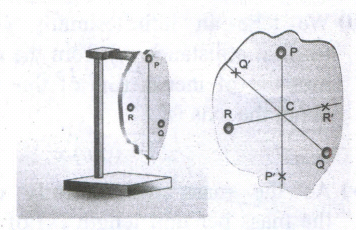
Explain the method to find the center of gravity of a irregularly shaped lamina?
10.
Derive the equations of motion for a particle
(a) falling vertically
(b) projected vertically.
1.
v =\(\sqrt { (rg\quad tan\theta ) } =\sqrt { 20\times 9.8\times tan{ 15 }^{ 0 } } =\sqrt { 20\times 9.8\times 0.26 } \) = 7.1 ms-1
The safe speed for the car on this road is 7.1 ms-1
2.
(a) Unit: An arbitrarily chosen standard of measurement of a quantity, which is accepted internationally is called unit of the quantity.
3.
The loudness of sound is defined as the degree of sensation of sound produced in the ear or the perception of sound by the listener.
Loudness of sound depends on both intensity of sound wave and sensitivity of the ear.
Intensity of sound is the sound power fans miffed per unit area placed normal to the propagation of sound wave.
According to Weber-Fechner's law, "loudness (L) is proportional to the logarithm of the actual intensity (I) measured with an accurate non-human instrument". This means that
\(L \propto \ln I\)
\(\mathrm{L}=\mathrm{k} \ln \mathrm{I}\)
where k is a constant, which depends on the unit of measurement. The difference between two loudness, L1 and L0 measures the relative loudness
between two precisely measured intensities and is called as sound intensity level. Mathematically, sound intensity level is
\(\Delta L =\mathrm{L}_{1}-\mathrm{L}_{0}
\)
\(=\mathrm{k} \ln \mathrm{I}_{1}-\mathrm{I}_{1}-\mathrm{k} \ln \mathrm{I}_{0}=\mathrm{k} \ln \left[\frac{I_{1}}{I_{0}}\right]\)
If k = 1, then sound intensity level is measured in bel, in honour of Alexander Graham Bell. Therefore
\(\Delta L=\ln \left[\frac{I_{1}}{I_{0}}\right] \text { bel }\)
However, this is practically a bigger unit, so we use a convenient smaller unit, called decibel. Thus, decibel \(=\frac{1}{10}\) bel. Therefore, by multiplying and dividing by 10, we get
\(\Delta L=10\left[\ln \left[|\frac{I_{1}}{I_{0}} |\right] \frac{1}{10}\right. \text { bel }
\)
\(\Delta L=10 \ln \left[\frac{I_{1}}{I_{0}}\right] \text { decibel with } \mathrm{k}=10\)
For practical purposes, we use logarithm to base 10 instead of natural logarithm,
\(\Delta L=10 \log _{10}\left[\frac{I_{1}}{I_{0}}\right] \text { decibel }\) ....(1)
4.
A pendulum is a mechanical system which exhibits periodic motion. It has a bob with mass m suspended by a long string (assumed to be massless and in extensible string) and the other end is fixed on a stand as shown in figure. (a). At equilibrium, the pendulum does not oscillate and hangs vertically downward. Such a position is known as mean position or equilibrium position. When a pendulum is displaced through a small displacement from its equilibrium position and released, the bob of the pendulum executes to and fro motion. Let l be the length of the pendulum which is taken as the distance between the point of suspension and the centre of gravity of the bob. Two forces act on the bob of the pendulum at any displaced position, as shown in the figure.
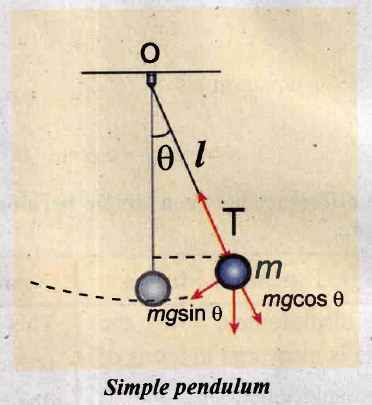
(i) The gravitational force acting on the body \((\vec{F}=\mathrm{m} \vec{g})\) which acts vertically downwards.
(ii) The tension in the string \(\vec{T}\)which acts along the string to the point of suspension.
Resolving the gravitational force into its components:
a) Normal component: The component along the string but in opposition to the direction of tension, \(F_{a s}=m g \cos \theta\).
b) Tangential component: The component perpendicular to the string i.e., along tangential direction of arc of swing, \(F_{p s}=m g \sin \theta\).
Therefore, The normal component of the force is, along the string,
\(T-W_{a s}=m \frac{v^{2}}{l}\)
Here v is speed of bob
\(\mathrm{T}-\mathrm{mg} \cos \theta=\mathrm{m} \frac{v^{2}}{l}\)
From the Figure, we can observe that the tangential component \(\mathrm{W}_{\mathrm{ps}}\) of the gravitational force always points towards the equilibrium position, i.e., the direction in which it always points opposite to the direction of displacement of the bob from the mean position. Hence, in this case, the tangential force is nothing but the restoring force. Applying Newton's second law along tangential direction, we have
\(m \frac{d^{2} s}{d t^{2}}+F_{p s} =0 \Rightarrow m \frac{d^{2} s}{d t^{2}}=F_{p s}
\)
\(m \frac{d^{2} s}{d t^{2}} =m g \sin \theta\) ......(1)
where, s is the position of bob which is measured along the arc. Expressing arc length in terms of angular displacement i.e.,
\(s =l \theta
\) .....(2)
\(\text {then its acceleration, } \frac{d^{2} s}{d t^{2}} =l \frac{d^{2} \theta}{d t^{2}}\) .....(3)
Substituting equation (3) in equation (1) we get
\(l \frac{d^{2} \theta}{d t^{2}}=-g \sin \theta
\)
\(\frac{d^{2} \theta}{d t^{2}}=-\frac{g}{l} \sin \theta\) ....(4)
Because of the presence of sin θ in the above differential equation, it is a non-linear differential equation (Here, homogeneous second order). Assume "the small oscillation approximation". sin θ ≈ θ, the above differential equation becomes linear differential equation.
.JPG)
\(\frac{d^{2} \theta}{d t^{2}}=-\frac{g}{l} \theta\) ....(5)
This is the well known oscillatory differential equation. Therefore, the angular frequency of this oscillator (natural frequency of this system) is
\(\omega^{2} =\frac{g}{l}
\) ....(6)
\(\Rightarrow \omega=\sqrt{\frac{g}{l}} \text { in } \mathrm{rad} \mathrm{s}^{-1}\) .....(7)
The frequency of oscillations is
\(\mathrm{f}=\frac{1}{2 \pi} \sqrt{\frac{\mathrm{g}}{l}} \text { in } \mathrm{Hz}\) .....(8)
and time period of oscillation is
\(T=2 \pi \sqrt{\frac{l}{g}} \text { in second }\) ......(9)
5.
This is a process in which no heat flows into or out of the system (Q = 0). But the gas can expand by spending its internal energy or gas can be compressed through some external work. So the pressure, volume and temperature of the system may change in an adiabatic process.
For an adiabatic process, the first law becomes ΔU = W.
This implies that the work is done by the gas at the expense of internal energy or work is done on the system which increases its internal energy.
The adiabatic process can be achieved by the following methods.
(i) Thermally insulating the system from surroundings so that no heat flows into or out of the system; for example, when thermally insulated cylinder of gas is compressed (adiabatic compression) or expanded (adiabatic expansion) as shown in the figure.
.JPG)
(ii) If the process occurs so quickly that there is no time to exchange heat with surroundings even though there is no thermal insulation.
Examples:
(a) When the tyre bursts the air expands so quickly that there is no time to exchange heat with the surroundings.
(b) When the gas is compressed or expanded so fast, the gas cannot exchange heat with surrounding even though there is no thermal insulation.
(c) When the warm air rises from the surface of the Earth, it adiabatically expands. As a result the water vapor cools and condenses into water droplets forming a cloud.
The equation of state for an adiabatic process is given by
\(P V^{\gamma}=\text { constant }\) ...(1)
Here \(\gamma\) is called adiabatic exponent \(\left(\gamma=C_{p} / C_{V}\right)\) which depends on the nature of the gas.
The equation (1) implies that if the gas goes from an equilibrium state \(\left(P_{i}, V_{i}\right)\) to another equilibrium state \(\left(\mathrm{P}_{\mathrm{f}}, \mathrm{V}_{\mathrm{f}}\right)\) adiabatically then it satisfies the relation
\(P_{i} V_{i}^{\gamma}=P_{f} V_{f}^{\gamma}\) .......(2)
.JPG)
The PV diagram of an adiabatic expansion and adiabatic compression process are shown in Figure. The PV diagram for an adiabatic process is also called adiabat. Note that the PV diagram for isothermal and adiabatic processes look similar. But actually the adiabatic curve is steeper than isothermal curve. We can also rewrite the equation (1) in terms of T and V. From ideal gas equation the pressure \(P=\frac{\mu R T}{V}\) Substituting this equation in the equation (1), we have
\(\frac{\mu R T}{V} V^{\gamma}=\text { constant (or) } \quad \frac{T}{V} V^{\gamma}=\frac{\text { constant }}{\mu R}\)
Note here that is another constant. So it can be written as
\(T V^{\gamma-1}=\text { constant }\)
The equation (3) implies that if the gas goes from an initial equilibrium state \(\left(T_{i}, V_{i}\right)\) to final equilibrium state \(\left(\mathrm{T}_{\mathrm{f}}, \mathrm{V}_{\mathrm{f}}\right)\) adiabatically then it satisfies the relation.
\(T V_{i}^{\gamma-1}=T_{f} V_{f}^{\gamma-1}\)
The equation of state for adiabatic process can also be written in terms of T and P as.
\(T^{\gamma} P^{1-\gamma}=\text { constant }\)
6.
When a body is stretched, work is done against the restoring force (internal force). This work done is stored in the body in the form of elastic energy. Consider a wire whose un-stretch length is L and area of cross section is A. Let a force produce an extension I and further assume that the elastic limit of the wire has not been exceeded and there is no loss in energy. Then, the work done by the force F is equal to the energy gained by the wire.
The work done in stretching the wire by dl, dW = Fdl
The total work done in stretching the wire from 0 to l is
\(W=\int^{l}_{o}F dl\) --- (1)
From Young's modulus of elasticity,
\(\mathrm{Y}=\frac{F}{A} \times \frac{L}{l} \Rightarrow \frac{Y A l}{L}\) ......(2)
Substituting equation (2) in equation (1), we get
\(\mathrm{W}=\int_{0}^{1} \frac{Y A l}{L} d l\)
Since, l is the dummy variable in the integration, we can change l to l' (not in limits), therefore
\(\mathrm{W}=\int_{0}^{l} \frac{Y A l^{\prime}}{L} d l^{\prime} =\frac{Y A}{L}\left(\frac{l^{\prime 2}}{2}\right)_{0}^{i}=\frac{Y A}{I} \frac{l^{2}}{2}=\frac{1}{2}\left(\frac{Y A l}{L}\right) l=\frac{1}{2} F l \)
\(W =\frac{1}{2} F l=\text { Elastic potential energy }\)
Energy per unit volume is called energy density,
\(u =\frac{\text { Elastic potential energy }}{\text { Volume }}=\frac{\frac{1}{2} F l}{A L}
\)
\(\frac{1}{2} \frac{F}{A} \frac{l}{L} =\frac{1}{2}(\text { Stress } \times \text { Strain })\) ......(3)
7.
Consider an object of mass M on the surface of the Earth. When it is thrown up with an initial speed Vi' the initial total energy of the object is
Ei = \(\frac { 1 }{ 2 } { Mv }_{ i }^{ 2 }-\frac { GMM_{ E } }{ R_{ E } } \) ............(1)
where, ME is the mass of the Earth and RE- the radius of the Earth. The term \(\frac { GMM_{ E } }{ R_{ E } } \) is the potential energy of the mass M.
When the object reaches a height far away from Earth and hence treated as approaching infinity, the gravitational potential energy becomes zero [U(∝) = 0] and the kinetic energy becomes zero as well. Therefore the final total energy of the object becomes zero. This is for minimum energy and for minimum speed to escape. Otherwise Kinetic energy can be non-zero.
Ef = 0
According to the law of energy conservation,
Ei = Ef .............(2)
Substituting (1) in (2) we get,
\(\frac { 1 }{ 2 } { Mv }_{ i }^{ 2 }-\frac { GMM_{ E } }{ R_{ E } } \) =0
\(\frac { 1 }{ 2 } { Mv }_{ e }^{ 2 }-\frac { GMM_{ E } }{ R_{ E } } \) = 0 .............(3)
Consider the escape speed, the minimum speed required by an object to escape Earth's gravitational field, hence replace vi with ve. i.e.,
\(\frac { 1 }{ 2 } { Mv }_{ e }^{ 2 }-\frac { GMM_{ E } }{ R_{ E } } \)
\(v_{ e }^{ 2 }-\frac { GMM_{ E } }{ R_{ E } } .\frac { 2 }{ M } \)
\(v_{ e }^{ 2 }=\frac { 2G{ M }_{ E } }{ { R }_{ E } } \) ..............(4)
Using g = \(\frac { G{ M }_{ E } }{ { R }_{ e } } \) ..............(5)
\(v_{ e }^{ 2 }=2g{ R }_{ E }\)
\({ v }_{ e }=\sqrt { 2g{ R }_{ E } } \) .................(6)
8.
Angular Velocity rad = 20\(\pi\) rad/s
Angular velocity rad = 10\(\pi\) rad/s
time taken, t = 10 s
No. of rotations / sec = ?
\(\omega ={ \omega }_{ 0 }+\alpha t\)
\(\alpha =\frac { \omega -{ \omega }_{ 0 } }{ t } =\frac { 40\pi -20\pi }{ 10 } =\frac { 20\pi }{ 10 } =2\pi \)
\(\alpha\) = 2 rad/s
\(\theta ={ \omega }_{ 0 }t+\frac { 1 }{ 2 } \alpha { t }^{ 2 }\)
= 20\(\pi\) \(\times\) 10 + \(\frac{1}{2}\) \(\times\) 2\(\pi\) \(\times\) 10 \(\times\)10
= 200\(\pi\) + 100\(\pi\)
\(\theta\) = 300\(\pi\)
No. of rotations / sec = \(\frac{\theta}{2\pi}=\frac{300\pi}{2\pi}\)= 150 rotations.
9.
If we suspend the lamina from different points like P, Q, R as shown in Figure, the vertical lines PP', QQ', RR' all pass through the centre of gravity Here, reaction force acting at the point of suspension and the gravitational force acting at the centre of gravity cancel each other and the torques caused by them also cancel each other.
10.
Case (1): A body falling from a height h
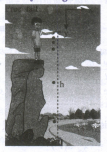
(i) Consider an object of mass 'm' falling from a height 'h: Assume there is no air resistance.
(ii) Let the downward direction is along positive y-axis. The object experiences acceleration 'g' due to gravity which is constant near the surface of the Earth. We can use kinematic equations to explain its motion. We have
The acceleration \(\overrightarrow{a}=g\hat{h}\)
By comparing the components,
ax = 0, az = 0, ay = g ,
Let us take ay = a = g
If the particle is thrown with initial velocity 'u'downward which is in negative y axis, then velocity and position of the particle at any time t is given by
v = u + gt ..............(1)
\(y=ut+{{1}\over{2}}gt^2\) .................(2)
The square of the speed of the particle when it is at a distance y from the hill-top, is
v2 = u2 + 2gy .................(3)
Suppose the particle starts from rest.
Then u = 0
Then the velocity v, the position of the particle and v2 at any time t are given by (for a point y from the hill-top)
v = gt ................(4)
\(y={{1}\over{2}}{gt}^{2}\) .............(5)
v2 = 2gy ...................(6)
Suppose the particle starts from rest.
Then u = 0
The time (t = T) taken by the particle to reach the ground (for which y = h), is given by using equation (5).
\(h={{1}\over{2}}g{T}^{2}\) ...........(7)
\(T=\sqrt{{{2h}\over{g}}}\) ............(8)
The equation (8) implies that greater the height (h), particle takes more time (T) to reach the ground. For lesser height (h), it takes lesser time to reach the ground.
The speed of the particle when it reaches the ground (y = h) can be found using equation (6), we get
\({v}_{gound}=\sqrt{2gh}\) ..............(9)
The above equation implies that the body falling from greater height (h) will have higher velocity when it reaches the ground.
The motion of a body falling towards the Earth from a small altitude (h<< R), purely under the force of gravity is called free fall. (Here R is radius of the Earth)
Case (ii): A body thrown vertically upwards.
Consider an object of mass m thrown vertically upwards with an initial velocity u. Let us neglect the air friction.
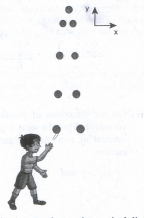
In this case we choose the vertical direction as positive y axis as shown in the Figure then the acceleration a = -g (neglect air friction) and g points towards the negative y axis.
The kinematic equations for this motion are, The velocity and position of the object at any time t are,
v = u - gt .............(10)
\(s=ut={{1}\over{2}}{gt}^{2}\) ............(11)
The velocity of the object at any position y (from the point where the object is thrown) is
v2 = u2 - 2gy. ................(12)

11th Standard Syllabus & Materials
11th Standard
TN 11th Tamil பீடு பெற நில் - செய்யுள் - காவடிச்சிந்து Important Questions And Answers Study Material - QB365 Set A
NEW11th Standard
TN 11th Tamil பீடு பெற நில் - உரைநடை - மலை இடப்பெயர்கள் : ஓர் ஆய்வு Important Questions And Answers Study Material - QB365 Set A
NEW11th Standard
TN 11th Tamil மாமழை போற்றுதும் - துணைப்பாடம் - யானை டாக்டர் Important Questions And Answers Study Material - QB365 Set A
NEW11th Standard
TN 11th Tamil மாமழை போற்றுதும் - செய்யுள் - ஐங்குறுநூறு Important Questions And Answers Study Material - QB365 Set A



Tamilnadu Stateboard 11th Standard Subjects

Maths

Commerce

Economics

Biology

Business Maths and Statistics

Accountancy

Computer Science
Physics

Chemistry
Maths
Biology
Economics
Physics
Chemistry

History
Business Maths and Statistics

Computer Science
Accountancy

Computer Applications
History
Computer Technology
Commerce
Computer Applications
Computer Technology

Tamil

English

French
Tamilnadu Stateboard Standards



