
 100% FREE ACCESS
11th Standard Syllabus & Materials
11th Standard
TN 11th Tamil இயற்கை வேளாண்மை,சுற்றுச்சூழல் -செய்யுள் - மனோன்மணீயம் Important Questions And Answers Study Material - QB365 Set A
NEW11th Standard
TN 11th Tamil என்னுயிர் என்பேன் -துணைப்பாடம் - இசைத்தமிழர் இருவர் Important Questions And Answers Study Material - QB365 Set A
NEW11th Standard
TN 11th Tamil மொழி கலை -செய்யுள் - ஒவ்வொரு புல்லையும் Important Questions And Answers Study Material - QB365 Set A
NEW11th Standard
TN 11th Tamil பீடு பெற நில் - இலக்கணம் - பகுபத உறுப்புகள் Important Questions And Answers Study Material - QB365 Set A
NEW11th Standard
TN 11th Tamil பீடு பெற நில் - துணைப்பாடம் - வாடிவாசல் Important Questions And Answers Study Material - QB365 Set A
NEW11th Standard
TN 11th Tamil பீடு பெற நில் - செய்யுள் - குறுந்தொகை Important Questions And Answers Study Material - QB365 Set A

Published on: 13/05/2022
QB365 provides detailed and simple solution for every
Creative Questions in class 11 Physics Subject. It will helps to get more idea about question pattern in every Creative questions with solution.
Download Tamil Nadu 11th Standard Physics question papers, model tests, one-mark questions, important questions, and public exam papers in PDF format. Free study materials and answer keys for TN State Board students.
Questions + Answers key
Take MCQ Physics Test1.
What are the points to be noted to study about gravitational field?
2.
Derive an expression for PE and KE in SHM, and deduced the graphical representation.
3.
Draw and explain the distribution of radiation intensity.
4.
State and derive the perfect or ideal gas equation?
5.
Which is more elastic steel or rubber? Explain.
6.
What is meant by Collinear vector? Explain them.
7.
What is rolling motion?
8.
What is mechanical energy? What are its two types?
9.
What are fundamental units and derived units?
10.
What is Centripetal force? Write the expression for it?
1.
(i) The magnitude of \(\overrightarrow { E } \) decreases as the distance r increases.
(ii) To calculate gravitational interaction. It carries energy and momentum in space.
(iii) The concept of field is inevitable in understanding the behaviour of charges.
2.
Let the displacement of particle of mass m executing simple harmonic motion at any instant t be X, then in that position of potential energy and kinetic energy of particle are given as
Potential energy U =\(\frac{1}{2}\)mw2x2
Kinetic energy K = \(\frac{1}{2}\)mw2(a2-x2)
(i) When x = 0 (i.e, at mean position) potential energy U = 0 kinetic energy K = \(\frac{1}{2}\)mw2a2= E
(ii) When s = ±\(\frac{a}{2}\) potential energy
U = \(\frac { 1 }{ 2 } mw^{ 2 }\left( \frac { a }{ 2 } \right) ^{ 2 }\)
= \(\frac { 1 }{ 4 } \times \frac { 1 }{ 2 } m{ w }^{ 2 }a^{ 2 }=\frac { E }{ 4 } \)
Kinetic energy
K = \(\frac { 1 }{ 2 } m{ w }^{ 2 }\left[ { a }^{ 2 }-\left( \frac { a }{ 2 } \right) ^{ 2 } \right] \)
= \(\frac { 3 }{ 4 } \times \frac { 1 }{ 4 } mw^{ 2 }a^{ 2 }=\frac { 3 }{ 4 } E\)
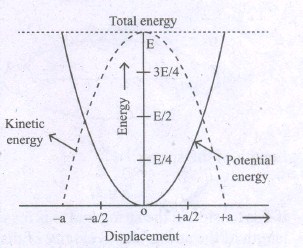
Displacement
Graphical representation of pE and kE in SHM
(iii) When x = ±a p.E U =\(\frac{1}{2}\)mw2- a2 = E
KE = 0
Now taking the displacement x on x-axis and the energy on y-axis, the graph plotted, the dotted line drawn parallel to x-axis represents the total energy of the particle, which remains constant during the entire motion.
3.
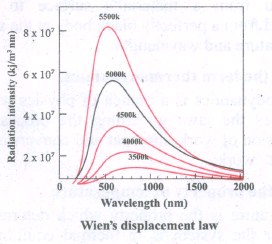
(i) It implies that if temperature of the body increases, maximal intensity wavelength \(\left( { \lambda }_{ m } \right) \) shifts towards lower wavelength (higher frequency) of electromagnetic spectrum.
(ii) From the graph it is clear that the peak of. the wavelengths is inversely proportional to temperature. The curve is known as 'black body radiation curve'.
4.
This-equation gives the relation between pressure P, volume. (v) and absolute temperature (T) of a gas.
The equation is PV = nRT
n - number of molecules of the gas
R - universal gas constant .
Derivation:
Accumulate the Boyle's law, for a gn mass of a gas at constant temperature.
v\(\times\)\(\frac{1}{p}\) .............(1)
Accumulate to charle's law, for a gn mass of a gas at constant pressure,
V\(\times\)T ................(2)
Combining (1) & (2)
v\(\times\) \(\frac{1}{p}\) (or) v = constant \(\frac{T}{P}\)(or) \(\frac{pv}{T}\) = constant
constant is called universal gas constant R.
pv = RT.
For one molecule of a gas, the constant has same value for all gases.
For n moles of a gas pv = nRT.
This is perfect (or) ideal gas equation.
5.
Steel is more elastic than rubber:
(i) We know that young's modulus is the ratio of stress to the strain. If the same force is applied to the wire of steel and rubber thread, which are of equal length and cross section area, we will find that the extension in the rubber thread is much greater than extension in steel wire.
(ii) Therefore, for a given stress, the strain produced in steel is much smaller than that produced in the rubber. This implies that young's modulus for steel is greater than that for rubber. Therefore, steel is more elastic than rubber.
Young's modulus of steel, \(Y_{s}=\frac{F}{A}=\frac{I}{\Delta I_{s}}\)
Young's modulus of rubber, \(Y_{r}=\frac{F}{A}=\frac{I}{\Delta I_{r}}\)
(iii) For same force applied to wires made of steel & rubber of same length and same area of cross section \(\Delta I_{s}<\Delta I_{r}\)
\(\frac{Y{s}}{Y_{r}}=\frac{\Delta I_{r}}{\Delta I_{s}}>1\)
ஃ Ys>Yr
6.
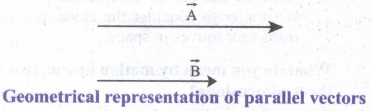
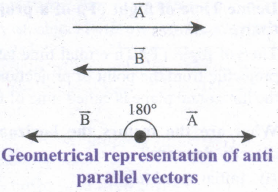
Collinear vectors are those which act along the same line. The angle between them can be 0° or 180°.
(i) Parallel Vectors: If two vectors \(\overrightarrow { A } \) and \(\overrightarrow { B } \) act in the same direction along the same line or on parallel lines, then the angle between them is 0°.
(ii) Anti-parallel vectors: Two vectors \(\overrightarrow { A } \ and\ \overrightarrow { B } \) are said to be anti-parallel when they are in opposite directions along the same line or on parallel lines. Then the angle between them is 180°.
7.
It is the combination of pure translational and pure rotational motion.
1. The rolling motion is the most commonly observed motion in daily life. The motion of wheel is an example of rolling motion.
2. Round objects like ring, disc, sphere etc. are most suitable for rolling. Let us study the rolling of a disc on a horizontal surface. Consider a point P on the edge of the disc.
3. While rolling, the point undergoes translational motion along with its center of mass and rotational motion with respect to its center of mass.
8.
(i) The energy produced by mechanical means is called mechanical energy.
(ii) It is classified into 2 types : (1) Kinetic energy (2) Potential energy.
(iii) The energy possessed by a body due to its motion is called kinetic energy. The energy possessed by the body by virtue of its position is called potential energy. SI unit of energy: N m (or) joule (J).
9.
Fundamental units:
The units in which the fundamental quantities are measured are called fundamental units. It is also known as base units.
Derived units:
The units of measurements of all other physical quantities, which can be obtained by a suitable multiplication or division of powers of fundamental units are called derived units.
Example:
Unit of speed = \({{Unit\ of\ distance}\over{Unit\ of\ \ time}}\)
\(={{m}\over{s}}={ms}^{-1}\)
ms-1 is a derived unit.
10.
(i) If a particle is in uniform circular motion, there must be centripetal acceleration towards the center of the circle.
(ii) If there is acceleration then there must be some force acting on it with respect to an inertial frame. This force is called centripetal force.
(iii) The centripetal acceleration of a particle in the circular motion is given by \(a=\frac { { V }^{ 2 } }{ r } \) and it acts towards center of the circle. According to Newton's second law, the centripetal force is given by
\({ F }_{ Cp }={ ma }_{ cp }=\frac { { MV }^{ 2 } }{ r } \quad a=\frac { { V }^{ 2 } }{ r } \)
(iv) The word Centripetal force means center seeking force in vector notation \({ F }_{ Cp }=\frac { { MV }^{ 2 } }{ r } \hat { r } \). For Uniform circular Motion \({ F }_{ Cp }=-m\omega ^{ 2 }r\hat { r } \)

11th Standard Syllabus & Materials
11th Standard
TN 11th Tamil பீடு பெற நில் - செய்யுள் - காவடிச்சிந்து Important Questions And Answers Study Material - QB365 Set A
NEW11th Standard
TN 11th Tamil பீடு பெற நில் - உரைநடை - மலை இடப்பெயர்கள் : ஓர் ஆய்வு Important Questions And Answers Study Material - QB365 Set A
NEW11th Standard
TN 11th Tamil மாமழை போற்றுதும் - துணைப்பாடம் - யானை டாக்டர் Important Questions And Answers Study Material - QB365 Set A
NEW11th Standard
TN 11th Tamil மாமழை போற்றுதும் - செய்யுள் - ஐங்குறுநூறு Important Questions And Answers Study Material - QB365 Set A



Tamilnadu Stateboard 11th Standard Subjects

Maths

Commerce

Economics

Biology

Business Maths and Statistics

Accountancy

Computer Science
Physics

Chemistry
Maths
Biology
Economics
Physics
Chemistry

History
Business Maths and Statistics

Computer Science
Accountancy

Computer Applications
History
Computer Technology
Commerce
Computer Applications
Computer Technology

Tamil

English

French
Tamilnadu Stateboard Standards



