
 100% FREE ACCESS
11th Standard Syllabus & Materials
11th Standard
TN 11th Tamil இயற்கை வேளாண்மை,சுற்றுச்சூழல் -செய்யுள் - மனோன்மணீயம் Important Questions And Answers Study Material - QB365 Set A
NEW11th Standard
TN 11th Tamil என்னுயிர் என்பேன் -துணைப்பாடம் - இசைத்தமிழர் இருவர் Important Questions And Answers Study Material - QB365 Set A
NEW11th Standard
TN 11th Tamil மொழி கலை -செய்யுள் - ஒவ்வொரு புல்லையும் Important Questions And Answers Study Material - QB365 Set A
NEW11th Standard
TN 11th Tamil பீடு பெற நில் - இலக்கணம் - பகுபத உறுப்புகள் Important Questions And Answers Study Material - QB365 Set A
NEW11th Standard
TN 11th Tamil பீடு பெற நில் - துணைப்பாடம் - வாடிவாசல் Important Questions And Answers Study Material - QB365 Set A
NEW11th Standard
TN 11th Tamil பீடு பெற நில் - செய்யுள் - குறுந்தொகை Important Questions And Answers Study Material - QB365 Set A

Published on: 24/06/2021
QB365 provides detailed and simple solution for every
Creative Questions in class 11 Physics Subject. It will helps to get more idea about question pattern in every Creative questions with solution.
Download Tamil Nadu 11th Standard Physics question papers, model tests, one-mark questions, important questions, and public exam papers in PDF format. Free study materials and answer keys for TN State Board students.
Questions + Answers key
Take MCQ Physics Test1.
Explain the freely falling apple on Earth using the concept of gravitational potential V(r)?
2.
Explain Displacement, velocity in SHM, and derive special cases.
3.
State Newton's law of cooling verify with an experiment.
4.
Distinguish between conduction, convection and radiation.
5.
Write the applications of surface tension?
6.
Mention important properties of the scalar product of two vectors.
7.
Define Torque and derive its expression.
8.
State and prove the law of conservation of energy.
9.
Find
(i) acceleration
(ii) speed of the sliding object using free body diagram.
1.
The gravitational potential V (r) at a point of height h from the surface of the Earth is given by,
V(r = R + h) =\(\frac { { GM }_{ e } }{ \left( { R }+h \right) } \)
The gravitational potential V(r) on the surface of Earth is given by,
V(r = R) = \(\frac { { GM }_{ e } }{ R}\)
Thus we see that
V(r = R) < V(r = R + h)
Gravitational potential energy near the surface of the Earth at height h is mgh. The gravitational potential at this point is simply V(h) = U(h)/m = gh. In fact, the gravitational potential on the surface of the Earth is zero since h is zero. So the apple falls from a region of a higher gravitational potential to a region of lower" gravitational potential.
2.
Displacement in SHM:
The distance travelled by the vibrating particle at any instant of time t from its mean position is known as displacement. When the particle is at p, the displacement of the particle along y axis is y.
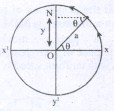
The in ΔOPN, sinθ=\(\frac { ON }{ op } \)
ON = y = op sinθ
y = op sin wt
Since op = a, the radius of the circle, the displacement of the vibrating particle is
y = a sin wt ....(1)
The amplitude of the vibrating particle is defined as its maximum displacement from the mean position.
Velocity in SHM:
The rate of change of displacement is the velocity of the vibrating particle.
Differentiating equation (1), with respect to time t.
\(\frac { dy }{ dt } =\frac { d }{ dt } \) (a sin wt) ....(2)
∴ v = aw cost wt
The velocity v of the particle moving along the circle can also be obtained by resolving it into two components.
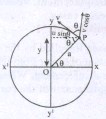
Velocity in SHM
(i) cos θ in a direction parallel to oy.
(ii) V sin θ in a direction perpendicular to oy.
The component v sin θ has no effect along yoy' since it is perpendicular to oy
Velocity =V cosθ = V cos wt
We know that,
Linear Velocity = radius\(\times\)angular velocity
∴ v = aw
Velocity = aw cost wt
Velocity = \(aw\sqrt { 1-sin^{ 2 }wt } \)
∴ Velocity =\(w=\sqrt { ({ a }^{ 2 }-y^{ 2 }) } \)
Special cases:
When the particle is at mean position,
(i.e.) y = 0. Velocity is aw and is maximum.
v = ± aw is called velocity amplitude.
When the particle is in the extreme position,
(i.e) y = +a, the velocity is zero.
3.
(i). It states that the rate of cooling of a body is directly proportional to the temperature differ between the body and the surroundings.
(ii) Consider a spherical calorimeter of mass m whose outer surface is blackened. It is filled with hot water of mass m, the calorimeter with thermometer is suspended from a stand.
(iii) The calorimeter & the hot water radiate heat energy to the surrounding. Using a stop clock, the temperature is noted for every 30 sec. interval of time tree the temperature falls by about 20°C. The readings are tabulated.
(iv) If the temperature falls from T1 to T2 in I see, the quantity of heat energy lost by radiation Q = (ms + m1s1)(T1 - T2), where 's' is the specific heat capacity of the material of the calorimeter & S1 - specific heat capacity of water.
Rate of cooling =\(\frac{Heat energy lost}{timet_n}\)
\(\therefore \frac { Q }{ E } =\frac { \left( ms+{ m }_{ 1 }{ m }_{ 1 } \right) \left( { T }_{ 1 }+{ T }_{ 2 } \right) }{ t } \)
Room temperature - To
(v) Average excess temperature of the colorimeter over that of the surroundings
\(-\frac { { T }_{ 1 }-{ T }_{ 2 } }{ 2 } ={ T }_{ 0 }\)
(vi) Acceleration to Newton's law of cooling
\(\frac { Q }{ T } =\left( \frac { { T }_{ 1 }+{ T }_{ 2 } }{ 2 } -{ T }_{ 0 } \right) \)
(vii) Assume the pressure of the gas remains constant during an infinitesimally small outward displacement dy then work done dW - F. dx = P.A. dx
dW = pdv
Total work done by the gas from volume
V1 to v2 is \(W=\int _{ { v }_{ 1 } }^{ { v }_{ 2 } }{ pdv } \)
(ix) But pv\(\gamma\) = constant (k)
\(W=\int _{ { v }_{ 1 } }^{ { v }_{ 2 } }{ k{ v }^{ \gamma } } dv=k{ \left[ \frac { { v }^{ \gamma -1 } }{ 1-\gamma } \right] }_{ { v }_{ 1 } }^{ { v }_{ 2 } }\quad \left[ \because p=\frac { k }{ { v }^{ \gamma } } \right] \)
\(\therefore W=\frac { k }{ 1-\gamma } \left[ { v }_{ 2 }^{ 1-\gamma }{ -v }_{ 1 }^{ 1-\gamma } \right] \)
\(W=\frac { 1 }{ 1-\gamma } \left[ { kv }_{ 2 }^{ 1-\gamma }{ -kv }_{ 1 }^{ 1-\gamma } \right] \)
\({ p }_{ 2 }{ v }_{ 2 }^{ \gamma }={ p }_{ 1 }{ v }_{ 2 }^{ \gamma }\)
(x) Subtract the value of k
\(\therefore W=\frac { 1 }{ 1-\gamma } \left[ { p }_{ 2 }{ v }_{ 2 }^{ \gamma },{ v }_{ 2 }^{ 1-\gamma }-{ p }_{ 1 }{ v }_{ 1 }^{ \gamma }{ v }_{ 1 }^{ 1-\gamma } \right] \)
\(W=\frac { 1 }{ 1-\gamma } \left[ { { p }_{ 2 }v }_{ 2 }^{ }{ -{ p }_{ 1 }v }_{ 1 }^{ } \right] \)
It T~ is the final temperature of the gas in adorable expansion, then
p1v1 = RT1P2v2 = RT2
\(\therefore W=\frac { 1 }{ 1-\gamma } \left[ { R }_{ 2 }^{ }{ -R }_{ 1 }^{ } \right] \)
This is the equation for the work done during adiabatic process.
4.
| S.No | Condcution | Convection | Rediation |
|---|---|---|---|
| 1. | Material medium is required. | Material medium is required. | No material medium is required. |
| 2. | It is due to temperature difference. Heat flows from high temperature to low temperature. |
It is due to difference in density. Heat flows from low density to high density region. |
It occurs at temperature above 0 K |
| 3. | It occurs in solids through molecular collisions without actual movement of particles. | It occurs in fluids by the actual movement of particles. | It takes place at large distances and does not the inversting medium. |
| 4. | It is a slow process. | It is also a slow process. | It propagates at the speed of light. |
| 5. | It does not obey the laws of reflection & refraction | It does not obey the laws. | It obeys the laws of of reflection reflection. |
5.
(i) Mosquitoes lay their eggs on the surface of water. To reduce the surface tension of water, a small amount of oil is poured. This breaks the elastic film of water surface and eggs are killed by drowning.
(ii) Chemical engineers must finely adjust the surface tension. of the liquid, so it forms droplets of designed size and so it adheres to the surface without smearing. This is used in desktop printing, to paint automobiles and decorative items.
(iii) Specks of dirt get removed when detergents are added to hot water while washing clothes because surface tension is reduced.
(iv) A fabric can be made waterproof, by adding suitable waterproof material (wax) to the fabric. This increases the angle of contact.
6.
(i) The product quantity \(\overrightarrow{A}.\overrightarrow{B}\) is always a scalar. It is positive if the angle between the vectors is acute (i.e., < 90°) and negative if the angle between them is obtuse (i.e. 90°<0< 180°).
(ii) The scalar product is commutative i.e., \(\overrightarrow{A}.\overrightarrow{B}=\overrightarrow{B}.\overrightarrow{A}\)
(iii) The vectors obey distributive law i.e.
\(\overrightarrow{A}.\left( \overrightarrow{B}+\overrightarrow{C} \right)=\overrightarrow{A}+\overrightarrow{B}+\overrightarrow{A}.\overrightarrow{C}\)
(iv) The angle between the vectors
\(\theta={cos}^{-1}\left[ {{\overrightarrow{A}.\overrightarrow{B}}\over{AB}} \right]\)
(v) The scalar product of two vectors will be maximum when cos \(\theta\) = 1, i.e., \(\theta=0°\) , i.e., when the vectors are parallel;
\((\overrightarrow{A}.\overrightarrow{B})_{max}=AB\)
(vi) The scalar product of two vectors will be minimum, when cos \(\theta\) = -1, i.e. 0 = 180° \((\overrightarrow{A}.\overrightarrow{B})=-AB,\) when the vectors are mm anti-parallel.
(vii) If two vectors \(\overrightarrow{A}\) and \(\overrightarrow{B}\) are perpendicular to each other then their scalar product \(\overrightarrow{A}.\overrightarrow{B}=0,\) 0, because cos 90°= O. Then the vectors \(\overrightarrow{A}\) and \(\overrightarrow{B}\) are said to be mutually orthogonal.
(viii) The scalar product of a vector with itself is termed as self-dot product and is given by \({(\overrightarrow{A})}^{2}=\overrightarrow{A}.\overrightarrow{A}=AA\ \cos\ \theta={A}^{2}.\)
Here angle 0 = 0°
The magnitude or norm of the vector \(\overrightarrow{A}\) is \(|\overrightarrow{A}|=A=\sqrt{\overrightarrow{A}.\overrightarrow{A}}\)
(ix) In case of a unit vector \(\overrightarrow{n}\)
\(\hat{n},\hat{n}=1\times1\times\cos\theta=1.\) For example,
\(\hat{i},\hat{j}=\hat{j}.\hat{j}=\hat{k},\hat{k}=1.\)
(x) In the case of orthogonal unit vectors \(\hat{i},\hat{j}\) and \(\hat{k}.\)
\(\hat{i},\hat{j}=\hat{j},\hat{k}=\hat{k},\hat{i}=1.1\cos 90°=0\)
(xi) In terms of components, the scalar product of \(\overrightarrow{A}\) and \(\overrightarrow{B}\) can be written as \(\overrightarrow{A}.\overrightarrow{B}=(A_z\hat{i}+A_y\hat{j}+A_z\hat{k}).(B_x\hat{i}+B_y\hat{j}+B_z\hat{k})\)
\(=A_xB_x+A_yB_y+A_zB_z,\) with all other terms zero. The magnitude of vector \(|\overrightarrow{A}|\) is given by \(|\overrightarrow{A}|=A=\sqrt{{A}_{x}^{2}+{A}_{y}^{2}+{A}_{z}^{2}}\)
7.
(i) Torque is defined as the moment of the external applied force about a point or axis of rotation.
(ii) \(\overset { \rightarrow }{ \tau } =\overset { \rightarrow }{ r } \times \overset { \rightarrow }{ F } \)
where, \(\overset { \rightarrow }{ r } \) is the position vector of the point where the force \(\overset { \rightarrow }{ F } \) is acting on the body as shown in Figure.
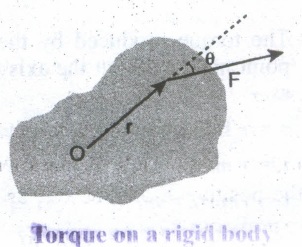
(iii) Here, the product of \(\overset { \rightarrow }{ r } \) and \(\overset { \rightarrow }{ F } \) is called the vector product or cross product. The vector product of two vectors results in another vector that is perpendicular to both the vectors. Hence, torque (\(\overset { \rightarrow }{ \tau } \)) is a vector quantity.
(iv) Torque has a magnitude (r F sinፀ) and direction perpendicular to \(\overset { \rightarrow }{ r } \) and \(\overset { \rightarrow }{ F } \). Its unit is N m.
\(\overset { \rightarrow }{ \tau } =(r\ F\sin\theta )\hat { n } \)
(v) Here, \(\theta\) is the angle between \(\overset { \rightarrow }{ r } \) and \(\overset { \rightarrow }{ F } \) and \(\hat { n } \) is the unit vector in the direction of \(\overset { \rightarrow }{ \tau } \).
8.
(i) When an object is thrown upwards its kinetic energy goes on decreasing and consequently its potential energy keeps increasing (neglecting air resistance).
(ii) When it reaches the highest point its energy is completely potential. Similarly, when the object falls back from a height its kinetic energy increases whereas its potential energy decreases.
(iii) When it touches the ground its energy is completely kinetic. At the intermediate points the energy is both kinetic and potential as shown in Figure.
(iv) When the body reaches the ground the kinetic energy is completely dissipated into some other form of energy like sound, heat, light and deformation of the body etc.
(v) In this example the energy transformation takes place at every point. The sum of kinetic energy and potential energy i.e., the total mechanical energy always remains constant, implying that the total energy is conserved. This is stated as the law of conservation of energy.
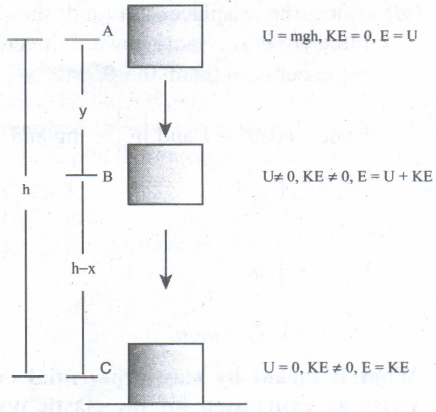
(vi) The law of conservation of energy states that energy can neither be created nor destroyed. It may be transformed from one form to another but the total energy of an isolated system remains constant.
(vii)The figure Illustrates that, if an object starts from rest at height h, the total energy is purely potential energy (U=mgh) and the kinetic energy (KE) is zero at h. When the object falls at some distance y, the potential energy and the kinetic energy are not zero whereas, the total energy remains same as measured at height h. When the object is about to touch the ground, the potential
energy is zero and total energy is purely kinetic.
9.
(i) To draw the free body diagram, the block is assumed to be a point mass. Since the motion is on the inclined surface, we have to choose the coordinate system parallel to the inclined surface as shown in Figure (b).
(ii) The gravitational force mg is resolved in to parallel component mg sin e along the inclined plane and perpendicular component mg cos e perpendicular to the inclined surface. (Figure (b)).
(iii) Note that the angle made by the gravitational force (mg) with the perpendicular to the surface is equal to the angle of inclination angle e as shown in Figure (c).
.png)
(a)Free body diagram
(b) mg resolved into parallel and perpendicular components
.png)
In the Triangle ABC Total Angle = 90 + \(\theta +{ \theta }_{ 1 }\) = 180 From the above equation
\({ \theta }_{ 1 }\) = 180 -90 - \(\theta\) = 90 - \(\theta\)
But from the figure \({ \theta }_{ 2 }\) =90 - \({ \theta }_{ 1 }\) = 90 -(90-\(\theta\))
It given \({ \theta }_{ 2 }\) = \(\theta\)
C) The angle \({ \theta }_{ 2 }\) is equal to \(\theta\)
There is no motion(acceleration) along they axis. Applying Newton's second law in the y-direction
-mg cos \(\theta\) \(\hat { j } +N\vec { j } \) = 0(No acceleration)
By comparing the components on both sides, N - mg cos \(\theta =0\)
N=mg cos \(\theta\)
The magnitude of normal force (N) exerted by the surface is equivalent to mg cos \(\theta\)
(v) The object slides (with an acceleration) along the x-direction. Applying Newton's second law in the x-direction
mg sin \(\quad \theta \hat { i } =ma\hat { i } \)
By comparing the components on both sides, we can equate. mg sin \(\theta\) = ma
The acceleration of the sliding object is a = g sin \(\theta\)
(vi) Note that the acceleration depends on the angle of inclination.\(\theta\) If the angle 9 is 90 degree, the block will move vertically with acceleration a = g
(vii) Newton's kinematic equation is used to find the speed of the object when it reaches the- bottom. The acceleration is constant throughout the motion
v2 = u2 + 2as along the x-direction .......(1)
The acceleration a is equal to mg sin \(\theta\) The initial speed (u) is equal to zero as it starts from rest. Here s is the length of the inclined surface.
The speed (v) when it reaches the bottom is (using equation (1))
\(v=\sqrt { 2sg\ sin\ \theta } \)

11th Standard Syllabus & Materials
11th Standard
TN 11th Tamil பீடு பெற நில் - செய்யுள் - காவடிச்சிந்து Important Questions And Answers Study Material - QB365 Set A
NEW11th Standard
TN 11th Tamil பீடு பெற நில் - உரைநடை - மலை இடப்பெயர்கள் : ஓர் ஆய்வு Important Questions And Answers Study Material - QB365 Set A
NEW11th Standard
TN 11th Tamil மாமழை போற்றுதும் - துணைப்பாடம் - யானை டாக்டர் Important Questions And Answers Study Material - QB365 Set A
NEW11th Standard
TN 11th Tamil மாமழை போற்றுதும் - செய்யுள் - ஐங்குறுநூறு Important Questions And Answers Study Material - QB365 Set A



Tamilnadu Stateboard 11th Standard Subjects

Maths

Commerce

Economics

Biology

Business Maths and Statistics

Accountancy

Computer Science
Physics

Chemistry
Maths
Biology
Economics
Physics
Chemistry

History
Business Maths and Statistics

Computer Science
Accountancy

Computer Applications
History
Computer Technology
Commerce
Computer Applications
Computer Technology

Tamil

English

French
Tamilnadu Stateboard Standards



