
 100% FREE ACCESS
11th Standard Syllabus & Materials
11th Standard
TN 11th Tamil இயற்கை வேளாண்மை,சுற்றுச்சூழல் -செய்யுள் - மனோன்மணீயம் Important Questions And Answers Study Material - QB365 Set A
NEW11th Standard
TN 11th Tamil என்னுயிர் என்பேன் -துணைப்பாடம் - இசைத்தமிழர் இருவர் Important Questions And Answers Study Material - QB365 Set A
NEW11th Standard
TN 11th Tamil மொழி கலை -செய்யுள் - ஒவ்வொரு புல்லையும் Important Questions And Answers Study Material - QB365 Set A
NEW11th Standard
TN 11th Tamil பீடு பெற நில் - இலக்கணம் - பகுபத உறுப்புகள் Important Questions And Answers Study Material - QB365 Set A
NEW11th Standard
TN 11th Tamil பீடு பெற நில் - துணைப்பாடம் - வாடிவாசல் Important Questions And Answers Study Material - QB365 Set A
NEW11th Standard
TN 11th Tamil பீடு பெற நில் - செய்யுள் - குறுந்தொகை Important Questions And Answers Study Material - QB365 Set A

Published on: 13/05/2022
QB365 provides detailed and simple solution for every
Creative Questions in class 11 Physics Subject. It will helps to get more idea about question pattern in every Creative questions with solution.
Download Tamil Nadu 11th Standard Physics question papers, model tests, one-mark questions, important questions, and public exam papers in PDF format. Free study materials and answer keys for TN State Board students.
Questions + Answers key
Take MCQ Physics Test1.
The bob of simple pendulum executes S.H.M is water with a period t, while the period of oscillation of the bob is to in air, neglecting frictional force of water and given that the density of the bob is \(\frac{4000}{3}\)kg m-3, find the relationship between t and t0?
2.
A transverse harmonic wave on a string is described by y(x, t) = 5.0 sin (48t + 0.0264x + ), where x and y are in cm and t in sec. The positive direction of x is from left to right.
(a) What are its amplitude and frequency?
(b) What is the least distance between two success in crests in the wave?
3.
Speed of an atom in an argon gas cylinder equal to the rms speed of a helium gas atom at -20°C? [Atomic mass of Ar =39.90, He =4.04]
4.
Distinguish between isothermal and adiabatic process.
5.
The terminal velocity of a tiny droplet is V. N number of such identical droplets combine together forming a bigger drop v Find the terminal velocity of the bigger drop?
6.
Discuss how the rolling is the combination of translational and rotational and also be possibilities of velocity of different points in pure rolling.
7.
The frequency of vibration of a string depends of on,
(i) tension in the string
(ii) mass per unit length of string
(iii) vibrating length of the string
Establish dimensionally the relation for frequency.
8.
Derive an expression for the potential energy of an elastic stretched spring.
9.
Briefly explain how is a horse able to pull a cart.
10.
A car moving uniform motion with speed 120 kmh-2 is brought to a stop within a distance of 200 m. How long does it take for the car to stop?
1.
In air t0=\(2\pi \sqrt { \frac { l }{ g } } \)
Let V be the volume of the bob. Then apparent weight of bob in water = weight of bob in air - up thrust
\(V\rho { g }^{ ' }=V\rho g-v\sigma g\)
\({ g }^{ ' }=\left( 1-\frac { \sigma }{ \rho } \right) g\)
Density of bob, \(\rho \)=\(\frac{400}{3}\) kg m-3
Density of water, \(\sigma \)= 1000 kg m-3
g'=\(\left( 1-\frac { 1000\times 3 }{ 4000 } \right) g\)
=\(\frac{g}{4}\)
Time period of the-pendulum in water
t=\(2\pi \sqrt { \frac { l }{ g } } =2\pi \sqrt { \frac { l }{ \frac { g }{ 4 } } } =2\times 2\pi \sqrt { \frac { l }{ g } } \)
2.
Here,
y(x, t) = 5.0 sin (48t + 0.0264x + \(\pi\over 6\))
The general equation of a plane progressive wave is,
v(x,t) = a Sin\(\left[{2\pi\over \lambda}(vt+x)+\phi\right]\)
It is observed that the given equation represent a travelling waveform right to left.
Velocity \(V={48\over 0.0264}=1818.18cms^{-1}, r=5cm\)
(a) Amplitude and frequency:
Amplitude,
\({2\pi\over \lambda}=0.0264\)
or
\(\lambda={2\pi\over 0.0264}cm={2\times3.14\over 0.0264}={6.28\over 0.0264}=237.8cm\)
frequency,
From the equation
v = ⋋v,
\(v={v\over \lambda}={1818.18\over 2\pi}\times0.0264\)
\(={1818.18\over 2\times3.14}\times0.0264\)
= 289.51 x 0.0264
= 7.64 Hz
b) To find least distance between two successive crests in the wave.
\(\lambda={2\pi\over 0.0264 }={2\times3.14\over 0.0264}={6.28\over0.0264}\)
= 237.8 em = 2.38 m
(c) When \(x={\lambda\over 4}\)
\(\phi={2\pi\over \lambda}\times{\lambda\over 4}={\pi\over 2}rad\)
3.
temperature of the helium atom,
THe= -20oC = 273 - 20 = 253 K.
Atomic mass of argon, MAr = 39.90,
Atomic mass of helium, MHe= 4.04.
Let, (Vrm) Ar be the rms speed of argon,
Let, (Vrms) He be the rms speed of Helium.
The rms speed of argon is given by:
(Vrms)Ar=\(\sqrt { \frac { { 3RT }_{ AR } }{ { M }_{ Ar } } } \) ............ (1)
(Vrms)He=\(\sqrt { \frac { { 3RT }_{ He } }{ { M }_{ He } } } \) ............ (2)
It is given that:
(Vrms) Ar = (Vrms)He
\(\sqrt { \frac { { 3RT }_{ AR } }{ { M }_{ Ar } } } \)=\(\sqrt { \frac { { 3RT }_{ He } }{ { M }_{ He } } } \)
\(\frac { { T }_{ AR } }{ { M }_{ Ar } } =\frac { { T }_{ He } }{ { M }_{ He } } \)
\({ T }_{ Ar }=\frac { { T }_{ He } }{ { M }_{ He } } \times { M }_{ Ar }\)
\(=\frac { 253 }{ 4 } \times 39.9\)
= 2523.675 = 2.52\(\times\)103K.
Therefore, the temperature of the argon atom is 2.52\(\times\)103 K.
4.
| S.No | Isothermal | Adiabatic |
|---|---|---|
| 1. | Temperature remains constant \(\triangle\)T =0 | Heat content remains constant \(\triangle\)Q |
| 2 | Walls of the container is perfectly conductivity. | All walls and piston are perfectly an insulating. |
| 3. | The changes occur slowly i.e. slow process. | The changes occur suddenly i.e. a fast process. |
| 4. | Internal energy remains constant, i.e \(\triangle\)U = 0 | internal energy changes \(\triangle\)U \(\neq \) 0 |
| 5. | Pv = constant | \({ P }_{ v }^{ \gamma }\) constant |
| 6 | Slope of isothermal curve on pv dig. \(\frac { -P }{ v } =\frac { dp }{ dv } \) |
Slope is \(\frac { -\gamma p }{ v } \) \(\gamma >1\) Slope of adiabatic greater than isothermal. |
5.
The maximum constant velocity acquired by a body while falling through a viscous fluid is called its terminal velocity.
Terminal velocity, \(V=\frac{2}{9}. r^{2} \frac{(\rho-\sigma)g}{\eta}\)
\(⇒ \frac{V}{r{2}}=\frac{2}{9}[\frac{(\rho-\sigma)g}{\eta}]\)
\(\frac{V}{r^{2}}=\frac{2g}{9\eta}(\rho-\sigma)\) --- (1)
Similarly, the bigger drip,
\(\frac{V^{'}}{r^{2}}=\frac{2g}{9\eta}(\rho-\sigma)\) --- (2)
Dividing equ (1) by (2),
\(\frac{V}{V^{'}}=\frac{r^{2}}{R^{2}}\Rightarrow V^{'}=V(\frac{R}{r})^{2}\) -- (3)
IfN drops, then
Volume of one big drop =Volume of N droplets.
\(\frac{4}{3} \pi R^{3}=N(\frac{4}{3}\pi r^{3})\) [∵ Volume of the sphere \(V=\frac{4}{3} \pi r^{3}\) ]
R3 = N(r3)
R3 = N1/3(r)
∴ Terminal velocity of bigger drop,
=\((\frac{R}{r})^{2} \times V\) from equation --- (1)
\(= (\frac{N^{\frac{1}{3}}}{\frac{r}{r}})^{2} \times V=(N^{1/3})^{2} \times V\)
= N2/3 \(\times\)V from equation --- (2)
6.
The rolling motion is the most commonly observed motion in daily life. The motion of wheel is an example of rolling motion. Round objects like ring, disc, sphere etc. are most suitable for rolling. Let us study the rolling of a disc on a horizontal surface. Consider a point P on the edge of the disc. While rolling, the point undergoes translational motion along with its center of mass and rotational motion with respect to its center of mass.
Combination of Translation and Rotation: We will now see how these translational and rotational motions are related in rolling. If the radius of the rolling object is R, in one full rotation, the center of mass is displaced by 2\(\pi\)R (its circumference). One would agree that not only the center of mass, but all the points on the disc are displaced by the same 2\(\pi\)R after one full rotation. The only difference is that the center of mass takes a straight path; but, all the other points undergo a path which has a combination of the translational and rotational motion. Especially the point on the edge undergoes a path of a cycloid as shown in the figure.
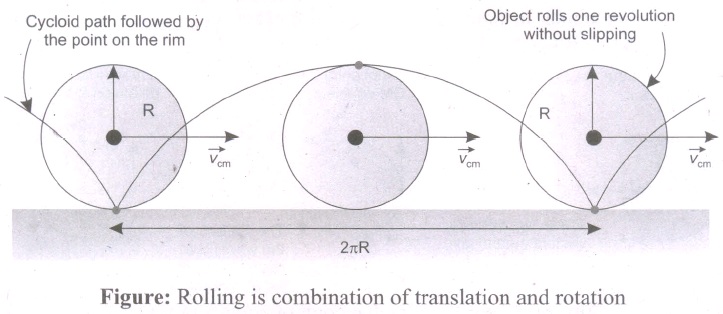
As the center of mass takes only a straight line path, its velocity vCM is only translational velocity vTRANS (vCM = vTRANS)· All the other points have two velocities. One is the translational velocity vTRANS, (which is also the velocity of center of mass) and the other is the rotational velocity vROT (vROT = r\(\omega\)). Here, r is the distance of the point from the center of mass and eo is the angular velocity. The rotational velocity vROT is perpendicular to the instantaneous position vector from the center of mass as shown in figure (a). The resultant of these two velocities is v. This resultant velocity v is perpendicular to the position vector from the point of contact of the rolling object with the surface on which it is rolling as shown in figure (b).
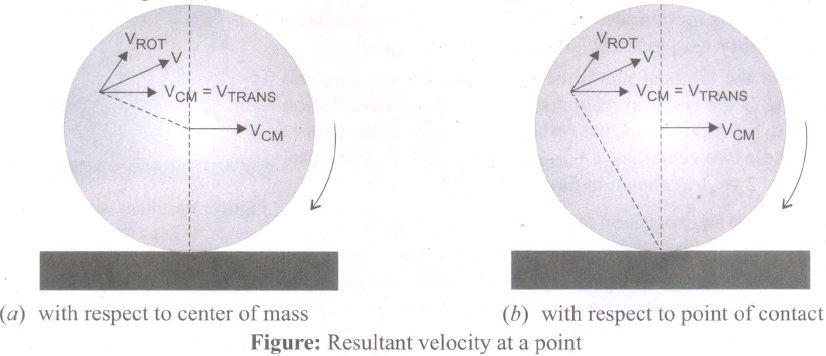
We shall now give importance to the point of contact. In pure rolling, the point of the rolling object which comes in contact with the surface is at momentary rest. This is the case with every point that is on the edge of the rolling object. As the rolling proceeds, all the points on the edge, one by one come in contact with the surface; remain at momentary rest at the time of contact and then take the path of the cycloid as already mentioned.
Hence, we can consider the pure rolling in two different ways. (i) The combination of translational motion and rotational motion about the center of mass. (or) (ii) The momentary rotational motion about the point of contact. As the point of contact is at momentary rest in pure rolling, its resultant velocity v is zero (v = 0). For example, in figure, at the point of contact, vTRANS is forward (to right) and vROT is backwards (to the left).
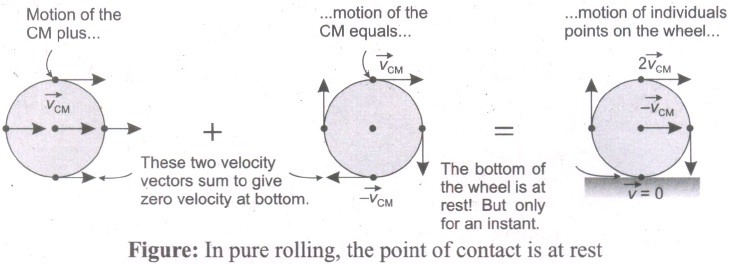
That implies that, vTRANS and vROT are equal in magnitude and opposite in direction (v = vTRANS -vROT = 0). Hence, we conclude that in pure rolling, for all the points on the edge, the magnitudes of vTRANS and vROT are equal (vTRANS = vROT)· As vTRANS = vCM and vROT = \(R_\omega\), in pure rolling we have,
\(V_{CM}=R_\omega\)
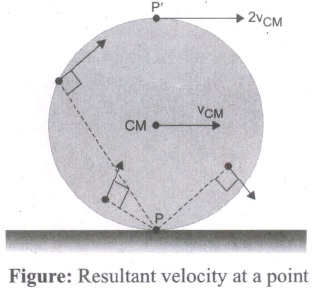
We should remember the special feature of the above equation. In rotational motion, as per the relation v = r\(\omega\), the center point will not have any velocity as r is zero. But in rolling motion, it suggests that the center point has a velocity vCM given by above equation VCM - R\(\omega\). For the topmost point, the two velocities vTRANS and vROT are equal in magnitude and in the same direction (to the right). Thus, the resultant velocity v is the sum of these two velocities, v = vTRANS + vROT· In other form,v= 2 vCM as shown in figure below.
7.
n\(\propto\) IaTbmc, [I] = [MoL1To]
[T] = [M1L1T-2] (force)
[M] = [M1L-1To]
[Mo LoT-1] = [MoL1To]a [M1L1T-2]b [MoL-1To]C
b + c = 0
a + b - c = 0
-2b = -1 \(\Rightarrow\) b = \(1\over2\)
c =\(-{1\over2}a=1\)
n\(\propto\) \({1\over l}{\sqrt{T\over m}}\)
8.
Consider a spring-mass system. Let us assume a mass, m lying on a smooth horizontal table as shown in the figure. Here, x = 0 is the equilibrium position. One end of the spring is attached to a rigid wall and the other end to the mass.
As long as the spring remains in equilibrium position, its potential energy is zero. Now an, external force \(\bar{F},\) is applied 'so that it is stretched by a distance (x) in the direction of the force.
There is a restoring force called spring force Fs developed in the spring which tries to bring the mass back to its original position. This applied force and the spring force are equal in magnitude but opposite in direction i.e., \(\bar{F}_a=-\bar{F}_s.\)
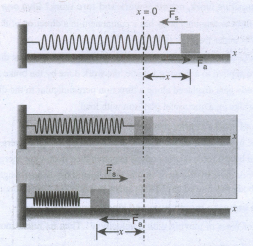
According to Hooke's law, the, restoring force developed in the spring is
\(\bar{F}_s=-k.\bar{x}\) ...(1)
The negative sign 'in the above expression implies that the spring force is always opposite to that of displacement i and k is the force constant. Therefore applied force is \(\bar{F}_a=+k.\bar{x}\). The positive sign implies that the applied force is in the direction of displacement \(\bar{x}\). The spring force is an example of variable force as it depends on the displacement \(\bar{x}\). Let the spring be stretched to a small distance d \(\bar{x}\). The work done by the applied force on the spring to stretch it by a displacement x is stored as elastic potential energy.
\(U=\int{\bar{F}_ad\bar{r}}=\int_{0}^{\pi}|\bar{F a}||d\bar{r}|\cos\theta\)
\(U=\int_{0}^{x}F_adx \cos \theta\) ...(2)
The applied force \(\bar{F}_a\) and the displacement \(d\bar{r}\) (i.e., here dx) are in the same direction. As, the initial position is taken as the equilibrium position or mean position, x = 0 is the lower limit of integration.
\(U=\int_{0}^{\pi}kxdx\) ........(3)
\(U=k{\left[ {x^2 \over 2} \right]}_{x}^{0}\) ............(4)
\(U={1\over2}kx^2\) ........(5)
If the initial position is not zero, and if the mass is changed from position xi to xf, then the elastic potential energy is
\(U={1\over2}k({x}_{f}^{2}-{x}_{i}^{2})\) .......(6)
From equations (5) and (6), we observe that the potential energy of the stretched spring depends on the force constant k and elongation or compression x.
9.
Consider the horse as the 'system', then there are three forces acting on the horse
(i) Downward gravitational force (mhg)
(ii) Force exerted by the road (Fr)
(iii) Backward force exerted by the cart (Fc)
It is shown in the following figure.
Fr - Force exerted by the road on the horse
Fc - force exerted by the cart on the horse
Fr丄 - Perpendicular component of Fr = N
Fr||-Parallel component of F, which is reason for forward movement.
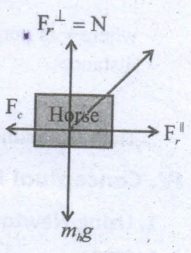
The force exerted by .the road can be resolved into parallel and perpendicular components, The perpendicular component balances the downward gravitational force. There is parallel component along the forward direction. It is greater than the backward force (Fc). So there is net force along the forward direction which causes the forward movement of the horse.
If we take the cart as the system, then there are three forces acting on the cart.
(i) Downward gravitational force (mcg)
(ii) Force exerted by the road (Fr')
(iii) Force exerted by the horse (Fh)
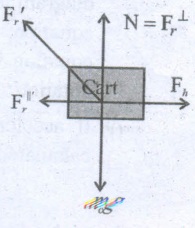
It is shown in the figure
The force exerted by the road (\(\vec { { F }_{ r } } \)) can be resolved into parallel and perpendicular components. The perpendicular component cancels the downward gravity (mcg)
Parallel component acts backwards and the force exerted by the horse (\(\vec { { F }_{ h } } \)) acts forward. Force (\(\vec { { F }_{ h } } \)) is greater than the parallel component acting in the opposite direction. So there is an overall unbalanced force in the forward direction which causes the cart to accelerate forward.
If we take the cart + horse as a system, then there are two forces acting on the system.
(i) Downward gravitational force (mh + mc)g
(ii) The force exerted by the road (Fr) on the system.
It is shown in the following figure.
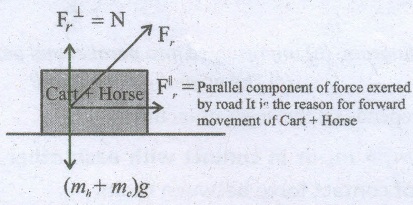
(iii) In this case the force exerted by the road (Fr) on the system (cart + horse) is resolved in to parallel and perpendicular components. The perpendicular component is the normal force which cancels the downward gravitational force (mh +mc)g. The parallel component of the force is not balanced, hence the system (cart + horse) accelerates and moves forward due to this force.
10.
Speed u = 120 km/h = 120\(\times\)\(\frac { 5 }{ 18 } \)
u = 33 m/s
Final velocity v =0, distances = 200 m
We know,
v2=u2 +2as
02=(33)2+2a \(\times\) (200)
a = (-33)2/(2\(\times\)200)
\(a=\frac { 1089 }{ 400 } =2.722\quad { ms }^{ -2 }\)
As
v = u + at
0 = 33+(2.72)t
\(t=\frac { 33 }{ 2.72 } \)
t=12.13s

11th Standard Syllabus & Materials
11th Standard
TN 11th Tamil பீடு பெற நில் - செய்யுள் - காவடிச்சிந்து Important Questions And Answers Study Material - QB365 Set A
NEW11th Standard
TN 11th Tamil பீடு பெற நில் - உரைநடை - மலை இடப்பெயர்கள் : ஓர் ஆய்வு Important Questions And Answers Study Material - QB365 Set A
NEW11th Standard
TN 11th Tamil மாமழை போற்றுதும் - துணைப்பாடம் - யானை டாக்டர் Important Questions And Answers Study Material - QB365 Set A
NEW11th Standard
TN 11th Tamil மாமழை போற்றுதும் - செய்யுள் - ஐங்குறுநூறு Important Questions And Answers Study Material - QB365 Set A



Tamilnadu Stateboard 11th Standard Subjects

Maths

Commerce

Economics

Biology

Business Maths and Statistics

Accountancy

Computer Science
Physics

Chemistry
Maths
Biology
Economics
Physics
Chemistry

History
Business Maths and Statistics

Computer Science
Accountancy

Computer Applications
History
Computer Technology
Commerce
Computer Applications
Computer Technology

Tamil

English

French
Tamilnadu Stateboard Standards



