
 100% FREE ACCESS
11th Standard Syllabus & Materials
11th Standard
TN 11th Tamil இயற்கை வேளாண்மை,சுற்றுச்சூழல் -செய்யுள் - மனோன்மணீயம் Important Questions And Answers Study Material - QB365 Set A
NEW11th Standard
TN 11th Tamil என்னுயிர் என்பேன் -துணைப்பாடம் - இசைத்தமிழர் இருவர் Important Questions And Answers Study Material - QB365 Set A
NEW11th Standard
TN 11th Tamil மொழி கலை -செய்யுள் - ஒவ்வொரு புல்லையும் Important Questions And Answers Study Material - QB365 Set A
NEW11th Standard
TN 11th Tamil பீடு பெற நில் - இலக்கணம் - பகுபத உறுப்புகள் Important Questions And Answers Study Material - QB365 Set A
NEW11th Standard
TN 11th Tamil பீடு பெற நில் - துணைப்பாடம் - வாடிவாசல் Important Questions And Answers Study Material - QB365 Set A
NEW11th Standard
TN 11th Tamil பீடு பெற நில் - செய்யுள் - குறுந்தொகை Important Questions And Answers Study Material - QB365 Set A

Published on: 07/06/2021
QB365 provides detailed and simple solution for every Book back Questions in class 11 Physics Subject. It will helps to get more idea about question pattern in every book back questions with solution.
Download Tamil Nadu 11th Standard Physics question papers, model tests, one-mark questions, important questions, and public exam papers in PDF format. Free study materials and answer keys for TN State Board students.
Questions + Answers key
Take MCQ Physics Test1.
Explain the variation of g with depth from the Earth’s surface.
2.
Explain the variation of g with lattitude.
3.
Describe the measurement of Earth’s shadow (umbra) radius during total lunar eclipse.
4.
Explain how geocentric theory is replaced by heliocentric theory using the idea of retrograde motion of planets.
5.
1.
Variation of g with depth:
Consider a particle of mass m which is in a deep mine on the Earth. (Example: coal mines -in Neyveli). Assume the depth of the mine as d. To calculate g' at a depth d, consider the following points.
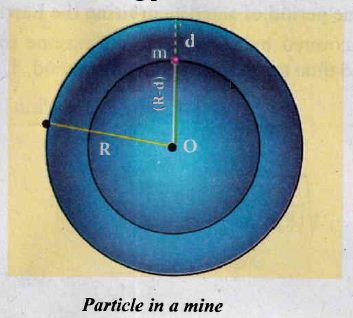
The part of the Earth which is above the radius (Re - d) do not contribute to the acceleration. The e· result is proved earlier and is given as
g' = \(\frac { GM' }{ ({ R }_{ e }-d)^{ 2 } } \)
Here M' is the mass of the Earth of radius (Re - d)
Assuming the density of Earth p to be constant
\(\rho =\frac { M' }{ V' } \)
where M is the mass of the Earth and V its volume, Thus
\(\rho =\frac { M' }{ V' } \)
\(\frac { M' }{ V' } =\frac { M }{ V } \) and M' = \(\frac { M }{ V } V'\)
M' = \(\left( \frac { M }{ \frac { 4 }{ 3 } \pi { R }_{ e }^{ 3 } } \right) \left( \frac { 4 }{ 3 } \pi ({ R }_{ e }-d)^{ 3 } \right) \)
M'=\(\frac { M }{ { R }_{ e }^{ 3 } } \)(Re - d)3
g' = G\(\frac { M }{ { R }_{ e }^{ 3 } } \)(Re - d)3.\(\frac { 1 }{ ({ R }_{ e }-d)^{ 2 } } \)
g' = GM \(\frac { R_{ e }\left( 1-\frac { d }{ { R }_{ e } } \right) }{ { R }_{ e }^{ 3 } } \)
g' = GM \(\frac { \left( 1-\frac { d }{ { R }_{ e } } \right) }{ { R }_{ e }^{ 2 } } \)
Thus
g' = g \(\left( 1-\frac { d }{ { R }_{ e } } \right) \)
Here also g' < g. As depth increases, g' decreases. It is very interesting to know that acceleration due to gravity is maximum on the surface of the Earth but decreases when we go either upward or downward.
2.
Whenever we analyze the motion of objects in rotating frames we must take into account the centrifugal force. Even though we treat the Earth as an inertial frame, it is not exactly correct because the Earth spins about its own axis. So when an object is on the surface of the Earth, it experiences a centrifugal force that depends on the latitude of the object on Earth. If the Earth were not spinning, the force on the object would have been mg. However, the object experiences an additional centrifugal force due to spinning of the Earth.
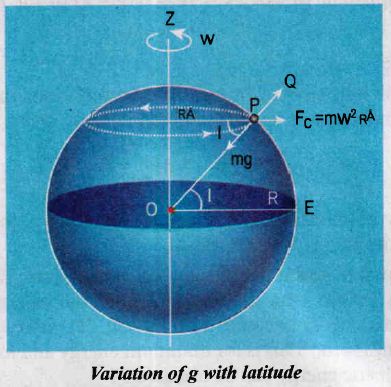
This centrifugal force is given by mω2R'.
R' = R cos λ ....(1)
where λ is the latitude. The component of centrifugal acceleration experienced by the object in the direction opposite to g is
ac = ω2R' cos λ = ω2R cos2 λ
since R' = R cos λ
Therefore,
g' = g -ω2R cos2 λ ...(2)
From the expression (2), we can infer that at equator, λ = 0; g' = g - ω2R. The acceleration due to gravity is minimum. At poles λ = 90; g' = g, it is maximum. At the equator, g' is minimum.
3.
By finding the apparent radii of the Earth's umbra shadow and the Moon, the ratio of the these radii can be calculated. This is shown in Figure.
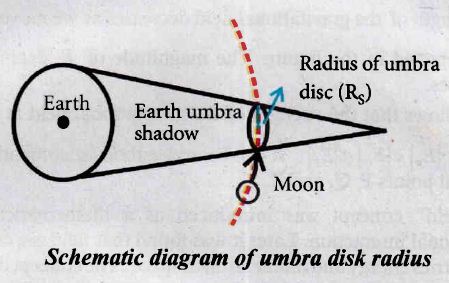
The apparent radius of Earth's umbra shadow
\(=\mathrm{R}_{\mathrm{s}}=13.2 \mathrm{~cm}\)
The apparent radius of the Moon
\(=\mathrm{R}_{\mathrm{m}}=5.15 \mathrm{~cm}\)
The ratio
\(\frac{R_{S}}{R_{m}} \approx 2.56\)
The radius of the Earth's umbra shadow is
\(\mathrm{R}_{\mathrm{s}}=2.56 \times \mathrm{Rm}\)
The radius of Moon \(\mathrm{R}_{\mathrm{m}}=1737 \mathrm{~km}\)
The radius of the Earth's umbra shadow is
\(\mathrm{R}_{\mathrm{s}}=2.56 \times 1737 \mathrm{~km} \cong 4446 \mathrm{~km} \text {. }\)
The correct radius is 4610 km.
The percentage of error in the calculation
4.
According to this model, the Sun is at the center of the solar system and all planets orbited the Sun. The retrograde motion of planets with respect to Earth is because of the relative motion of the planet with respect to Earth. The retrograde motion from the heliocentric point of view is shown in Figure.
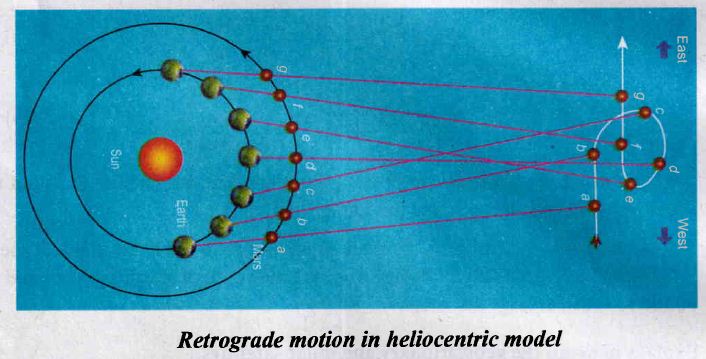
Figure shows that the Earth orbits around the Sun faster than Mars. Because of the relative motion between Mars and Earth, Mars appears to move backward from July to October. In the same way the retrograde motion of all other planets was explained successfully by the Copernicus model. It was because of its simplicity the heliocentric model slowly replaced the geocentric model. Historically, if any natural phenomenon has one or more explanations, the simplest one is usually accepted. Though this was not the only reason to disqualify the geocentric model, a detailed discussion on correctness of the Copernicus model over to Ptolemy's model can be found in astronomy books.
5.

11th Standard Syllabus & Materials
11th Standard
TN 11th Tamil பீடு பெற நில் - செய்யுள் - காவடிச்சிந்து Important Questions And Answers Study Material - QB365 Set A
NEW11th Standard
TN 11th Tamil பீடு பெற நில் - உரைநடை - மலை இடப்பெயர்கள் : ஓர் ஆய்வு Important Questions And Answers Study Material - QB365 Set A
NEW11th Standard
TN 11th Tamil மாமழை போற்றுதும் - துணைப்பாடம் - யானை டாக்டர் Important Questions And Answers Study Material - QB365 Set A
NEW11th Standard
TN 11th Tamil மாமழை போற்றுதும் - செய்யுள் - ஐங்குறுநூறு Important Questions And Answers Study Material - QB365 Set A



Tamilnadu Stateboard 11th Standard Subjects

Maths

Commerce

Economics

Biology

Business Maths and Statistics

Accountancy

Computer Science
Physics

Chemistry
Maths
Biology
Economics
Physics
Chemistry

History
Business Maths and Statistics

Computer Science
Accountancy

Computer Applications
History
Computer Technology
Commerce
Computer Applications
Computer Technology

Tamil

English

French
Tamilnadu Stateboard Standards



